Just tonight I had dinner with a big brother in traditional finance, and we talked about similar issues. I felt more clearly that this world is actually not friendly to the middle class, especially when it comes to investments, which is very evident.
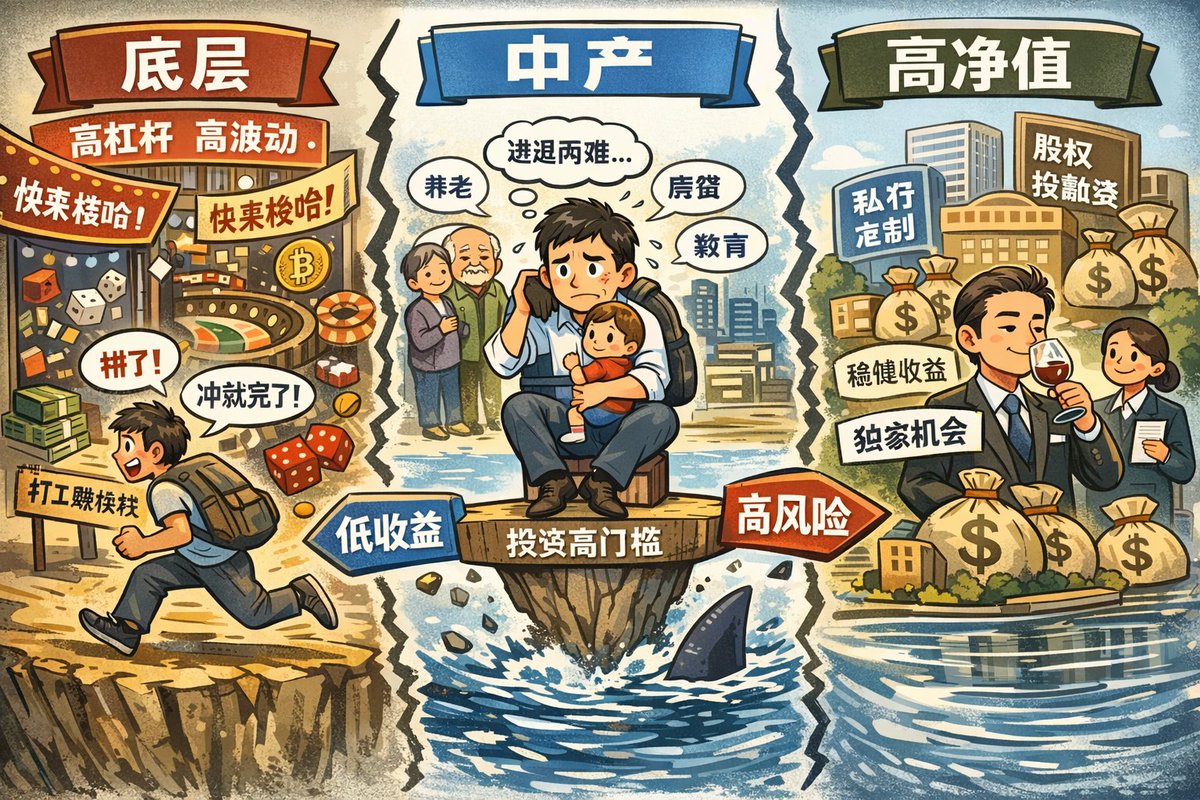
For people with low asset amounts, the market has long provided countless schemes to gamble. High leverage, high volatility, high stimulation, almost constantly promoting the possibility of getting rich overnight.
For many young people, the logic is simple: if you have money, take a gamble; if you don’t have money, work for a month, make some money and then come back to gamble again. Anyway, the principal is not much, and the cost of trial and error doesn’t seem too high. There are many ways and means to participate, so even if knowing the risks are high, there are always people willing to dive in.
For high-net-worth individuals, of course, there are countless risky assets, but more critically, there are never a lack of low-risk investments that yield higher returns than ordinary people's. Many private bank wealth management products start at 5%, with professional financial practitioners helping to create customized asset allocations. The projects one can participate in, the information one can access, and the circles one can enter are not things that ordinary people can reach.
Not to mention many equity, debt, primary, semi-primary markets, and various structured products, which can only be participated in by qualified investors and institutional clients. These things essentially represent a game where the more money one has, the more one can make money.
But the most awkward position is precisely the middle class. With limited funds, taking care of both the elderly and children, every penny, while not needing to be meticulously planned for spending, must still consider family, children, healthcare, retirement, mortgages, cash flow, and future uncertainties.
If you say they have no money, that's not true; they have managed to accumulate something. If you say they have money, it's still far from the level where they can afford to make significant mistakes. They barely meet the threshold of qualified investors, but when they see many investment projects starting at $100,000, they still feel conflicted; if they make the wrong judgment, it could disrupt their family’s rhythm for several years.
What’s even more troublesome is that the middle class often lacks choices the most. They dare not touch high-risk investments, and they feel discontent with low returns. The products that are really suitable for them, which are of medium risk, medium return, and also have liquidity, are very few. Therefore, many times, the most difficult part for the middle class is not the lack of investment awareness or not understanding how to diversify risks, but rather the limited space left for them by the market.
Ultimately, the easiest group to be overlooked by the financial system is not the poorest or the richest, but rather the middle class. Because the poor can gamble, the rich can allocate, but only the middle class cannot afford to lose, cannot win quickly, yet still bear the greatest real responsibilities.
This year I want to study what ways can be designed as investment channels for the middle class, who "are not qualified to gamble."
#Bitget VIP, lower fees, greater benefits
免责声明:本文章仅代表作者个人观点,不代表本平台的立场和观点。本文章仅供信息分享,不构成对任何人的任何投资建议。用户与作者之间的任何争议,与本平台无关。如网页中刊载的文章或图片涉及侵权,请提供相关的权利证明和身份证明发送邮件到support@aicoin.com,本平台相关工作人员将会进行核查。


