Author: Golem, Odaily Planet Daily
"Crypto Czar" David Sacks is leaving. David Sacks explained that he is stepping down due to having reached the 130-day limit for special government employees, but he will continue to participate in related government affairs as co-chair of the President's Council of Advisors on Science and Technology.
On December 6, 2024, Trump announced the appointment of David Sacks as the head of White House artificial intelligence and cryptocurrency affairs. Because Trump directly referred to him as the "White House A.I. & Crypto Czar," David Sacks earned the title of "Crypto Czar." This is not an official title, just a role that allows David Sacks to formalize his influence. In his appointment letter, Trump specifically expressed his expectations for David Sacks in the cryptocurrency field, "to promote the establishment of a clear legal framework that provides the long-awaited clarity needed for the cryptocurrency industry to thrive in the United States."
From a motivational perspective, in 2024, Trump made numerous cryptocurrency commitments to gain support from the American cryptocurrency community; therefore, after successfully taking office as President, he needed a capable person to help fulfill these commitments, and David Sacks was chosen as the policy executor.
David Sacks indeed did not disappoint Trump's expectations, achieving some political milestones during his 130-day tenure: prohibiting CBDC, holding the first White House cryptocurrency summit, establishing the U.S. Strategic Bitcoin Reserve Act, and facilitating the passage of the CLARITY Act.
Most of the promises Trump made during his campaign regarding the cryptocurrency industry were fulfilled by David Sacks, so many are willing to frame his tenure as a victory narrative. On the surface, it appears this way, but a closer look at what David Sacks has done for the cryptocurrency industry reveals a characteristic—the political statements were robust, but the sense of gain within the cryptocurrency industry was quite thin.
During these 130 days, David Sacks was not reshaping the cryptocurrency industry; he was merely completing a crypto political performance on behalf of Trump.
I. White House Cryptocurrency Summit = Trump’s Praise Meeting
The highlight of this performance was the seemingly sincere but actually full of flattery and mere slogans White House cryptocurrency summit.
On March 7, 2025, David Sacks invited a number of cryptocurrency companies and industry figures to the White House on behalf of Trump, including a16z partner Chris Dixon, Ripple CEO, Robinhood CEO, Strategy founder Michael Saylor, Coinbase CEO, and several U.S. government officials, including Trump and the Secretary of the Treasury, spoke.
It wasn't the first time that crypto figures went to Washington, but previously it was mostly to testify, get scolded, or explain whether they were scams. This time was different; the setting changed from the hearing room to the White House, and the atmosphere changed from tension to a friendly group photo. For the first time, crypto figures were treated as "honored guests" by the U.S. government, with David Sacks sitting next to Trump as the main director responsible for coordinating the event.
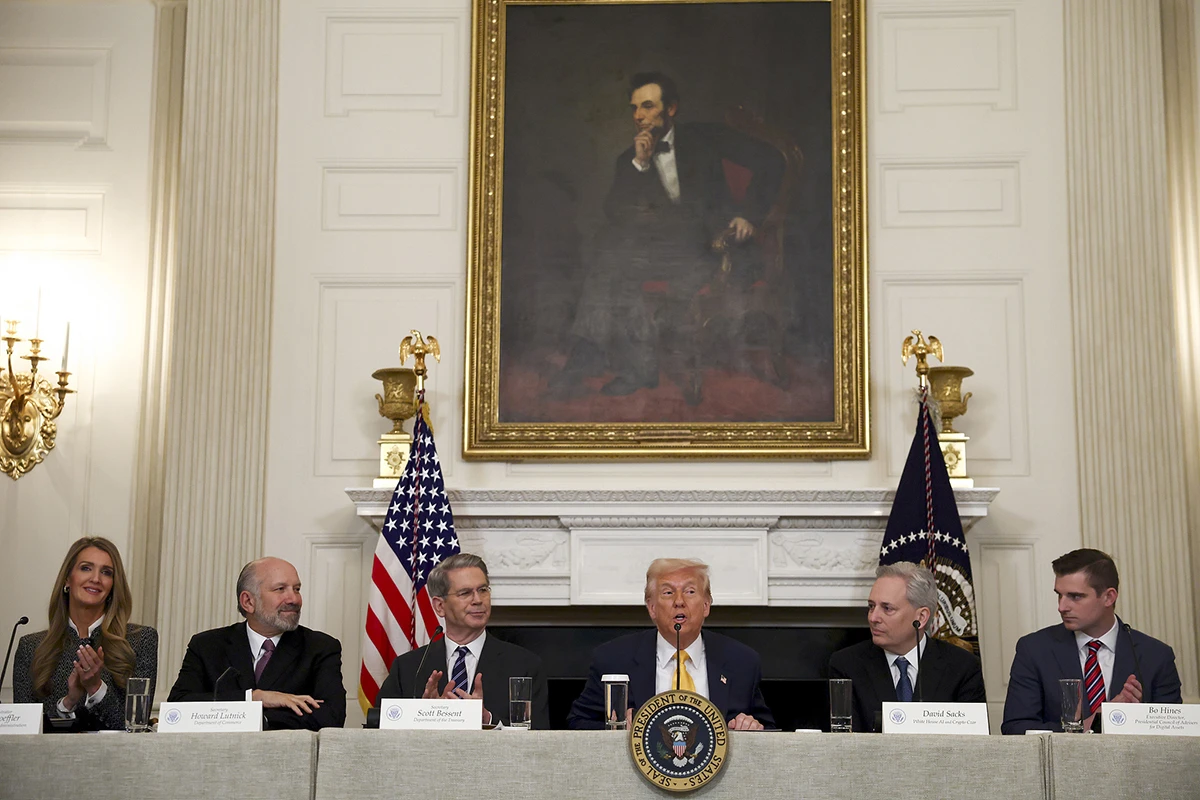
David Sacks sitting on Trump's left during the White House cryptocurrency summit
What was said at such a high-profile and highly anticipated government cryptocurrency meeting?
Journalists monitoring the live stream that night recorded that everyone was flattering Trump throughout the session. The closed-door meeting, claimed to define the regulatory direction of cryptocurrency for the next four years, did not release any substantive policy documents. Due to the content of the meeting being far from market expectations, the cryptocurrency market immediately dropped after the summit concluded, according to OKX market data.
The summit certainly had symbolic significance, but the problem is, it only had symbolic significance. It staged another performance of Trump siding with cryptocurrency, but the industry did not receive what it most desired, such as unified, stable, and predictable regulatory boundaries, long-term rules that would allow institutions to enter safely, and avoiding daily guessing by project teams on what SEC and CFTC would say next. The meeting was lively and emotions were high, but in the end, what impacted the industry was still the news.
If you ask why this meeting felt so empty, it’s because it was not planned in advance. Trump’s original campaign promise was to establish a cryptocurrency committee that would allow cryptocurrency industry leaders to engage directly and continuously with the White House and the president, but this did not materialize for various reasons. Thus, a cryptocurrency summit was hastily organized as compensation, with claims that it would continue to be held in the future, but so far, the White House has not hosted another summit of similar caliber.
II. Strategic Bitcoin Reserve = Just a Different Drawer for Bitcoin
The second major initiative pushed by David Sacks, the U.S. Strategic Bitcoin Reserve, is not a performance, but rather a magic trick.
A few hours before the White House cryptocurrency summit, Trump signed an executive order to establish the strategic Bitcoin reserve, but after the news broke, Bitcoin prices even fell. The core reason is that David Sacks explained that this Bitcoin strategic reserve comes from Bitcoin seized by the U.S. government during previous criminal or civil asset forfeiture procedures, rather than new purchases of Bitcoin, thus not spending a single penny of taxpayer money.
Although the Treasury and Commerce Departments were authorized in the order to explore "budget-neutral" new purchasing strategies, no specific timeline or scale for purchases was provided. Therefore, this Bitcoin strategic reserve conveyed to the market that it would no longer sell Bitcoin, but also would not buy Bitcoin.
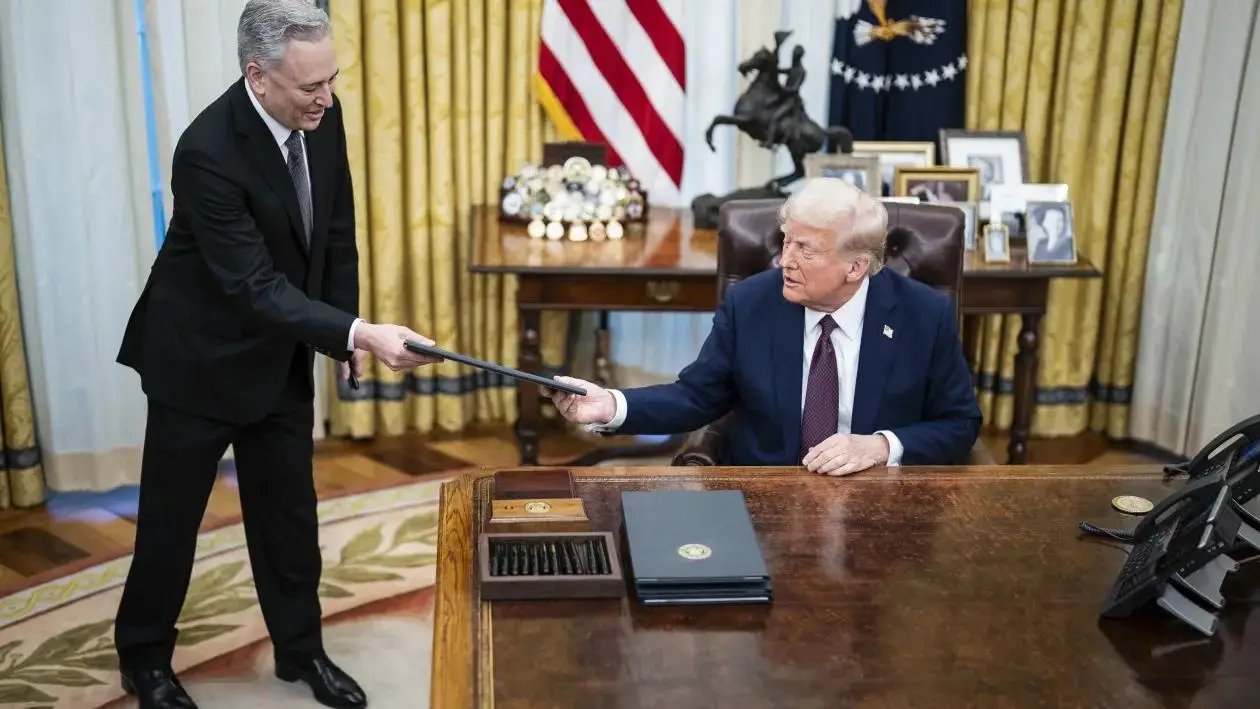
Trump signing the executive order for the Bitcoin strategic reserve
Did David Sacks handle this beautifully? Of course, it looks good for Trump, as he fulfilled a promise without spending a dime. But for the cryptocurrency industry, it only had symbolic significance; the market was hoping for the U.S. government to increase its holdings of Bitcoin to inject liquidity and provide endorsement for the market, but what they got was "just putting previously sealed Bitcoin in a different drawer."
III. The GENIUS Act is the Real Legacy
The GENIUS Act may be David Sacks' true achievement as Crypto Czar.
On July 18, 2025, Trump formally signed the GENIUS Act in the East Room of the White House, making it an officially registered law. It not only has symbolic significance but also practical significance; from an industry impact perspective, the GENIUS Act established a federal framework for stablecoins, indicating that stablecoins have moved out of the phase of reckless growth into compliance territory, becoming a new financial instrument backed by federal legal validity.
This achievement was not completed by David Sacks alone, but he indeed has credit. However, another bill, the twin brother of the GENIUS Act, the CLARITY Act, is still struggling to get passed. The CLARITY Act was passed by U.S. House Representatives on July 18, 2025, alongside the GENIUS Act, but to this day it has not completed the Senate process and has been stuck in negotiations between the banking and cryptocurrency industries.
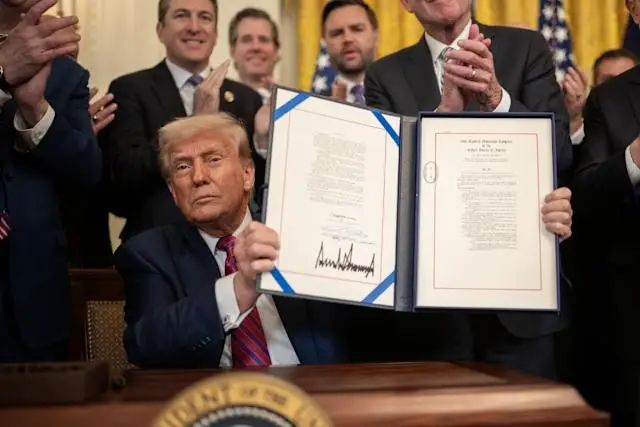
Trump signing the GENIUS Act
David Sacks once confidently stated that the CLARITY Act and the GENIUS Act would be passed within the first 100 days of this administration. Currently, it seems he has been thoroughly proven wrong.
The failure of the CLARITY Act to pass is not solely on David Sacks, but he certainly bears some responsibility, just as he can claim some credit for the passing of the GENIUS Act. The White House Digital Asset Working Group led by David Sacks explicitly termed the CLARITY Act as an "excellent foundation"; since the White House has already considered it a core draft for market structure legislation, can David Sacks remain a completely uninvolved bystander while it encounters setbacks?
The core deadlock around the bill concentrates on the conflict between the banking industry and the cryptocurrency industry over interest-bearing stablecoins, and according to the latest revised text, the banks emerged victorious. Upon hearing the news, on March 25, Circle (CRCL) stock fell by 18% at one point, and Coinbase (COIN) fell about 8%. Moreover, if such a CLARITY Act is really passed, it would be a blow to the entire DeFi sector.
This outcome is quite different from the favorable narrative that Trump and David Sacks had promoted for the cryptocurrency industry; a bill touted as promoting the development of the cryptocurrency industry ultimately benefits the banks rather than the cryptocurrency industry, which is truly ironic.
On March 4, Trump, amidst his busy schedule, still took the time to mention the cryptocurrency industry, stating in a post on Truth Social that the U.S. must pass the CLARITY Act as soon as possible, and Americans should make their funds earn higher returns. It seems that Trump is still concerned about the cryptocurrency industry, but it wasn't until the latest revision text of the bill was published on March 24 that we realized it was once again merely a "symbolic" statement.
Now, the "Crypto President" Trump has completely silenced. As for David Sacks, the White House had long prepared a script for him, standing in front as the Crypto Czar, translating Trump's campaign slogan of "making America the global cryptocurrency capital" into several decent political actions. Now that the performance is coming to an end, it is time to retreat. Currently, as the co-chair of the President's Council of Advisors on Science and Technology, David Sacks stated that he will continue to engage in artificial intelligence policy and technology strategy work, without even mentioning cryptocurrency.
The former Crypto Czar has disappeared, and Trump's ambiguous relationship with cryptocurrency has come to an end.
免责声明:本文章仅代表作者个人观点,不代表本平台的立场和观点。本文章仅供信息分享,不构成对任何人的任何投资建议。用户与作者之间的任何争议,与本平台无关。如网页中刊载的文章或图片涉及侵权,请提供相关的权利证明和身份证明发送邮件到support@aicoin.com,本平台相关工作人员将会进行核查。


