Text | Sleepy.md
For thousands of years, in order to grasp even a shred of security in the face of unpredictable fate, Chinese people have accumulated an extremely complex system of explanations. From oracle bone divination to the I Ching's trigrams, and then to the highly systematized Four Pillars of Destiny, metaphysics has always been the most secretive yet most effective psychological defense mechanism on this land. Even someone like Zeng Guofan, a master of Neo-Confucianism, once secretly expressed in his diary: "The most mysterious thing in my life is fortune-telling."
How big is the market scale of this explanatory system? According to industry insiders, the Chinese metaphysics market has long surpassed one hundred billion.
Let's refer to some overseas data. As early as 2018, the annual revenue of the divination industry in the United States reached 2 billion dollars; in South Korea, the situation is even more exaggerated, with a population of 50 million, the scale of the divination industry reaching 3.7 billion dollars, and 150,000 registered practitioners, almost becoming a national profession, even this year there was a fortune-telling variety show. The size of the market in China can only be larger, not smaller.
Then modern technology rose, and this traditional explanatory system was viewed as an outdated feudal superstition, being forcibly pushed to the margins of society. Technology attempted to completely take over the prediction of the future using rationality and data.
But the most paradoxical part of history lies here: when technology reaches the forefront of development, and when AI large models demonstrate seemingly miraculous reasoning capabilities, it not only did not extinguish metaphysics but instead became the most handy weapon in the hands of metaphysics.
Recently, first, the police in Shanghai dismantled a fake Taoist group involved with 50,000 people over six months. This group of pseudo-Taoists with only middle school education, when faced with victims’ bizarre fate inquiries, skillfully turned to AI large models to search for answers. Following that, the app called Measuring, with 60 million users, was named on March 15; its core business model is to attract traffic with free AI fortune-telling, then resell that traffic to over 20,000 live stream hosts on the platform, charging by the minute.
You see, cutting-edge AI has thus naturally become the add-on for the oldest superstition. People pay for fortune-telling, and what they buy is never the cold, hard result, but a process that smooths out anxiety. No matter how rigorous AI's logic is, it can never provide that bit of spiritual energy nor perform as the medium that communicates with the divine.
And in China, if you want to find the industrial basis for mediums, no place is larger or more mature than Northeast China.
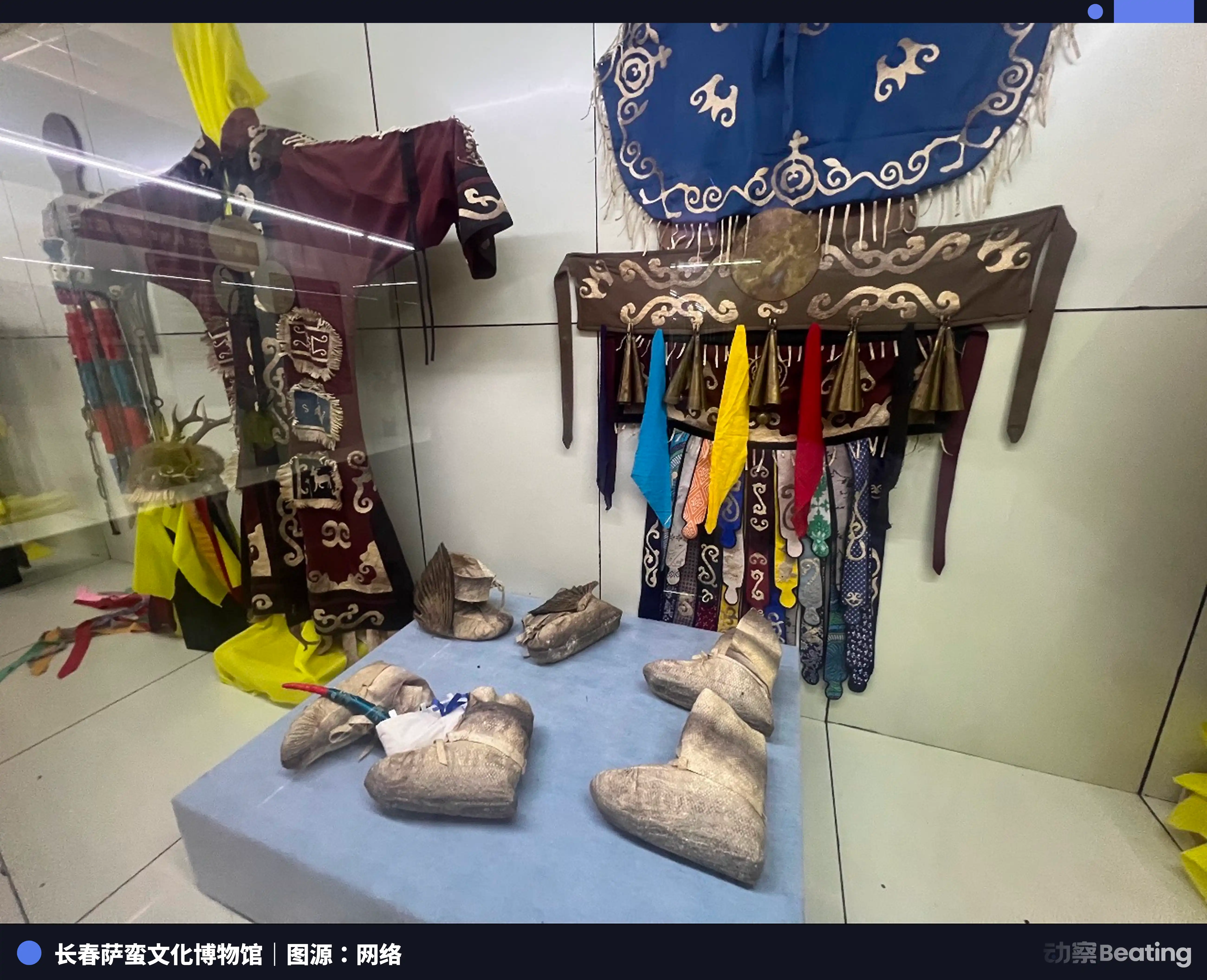
The black land of Northeast China is deeply rooted in Shaman culture and the tradition of traveling deities. Here, a "great deity" is not only a form of folk belief but a real, large-scale occupational group. When the traffic bonus of mobile internet collided with the brute force of AI large models, this massive group almost instinctively underwent a cyber transformation.
Thus, an absurd yet cohesive industrial chain took shape, with AI responsible for the "calculation" power, while practitioners steeped in the rich culture of traveling deities from Northeast China provided the "spiritual" texture. In some late-night live streaming rooms, even genuine disciples with lineage habitually let AI run the destiny chart first; as for those who understand only a bit and dare to enter the field, they simply use AI-generated scripts to engage in the business of comforting people.
Fortune-telling, a type of psychological consultation better suited for Chinese people's constitution
The foundation of Northeast metaphysics is Shaman culture and traveling deities.
Tencent News previously published an article titled "One Hundred Thousand Great Deities Reside in Northeast," in which YouTuber and member of the folk organization Association of Traveling Deities, Mr. Sun, estimated that in Liaoning province alone, there are over 40,000 great deities earning a living through "traveling deities." This is a form of folk belief with strong regional characteristics, where a person is possessed by a deity and suddenly gains the ability to see things, heal ailments, and predict fortunes.
This belief system has its own complete pantheon of deities. People in Northeast China call these five types of deities "Fox, Yellow, White, Willow, and Gray." The fox deity is represented by the fox, the yellow deity by the weasel, the white deity by the hedgehog, the willow deity by the snake, and the gray deity by the rat. After these animal spirits cultivate for hundreds of years, they seek out individuals with "spiritual energy and fateful connections" to possess, delivering information through the mouth of their disciples. The way a disciple is chosen also has its own lore, usually involving suffering from a major disaster or severe illness, triggering feverish delirium, then suddenly experiencing a profound change, speaking with a voice and manner that feels as though a different person has taken over — this is the possession by a deity.
The opening ceremony of a traveling deities' session is truly a spectacle. For example, someone causing disturbances may be asked to hold a rooster and walk around a specific location, bury a ceramic jar underground, and then at midnight, burn paper offerings at a crossroad. These rituals still occur in many places in Northeast China today, not as ancient legends, but as experiences that perhaps your grandparents have witnessed firsthand.
More than a hundred years ago, during the period of migration to Northeast China, pioneers faced the brutal cold that could freeze people to death, wild beasts, bandits, and utterly incomprehensible tomorrows, leaving no place for their fears to rest. In such extreme insecurity, they desperately needed a powerful explanatory system like the traveling deities to bolster their courage.
From 1860 to 1911, over twenty million people surged into Northeast China. They brought not only hoes and seeds but also Shandong's protective deity beliefs and fox deity systems. These immigrants encountered the local Shaman traditions, and the two systems of spirituality collided, merging to create something new, as Shaman masters absorbed the narratives of the fox deity and developed new rites for the possession of deities, with the fox population in Changbai Mountain endowed with a mysterious legacy of millennia, becoming the new ancestral homeland of fox deities.
Thus, the traveling deities took root in Northeast China. The reason why this belief could take such deep root in Northeast China is that this land has been a breeding ground for suffering.
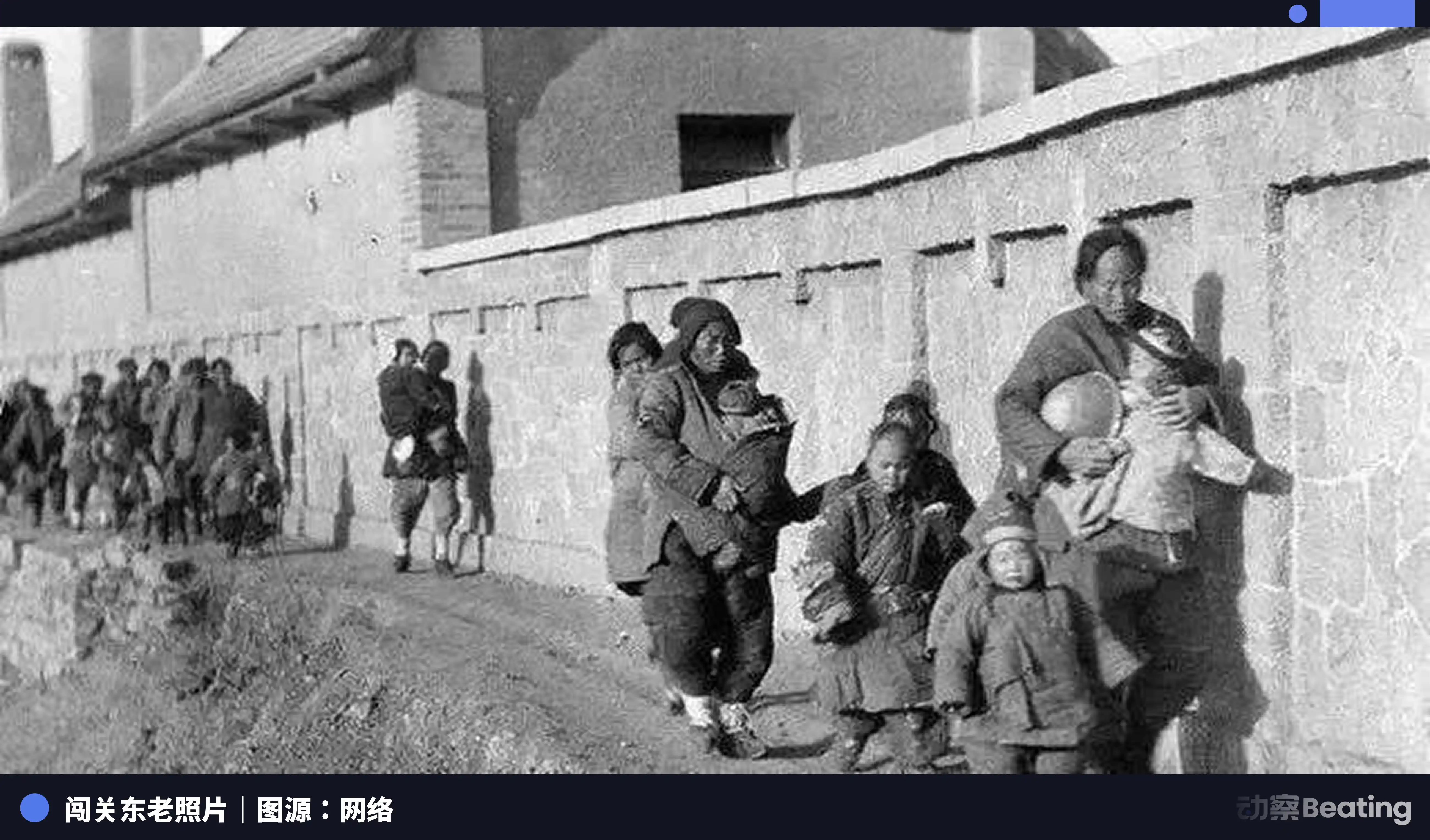
In those times, perhaps one in every two people who migrated to Northeast China died on the way or in the first few years of clearing the land. The legend of the Yellow deity's "transportation technique" reflects the collective anxiety over food shortages; the imagery of the White deity's "rolling ingots" encapsulates the wealth dreams of those migrating; the "substitution ritual" arose because at that time, medical conditions were terrible, and people had an irrational fear of illness and disaster, forcing them to use this as a means to combat death.
But this belief was not forged into its current form solely through suffering; it also relied on a history that nearly shattered it several times.
In 1934, Japan forcibly implemented group tribal policies in Northeast China, merging natural villages en masse, and the traditional Shaman worship spaces were destroyed. In 1939, Japan introduced a grain shipment policy, plundering seventy percent of Northeast China's grain output, resulting in widespread famine in the region. During the famine years, seeking deities for salvation became the most genuine social need, and thus numerous deities' sessions emerged. Folklorists recorded that during the Japanese occupation, some deities' venues were forced to serve as channels of information for the Japanese, as deities were first used as tools by political forces.
After the establishment of the country, the state ordered a ban, branding the traveling deities as feudal superstition, and practitioners were pushed underground. They learned a set of survival techniques, with family secrets passed down that included a lot of coded language to obscure their work from outsiders; some learned acupuncture to disguise their activities as traditional Chinese medicine practitioners. In the subsequent period of repression, the crackdown intensified, but this system did not die; it merely burrowed deeper into every courtyard of rural Northeast China. According to field surveys by folklorists, during that era, traveling deities were "secretly consulted in the dead of night, with curtains drawn."
The true release came only after the reform and opening up. In the 1980s, the deities' sessions began to resurface. In 2006, "Shaman rituals" were included in Jilin Province's intangible cultural heritage list, and in 2012, Changchun established the Shaman Culture Research Association to recruit former practitioners. However, the real explosion of this industry came in 1998.
That year, the number of laid-off workers in Northeast state-owned enterprises reached several million, coinciding with the Asian financial crisis. Overnight, millions lost their jobs, their identity given by their units, and their grip on the future. In the Tiexi District of Shenyang, once the heart of heavy industry, there emerged a street dedicated to fortune-telling, gathering 37 deities' sessions. Laid-off workers, unemployed women, and young people with no way out lined up to consult the deities about whether they still had any chance to turn their lives around.
This is the underlying logic of Northeast metaphysics, and its secret for rising from the ashes time and again. With each roll of history's timeline, it not only remained intact but absorbed the deepest fears of the era and completed its own evolution.
The fear of those migrating to Northeast China was death. The fear in that peculiar historical period was exposure. The fear of mass layoffs was loss. Today's fear is uncertainty. The shell keeps changing, but the driving force behind people seeking deities has always been the same.
Today, Northeast China is experiencing painful economic transformation and population outflow. According to national census data, from 2010 to 2020, the three northeastern provinces saw a net decrease of 11.01 million residents, equivalent to the entire population of Harbin disappearing.
When grand historical narratives hit individuals' heads, they transform into unemployment, loss, confusion, and a deep sense of powerlessness about the future. The more unsure tomorrow seems, the more the metaphysics market is ablaze, a classic example of the lipstick effect in economics.
When the real world offers no certainty, people naturally turn towards supernatural forces. This psychological need has birthed a massive consumer market for metaphysics. In this pool, the "great deities" of Northeast China, with their unique cultural background and linguistic talent, have firmly claimed a substantial slice of the pie.
"Fortune-telling is psychological counseling more suitable for the constitution of Chinese babies."
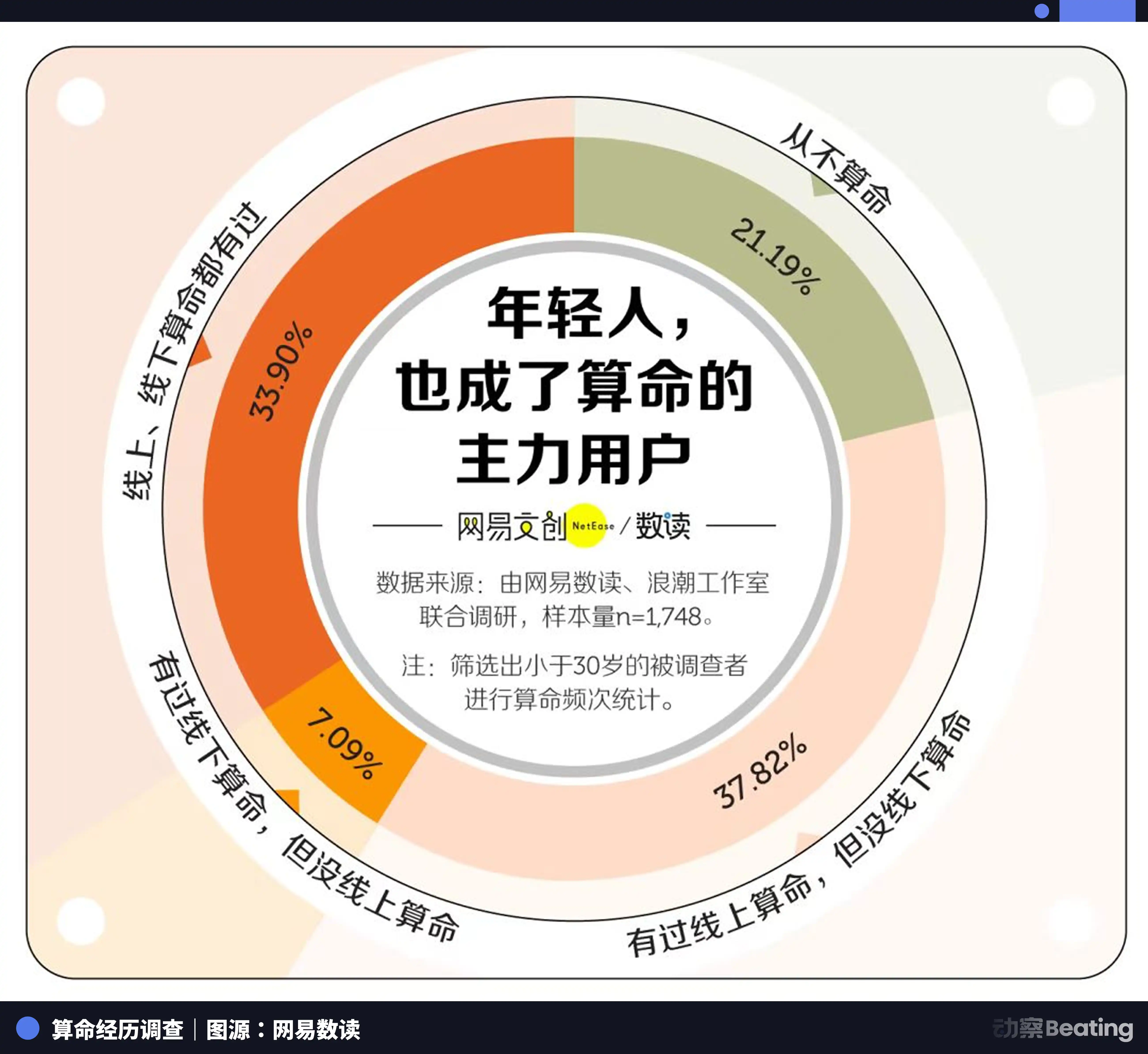
A survey by NetEase found that 78.81% of young people have had a fortune-telling experience. Looking at another set of data, Frost & Sullivan estimates that by 2025, the market size for general mental health services in China will only reach 10.4 billion yuan.
The underlying logic of the Western psychological counseling system is inward attribution. Your depression, your anxiety, your messed-up relationships are due to problems in your family of origin, trauma in your childhood, and you must analyze yourself, accept yourself, change yourself.
This logic, when applied to our collectivist and shame-oriented East Asian society, often burdens people with extremely heavy moral weight. Many times, when young people go to see psychologists, they are not only out of breath but also fall deeper into self-doubt as they repeatedly uncover their inner wounds.
However, fortune-telling is purely externally attributed. When your job goes wrong, your relationship goes wrong, or something as simple as drinking cool water causes a problem, fortune tellers will firmly tell you: this is not your fault, it’s because you are clashing with Tai Sui this year, your birth chart is unfavorable, someone is getting in your way.
This explanatory logic, once presented, immediately relieves the "guilt" burden in the help-seeker's heart.
This "not my fault" psychological suggestion is, for the current generation of young people crushed by competition and anxiety, the highest form of mental massage. It gives you an external target to validly blame, allowing you to at least preserve a shred of dignity when facing life's travails.
But at the end of the day, this is still a game between people. Until AI entered the scene, the level and nature of this game changed entirely.
The fortune-telling industry forced to evolve by algorithms
The Eight Characters of your birth date is actually an extremely rigorous set of parameters and algorithms, nearly a form of statistics. The heavenly stems and earthly branches serve as variables, the five elements of creation and destruction are functions, and the great luck and yearly cycles form a time series. This indigenous Chinese code running for thousands of years surprisingly aligns closely with the underlying logic of modern AI.
According to reports, a startup called MirrorAI used real cases from a Hong Kong divination competition as training data for its large model. The team at MirrorAI tested and found that the AI's prediction accuracy for users' past experiences was nearing that of seasoned divination experts, far exceeding the baseline of 40% for native large models.
This figure implies that in purely "deductive" abilities, AI has reached the ceiling of the industry's top practitioners. Those low-end fortune-tellers who rely solely on backing and scripted talk are being thoroughly outperformed by free AI large models. Facing this dimensionality reduction strike from AI, the traditional fortune-telling industry is not dead but rather forced to evolve. Some institutions predict that by 2025, the Chinese AI fortune-telling market will surpass 120 billion yuan; the global astrology app market is also projected to rise from about 3 billion dollars in 2024 at an annual growth rate of 20%. This pace is more vigorous than most so-called "hot tracks."
As fortune-telling becomes a calculative service with almost zero marginal cost, the power center of this industry has shifted. In the past, the competition was over who mastered the complex knowledge of divination; now, the core asset is who knows how to use AI tools while also providing emotional value.
A segment of agile practitioners have begun to transition from fortune-tellers to fortune-telling prompt engineers.
They no longer compile charts themselves but directly generate lengthy fortune-telling reports using AI, merely handling the final touch, providing emotional support and packaging the talk. They are quite aware that no matter how accurately AI calculates, it cannot replace the warmth of human emotional exchange.
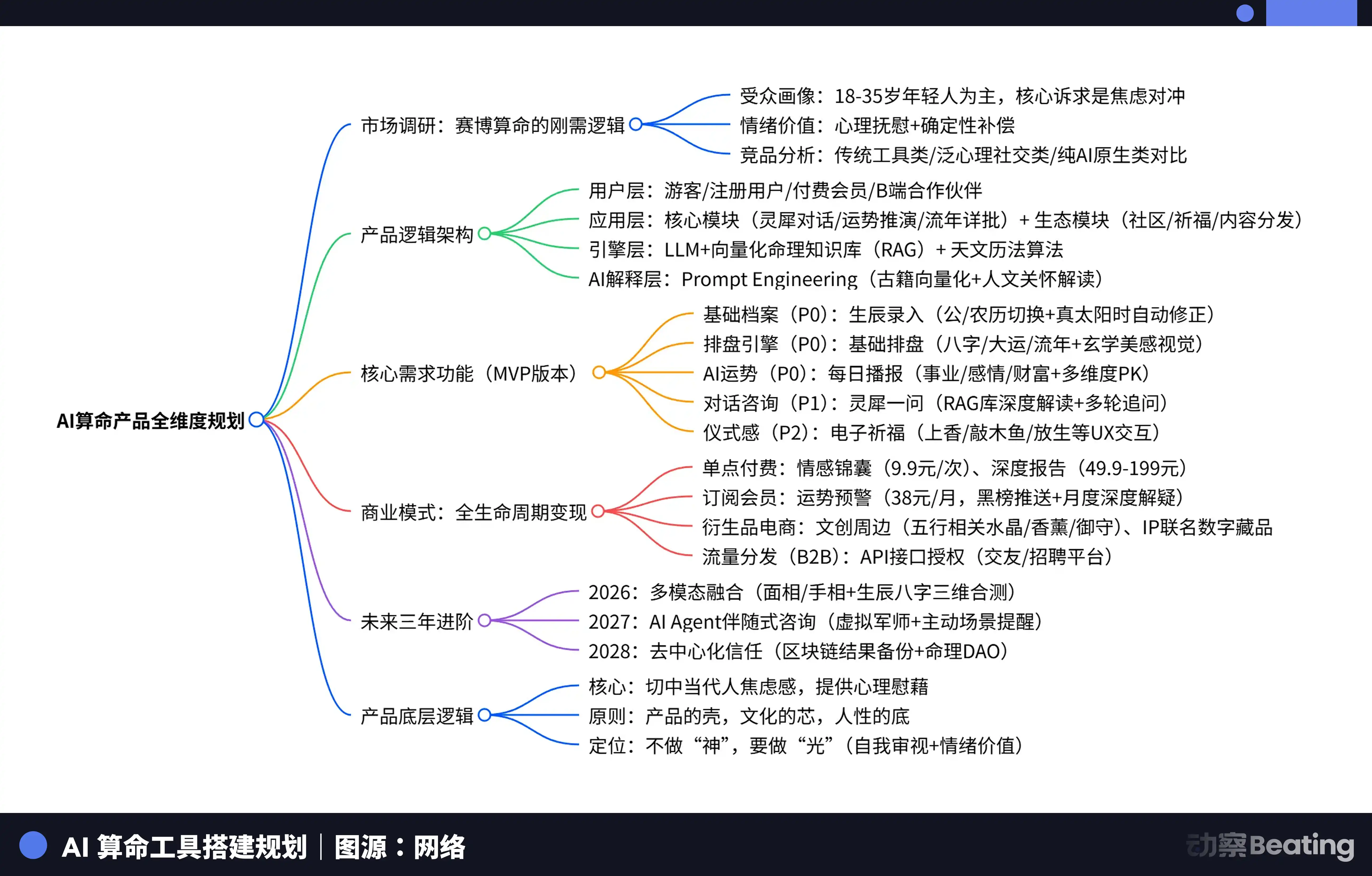
This all circles back to the previously mentioned metaphysical live-streaming industry chain. Why can those with only a middle school education, or even no knowledge of metaphysics, become masters after a month of training? Because AI takes care of the most mentally taxing calculations and knowledge retrieval; they only need to play the role that provides emotional value.
In live streaming rooms, "great deities" engage earnestly with devoted followers on one side of the screen while the other side operates a frantically functioning AI script generator. Nowadays, the traveling deities no longer need authentic divine participation; the large model serves as their most effective cyber divine entity. They use relatable, straightforward language to break down complex destiny charts generated by AI and feed them to anxious young people on the other side of the screen, offering inexpensive yet effective psychological comfort.
This surge of efficiency brought by technological dimensionality reduction has not only harvested young people domestically but has also sparked a digital expedition of Eastern mystical power.
When China's Eight Characters are translated into English by AI, will those elite sitting in Silicon Valley offices pay for this "Eastern philosophy"?
Mystical power from the East
Not only will they pay, but they do so quite willingly. In the past two years, the global market for spiritual products and services has reached 18.018 billion dollars, with the search volume for the term "Feng Shui" on Google hitting two million times per month, primarily by users from Europe and the United States.
According to Tencent News, a five-person startup team in Shenzhen called FateTell has packaged China's Eight Characters under a new name, "Book of Destiny," specifically for foreign markets. They use AI to generate extremely detailed AI fortune-telling reports, effectively turning this ancient Eastern metaphysics into a high-ticket digital commodity. Their overseas user pay rate is as high as 4%, with a repurchase rate of 38.7%, with 70% of their revenue coming from subscription memberships, with the project achieving profitability early.
This is a cultural export filled with magical realism. Once criticized as feudal superstition, fortune-telling has now donned the cloak of AI, transforming into Eastern philosophy, striking right at the heart of the fate anxieties experienced by overseas middle classes and Silicon Valley elites. Those highly paid engineers in Silicon Valley, facing waves of layoffs and industry pressures, equally lack certainty and require a force beyond rationality to calm their nerves.
In the realm of metaphysical consumption, people from different social strata are served by completely different tools.
Young individuals at the bottom level can only treat the free DeepSeek as a "digital oracle" or sit in TikTok or Kuaishou live streaming rooms, spending a few dozen yuan to draw a tarot card and listen to the host offer them some comfort. Their questions are often specific and trivial, such as whether they will pass an interview tomorrow or if they can reconcile with their partner.
Anxious middle-class white-collar workers are willing to spend several hundred to a thousand dollars on apps like Measuring for one-on-one services. What they are buying is not the precision of the fortune-telling but a listening ear for venting about their boss or partner. Their inquiries often mix dissatisfaction with their current situation and uncertainty about the future, such as when they can achieve financial freedom or whether their marriage can be saved.
As for the wealthy standing at the pinnacle of the financial pyramid, they continue to spend heavily to hire top offline masters for Feng Shui consultations and dragon vein tracing. According to the "Sanlian Life Weekly," a post-90s fortune-teller named Qingshan charges several hundred yuan per hour by providing clients with deep emotional value and psychological guidance.
Algorithmic comfort
Traditional Northeast traveling deities fundamentally hinge on connections between people. Fortune-tellers have limits on their energy, and as humans, their empathy has warmth. That kind of comfort delivered with a local accent may sound rough, but it carries the heat of a living person.
AI is tireless and possesses a god's-eye view. It knows you're still asking at 3 a.m. whether your ex-boyfriend will come back, and it is aware that you bought two astrological reports last month because of job anxiety. Thus, when you click on that connection interface once again, the scripts generated by AI will always seamlessly present the words you most want to hear.
According to 36Kr, a girl living in a third-tier city spent over 60,000 yuan on metaphysical apps and live streams to win her boyfriend back. Meanwhile, a user named Ranran exposed on the "Consumption Daily" spent nearly 40,000 yuan waiting to hear the phrase "he will come back" on the Measuring app.
Behind these stories lies not human greed or foolishness, but modern people's fragility when confronted with enormous uncertainty. When the variables in life become overwhelming, and we find we have no control over work, relationships, or even health, the seemingly certain answers offered by algorithms become the last straw of salvation.
As the ancient practice of traveling deities equips itself with AI, it transforms into a massive mirror reflecting the most prevalent anxieties of this era. Whether it's the live-streaming hosts speaking with Northeast accents or the English fortune-telling reports purchased with dollars by Silicon Valley elites, what they sell has never been the future but rather the small sliver of certainty to combat uncertainty.
This is precisely why in 2026, the entire AI fortune-telling sector will face intense regulation. From the cases broken by Shanghai police to the special rectification efforts by the Cyberspace Administration, the imposition of regulation attempts to draw a red line around this fervent cyber metaphysics.
In April 2025, the Central Cyberspace Administration launched a special campaign titled "Clearing and Rectifying the Misuse of AI Technology," explicitly targeting "misleading and deceiving internet users through AI fortune-telling, AI divination, and the dissemination of superstitious thoughts." During the first phase of action, over 3,500 non-compliant AI products were dealt with. Entering 2026, the Cyberspace Administration’s Spring Festival action identified online fortune-telling and divination services marketed as changing fate and overcoming Tai Sui as key problems to address.
But behind all this, the human quest for certainty remains perpetual.
More than a hundred years ago, those pioneers crossing into Northeast China prayed for safety from shamans in the wind and snow; more than a hundred years later, we lie in our beds at dawn, asking DeepSeek about our futures. The shell has changed, but the vulnerability and loneliness that people face when confronted with the unknown have not altered a bit.
We attempt to use AI algorithms to smooth out the uncertainties of life, converting the Eight Characters of our birth into lines of code. What we are unaware of is that under the gaze of algorithms, all our anxieties, weaknesses, and frustrations have long been fragmented into data that can be precisely calculated.
In the TV series "Ma Dashuai," Fan Debiao lived for forty years, having struggled half his life, with both career and love failing. On the most desperate night, he confided to Ma Dashuai: "The best way to end the dream-walking is to lie down and sleep deeply. When you wake up, a brand new Debiao will stand tall once more on the land of Liaobei."
The end of the universe is Tieling, and the end of metaphysics is AI. Yet regardless of how technology evolves, in those late-night live streaming rooms and behind the Eight Characters fed into DeepSeek, still stand countless individuals like Fan Debiao, repeatedly battered by life, yet still trying to seek a bit of comfort, wanting to "stand tall once more."
免责声明:本文章仅代表作者个人观点,不代表本平台的立场和观点。本文章仅供信息分享,不构成对任何人的任何投资建议。用户与作者之间的任何争议,与本平台无关。如网页中刊载的文章或图片涉及侵权,请提供相关的权利证明和身份证明发送邮件到support@aicoin.com,本平台相关工作人员将会进行核查。


