Author: Changan I Biteye Content Team
Opening the Polymarket leaderboard, the first reaction might be: this address earned $200,000, is it safe to follow their trades?
Not necessarily.
Behind huge profits, it could be a matter of consistently betting correctly on 50 markets, or it could be just one lucky bet.
The former represents a replicable systematic profit, while the latter reflects an unsustainable survivor bias.
This article will address two core questions:
- How to penetrate data noise and identify true "smart money"?
- After locating the address, how to implement different strategies?
1. Finding Smart Money: The Essence of Prediction Markets is Information Games
Prediction markets differ fundamentally from secondary market trading: it is an extremely segmented information game.
Each market target is backed by a tangible professional problem:
- Will a certain movie break 100 million at the box office in its opening week? (Scheduling data, pre-sale numbers)
- Will the maximum temperature in a certain city exceed 35 degrees tomorrow? (Meteorological models, historical averages)
- Will Iran launch an attack on Israel within this month? (Geopolitics, intelligence monitoring)
These fields have extremely high information barriers.Following smart money essentially means looking for individuals who have a better understanding in a specific vertical than you do.
So where can we find these people?
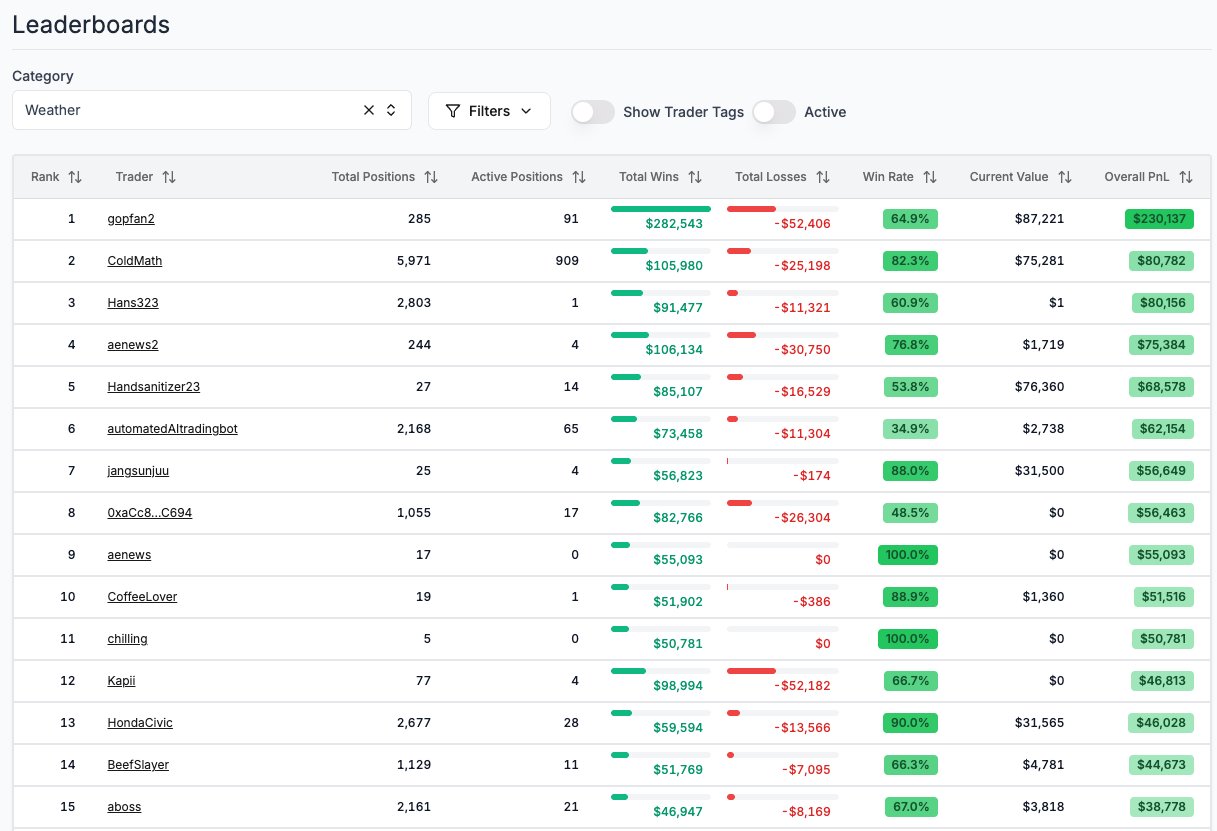
In a previous article on Biteye"Mastering Polymarket: These 7 Tools are Enough", seven Polymarket tools were introduced. Taking Polymarket Analytics as an example, we must be cautious of the following three pitfalls when filtering:
1.The false prosperity of PNL (profit and loss) dataPolymarket's data structure is extremely complex, involving various on-chain operations like buying, splitting, merging, and redeeming. Many tools (even the official site) can suffer huge deviations in PNL if the calculation parameters are wrong.True smart money should be based on event dimensions and penetrate calculations that integrate inflows, outflows, and the current position market value.
2. The interference of arbitrage botsFor example, the automatedAltradingbot commonly appears on the leaderboard. These addresses profit through cross-market arbitrage or providing liquidity; although their win rate is impressive, every trade has a hedged position. If you follow just one "leg" of that, the risk will be completely asymmetric.
3. High win rate does not equal high expectationSome addresses target markets with a win rate above 98% that are about to settle, earning the last $0.02 margin. Although this strategy has a win rate close to 100%, there is no profit margin for followers, and it may even lead to a loss due to transaction fees.
2. Four Dimensions for Filtering Smart Money
After finding the leaderboard, the next step is filtering. Smart money has two bottom-line conditions:
- Profits must comply with the logic of the Kelly formula
- And there should not be excessive single losses.
The core idea of the Kelly formula is: the size of the bet should match the win rate and odds. You cannot go all in just because you feel lucky this time. Traders who truly understand risk control have calculated every position and won't face the situation where one loss negates all previous profits.
Therefore, before looking at specific data, first eliminate two types of addresses: those with unusually large total losses, and those that have had records of a single massive loss. Even if the total PNL of such addresses is positive, their risk control logic is still problematic.
The remaining addresses can then be judged using four dimensions:
1. Win Rate
Win rate is the core indicator for determining whether an address is consistently profitable, but it should be viewed in conjunction with PNL.
- High win rate but low PNL: usually indicates end-of-day operations; winning yields little;
- Low win rate but high PNL: might be due to a few heavy bets that happened to be correct
2. Number of Markets
A small sample size renders the win rate without reference value. The probability of winning a coin toss 5 times in a row isn't low, but no one would think it means anything.
Betting on 10 markets with an 80% win rate is less valuable than betting on 300 markets with a 70% win rate; the latter holds significantly more weight. The more markets involved, the harder it is to attribute profits purely to luck.
However, if the number of markets is too high, it could indicate that the address belongs to a strategy bot, making it unnecessary to follow.
3. Holding Period
Addresses with short holding times, where entries and exits occur within hours, mean that by the time you notice their purchase, the news may have already been reflected in the price, making it merely chasing the price and potentially becoming liquidity for exits.
Addresses with longer holding periods resemble positioning for a judgment in advance, often still having a sufficient follow-up window when you notice them, making these the most friendly types for regular followers.
4. Profit Structure: Is it diversified or supported by one bet?
Overall PNL looks appealing, but it doesn't mean every market is profitable. Some addresses are lifted by a couple of big bets while most others are in the red. This structure is hard to replicate—you don't know where the next big bet will be placed or if it's a judgment or luck.
Stable smart money should have earnings spread over multiple markets rather than being concentrated in a few abnormally large trades.
What does a healthy address look like?
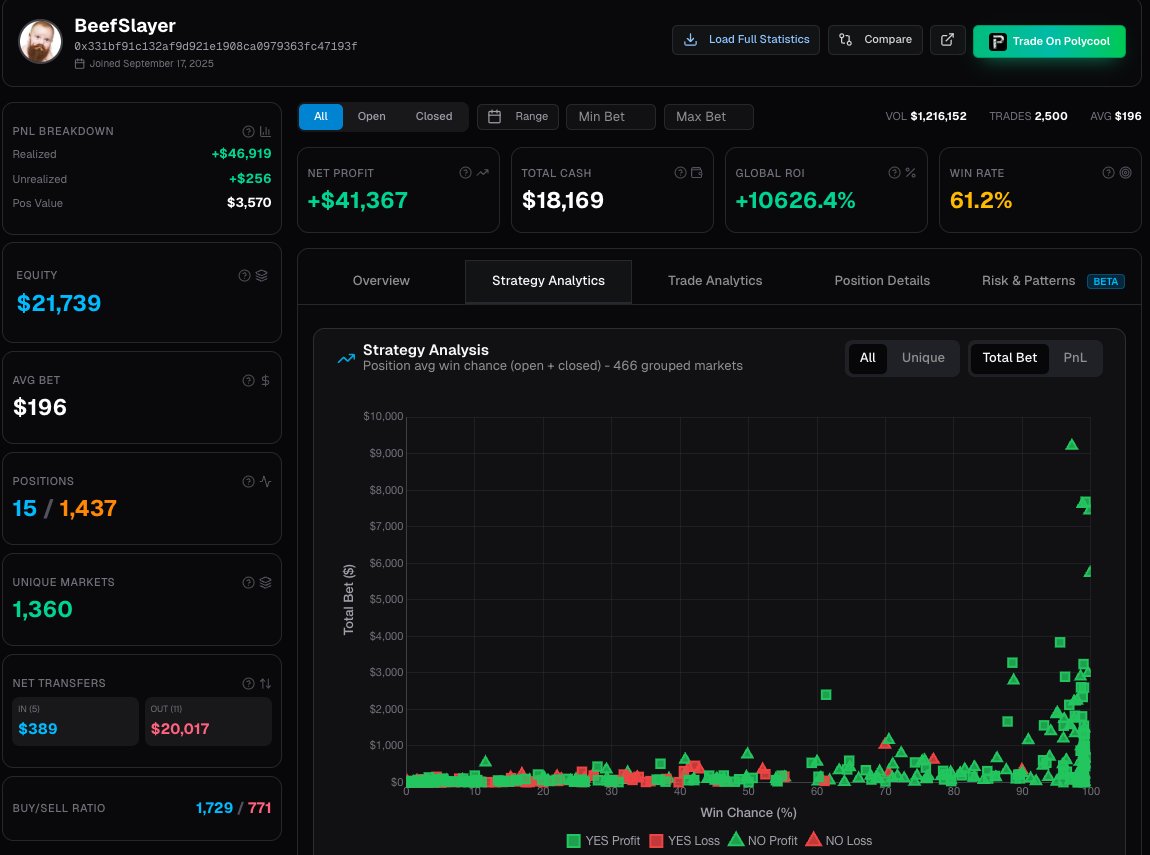
Taking BeefSlayer from the weather leaderboard as an example.
Looking at the data: it has participated in 1,360 independent markets, with a total of 2,500 transactions, a net profit of $41,367, a win rate of 61.2%, and an average bet of $196.
From the scatter plot on the right, you can see that profit points are distributed across various win rate ranges, not concentrated in a few abnormally large trades. Large positions are concentrated in the 60%-90% win rate range, reflecting the logic of the Kelly formula—betting heavier in more certain markets and controlling positions in uncertain markets.
Fund management: On average, only $196 is bet each time, and in the 2,500 transactions, there has never been a single massive bet that wiped out the account, indicating stable risk control.
3. Following Practices: Automated Tools vs. Subjective Judgment
After finding an address worth following, how should one proceed? There are generally two paths: one is to use a bot to automatically follow, which is easy but has limitations; the other is to use the positions of smart money as reference signals and then decide whether to follow based on one's own judgment. Both methods have applicable scenarios, which will be discussed separately below.
Strategy One: Following Bots
Currently, there are existing automated following bot tools that can automatically follow designated addresses once set up. Common ones include:
Polygun: A Telegram following bot that recently acquired Polymarket Analytics. The latter is a data analysis platform, and after the merger, it can both analyze and execute trades.
Kreo (XHunt rank 194239): A Telegram bot that monitors on-chain smart money actions in real-time and automatically executes trades, supporting settings for daily loss limits and stop-loss rules, covering both Polymarket and Kalshi.
PolyHub (Hubble) (XHunt rank 49220): A tool from Hubble that helps users identify smart money addresses on Polymarket and has now launched a trading tool for following.
However, following bots are not as simple as expected. After trying to follow with one, I found three issues:
Issue One: Unequal Capital Size.
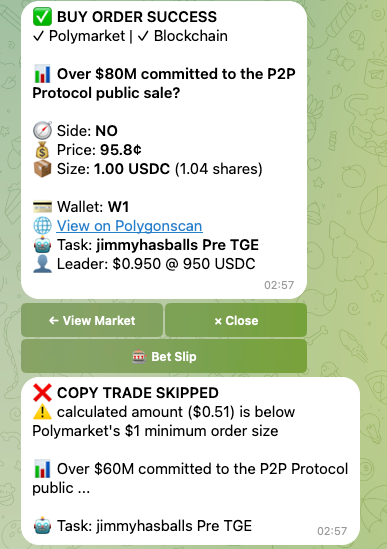
Assuming the address you are tracking has a $100,000 capital, and it bets $500 on a certain market, that is 0.5% of its total capital. If your following wallet only has $100, and you follow proportionately, that means spending $0.50, but the minimum transaction amount on Polymarket is $1, making it easy for your follow to not execute.
Issue Two: Market Liquidity Constraints.
If smart money holds significant capital, a single buy may have consumed most of the liquidity in the order book. By the time a follow is triggered, the remaining liquidity might be insufficient, either preventing you from getting the same price or sufficient volume.
Issue Three: Order Execution Mechanism
Most Polymarket traders rarely use market orders; the majority place orders at their ideal price as takers, leading to small orders being filled consecutively.
This complicates the choice of following method:
If you choose to follow based on portfolio proportions, small order completions can easily prevent achieving the minimum transaction amount of $1;
If you fix the amount for each transaction, multiple completions on the same option can severely skew positions, leading to insufficient funds for buy hedging if the trader chooses to hedge later.
These issues might not be prominent when the capital is small, but they become increasingly severe as the following funds increase.
Strategy Two: Subjective Following
Use the positions of smart money as signals, make judgments, and then decide whether to follow.
Step One: Monitor Target Address
After finding a promising address to follow, do not rely on manual refreshing to discover new actions. The actual practice is to use tools to monitor their on-chain trades, receiving notifications as soon as they enter new buys or sells.
You can use Kreo's Telegram monitoring bot, which sends notifications whenever the monitored wallet address conducts a transaction.
Step Two: Assess Why the Wallet Made a Purchase
After receiving the transaction alert, we need to determine why that address made the purchase.
Look at the timing of the entry: Was it right after some significant news? If it’s news-driven trading, the market might have already adjusted the price by the time you receive the notification, meaning you are just chasing the price.
If they entered early, implying they were acting on their own judgment, this signal is more valuable, as you would still have time to follow.
If the entry price is close to 100, this indicates that the address is performing "end-of-day trading," meaning the market outcome is largely determined and they are seizing the last bit of profit. Whether or not to follow this position depends on whether you find the remaining potential worth it.
Step Three: Determine If It’s Worth Following
After assessing the wallet’s strategy, two more aspects need to be checked before following:
Price Spread: The larger the spread, the greater your entry cost relative to theirs, compressing potential gains and amplifying risks.
Position Proportion: The higher the proportion of this position to their total capital, the more confidence they have, making the signal more significant.
4. Pitfall Guide: Why Do You Still Lose Money Following?
Following sounds simple, but many details in actual operations can lead to losses. Here are three misconceptions I have encountered.
Miscalculation One: The Position Mode of the Bot was Set Incorrectly
Following bots generally have four position modes: fixed amount, precise replication, proportional, and based on portfolio weights.
Initially, I used proportional following, but if their capital is 100 times mine and they bet 1%, I would follow with 1%, which in absolute terms could be just a few cents, making it impossible to execute. Meanwhile, smart money bets on low probability markets precisely with small positions for high odds, which this profit cannot track at all.
So, I switched to a fixed amount per trade, betting $1 each time. But this led to another problem: low probability markets inherently tend to lose money. Smart money may win once out of 100 bets to break even; if you just follow a few times each day, you will quickly deplete your funds without reaching that one big win.
The conclusion is that before following with a bot, understand the profit structure of the smart money address. If their profits mainly come from low probability markets, the bot following strategy is hard to replicate.
Miscalculation Two: Discovering Too Late and Still Following
It is impossible for a person to watch the screen constantly. When you check the market after seeing a monitoring alert, you often find that the price has already risen from $0.35 to $0.72.
Following at that point not only doubles your cost but leaves you with less than $0.28 of potential profit space. If the judgment is wrong, the downside still sees $0.72, making the risk-return completely asymmetric.
Miscalculation Three: Holding on When Smart Money Liquidates
Monitoring smart money starting to reduce positions and thinking "the direction is still correct, let's wait", only to find they completely liquidated while you are still fully invested.
The underlying logic of following is to leverage their information and judgments. When they exit with a loss, holding on with hope to continue is also one of the main reasons for my losses in following trades.
This is similar to being a liquidity provider in Polymarket: orders mistakenly executed when spread is large often lead to holding onto positions, believing prices will rebound, only to see them drop continually.
These three misconceptions stem from a common problem: following can easily lead to a lack of critical thought.
Bots help you execute, while smart money helps you judge, making it seem like you don't have to worry about anything. But once a problem arises, you have no idea where it went wrong or how to adjust.
5. Finally: Following is the Entry Point, Understanding is the Upgrade
Following is a crutch; it can help you enter the deep waters of prediction markets, but it cannot replace your own walking.
What truly holds value is not what smart money "buys," but why they "buy." When you start to derive the logic behind their actions, following will no longer be your lifeline but a tool to enhance efficiency in selection.
This is the essential path from being a "retail trader" to evolving into "smart money."
免责声明:本文章仅代表作者个人观点,不代表本平台的立场和观点。本文章仅供信息分享,不构成对任何人的任何投资建议。用户与作者之间的任何争议,与本平台无关。如网页中刊载的文章或图片涉及侵权,请提供相关的权利证明和身份证明发送邮件到support@aicoin.com,本平台相关工作人员将会进行核查。


