Author: Chloe, ChainCatcher
Polymarket officially announced the updated "Market Integrity Rules" on March 23, which apply simultaneously to its DeFi platform and the U.S. exchange under CFTC regulation. The new rules explicitly prohibit three types of insider trading behaviors and strengthen the framework for combating market manipulation tactics. This policy adjustment did not come out of thin air, but is the result of a series of controversies and public pressure, as well as Polymarket's compliance self-rescue actions before facing the impact of mainstream U.S. financial regulation.
However, the new rules affect not only true insider players; do they more directly threaten the interests of the large number of arbitrage users? Or those professional arbitrageurs who truly provide liquidity?
The History of Pressure Behind the Rule Upgrade: From the Venezuelan Coup to the Iran War
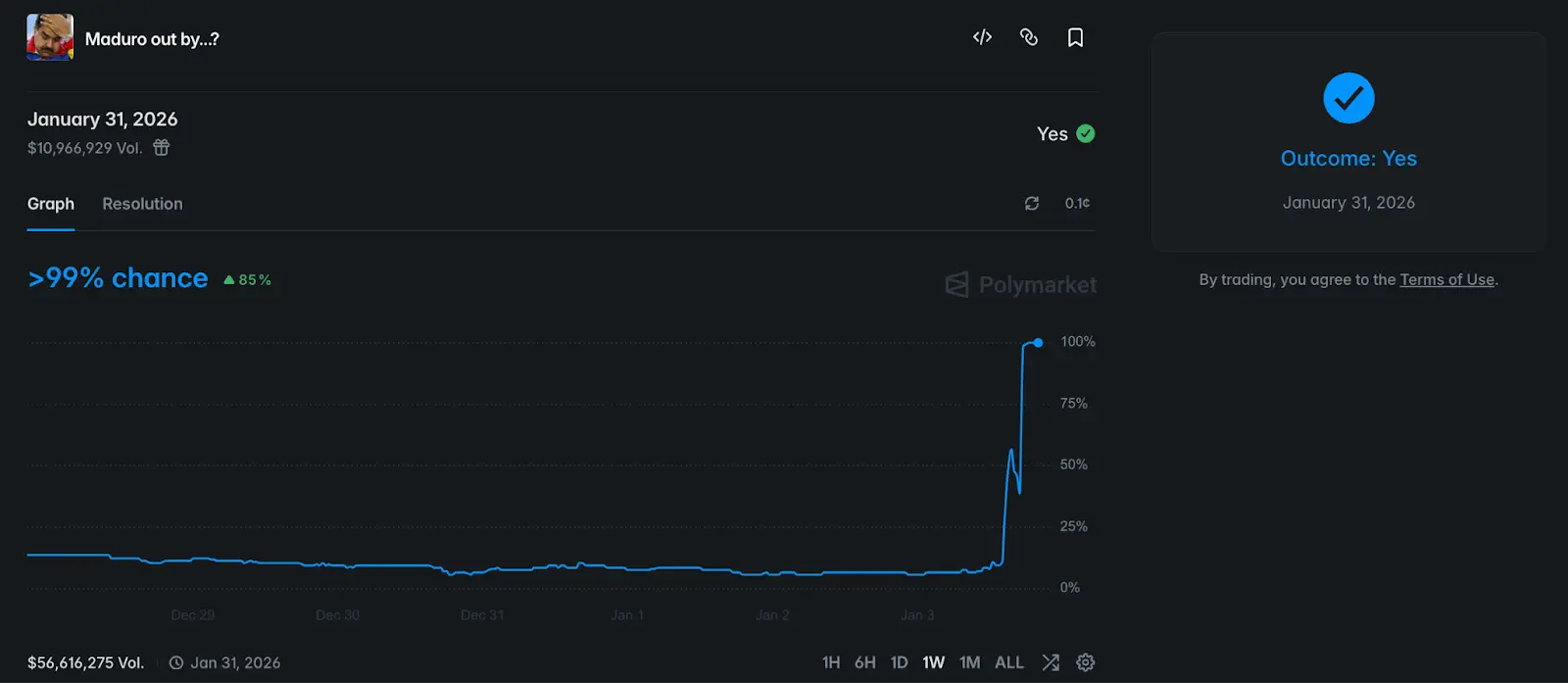
Looking back at the public and regulatory pressure Polymarket has endured in recent months, in early January 2026, an anonymous user spent $32,537 on Polymarket, betting that “Maduro will resign by January 31.” As Trump announced at 4:21 AM on Truth Social that Maduro had been arrested, the user immediately received a return of up to $436,000, yielding an investment return rate of over 13 times.
Investigations found that the account was only created in December 2025, and all betting targets were precisely aimed at the Venezuelan political situation, with betting occurring just hours before the incident broke out. In response, Dennis Kelleher, co-founder of Better Markets, noted that this transaction exhibited all the characteristics of insider trading: a newly created account, large sums of money, precise forecasting of timing, all occurring in an unregulated, opaque market.
Coincidentally, around the same time, suspicious trades related to "timing of U.S. military action against Iran" appeared on Polymarket, with some accounts accurately entering positions just before U.S. military strikes, yielding profits of hundreds of thousands of dollars.
Notably, Polymarket CEO Shayne Coplan once said in an interview with CBS News, “It’s a good thing that insiders have advantages in the market.”
However, the reality is that in March 2026, Senators Adam Schiff and John Curtis jointly proposed bipartisan legislation to prohibit trading contracts on prediction markets that are "similar to sports or casino games." The Commodity Futures Trading Commission (CFTC) also issued guidelines in the same month, requiring prediction market platforms to implement specific measures to prevent insider trading and encouraging exchanges to actively consult regulatory agencies when designing event contracts to identify "manipulation or price distortion risks."
The regulatory hunting has already formed, and Polymarket's policy upgrade is a proactive response to this hunt.
Dissection of the New Rules: Three Types of Prohibitions and a Multi-Layered Monitoring Framework
On March 23, 2026, Polymarket officially released updated market integrity rules, clearly defining three red lines: First, trading based on stolen confidential information; second, trading based on illegal sources of information; third, trading influenced by result influencers.
In terms of market manipulation, the rules further explicitly prohibit spoofing, wash trading, and fictitious transactions. In response to such prohibitions, ChainCatcher interviewed the Chain Practice Society, which stated that the boundary between "wash trading" and normal trading lies in whether it generates real value and whether trading costs are incurred. Wash trading is when the same group of people trades back and forth purely for data; whereas regular arbitrage or market making involves placing limit orders at different price levels and bearing the risk of holding positions, with every transaction being executed with real market users that can withstand scrutiny.
In terms of the enforcement structure, Polymarket adopts a "multi-level monitoring" design. On the DeFi platform side, all transactions are recorded on the Polygon chain, and anyone can publicly check them. The platform cooperates with world-class monitoring technology organizations for on-chain anomaly detection; once suspicious behavior is detected, possible sanctions include blocking wallet addresses and referring users to law enforcement agencies.
On the Polymarket US (CFTC regulated exchange) side, monitoring is divided into three levels: external monitoring technology partners, real-time monitoring dashboards, and a regulatory service agreement signed with the National Futures Association (NFA), which can directly conduct investigations and penalize violators. Sanction methods include suspending qualification, terminating accounts, monetary fines, or referral to regulatory agencies.
The Interests of Arbitrage Users and the Dilemmas of Related Studios?
Polymarket's actions are a heavy blow to "insider players," but may generate different sparks for the arbitrage user group and related studios. In response to the new rules, the reactions of major players in the market are intriguing. Currently, the historical trading volume on Polymarket has exceeded $200 million, and the Chain Practice Society accepted an interview with ChainCatcher, stating that the rollout of the new rules was expected and even long awaited. They believe this is not a crackdown, but a sign of market maturity. As early as when the platform began charging transaction fees, the professional team had predicted that it would eventually charge the entire market and strengthen regulation.
For ordinary wash trading air-drop users, relying on creating massive on-chain records and trading against dual accounts in a single market is now hitting the new regulations. Some players have even evolved to control matrices of 100 wallets, or hedge between Polymarket and Kalshi, but the upgrade of the monitoring system has increased the risks of such behaviors exponentially.
The Chain Practice Society believes that truly high-quality strategies should not be "arbitrage" but rather real arbitrage. Arbitrage itself is the process of discovering price deviations and correcting market inefficiencies, which is healthy behavior needed in prediction markets. As gray operations are squeezed out, the market will become cleaner, and the earnings of professional arbitrageurs may actually increase.
The Paradox of Liquidity: Are Wash Trading Users Parasites, or Infrastructure?
Furthermore, behind this wave of regulations, there lies an unavoidable contradiction for Polymarket: its liquidity is not naturally formed. According to on-chain data, 80% of users on the platform make single bets of less than $500, and the average single bet amount over the past month is only around $100. Therefore, the true support for market depth comes from a very small number of large traders and liquidity providers.
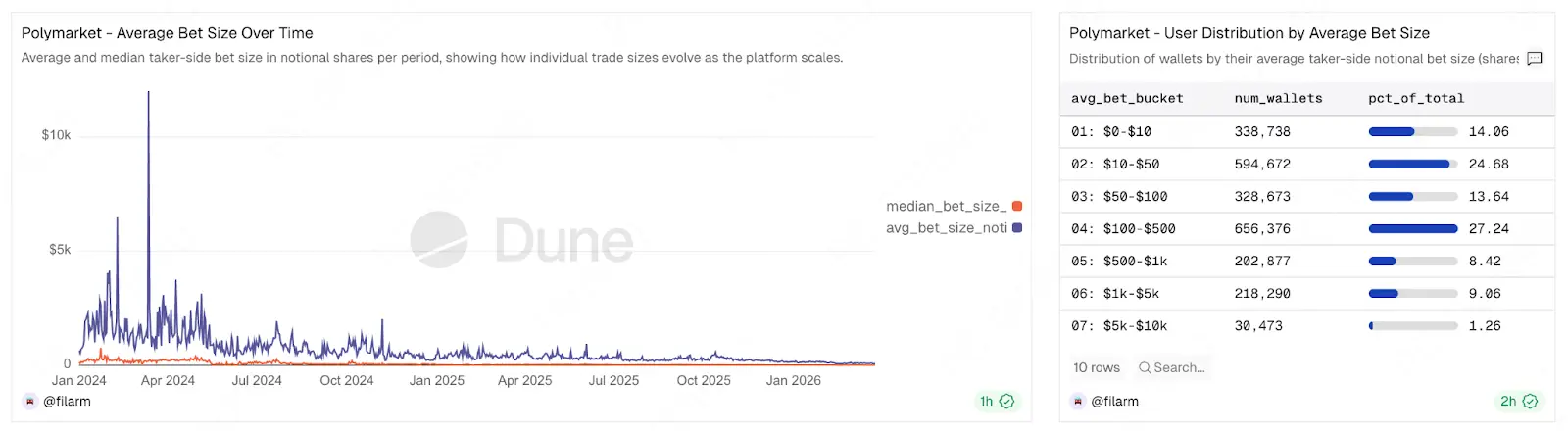
It is worth discussing whether those among the airdrop farmers who adopt "legal strategies" (such as providing two-way liquidity and cross-platform arbitrage) play an informal market maker role?
They narrow the bid-ask spread and enhance market capacity, allowing general users to enter positions at more reasonable prices. On the other hand, from a business logic standpoint, with Polymarket returning to the U.S. market, there is an urgent need for massive real trading and deep data to prove the market's validity to the CFTC, which is crucial for obtaining further regulatory approval.
If the new regulations are too aggressive and scare away this group of arbitrage users, a short-term liquidity drought is almost inevitable, especially in niche markets where these farmers are often the only source of counterparty.
In this regard, the Chain Practice Society expresses that the platform should acknowledge the contributions of users who provide real liquidity. For example, in a multi-account system, if millions of dollars in trading volume is contributed daily and all are maker limit orders, that is exactly what the platform mechanism encourages. Especially in events with low volatility and poor liquidity, these limit orders can deepen the market, allowing general users to execute trades. This behavior essentially exchanges capital and time for rebates while serving the market.
In the Context of Regulatory Compliance, Do Related Studios Also Need Strategic Transformation?
It can be said that Polymarket's compliance process is not just a brief market fluctuation but a signal of a strategic shift for the platform.
From acquiring the licensed exchange QCX to signing agreements with the NFA, all of these indicate that the prediction market is moving closer to traditional financial regulation. In this highly transparent and regulated path, the traditional "low-quality wash trading" survival space will only become narrower. The Chain Practice Society believes that the new rules are beneficial for professional teams, and in the future, they will take three countermeasures: First, increase liquidity provision to strive for more maker rebates; second, actively discuss deeper market-making plans with the platform; third, continuously optimize strategies to improve profits under compliance.
Overall, for studios that view Polymarket as a core profit source, now is a critical juncture for shifting the strategic focus from "quantity" to "quality." Rather than manipulating 100 wallets for low-quality wash trades, bearing the risk of being precisely identified and collectively banned by the monitoring system, it is better to abandon the multi-wallet matrix and operate a few high-quality accounts. Conducting deep trades through genuine market research or focusing on providing liquidity within the platform’s regulations can effectively avoid banning risks and may even lead to better token airdrop allocations due to the contribution of real value in the final airdrop weighting calculation.
免责声明:本文章仅代表作者个人观点,不代表本平台的立场和观点。本文章仅供信息分享,不构成对任何人的任何投资建议。用户与作者之间的任何争议,与本平台无关。如网页中刊载的文章或图片涉及侵权,请提供相关的权利证明和身份证明发送邮件到support@aicoin.com,本平台相关工作人员将会进行核查。


