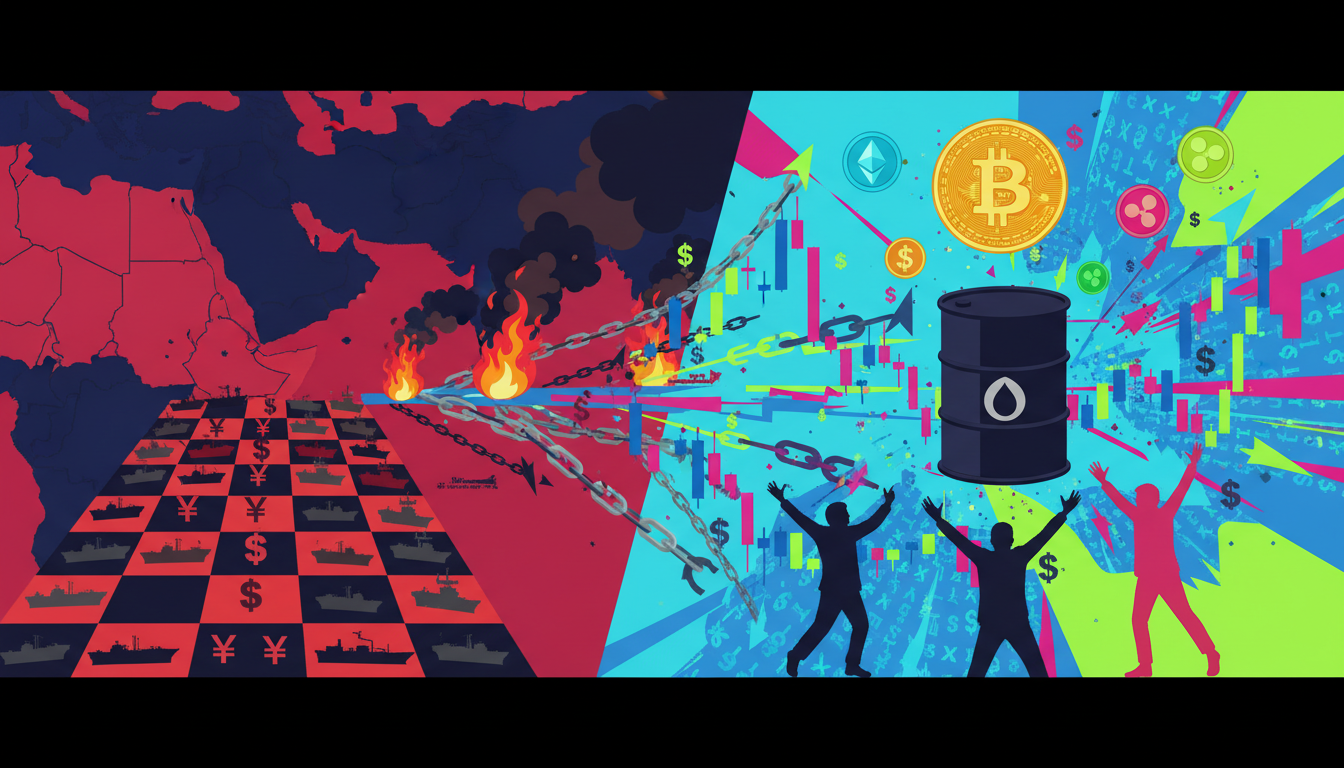
In March of a certain year, the trading data of the prediction market was completely rewritten: the monthly transaction volume soared to 191 million transactions, and under the comprehensive media statistics, the year-on-year increase was calculated to be 2,838%. In the curves of on-chain browsers and various data panels, this leap appeared almost like a straight line shooting up, giving a strong visual sense of emotions being ignited in an instant, and chips flying around madly. For many participants, this felt more like a speculative feast that was suddenly opened up, rather than a gradual market expansion.
This explosion prompted the need to ask: What exactly drove the 191 million bets? Was it a genuine hedging demand against geopolitical risks, or a pure casino-like bubble that packaged real events into tradeable chips? Media comments frequently expressed that "the trading volume in the prediction market reached a historical high, indicating a surge in speculative demand for geopolitical events," but the statistical criteria, sample scope, and base effect remained unclear. Next, it is necessary to break down the structural factors behind this "crazy March" from the angles of technical foundation and traditional finance on-chain, rather than merely staying at the emotional trading curves.
Behind 191 Million Transactions: Who is Placing Bets
To understand the momentum behind these 191 million bets, it is essential to return to the basic form of the prediction market itself: on the surface, it is a trading platform based on "event outcomes," which may take the form of simple binary outcomes, multiple-choice ranges, or complex conditional contracts; at a deeper level, it aggregates various information and sentiments around geopolitical issues, macro policies, and technological progress. The surge in transactions in March of a certain year was largely due to these themes being repackaged as high-frequency tradeable stories, attracting new funds that were originally outside the spot and contract markets.
The profile of participants is also changing. In addition to traditional speculators and professional market-making funds, social media and community discussions brought in a large number of "event-driven" retail investors who may not be familiar with derivatives but are willing to bet on their subjective views regarding elections, conflict trends, and the probabilities of policy implementations. A comprehensive media summary captures this atmosphere in one sentence—“the trading volume in the prediction market reached a historical high, indicating a surge in speculative demand for geopolitical events”—which not only describes the transaction data but also sets the tone for a new speculative narrative: every stir in the real world can be translated into a price point on the trading platform.
However, when the perspective is broadened, the figure "2,838%" also needs to be understood in a relative context. On one hand, extreme year-on-year growth often suggests a very low baseline—the same month in the previous year may have been in the market nurturing phase, with limited activity, and any new platform access or single event hotspots could exaggerate the year-on-year curve. On the other hand, the data from March of a certain year was likely driven by a concentration of short-term events, showing clear periodic characteristics rather than linear extrapolative growth. This means that if one ignores the baseline and sample structure and draws conclusions solely on the year-on-year percentage, they can easily be misled by the "visualized growth."
More importantly, the 191 million bets were not driven by a single motivation. They can be roughly divided into three categories: first, a genuine information demand, where research institutions and professional traders use market prices and depths to calibrate how certain risks are priced; second, a risk hedging motivation, where some entities exposed to the real world attempt to buy "reinsurance" on-chain for certain extreme scenarios; and third, a pure speculation and gaming motivation, treating the prediction market as a high-volatility casino, entering and exiting frequently, chasing emotional inflection points. These three types of motivations overlap significantly in the data dimension, yet differ greatly from the regulatory perspective and institutional tolerance, laying the groundwork for the subsequent discussion about gaming structure and regulatory conflicts.
The 200 Millisecond Advantage in Tokyo: How Infrastructure Amplifies Trading Floods
Understanding this trading surge solely through themes and emotions inevitably overlooks a key variable: technical infrastructure. In the world of on-chain derivatives during the same period, a frequently mentioned case is Hyperliquid—its validator cluster is deployed in the AWS Tokyo region, giving Asian traders approximately a 200-millisecond latency advantage. For ordinary users, this may mean "faster internet"; but for high-frequency strategies and market-making bots, it signifies the ability to capture price discrepancies and order flows more quickly on the same event and trading platform, thus "amplifying" every corresponding number of transactions on a micro level.
In the prediction market context, the penetration of high-frequency trading and automated strategies is accelerating: bots can perform cross-platform arbitrage among different order books around the same event, and they can also engage in passive order placement and active market-taking within order books, switching back and forth at high frequencies around price ranges. Every slight price fluctuation can trigger a series of programmatic orders, and these orders are counted as "transactions" in the statistics. This explains why, even when the event itself has not fundamentally changed, the monthly transaction volume can still be pushed up to 191 million, an almost visually distorted magnitude.
Data from Hyperliquid itself provides another layer of reference: according to public reports, its open interest at one point reached $1.65 billion. This indicates that on similar infrastructures, leverage and derivative positions can quickly stack up to substantial risk exposures, and if the prediction market adopts a similar matching and settlement framework, it could technically also achieve high leverage and high-frequency betting. The problem is that such infrastructure is often claimed to be "neutral" in design—lower latency, higher throughput, smarter matching logic—but in reality, it inevitably serves the side of capital with greater resources and strategic advantage.
This contrast raises an unavoidable question: Who is the technology actually serving, and who will bear the risks that follow? For ordinary participants, a 200-millisecond latency advantage does not translate into a "fair bonus" in earnings, but may instead amplify "information lag" and execution disadvantages in fast-moving markets, ultimately reflected in higher slippage and more frequent stop-loss scenarios. Behind the facade of 191 million bets, the technical infrastructure is quietly reshaping the gaming landscape, quietly transferring some profits and pricing power to those algorithms and institutions that can act at millisecond levels.
From On-Chain Contracts to Prediction Markets: Flows of Capital Across Multiple Interfaces
Beyond the technical foundation, traditional financial tools moving on-chain is also a key clue to understanding the surge in transaction numbers. Taking the example of the R2 Protocol Token Trading Launch mentioned in the Binance Alpha program, although the specific timing still needs further verification, this movement itself sends a clear signal: centralized platforms are attempting to establish closer interfaces with new on-chain protocols, allowing contract, collateral, and yield mechanisms that were originally limited to on-chain to be accessed more broadly through tokenization.
In this context, similar narratives around Trade.xyz with on-chain contracts are expanding: options, futures, and other traditional derivative tools are packaged into smart contracts, forming programmable and composable modules. These contracts can interface with multiple oracles, settlement layers, and margin models and can also stack with other protocols, such as yield aggregation, leveraged amplification, liquidity mining, etc. For capital, this means that previously relatively closed risk management tools are evolving into "Lego components" that can be arbitrarily invoked, restructured, and externally connected.
When these components intersect with prediction markets, the same event no longer has only one betting entry. A geopolitical risk or policy outcome can be priced in on-chain options, establish directional exposure in futures contracts, and simultaneously appear on the prediction market in the form of "event contracts." Traders can hedge, add, or conduct cross-market arbitrage across different interfaces, with capital moving back and forth among various contracts and order books. Thus, the statistic of that 191 million bets in the prediction market is essentially a product of "one event, multiple betting interfaces," rather than an isolated explosion from a single platform.
This multi-interface structure amplifies transaction numbers while blurring the true attribution of risks. The gains or losses of a particular bet in the prediction market may merely be a part of its overall composition, while the overall composition’s leverage and correlations can be very difficult to discern from the data of a single order book. For regulators and researchers, understanding this point is crucial: the extreme growth in transaction numbers reflects more the deepening of scenario interweaving and tool combinability rather than an "absolute victory" of a single narrative or platform.
Geopolitical Events Become the Betting Table: Speculative Feast and the Shadow of Settlement
No matter how technology and tools evolve, the surface narrative driving the prediction market toward "crazy March" still revolves around betting on geopolitical events. In communities and social media, every tense situation, every election, and every policy rumor can quickly be packaged into a visualized "story trading platform": headlines, odds, ups and downs screenshots, paired with short emotional copy, can soon attract a large number of shares and views.
In an ideal scenario, the prediction market provides positive value for information aggregation and probability pricing: more participants with information advantages enter, motivated by profit to continuously adjust prices, making market odds gradually approach objective probabilities; the public and institutions can observe these prices to gain a more "collective" judgment than that of a single expert prediction. However, as the proportion of pure speculative funds and emotional retail investors continues to rise within the participant structure, this mechanism can easily slip to the other end—turning into a "gamblers' market" co-opted by social narratives.
Combining the rise in open interest with the explosive short-term transaction volume reveals the latent risks of settlement and liquidity withdrawal chain reactions: when a significant result is announced or emotions suddenly shift, high-leverage bets can be concentratedly triggered for liquidation in a very short time, forcing market makers and liquidity providers to significantly reduce their positions; the rapid withdrawal of liquidity pools can trigger slippage amplification and price gapping, further eroding the margin safety of other participants. In this process, the grand number of "191 million bets" does not automatically translate into the market's ability to withstand pressure; instead, it may become a multiplier of pressure during extreme moments.
Therefore, an unavoidable question arises: To what extent do these prices reflect "collective wisdom"? If the vast majority of transactions come from chasing hot short-term plays, rather than rational pricing based on information advantages and risk management, then the market prices resemble a "noise curve" driven by emotions, with the statistical significance under a large sample far below its apparent precise decimals. This inquiry directly relates to how future regulators will view the social functions of prediction markets: is it an effective information market or a high-frequency casino cloaked in probability?
Fusion of Social and Speculation: BeatSwap and the Next FOMO Model
As the narratives continue to evolve, the further integration of social interaction and trading scenarios is being pushed to the forefront. The BeatSwap plan to launch the SocialFi product "Space" in a certain year Q2 serves as a typical signal: the platform attempts to bundle social interaction, content production, and trading behavior together, allowing discussions, following, tipping, and betting to be closed-looped on the same interface. For the prediction market, this means that future market data and betting behavior will likely be more deeply embedded in social spaces.
One can imagine a scenario: a prediction market for a hot geopolitical event being embedded in a discussion page of a Space room, with the odds curve and transaction data refreshing in real-time, KOLs providing their "judgment logic" in voice or live broadcasts, while fans can follow with a single click to place bets. The formerly multi-step wallet signature operation is simplified by interface design into a part of "instant interaction." Herd mentality and FOMO are more easily amplified in such an environment: rather than forming an independent judgment and then deciding whether to bet, participants are directly swept into the trading flood under the social pressure of "everyone is buying."
This socialized trading enhances the efficiency of information dissemination: market prices, transaction distributions, odds changes can reach a broader audience in a shorter time through social networks and content distribution mechanisms; related views, research, and dissenting voices also have the opportunity to be presented within the same space, theoretically helping to correct some biases. On the flip side, it equally amplifies the risks of rumor and emotional polarization: unverified news, out-of-context screenshots, and leading phrases can easily be amplified in group resonance, pushing prices far away from reasonable ranges in a short time.
In this "social + betting" mixed scenario, regulators and platform governance will face greater difficulties and gray areas. Should these spaces be regarded purely as social products, or should they functionally be akin to financial interfaces with certain leverage and settlement attributes? What are the boundaries for platform content and behavior review—should content that clearly promotes "insider news" or "sure-win bets" be restricted? Furthermore, when different jurisdictions have different compliance requirements for prediction markets and social platforms, these products with multiple identities may easily navigate the regulatory gray areas.
Bubbles or New Order: Where is the Prediction Market Heading
Returning to the starting point, the 191 million transactions and 2,838% year-on-year increase are not only manifestations shaped by the synergy of technology and narrative but also high-decibel warnings of potential risks. They demonstrate how, under the combined effects of latency optimization, matching efficiency enhancement, on-chain tool combinability, and social propagation, a relatively niche avenue can be pushed into the spotlight in a short time; at the same time, they remind us that when data is packaged into stories, extreme numbers often obscure uncertainties in sample structure, baselines, and data criteria, easily becoming part of the narrative rather than the facts themselves.
This explosion is essentially an intertwining of multiple factors: geopolitical speculative demand fuels the narrative; low-latency infrastructure represented by Hyperliquid opens the speed valve for high-frequency betting; the expansion of traditional financial tools on-chain allows for flexible splicing of options, futures, and other modules with the prediction market; and socialized products like BeatSwap "Space" further shorten the path from "seeing an event" to "betting across multiple interfaces." The 191 million bets are no longer just a victory for a single platform or a single narrative, but rather a phase resonance of technology, capital, and emotion within a multi-layered structure.
In assessing whether this indicates that "decentralized geopolitical betting has entered the mainstream," caution is warranted. Current observable data samples are limited, statistical criteria vary, and there is a lack of finer granularity in breaking down participant structures, capital sources, and holding periods. There is also the risk of data selection bias and narrative overreach—when media and platforms are more willing to amplify extreme growth and dramatic stories, quiet failed experiments and hidden risk accumulations are often drowned out in the information flow.
Looking ahead, the game rules in this arena are likely to be reshaped under the triple forces of regulation, compliance prediction platforms, and more cautious institutional participation. On one hand, some jurisdictions may establish "compliant prediction market" frameworks, incorporating positive functions like information aggregation and risk hedging into the regulatory view while imposing more detailed constraints on leverage ratios, betting limits, and types of participants; on the other hand, for institutional capital to deeply engage, higher demands will undoubtedly be placed on platform governance, oracle mechanisms, and settlement rules, thereby forcing infrastructure and product designs to evolve toward greater transparency and stability.
In this process, "crazy March" is more like a stress test and preview: it demonstrated that the prediction market can quickly amplify its scale under specific narratives and technical support, also exposing how, in the absence of unified rules and risk isolation mechanisms, the settlement chain and social emotions can self-reinforce in a short time. What is truly worth paying attention to is not when the next 191 million bets will occur, but whether, when that day arrives again, the market has the capability to withstand the ensuing volatility and costs.
Join our community for discussions and to grow stronger together!
Official Telegram community: https://t.me/aicoincn
AiCoin Chinese Twitter: https://x.com/AiCoinzh
OKX benefit group: https://aicoin.com/link/chat?cid=l61eM4owQ
Binance benefit group: https://aicoin.com/link/chat?cid=ynr7d1P6Z
免责声明:本文章仅代表作者个人观点,不代表本平台的立场和观点。本文章仅供信息分享,不构成对任何人的任何投资建议。用户与作者之间的任何争议,与本平台无关。如网页中刊载的文章或图片涉及侵权,请提供相关的权利证明和身份证明发送邮件到support@aicoin.com,本平台相关工作人员将会进行核查。