Written by: Phyrex
Many friends have asked me why I don't allocate some cryptocurrency, especially not allocating $BTC. I also want to discuss with my friends whether middle-aged people in the middle class should allocate cryptocurrency.
First, let's define what middle class means.
Everyone has a different understanding of middle class. In my understanding, middle class essentially means that income has clearly moved away from poverty, with certain consumption upgrade capabilities, certain risk resistance abilities, but still far from the level of asset freedom and resource freedom.
Moreover, middle age is different from youth. When young, many people are willing to take a portion or even all of their assets to gamble on volatility, bet on trends, bet on opportunities for tenfold, even hundredfold, or thousandfold returns, because even if they lose everything, there is still time to start over. But middle age is not like that. The most important thing in middle age is not how high the return rate is, but whether asset allocation can serve real life, whether it can hedge future uncertainties, and whether it can be accessed in critical moments to withstand pressure and allow one to sleep soundly.

More realistically, middle-aged people generally have elderly parents above and young children below. When they can achieve middle-class income, they certainly first need to improve their living conditions, such as children's education, family housing, travel convenience, and the whole family's medical security; these are all actual expenses that need to be incurred every year or even every month. Moreover, besides these visible expenses, they also need to consider issues for the next ten or even twenty years, such as parents' retirement, their own retirement, children's future further education, and whether the family has enough buffer space when facing unemployment, illness, or accidents.
Currently, many people in the crypto space are young; those born in the 90s should already be considered older. It indeed seems a bit early for those born in the 2000s to think about these things. But for “older” partners who have entered middle age outside of the cryptocurrency field, what often needs to be considered is not how much can be earned, but whether it can be lost. Once losses exceed the ability to bear, the impact is often not just on oneself but can disrupt the entire family's rhythm of life. Therefore, middle-aged unemployment is something that almost all middle-class individuals fear most. Without a stable income source, mortgage, car loan, insurance, education, and all planning will be disrupted.
Some friends may say that's well-deserved; why not save more or prepare better when there is money, reducing some “luxurious” spending.
But the problem is, the greatest awkwardness of the middle class lies here. Making money in reality is inherently about improving life; the pursuit of earning 5,000 a month is certainly different from pursuing 50,000 a month. The income of 5,000 primarily considers survival, while at an income of 50,000, more consideration is given to maintaining the normal operation of the family, maintaining the competitiveness of the next generation, and covering the costs necessary for a basic decent life. Improvements in education, healthcare, and housing may not be for luxury; many times, a slightly decent car, an occasional trip, or a living environment closer to work and school represents the meaning of making money for many people.
Sorry, I digressed. But I have to digress again.
Moreover, there is a very realistic issue for the middle class, which is that most assets are not as flexible as imagined. A house may seem very valuable, but it may not be easily liquidated immediately, and there may be a mortgage involved. Salary income may look good, but once interrupted, cash flow pressure will manifest very quickly. There may be some assets in investment accounts, but there aren't many that can really be activated at critical times. In short, much of the middle class's sense of security is actually built on the premise of "continuous income." Once this premise disappears, many structures that originally seemed stable will quickly become fragile.
So back to today's main discussion: for a middle-aged person who is already unemployed, with 2.1 million RMB in savings, a 93 square meter apartment, and a Honda Accord car, under these known conditions, I truly believe that they should not allocate cryptocurrency.
Of course, if they were not unemployed, I think it would be fine to take a portion of their salary each month to invest in cryptocurrency under these conditions. In other words, I believe that the premise for middle-aged people to invest in cryptocurrency is not to “gamble” on temporary tenfold or hundredfold increases, but it might bring unexpected gains over a longer period. It’s interesting to say that I have been promoting Bitcoin for people to buy for five years, and every time some friends tell me that they came to the crypto space to change their destiny, not just to earn tripling or quintupling returns.
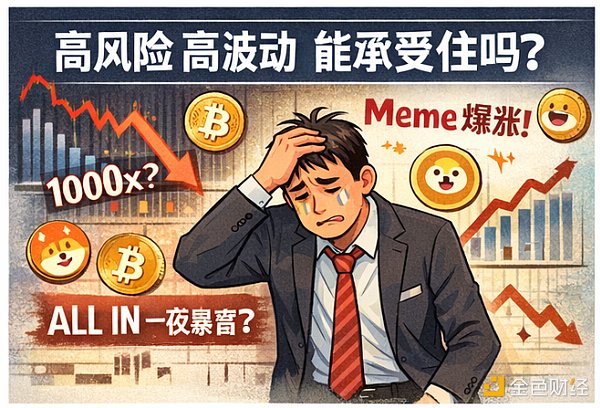
However, hidden behind this is that high returns often come with high risks. I actually think that middle-class unemployment is not a terrible thing; as long as one can recognize themselves, use savings properly, and face life positively, it’s not impossible to turn things around in adversity. But if the goal is to have altcoins double in a day, Memes tens or hundreds of times a day, engaging in various staking profits, on-chain returns, contract opportunities, and hot narratives, then unconsciously, one has moved from allocation to speculation.
Initially, one only wanted to invest a small amount to try, but eventually, under continuous rises and stimulation, the position expanded, even starting to use money that shouldn't have been touched at all. This seems skillful in a bull market but becomes a cost in a bear market. Don’t just mention the crypto space; how many familiar friends in X have become impoverished due to over-investing? With elderly parents above and children below, there are even loans involved, some people have borrowed to trade crypto. Some consider this approach to be "brave," but I see it more as irresponsible.
There are indeed people making money in the cryptocurrency field, even making a lot of money, and there are also those who have been able to walk away after striking it big with a small investment. But this is still a minority. When young, there's another chance after failure, but once middle-aged unemployment happens and there is no stable income, going ALL IN could lead to suffering not just for oneself but also for an entire family or even three families.
Therefore, my own view has always been very clear: middle-aged middle-class individuals should not allocate cryptocurrency, but they should not make cryptocurrency the core of family assets.

For middle-aged individuals who have already lost a stable income and aren't in a strong financial position, facing daily expenses, buying cryptocurrencies, or even buying Bitcoin may not be a very reasonable action. Even after developing to this point, the cryptocurrency market is still characterized by high volatility, high emotion, and high expectation gaps. I also acknowledge Bitcoin's long-term value, its scarcity, decentralization attributes, and its special position in global liquidity, but none of these can change the fact that BTC will fluctuate violently.
Last October, Bitcoin's price was still $120,000, and now, in less than six months, it has halved. Facing such volatility, for middle-class individuals, it’s not just about temporary paper losses. When it comes time to pay the mortgage, the children's tuition, and various bills, will you cut losses or not? If you decide to cut losses thinking Bitcoin will definitely reach $200,000 but it might take two years or longer, and if you don’t cut losses, even if you handle this month's expenses, what about next month? What about the month after?
Of course, many friends will say that this way of thinking will not lead to wealth; it's just fearing wolves in front and tigers behind, never daring to take a gamble, and a lifetime may be spent in such a timid state.
I agree with this to some extent, but as a child, a parent, and a husband, there will always be responsibilities; it’s just a matter of the size of one’s sense of responsibility. If one is truly cornered, then there’s nothing more to say. Interested friends can check out "Gambling Addiction" forums; although they're now somewhat like storytelling formats, the reality is that winning once in adversity is possible, but the probability of winning every time is too low. The small number of survivors' bias cannot represent everything.
Cryptocurrency has helped many friends achieve class mobility or financial freedom, but money is not printed out of thin air; money in the market is finite and won't be created out of nothing. The money you earn must come from someone else's loss. When one person makes a million, there will be one or even multiple people losing a million alongside them, and cryptocurrency is not a place where windfall money blows in; someone must have genuinely invested real money for it to work.

Middle-aged middle-class individuals can allocate cryptocurrency, but the premise must be that this portion of the investment cannot impact family life, cannot affect cash flow, cannot interfere with large expenditure arrangements for the coming years, and certainly cannot be built on borrowing, leverage, and emotional impulses. They should only discuss this part of high-volatility asset allocation after fulfilling basic security, emergency reserves, insurance, housing, education, and retirement preparations.
If a family hasn't even prepared three to five years of emergency funds, hasn't laid a foundation for children's education and family medical needs, and has limited cushion space after unemployment, then discussing whether to allocate cryptocurrency at this point is no longer an investment question; it’s more about taking chances. Cryptocurrency has never been savings; it has no guaranteed returns, nor is it necessarily expected to yield positive returns. Even BTC has losses, so let's not mention anything else.
Moreover, for the middle-aged middle class, allocating Bitcoin and entering the crypto space are actually two different things. The former might be based on asset allocation logic, acknowledging it as an asset class that cannot be ignored in the future, while the latter often drags one into a high-noise, high-emotion, high-gambling environment. For young people, such high volatility and stimulation might still allow for experimentation, but for unemployed middle-aged individuals, the greatest fear is precisely in moments when they can least afford upheaval, to take on risks that they shouldn't be taking.
免责声明:本文章仅代表作者个人观点,不代表本平台的立场和观点。本文章仅供信息分享,不构成对任何人的任何投资建议。用户与作者之间的任何争议,与本平台无关。如网页中刊载的文章或图片涉及侵权,请提供相关的权利证明和身份证明发送邮件到support@aicoin.com,本平台相关工作人员将会进行核查。


