Author: Shao Jiadian
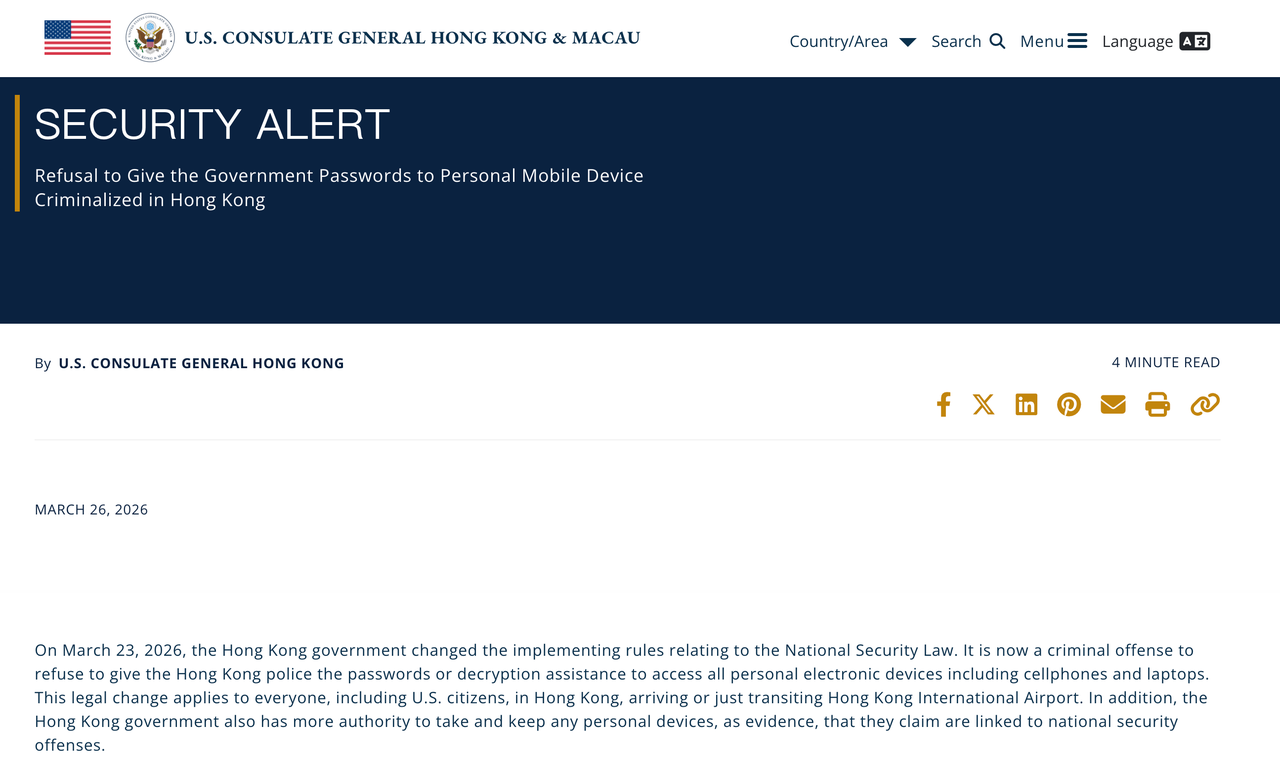
(The above screenshot is from the official website of the U.S. Consulate General in Hong Kong and Macau)
Recently, a widely circulated message in the cryptocurrency sector suggests that Hong Kong can now require the surrender of electronic device passwords, and non-compliance could constitute a crime, potentially even affecting hardware wallets. The direct source of this claim is a security alert issued by the U.S. Consulate General in Hong Kong and Macau in March 2026. The original text is quite straightforward:
“On March 23, 2026, the Hong Kong government changed the implementing rules relating to the National Security Law. It is now a criminal offense to refuse to give the Hong Kong police the passwords or decryption assistance to access all personal electronic devices including cellphones and laptops. This legal change applies to everyone, including U.S. citizens, in Hong Kong, arriving or just transiting Hong Kong International Airport. In addition, the Hong Kong government also has more authority to take and keep any personal devices, as evidence, that they claim are linked to national security offenses.”
Looking at this paragraph alone, it's easy to form the initial impression: entering Hong Kong might lead to a request for device passwords. After circulating on social media, it morphed into a more emotionally charged version — “Don’t bring hardware wallets to Hong Kong.” However, if one follows this information further, it’s easy to overestimate the risks and misunderstand it as a universal rule for everyone. The problem is that such alerts often emphasize the outcome without clarifying the applicable premises and scenarios. To understand this matter clearly, one needs to return to the legal rules behind it.
What exactly has changed in this adjustment of Hong Kong's rules?
The current discussion does not revolve around an entirely new law but is rather a strengthening of the "Electronic Evidence Acquisition" section within the Implementation Rules under the National Security Law. The core change actually centers on one thing: law enforcement agencies can not only access your device but can also require you to “assist in unlocking the data.” A key statement in the relevant text reads:
“A person must comply with the requirement to provide such assistance as is reasonably necessary to enable an officer to access the information.”
By looking at this sentence, it may seem abstract, but what it really expresses is that law enforcement can require you to assist them in “understanding the contents of your device.” This “assistance” is not vague; the subsequent text delineates the scope very specifically:
“The assistance may include providing access to an electronic device, providing any password, decryption key or other information necessary for gaining access to the information.”
Combining these two sentences, it essentially creates a very realistic scenario: law enforcement can not only take your device but can also require you to provide the password, unlocking method, and even things like recovery phrases as “access pathways.”
More critically, this “assistance” is no longer a matter of your willingness but becomes a legal obligation with sanctions. The text immediately follows with:
“A person who fails to comply with the requirement without reasonable excuse commits an offence.”
This means that under applicable conditions, refusing to provide passwords or cooperating in unlocking may itself constitute a crime; if the information provided is erroneous or misleading, even harsher liabilities may ensue.
From a law enforcement logic perspective, this change is quite direct:
In the past, even if law enforcement obtained the device, they might not gain access to the data; now, the law permits them to directly require you to surrender the “data entry point.”
Many people will feel an instinctive discomfort at this point, and the reason is simple — the rule impacts not just the device but the control itself. For encrypted assets, this is particularly sensitive because the device is merely a shell. What truly determines asset ownership is the string of information you may or may not be willing to disclose.
Devices can not only be inspected but may also be continuously detained
There is another statement in the security alert from the U.S. Consulate:
“the Hong Kong government also has more authority to take and keep any personal devices, as evidence, that they claim are linked to national security offenses.”
This statement can be understood more plainly as: not only can your device be examined, but it can also be taken away and kept for a period of time as evidence. The corresponding legal framework involves an expansion of powers regarding “seizure and detention.” The relevant rules permit law enforcement to seize any device they believe is related to national security cases and to preserve it as evidence.
Looking solely at the “seizure of devices” aspect, it's not unusual in criminal cases; various legal jurisdictions have similar arrangements. However, when this is combined with the “obligation to assist in decryption” mentioned earlier, it becomes clear that the focus of this adjustment is not on any single rule but rather on their combination.
The practical law enforcement pathway will likely look like this: devices can be taken away, data can be required to be unlocked, and non-compliance with unlocking will inherently bring additional legal risks. These three steps together essentially cover the most critical parts of digital evidence collection. The past scenario of “the device being in law enforcement's hands, but data being inaccessible” has been significantly compressed at the institutional level.
From a practical standpoint, the more concerning change is not "device safety" but "structural safety." Whether your assets are concentrated under a single private key, whether your address might be associated with high-risk labels, whether your funding pathways can withstand scrutiny—these issues are far closer to real risks than “whether to bring a wallet into the country.”
This news, if it were to leave behind a meaningful implication, would likely not be about travel habits but rather a more realistic change: in certain scenarios that have already entered law enforcement’s sights, the control of on-chain assets is no longer solely determined by technology.
免责声明:本文章仅代表作者个人观点,不代表本平台的立场和观点。本文章仅供信息分享,不构成对任何人的任何投资建议。用户与作者之间的任何争议,与本平台无关。如网页中刊载的文章或图片涉及侵权,请提供相关的权利证明和身份证明发送邮件到support@aicoin.com,本平台相关工作人员将会进行核查。


