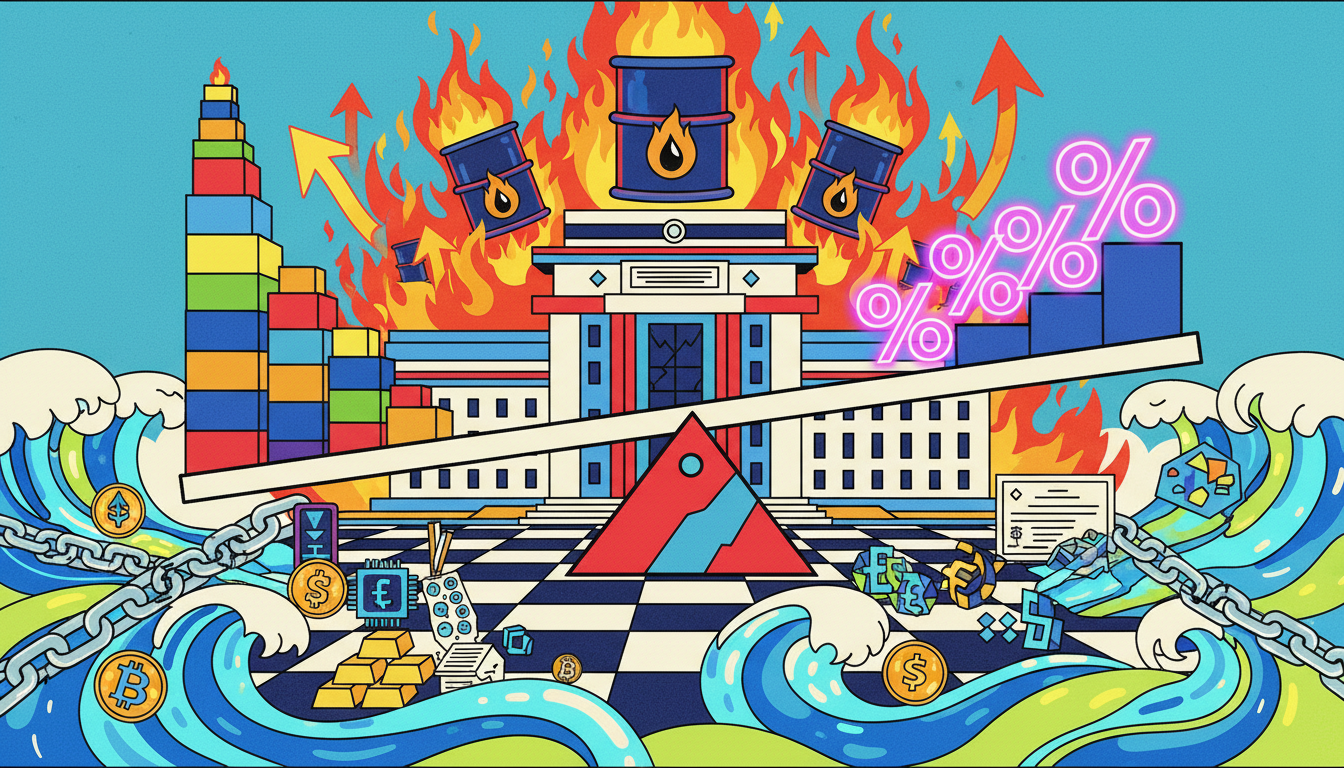
On March 30, 2026, Eastern Eight Time, the UK crypto investment institution Abraxas Capital was disclosed by on-chain monitoring, having established a total scale of 135 million U.S. dollars in short positions on crude oil futures on a derivatives platform, attracting market attention. This is not just a simple directional bet; it is also the first traditional commodity gamble exceeding 100 million U.S. dollars fully recorded on-chain, backed by a crypto-native hedge fund. Why are crypto funds engaging in a cross-industry shorting of crude oil? This shift from Bitcoin to commodity risk exposure raises core questions about how it will reshape the role of crypto institutions and the overall risk structure of the market.
On-chain exposure of 135 million U.S. dollars in crude oil shorts
From the publicly available on-chain data, Abraxas Capital's crude oil shorts are not a vague "directional view" but are precisely split into contracts and notional values. First, there are 954,996 contracts of Brent crude (BRENTOIL) with a notional value of approximately 102.7 million U.S. dollars; second, there are 322,885 contracts of WTI crude (CL) with a notional value of about 32.7 million U.S. dollars. The total constitutes about 135 million U.S. dollars in directional short exposure to crude oil, and the pairing of the two types of contracts itself carries a significant global macro hedging implication, rather than a short-term speculation on a single variety.
This position was established through two on-chain addresses 0xB83...6E36 and 0x5b5...8c060 and was first identified by the on-chain analytics platform Lookonchain. Subsequently, multiple Chinese media outlets, including Shenchao TechFlow, Foresight News, and Odaily Planet Daily, cross-verified the position size, forming a relatively consistent factual framework regarding on-chain transaction records, position sizes, and the underlying contract codes. For traditional financial markets, where large off-exchange derivatives transactions are common, such on-chain "solid proof" processes are extremely rare.
It is important to emphasize that the timing of these positions coincides with the intense volatility cycle of crude oil in March 2026. During this phase, international oil prices experienced substantial fluctuations in a short period, significantly amplifying the volatility range between Brent and WTI, making any directional high-leverage positions highly time-sensitive and vulnerable to liquidation risk. The short positions established by Abraxas during this volatility cycle indicate that their strategy not only bets on direction but also on the macro volatility itself, which is one of the reasons this position is particularly noteworthy.
From Bitcoin to crude oil: the risk landscape expansion of crypto funds
Abraxas Capital is a typical crypto-native institution, primarily active in Bitcoin, Ethereum, and various crypto derivatives markets. Traditionally, these institutions have their risk exposure concentrated in on-chain asset prices, DeFi yield fluctuations, and cryptocurrency market cycles. However, this time it chose to extend its risk landscape directly to crude oil futures, a traditional commodity, marking a shift where crypto funds begin to actively engage in the pricing and games of global macro assets, no longer content with “circulating within the crypto circle.”
For a crypto hedge fund, shorting crude oil does not necessarily imply a straightforward "bearish view on energy"; it is more likely a component of an overall asset portfolio. Crypto assets tend to experience valuation compression amidst macro tightening and changes in inflation expectations, while crude oil prices may exhibit temporary inverse or misaligned performances with risk assets under certain macro scenarios. By establishing crude oil shorts, the fund can hedge against the drawdown in crypto asset net worth with the price drop of commodities in specific macro shock scenarios or hedge against the risks brought about by rising financing costs, thereby making the overall portfolio volatility more manageable.
Compared to traditional macro hedge funds, crypto funds display a coexistence of "convergence and divergence" in their strategies on cross-asset trading. On one hand, they likewise focus on the correlations between interest rates, inflation, energy prices, and risk assets, adjusting exposure through long and short combinations across markets; on the other hand, the risk-bearing culture and the characteristics of underlying assets make crypto funds more inclined to use on-chain high-frequency derivatives and structured positions to amplify returns. Abraxas’s crude oil shorts resemble crypto institutions actively moving closer to traditional macro funds, participating in global asset pricing with the same language, only the execution medium has shifted to on-chain derivatives platforms.
On-chain transparency exposes institutional-level commodity bets
Several Chinese media outlets noted that this is the first traditional commodity bet exceeding 100 million U.S. dollars that can be completely tracked on-chain. Shenchao TechFlow even directly defined it as "the first publicly recorded traditional commodity bet exceeding 100 million U.S. dollars by a crypto hedge fund." In the past, similar-sized commodity shorts were often hidden in off-exchange structured products or internal ledgers of banks and brokerages, with the outside world at most seeing aggregated data like CFTC position reports, making it difficult to accurately pinpoint the specific position-building trajectory of any given institution.
The on-chain wallet address system changed this. Through addresses like 0xB83...6E36 and 0x5b5...8c060, observers can relatively directly track the institution's position-building rhythm, increment/decrement patterns, and even the hedging relationships with other assets. This transparency provides researchers, competitors, and even potential LPs with an unprecedented information advantage; meanwhile, it also unintentionally opens up new "information arbitrage" opportunities—whoever can decode on-chain institutional behavior faster and more accurately may gain a first-mover advantage before market reactions occur.
However, as more macro positions are moved on-chain, institutions will face impacts in terms of privacy, strategy confidentiality, and compliance. On the strategy side, details of positions that previously existed only in risk control reports and internal systems have now become public data that anyone can "observe on-chain"; on the compliance side, if regulatory agencies in different jurisdictions can directly trace specific addresses and positions, it will redefine the boundaries of cross-border commodity trading, leverage limits, and reporting obligations. The transparency that the crypto world has long prided itself on, may, after on-chaining macro funds, paradoxically become an amplifier for strategy exposure and regulatory alignment.
The blind spots of non-leveraged information are expanding
Currently, the publicly available information lacks specific leverage ratios and margin percentages for Abraxas’s crude oil shorts, which represents the largest blind spot in all discussions surrounding this position. While the notional value of 135 million U.S. dollars sounds astonishing, if it only corresponds to tens of millions of U.S. dollars in margin, the true risk exposure and liquidation sensitivity would tell a completely different story than "unleveraged full shorting." Without this crucial parameter, any external judgments on its net worth fluctuations and liquidation probabilities can only remain at the level of direction and relative magnitude, failing to form a quantitative assessment.
Under different leverage assumptions, the directional impact of crude oil price fluctuations on this position is consistent, but the intensity is radically different: under medium-to-low leverage conditions, a short-term rebound in crude oil would manifest more in floating losses and margin utilization, allowing the fund to choose to "buy time" through additional margin or hedging other assets while awaiting the macro narrative to realign with its position; under high leverage conditions, the same magnitude of reverse fluctuation might rapidly trigger additional margin calls and risk engines, forcing the fund to passively liquidate at local highs, turning what was intended as a macro hedge short into a part of short-term "programmatic buying."
This uncertainty, combined with the high-leverage culture of crypto derivatives platforms, amplifies the systemic risks of cross-market bets. The crypto market is accustomed to short-term trades with leverage of 10 times, 20 times, or even higher; when this concept is directly applied to crude oil and other high-volatility commodities driven by multiple macro and geopolitical factors, any extreme market movements could trigger a "flash crash—forced liquidation—reverse buying" chain reaction in the on-chain derivatives market. For external observers attempting to interpret such positions, the lack of leverage and margin data makes it difficult to ascertain how far a position appearing to be “casually macro hedging” is from its risk limits.
On-chain derivatives platforms are becoming connectors of cross-market liquidity
Abraxas's crude oil shorts are not just a single strategy choice but also reflect the trend of on-chain derivatives platforms taking on traditional commodity liquidity. In the past, crypto-native trading venues mainly designed contracts around BTC, ETH, and a few mainstream tokens, but now they are beginning to introduce traditional commodity contracts, including crude oil, opening up a new channel directly connecting crypto funds to the global commodity markets. This 135 million U.S. dollar short position is a concentrated manifestation of this structural change: commodities are no longer exclusive to traditional exchanges like CME and ICE; they have begun to appear on the on-chain product menu.
Crypto-native infrastructure possesses inherent advantages in settlement efficiency and access thresholds. On one hand, on-chain margin can be quickly transferred across different contracts and assets, and real-time settlement and 24-hour trading make it possible to price cross-time-zone macro events instantly; on the other hand, as long as the on-chain account and contracts are opened, institutions can participate in commodity trading directly with crypto assets as collateral, without the need for traditional brokerage and banking intermediaries. This flattening access method significantly reduces the time costs and institutional thresholds for cross-market trading.
With the maturation of such infrastructure, the future paths for traditional financial players to utilize on-chain platforms for macro positions are also becoming clearer. Some institutions wary of crypto asset risks, but hoping to leverage the efficient settlement and global liquidity of on-chain platforms, may choose to establish positions in commodities, interest rates, equity indices, etc., while using a limited proportion of crypto assets as collateral. In this scenario, on-chain platforms will no longer simply be “casinos for crypto players,” but will evolve into liquidity hubs connecting traditional finance and the crypto world.
The macro game has just begun: deep waters for crypto and traditional finance
In summary, the establishment of 135 million U.S. dollars in crude oil futures short positions by Abraxas Capital is a symbolic example of crypto funds transitioning from "crypto circle hedging" to macro-oriented, cross-asset investments. A crypto-native institution willing to bet such a large directional position on one of the largest traditional commodities indicates that it no longer merely sees itself as a participant in the crypto market, but actively expands its risk management and sources of returns into the global asset spectrum, signifying that more crypto capital will engage in pricing games of major asset classes in the future.
As more institutions move macro hedging and commodity trading on-chain, the linkage between the crypto market and global asset prices will be significantly strengthened. Bitcoin price fluctuations will no longer just reflect internal sentiment and liquidity of the crypto space; they will increasingly overlap with external variables such as energy prices, interest rate decisions, and commodity cycles. Conversely, the forced liquidations and rebalancing of large on-chain macro positions may also impact spot commodities and traditional financial markets through feedback from the derivatives market. The crypto world is entering a phase of deep coupling with the macro world "beyond the wall."
For ordinary participants, this event also sends an important reminder: when interpreting any large on-chain positions, one must be cautious of cognitive errors caused by undisclosed leverage ratios, margin percentages, and specific platform rules. Focusing only on notional value and direction can easily lead to misinterpreting a highly fragile position near liquidation as a "calm long-term macro view"; neglecting the risk engines and clearing mechanisms of different platforms may also underestimate the impact of chain reactions under extreme market conditions on prices. The information dividends brought by on-chain transparency will only avoid becoming new traps when these blind spots are fully recognized.
Join our community, let's discuss and become stronger together!
Official Telegram community: https://t.me/aicoincn
AiCoin Chinese Twitter: https://x.com/AiCoinzh
OKX benefits group: https://aicoin.com/link/chat?cid=l61eM4owQ
Binance benefits group: https://aicoin.com/link/chat?cid=ynr7d1P6Z
免责声明:本文章仅代表作者个人观点,不代表本平台的立场和观点。本文章仅供信息分享,不构成对任何人的任何投资建议。用户与作者之间的任何争议,与本平台无关。如网页中刊载的文章或图片涉及侵权,请提供相关的权利证明和身份证明发送邮件到support@aicoin.com,本平台相关工作人员将会进行核查。