Author: Shreyas Hariharan
Translation: Shen Chao TechFlow
Shen Chao Introduction: There are already 246 active markets related to Iran on Polymarket, with a total trading volume exceeding $1 billion—down to the specifics like the number of ships passing through the Strait of Hormuz, whether to strike Saudi Arabia, and whether Prince Pahlavi will return.
This article does not just describe the growth of prediction markets; it queries a deeper question: When war is broken down into tradable micro-events, what changes will occur in the relationships between reporters as referees of contracts, media, capital, and war information?
The full text is as follows:
Prediction markets have assigned a real-time score to war, along with off-market bets. Iran is the first war of the prediction market.
There are 246 active markets regarding Iran on Polymarket, with a total trading volume of over $1 billion in related markets. The granularity of these markets is astonishing: it’s not just "Will the U.S. strike Iran," but specifics like the number of ships passing through the Strait of Hormuz, whether Crown Prince Pahlavi will return, whether a ceasefire can be reached by a certain date, whether Iran will strike Saudi Arabia and the UAE, and whether nuclear options will be employed (although this market was taken down after strong opposition).
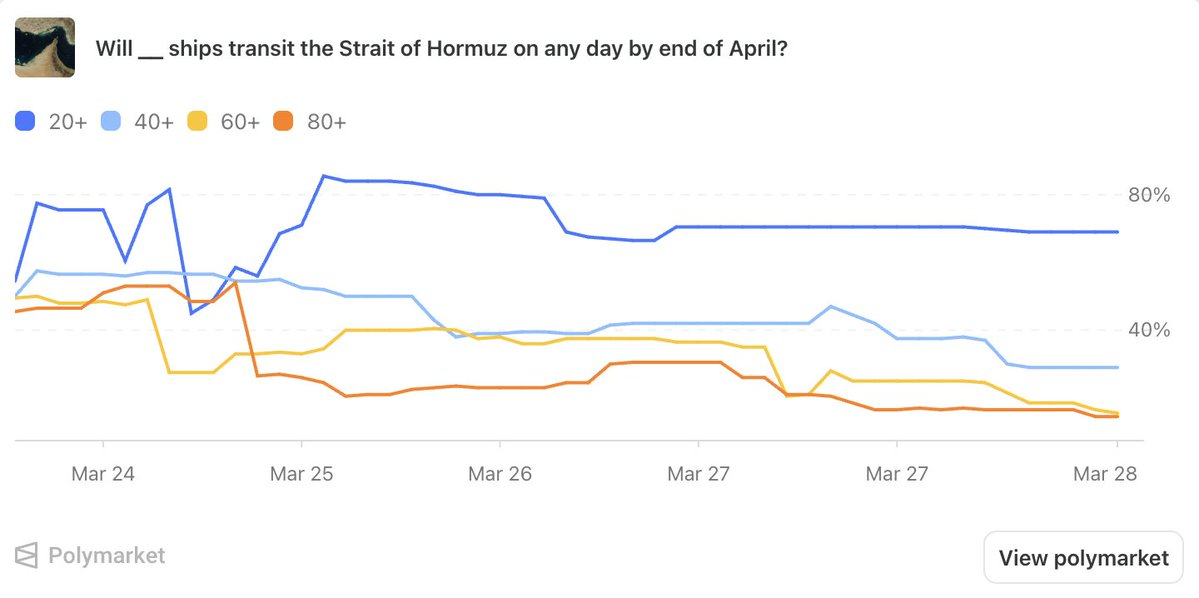
War is now broken down into player props.
The explosion of sports betting shifted from "Who will win the game" to micro-markets: player props, in-game odds, and real-time odds for each possession. The same breakdown is now happening in war—war is being disassembled into tradable micro-events, just like basketball games are broken down into "Will Jokic achieve a triple-double?"
When reporters become contract referees
Prediction markets settle based on the consensus of credible reports. Reporters are not just reporting on war; they are the adjudication mechanism for contracts worth millions of dollars riding on them. In March, a Polymarket contract inquired whether Iran would strike Israel by a certain date, with over 90% of the betting volume occurring after the event itself, as traders debated whether a certain explosion qualified as a "strike" under the contract rules.
A military reporter from The Times of Israel reported that a missile fell near Jerusalem, and his reporting was cited by The Economist and other media. Traders who needed the report content to diverge sent him death threats, demanding he modify his report to state that it was an intercepted warhead that caused the explosion—so it would not count towards the contract's settlement conditions. The more money flows into these markets, the stronger the economic incentives to influence reporting.
War now has real-time odds
War has always influenced prices. Oil prices surged during Iraq's invasion of Kuwait, defense stocks jumped after 9/11, and gold rises with each escalation in the Middle East over fifty years. But those were indirect signals that needed interpretation: You had to figure out what a $5 rise in crude oil meant for the probability of a broader conflict, what a shipping company’s sell-off indicated about the Strait of Hormuz, and what the VIX was actually telling you rather than what cable news was saying it told you. You had to infer from the lines, and in those lines, politicians could exaggerate, media agencies could inject bias, and intelligence agencies could introduce reports that served their own interests.
Prediction markets completely bypass the interpretation stage. On Polymarket, there is a contract inquiring which countries Iran would retaliate against, with separate yes/no odds for Israel, the UAE, and Saudi Arabia. You do not need to infer the probability of military action from Brent crude oil; there’s a real-time number telling you directly.
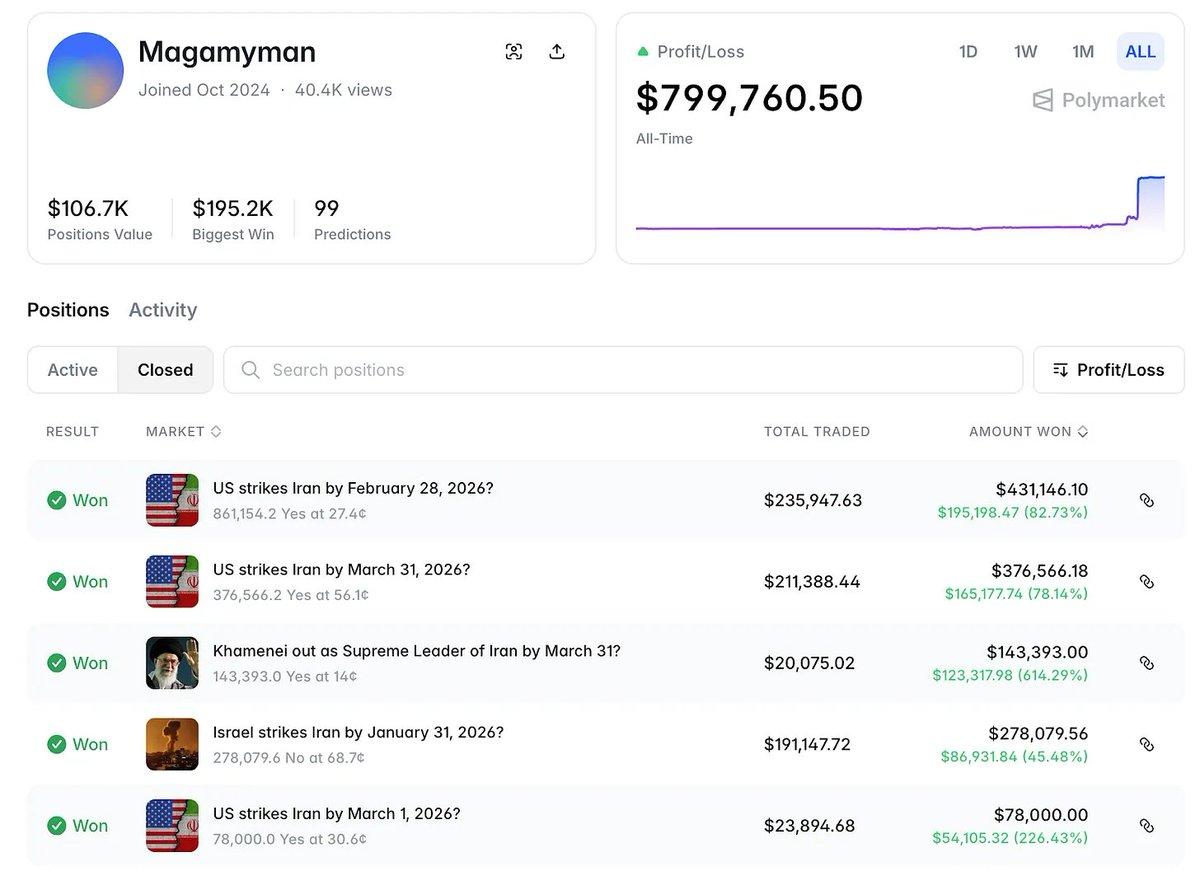
A trader earned nearly $800,000 by accurately predicting the timing of U.S. strikes on Iran. For people, earning life-changing wealth by predicting the truth carries economic incentives.
The evolution of war media
Iran is the first war that you can refresh every minute. Marshall McLuhan's most famous point is: the medium is the message. We are obsessed with the content on a screen or page, yet overlook that the screen or page itself is reshaping how we think, feel, and relate to each other. Content is distraction; form is what changes you. Television did not just show Americans the Vietnam War; it transformed a conflict in a distant jungle into the first "living room war": something that felt close and real, which you experienced physically while sitting on your couch after dinner. McLuhan noted that the same war reporting could evoke patriotic outrage in a newspaper while triggering sympathy for victims on television. The same facts, through different media, can evoke entirely different emotional responses.
In the Iran war, the media is money. And money is a medium fundamentally different from photographs, broadcasts, or tweets. It doesn’t show you suffering; it shows you nothing. It gives you a number. When you see that the probability of a ceasefire before March 31 on Polymarket is 24%, you don’t feel anything for those living under bombardment; you are processing a probability, assessing whether 24% is high or low, maybe thinking about the next bet, or refreshing the page like you would for playoff scores. Most people watching these odds are not betting; they are spectators. Watching these numbers change is as captivating as staring at stock prices or real-time scores—not as captivating as a photo of a bombed hospital.
Last week, Polymarket turned this experience into reality: they opened a pop-up bar in Washington, D.C., called "The Intelligence Room."
With eighty screens, a six-foot globe, Bloomberg terminals, flight radar, and walls with real-time rolling prediction market odds, they described it as "a sports bar, but designed for situational monitoring." War is now entertainment: watching the odds change as leaders announce military strikes is not much different from watching a wide receiver catch an unexpected touchdown pass.
Neil Postman warned throughout the 1980s that television would turn all serious public discourse into entertainment, framing it as a struggle between Orwell and Huxley: Orwell worried that the government would ban books and suppress the truth, while Huxley feared that there wouldn’t need to be any bans at all because the public would drown in information and entertainment, making the truth insignificant, lost in a sea of noise. Postman believed Huxley was winning, and he was right.
Television showed you what war looked like; Vietnam was the first television war. Social media made everyone a war correspondent; Ukraine is the first TikTok war. Prediction markets have turned war into a game with real-time scores; Iran is the first war of the prediction market.
免责声明:本文章仅代表作者个人观点,不代表本平台的立场和观点。本文章仅供信息分享,不构成对任何人的任何投资建议。用户与作者之间的任何争议,与本平台无关。如网页中刊载的文章或图片涉及侵权,请提供相关的权利证明和身份证明发送邮件到support@aicoin.com,本平台相关工作人员将会进行核查。


