Original | Odaily Planet Daily (@OdailyChina)
Author | Azuma (@azuma_eth)

The threat of quantum computing to cryptocurrency has once again become a focus of discussion on external networks.
The so-called "quantum threat" refers to the possibility that sufficiently powerful quantum computers in the future could break the cryptographic foundations that protect the security of current cryptocurrencies, potentially destroying their security models.
In November last year, when Vitalik mentioned the quantum threat at the Devconnect conference, Odaily Planet Daily published an article titled “Has the resurgence of the quantum threat shaken the foundation of cryptocurrency?.” The core logic of that article was that while the quantum threat objectively exists, there is still some time before the real threat arrives; and that cryptocurrencies can introduce post-quantum algorithms through upgrades, thereby completing a "lock change."
In other words, it is "worthy of attention, but not urgent." However, this time, market sentiment has shown a noticeable change.
What has happened recently?
The recent stir in the market over the quantum threat was ignited by two actions taken by the Google Quantum AI team, led by world-class quantum circuit expert Craig Gidney and others.
The first was on March 25, when Google officially proposed its post-quantum cryptography (PQC) migration timeline with a target of 2029; the second was on March 31, when Google Quantum AI specifically released a research report aimed at the cryptocurrency industry, stating outright that according to the latest research, the resources required for quantum computers to break the elliptic curve cryptography protecting cryptocurrencies are much less than previously understood.
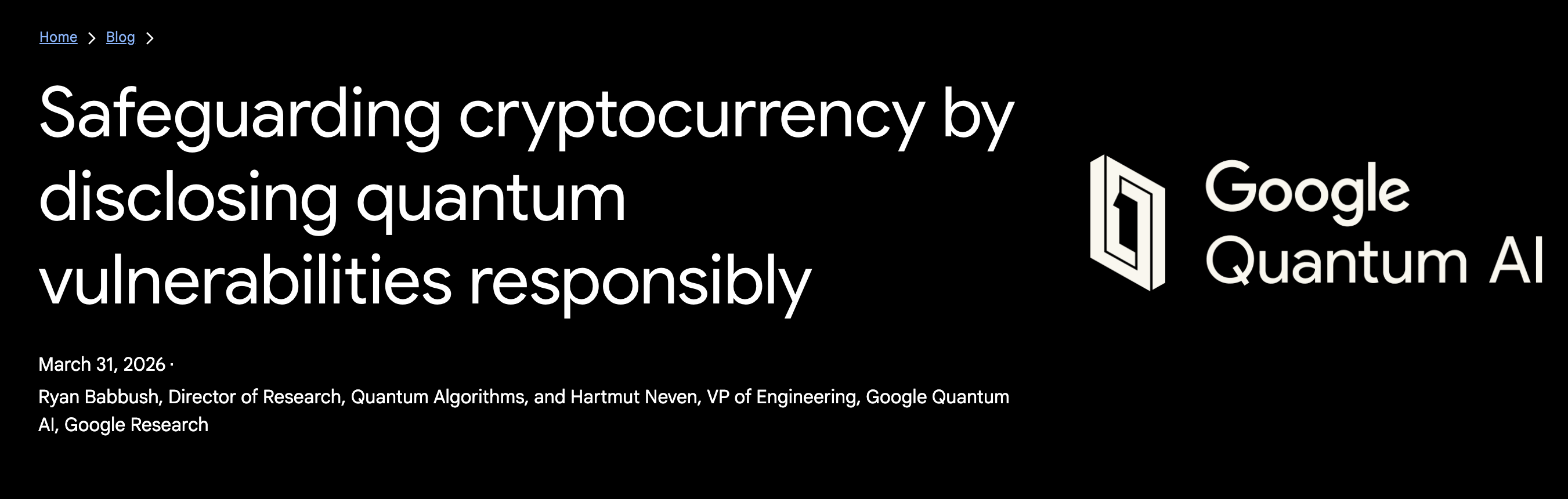
According to the article and accompanying research report released by Google on March 31, their team compiled two new Shor algorithm quantum circuits for the 256-bit elliptic curve discrete logarithm problem (ECDLP-256): one requiring fewer than 1200 logical qubits and 90 million Toffoli gates, and the other requiring fewer than 1450 logical qubits and 70 million Toffoli gates.
Google further estimated that under its proposed superconducting quantum computing architecture assumptions, such circuits could theoretically be executed on a fault-tolerant quantum computer with "fewer than 500,000 physical qubits" within minutes. This approximately indicates that the number of physical qubits needed to break ECDLP-256 has been reduced by about 20 times compared to previous estimates.
If the market's imagination about the quantum threat in the past was still at the stage of "millions or tens of millions of physical qubits are needed, feeling far from reality," then the biggest impact of Google's paper is that it has pulled that seemingly unreachable threshold much closer to the real world.
What’s more intriguing is that Google did not disclose the complete sensitive details of the underlying circuits as in traditional academic papers; instead, it stated that it had communicated with the U.S. government and had proven its estimates using zero-knowledge proofs (ZK). Google stated that this move can avoid disclosing the underlying quantum circuit to prevent misuse by third parties. This also implies that Google itself may believe that this research is no longer merely a technical showcase on paper, but a capability disclosure with real security threats.
What does this mean?
First, it is important to clarify that Google is not saying "Bitcoin and Ethereum will be hacked tomorrow"; rather, it is highlighting another matter that is equally worth being vigilant about——the quantum resource threshold required to break the current mainstream elliptic curve cryptography has been significantly lowered.
The former means that real attacks are imminent; the latter indicates that the industry's previous time judgments need to be corrected. Last year when Vitalik reminded of the quantum threat, the industry mostly understood this as a long-term risk, because in the mainstream narrative, truly threatening quantum computers are still very far away; however, Google’s research this time is equivalent to pushing that warning line, which previously seemed distant, much closer.
This is also why the market’s reaction this time is significantly stronger than last year, with many big names expressing their shock at Google's progress on social media.
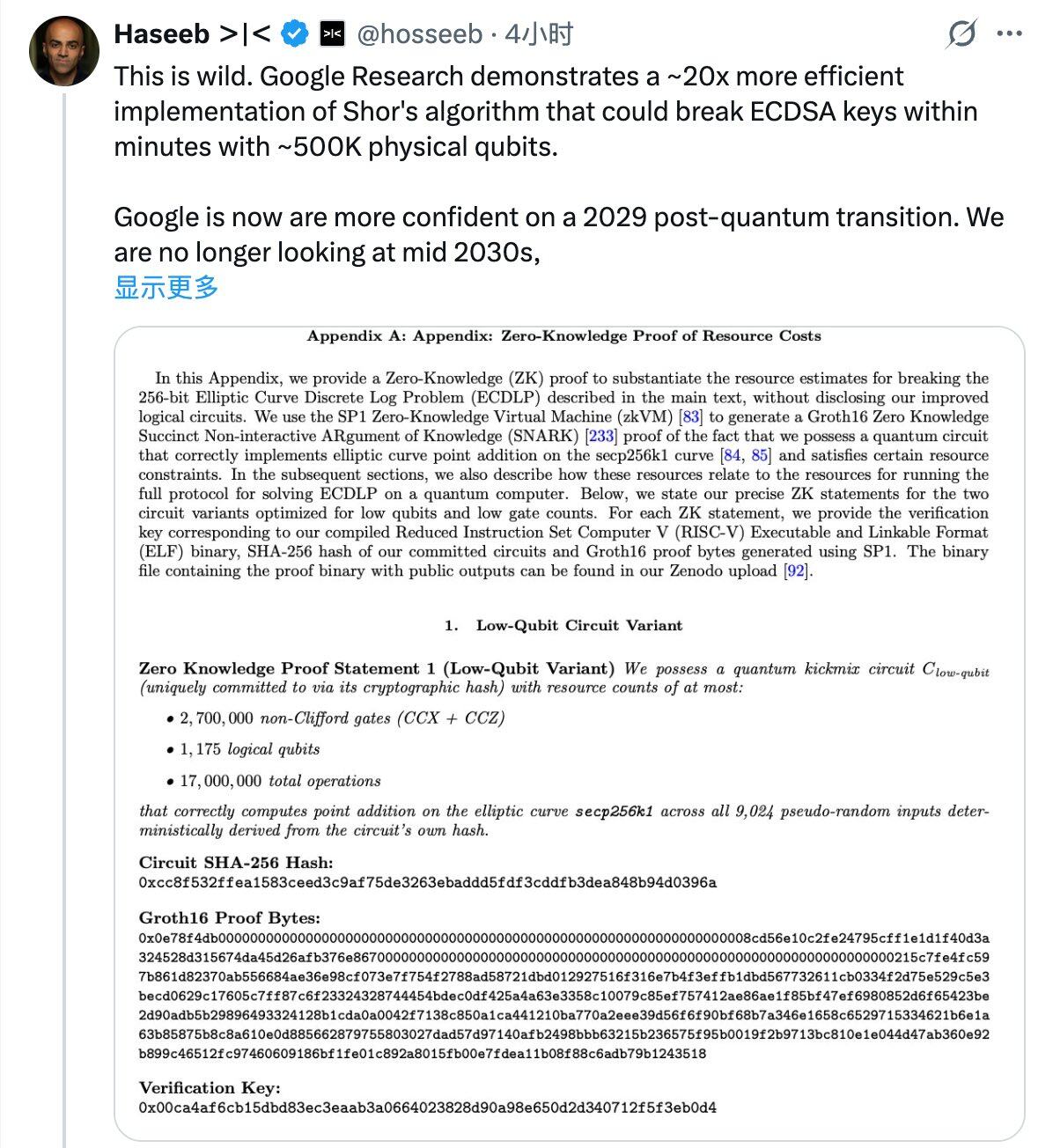
Haseeb Qureshi, a partner at Dragonfly Capital, tweeted on X: “This is unbelievable... and Google's failure to disclose the complete circuit is very rare, indicating that Google considers this matter serious. All blockchains need to formulate transformation plans as soon as possible. The post-quantum era is no longer a drill.”
Justin Drake, a former Ethereum Foundation researcher focused on quantum computing, stated: “Today is a milestone day for quantum computing and cryptography... Based on my conversations with the team, I believe Google Quantum AI's research results are conservative.”
The post-quantum era is no longer just a drill
In its research report aimed at cryptocurrency, Google directly addressed the industry, stating: “The urgency of taking action is on the rise.”
Although post-quantum cryptography is not a completely blank field. In recent years, the cryptocurrency industry has already discussed various potential upgrade paths; theoretical "new locks" are not nonexistent. But the troubling part is that upgrading in the blockchain world has never been as simple as just replacing algorithms; it also involves on-chain compatibility, wallet infrastructure, address systems, user migration costs, and the most challenging issue of community coordination. Especially for large networks like Bitcoin and Ethereum, which have complex historical assets and numerous ecosystem participants, any upgrade involving the underlying cryptographic system cannot be completed quickly based solely on a paper or a few community discussions. It requires joint participation from protocol layers, clients, wallets, exchanges, custodians, and even ordinary users, and also necessitates a sufficiently long buffer period.
But the objective reality is now in front of us; regardless, the timeline for "changing locks" must be moved up. As for the specific timetable, Google has set its migration target for 2029 and mentioned in the article that Google Quantum AI is working with institutions like Coinbase, Stanford Blockchain Research Center, and the Ethereum Foundation to responsibly advance according to the 2029 timeline.
In summary, what Google has brought this time is not an end judgment that "the crypto world will be destroyed by quantum computing tomorrow," but rather set a clear countdown for this bomb.
For every crypto project, this signifies a whole new security watershed. Those who can recognize problems sooner, push for upgrades, and complete the “lock change” will have a greater chance of maintaining their security boundaries in the next era.
免责声明:本文章仅代表作者个人观点,不代表本平台的立场和观点。本文章仅供信息分享,不构成对任何人的任何投资建议。用户与作者之间的任何争议,与本平台无关。如网页中刊载的文章或图片涉及侵权,请提供相关的权利证明和身份证明发送邮件到support@aicoin.com,本平台相关工作人员将会进行核查。


