Written by: Lawyer Shao Jiadian
Recently, the term "AI payment" has become increasingly popular. However, the concept itself is still rapidly evolving, and different people often see different aspects of it. Some focus on user experience upgrades like voice ordering and automatic payment, while others are concerned with giving AI agents access to wallets and enabling them to make payments. Yet, as some projects truly materialize, the market begins to see that the essence of AI payment is not just about "payment" itself, but rather how AI services are priced, traded, and settled.
Taking Nevermined as an example, it is not just a single payment tool, but rather an infrastructure that allows AI services to be priced, billed, and settled. The capabilities it offers include billing, access control, real-time settlement, and compatibility with agent protocols like MCP, A2A, x402, AP2, etc. What it truly aims to solve is not "how to pay," but how to immediately turn an AI's work into income.
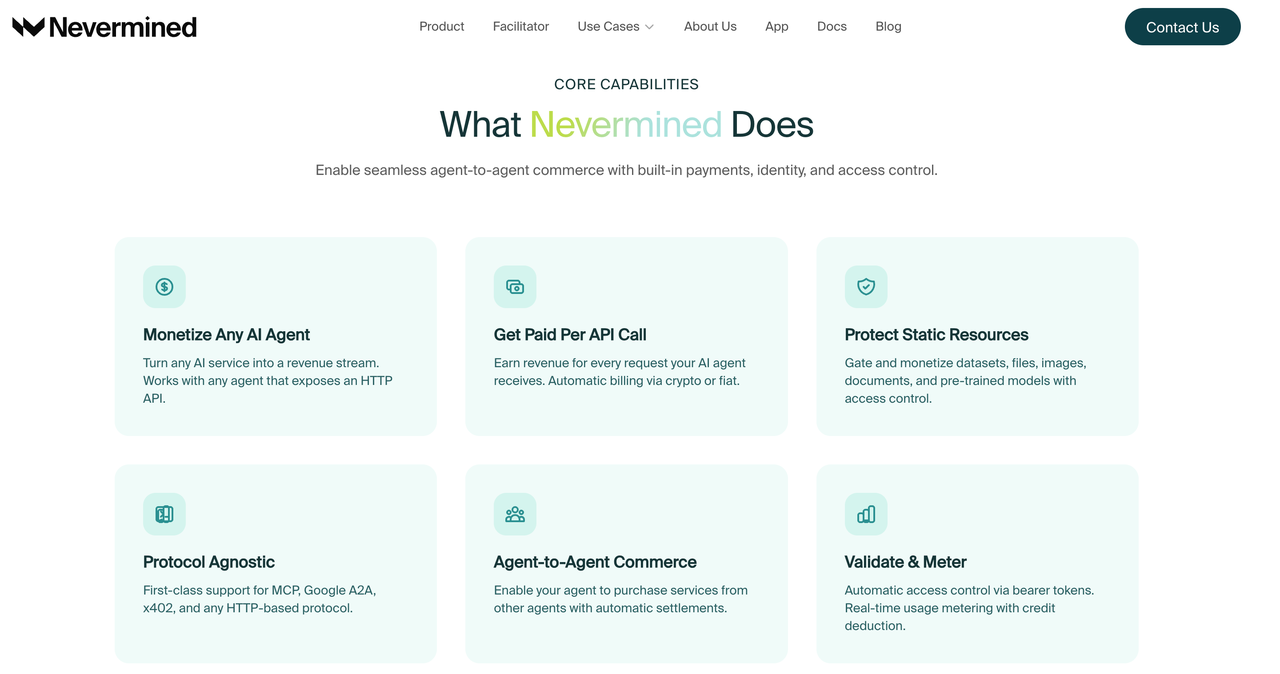
(The image above comes from a screenshot of Nevermined's official website)
It sells not wallets, but the billing system for AI services
Many payment products resemble cash registers, emphasizing the collection of money. Nevermined is different; it is more like equipping AI services with a complete billing system. Whenever an AI service is invoked, the system can determine whether to release the payment, how much to charge, how to keep records after deduction, and how to follow up in the event of disputes.
This may sound highly technical, but it is actually not difficult to understand. Today, many AI products are operational, yet very few can generate sustained revenue. The issue often lies not in capability, but in the billing method. Traditional software can charge based on account, annually, or by package, but AI agents often do not operate this way. A seemingly simple task may involve multiple model calls, several tools, and rounds of external services behind the scenes. Continuing to use traditional software billing methods can easily distort pricing.
What Nevermined captures is this step. It transforms the multiple calls that were previously hidden in the backend into individual billable business actions. In the past, people sold "software usage rights"; now they are selling "every instance of machine labor."
Why this business has become viable
The reason AI payment has started to have practical significance is not that the concept has become new, but because AI's mode of working has forced billing methods to change accordingly. Nevermined offers different models such as pay-per-usage, pay-for-results, and pay-for-value, essentially answering a very practical question: how should AI services be sold.
Many AI products in the past struggled to sell not because there was no demand, but because clients could not ascertain where the money was spent. With monthly subscriptions, they were worried about overpaying; with seat-based fees, they often did not align with actual usage. Especially in agent scenarios, a single conversation may involve dozens or even hundreds of micro-actions. If the billing logic does not closely follow the actual working process of AI, commercialization will always feel awkward.
Nevermined's solution is to transform calls, results, and access into billing events, and then integrate billing, authorization, and settlement into the same process. This way, what customers purchase is no longer a vague "AI capability pack," but instead a series of visible and easily calculable services. The true value of AI payment lies not in making machines able to pay, but in allowing the work performed by machines to be accurately valued.
It also has a crucial move in that it has not confined itself solely to pure cryptocurrency payment. Public information shows that it supports bank cards, stablecoins, crypto assets, and real-time bank transfers. This choice is significant because to turn AI payment into a business, customers first need to be able to easily engage with it. The more open the payment channels, the more it resembles infrastructure; the higher the barriers, the more it feels like a toy for insiders.
It is no longer a conceptual project
To judge whether such projects are still at the conceptual stage, one must not only look at how stories are told but also what is actually presented on the product page. Nevermined's public information shows that it has established partnerships with platforms like CrewAI, Olas, Naptha, Mother, Helicone, aiming to provide payment and billing capabilities for the next generation of agent trading scenarios. On its official product page, it has listed MCP tools, A2A services, x402 payments, as well as cards, stablecoins, bank transfers, etc., as specific product capabilities rather than just staying within visionary descriptions.
Moreover, it is worth noting that it has publicly crossed information with Olas. Nevermined mentioned that Valory, while deploying payment and billing capabilities for Olas’s AI agent marketplace, reduced the deployment time from six weeks to six hours by leveraging Nevermined. Olas’s public page also recognizes its marketplace integration with Nevermined, enabling agents to pay and get paid while supporting real-time, dynamic pricing for agent-to-agent transactions.
This at least indicates one thing: Nevermined is not just lingering on the imagination that "machines will trade with each other in the future"; it is already being utilized in actual scenarios. Of course, this does not mean it has produced a large-scale revenue myth. What public materials can confirm is that it has been productized, integrated into the ecosystem, and entered real usage scenarios; as for how much money it has specifically earned, no clear figures have been disclosed externally at this time. This boundary must be clarified.
The truly sensitive issue is not technology, but legal identity
The most troublesome aspect of AI payment often lies not in whether the technology can be realized, but in what the platform is legally considered after it is accomplished. Many technical teams tend to overestimate "code neutrality," but regulators usually do not buy that.
Nevermined emphasizes traceability, auditability, real-time invoicing, and immutable logs in its product introduction. From a business perspective, these capabilities are indeed beneficial as they enhance trust; however, from a regulatory perspective, issues arise accordingly.
If a platform merely offers billing logic, access control, and interface verification, with funds still controlled by the user and payment authorization remaining on the user or wallet side, it resembles a technology service provider. However, once the platform begins to accept, distribute, unify settlement, or manage funds, or deeply engage in stablecoin transfers, its regulatory profile will change significantly. Regulators are typically not overly concerned about what you call yourself; they care more about: are you handling money for others.
This is also the biggest difference between AI agent payment and regular software services. Previously, software platforms mainly sold tools; now, such platforms are starting to encounter issues near the core of payment such as "billing," "authorization," "settlement," and "recordkeeping." Moving a step further, they will face questions of liability: if an agent automatically invokes the wrong service or makes an incorrect decision within the scope of authorization, who bears the loss? The user, the platform, the service provider, or the model itself? The smoother the AI payment process, the clearer the backend's responsibility boundaries need to be written.
What it truly changes is not just the payment methods, but the way of transaction
If you only see Nevermined as a new type of payment tool, it’s easy to underestimate its significance. What’s truly interesting about it is that it assumes a future where AI is not only used by humans but will also be purchased, invoked, and employed by another AI.
Once this stage is reached, the transaction structure changes. Previously, one company sold software to another; now, it might be an agent invoking another agent; previously, one procurement corresponded to one contract; now, it might be a series of automatically triggered micro-transactions; previously, payment required manual confirmation; now, payment could be automatically completed within the scope of system authorization.
What is truly being rewritten behind it is not just the cash register but also pricing methods, contract structures, risk control logic, and even the regulatory perspective on payments. Nevermined is certainly not the end game, but it has at least brought a trend to the forefront: in the future, many businesses may not necessarily be negotiated between humans; they might also be calculated, invoked, and settled by machines.
Understanding this is far more important than simply focusing on the phrase "AI payment." Because what will truly be valuable in the next stage is not necessarily whose model chats better but who can first seamlessly execute "machine labor – machine billing – machine settlement." Whether AI payment is worth watching does not depend on whether it will order a cup of coffee for someone, but rather on whether it can genuinely transform machine labor into revenue units. Those who successfully navigate this process will be closer to entering the next phase of AI commercialization.
免责声明:本文章仅代表作者个人观点,不代表本平台的立场和观点。本文章仅供信息分享,不构成对任何人的任何投资建议。用户与作者之间的任何争议,与本平台无关。如网页中刊载的文章或图片涉及侵权,请提供相关的权利证明和身份证明发送邮件到support@aicoin.com,本平台相关工作人员将会进行核查。


