Translated by: Block unicorn
This year at the EthCC conference held in Cannes, the first major announcement was made: the Ethereum Economic Zone (Economic Zone).
This project is led by Gnosis and the ziskvm team, and it has received funding from the Ethereum Foundation. The initiative aims to eliminate fragmentation within the Ethereum ecosystem. Let’s take a look at the proposal currently being put forward.
Background
The L2 layer is designed to expand Ethereum’s block space and has achieved this goal. However, this expansion has come with the downside of fragmented liquidity. Your tokens on platforms like Arbitrum, Base, and Polygon cannot interact directly with contracts on the L1 layer or other L2 layers unless bridged, which takes time and incurs costs.
Of course, this is not a new discovery.
For example, at the 2024 Devcon SEA conference, Gnosis co-founder Martin Köppelmann delivered a speech titled "Ethereum Needs a Native L2 Layer," highlighting various trust assumptions that hinder L2 interoperation. To this end, he called for the development of zero-knowledge proof Rollups to enable read and write synchronization with Ethereum.
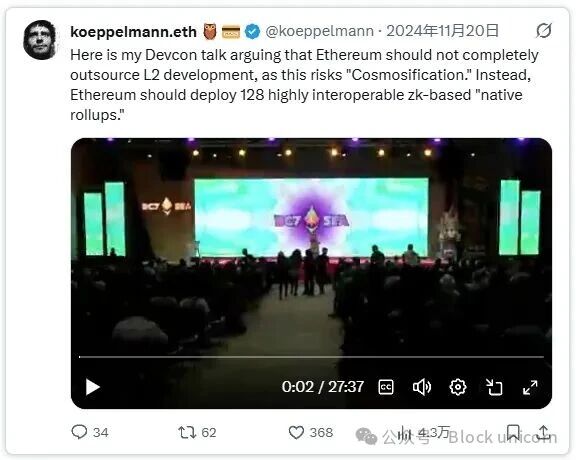
At that time, RYAN hailed this concept as the vision for Ethereum 3.0. Today, the Ethereum Economic Zone (EEZ) project is actively inheriting this vision and preparing to make it a reality.
While Köppelmann called for Ethereum-native Rollups at the time, the new EEZ concept is derived from his 2024 discussion and aims for broader and more permissionless interoperability. EEZ Rollups can be native and Ethereum-based or external and non-Ethereum-based; it depends on their architectural choices.
Who is Building EEZ?
Gnosis is a low-key development giant that has created many iconic on-chain infrastructures, such as the CoW protocol, Safe multisignature, Zodiac DAO architecture, conditional token format underpinning Polymarket predictions, Gnosis Chain, Gnosis Pay, and more.

In terms of ZK, led by Jordi Baylina, ZisK has innovatively developed an efficient open-source zkVM design capable of providing real-time proofs for the execution of smart contracts in the Ethereum ecosystem.
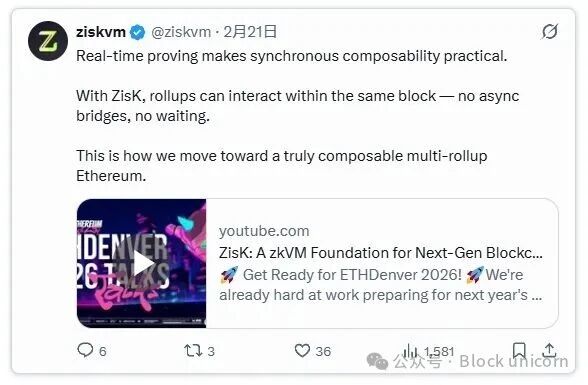
Importantly, neither Gnosis, ZisK, nor any other entity "owns" the EEZ stack; the Ethereum Foundation is funding the initiative, “positioning it as a trusted and neutral shared Ethereum infrastructure,” with outputs being freely open-sourced for everyone to use.
How EEZ Works
In simple terms, the Ethereum Economic Zone is a L1-L2 framework centered around synchronous composability (i.e., real-time interoperability).
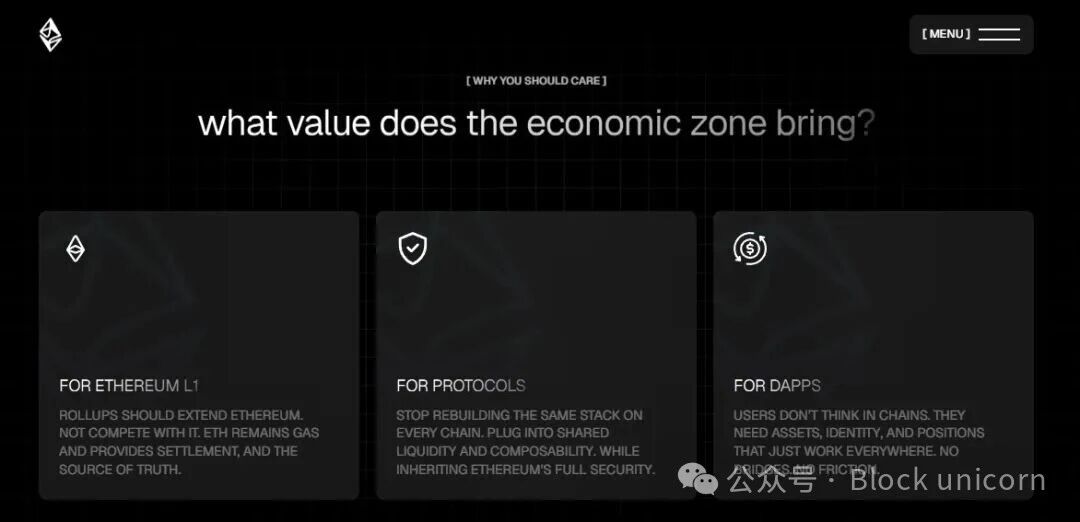
In other words, Rollups connecting to the EEZ can invoke contracts on the L1 or other L2 layers and receive responses in a single transaction. This will achieve atomic execution across chains, allowing users to feel as if they are using a single chain.
In this sense, contracts on the EEZ chain will operate as if they exist on the same chain. Transactions will be atomically completed within the relevant networks or not executed at all in the event of an error.
According to Baylina’s previous research, we can infer that the anchor point here will be proxy smart contracts, meaning a contract on one chain represents the execution of operations from a contract on another chain. If you are using Ethereum, you only need to call a proxy, which will handle the transaction and apply the state changes to the specified L2; that’s all there is to it.
Perhaps most notably, this shift of “single chain user experience, multi-chain results” can be achieved without any protocol-level changes to Ethereum, as the EEZ will rely on smart contracts and real-time zero-knowledge proofs.
Nevertheless, the main trade-off for L2 levels joining the EEZ system is that they must also be reorganized when Ethereum undergoes a reorganization, as pointed out by Martin Köppelmann. This will be a technical challenge but not an insurmountable issue. Rollups running their own sequencers will need to adapt to this merging, which is certainly feasible.
Importance
Imagine if a position on Aave on Ethereum could interact with a Uniswap liquidity pool (or Morpho treasury on Base, or Fluid treasury on Arbitrum, etc.) in a single transaction without bridging.
This is the future the EEZ project is striving to lead. Although there are still hardware and verification advancements needed before this vision is fully realized, we are at a pivotal moment of breakthrough.
The ultimate returns should be further consolidation and dominance for Ethereum. As RSA stated:
“If Ethereum can succeed—if it can integrate all its underlying blockchains into a unified economic zone—while simultaneously launching a streamlined version of Ethereum’s quantum upgrade and L1 scaling…
Ethereum will gain unstoppable network effects.
It will ultimately fulfill its core promise.
Ethereum = World Ledger.
ETH = World Reserve Asset.”
This is the grand vision. Therefore, while we await the official launch of the EEZ, be sure to keep an eye on the latest developments of the project and watch for new partners joining, as this alliance is just getting started.
免责声明:本文章仅代表作者个人观点,不代表本平台的立场和观点。本文章仅供信息分享,不构成对任何人的任何投资建议。用户与作者之间的任何争议,与本平台无关。如网页中刊载的文章或图片涉及侵权,请提供相关的权利证明和身份证明发送邮件到support@aicoin.com,本平台相关工作人员将会进行核查。