On April 2, OpenAI and Anthropic each announced an acquisition. OpenAI bought the tech live show TBPN, and Anthropic spent about $400 million in stock to acquire the AI biotech startup Coefficient Bio. Both companies are racing towards an IPO by the end of 2026, but their shopping lists point to completely different anxieties.
15 acquisitions vs 3 acquisitions. This is the number of acquisitions completed by OpenAI and Anthropic in the past three years, respectively.
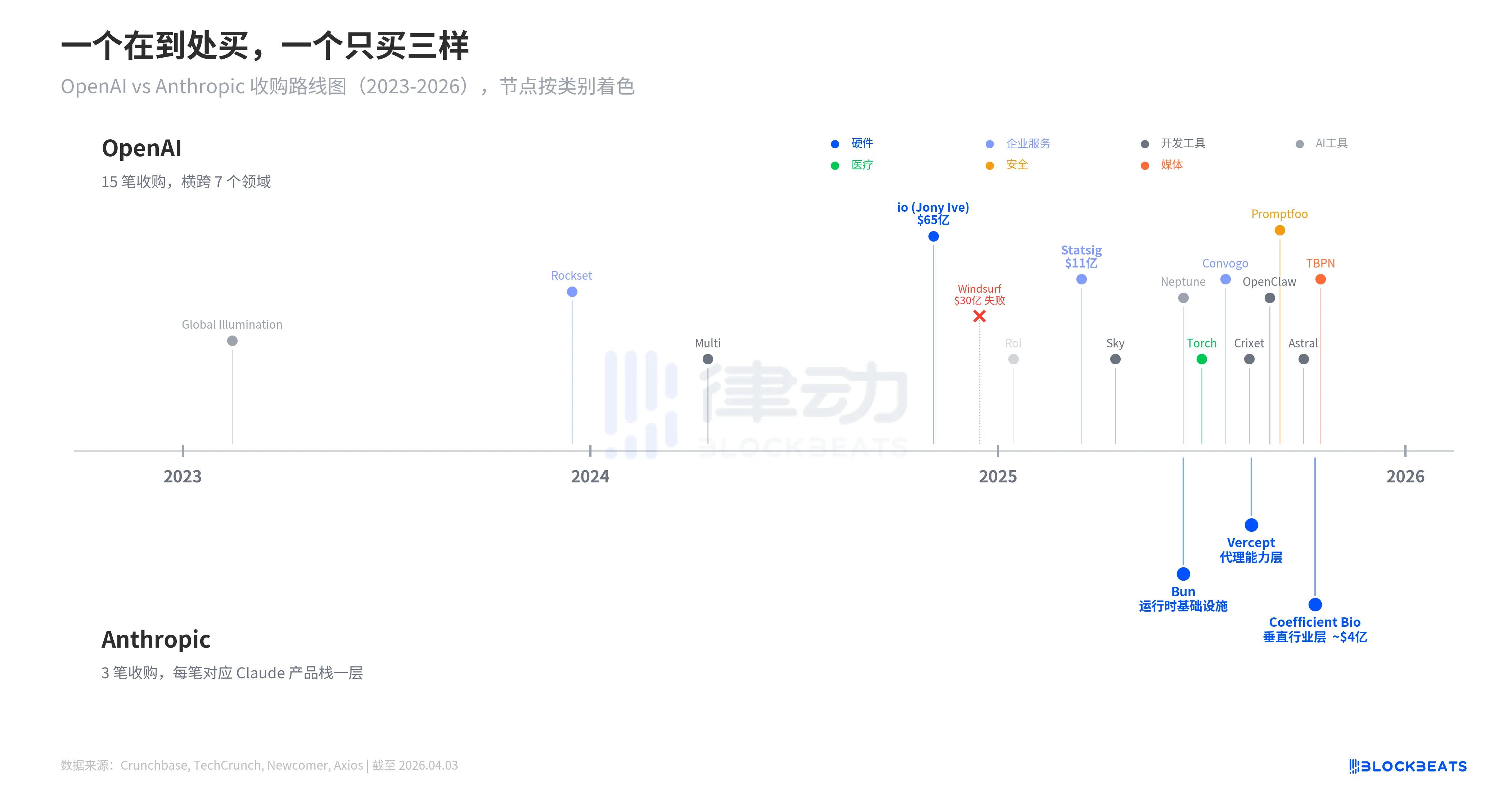
According to Crunchbase statistics, OpenAI has completed 15 acquisitions since 2023, spanning seven fields: hardware, enterprise services, development tools, healthcare, security, media, and consumer. In the first three months of 2026 alone, six acquisitions were completed. The total disclosed amount of transactions exceeds $7.7 billion, with the largest being the acquisition of the AI hardware company io, founded by former Apple designer Jony Ive, for $6.5 billion in May 2025.
Anthropic has only made 3 acquisitions. In December 2025, they acquired the JavaScript runtime Bun to supplement the underlying infrastructure for Claude Code. According to an official announcement from Anthropic, the acquisition of Bun coincided with a disclosure that Claude Code's annual revenue had reached $1 billion. In February 2026, they acquired the computer use agent startup Vercept to enhance Claude's autonomous operating capabilities. On April 2, they acquired Coefficient Bio, targeting the life sciences R&D pipeline. Each acquisition precisely aligns with a technical layer in the Claude product stack.
It is noteworthy that OpenAI had one unsuccessful transaction. In May 2025, OpenAI reached a $3 billion acquisition agreement with the code editor Windsurf (formerly Codeium), but according to IT Pro reports, due to the IP clause in Microsoft's contract, OpenAI could not protect Windsurf's technology from being acquired by Microsoft, causing the deal to collapse in July. This failure also reflects a structural constraint in OpenAI's "broad procurement" model.
This density difference is not coincidental. It reflects the starkly different revenue structures of the two companies and the resulting different anxieties.
Revenue Structure Determines Acquisition Direction
According to Sacra's estimate, OpenAI's annualized revenue in February 2026 was approximately $25 billion, with about 60% coming from the consumer side (ChatGPT subscriptions) and 40% from the enterprise side. 15.5 million paid users form the revenue base for OpenAI. For a company approaching an IPO, a high proportion of revenue from the consumer side means that public sentiment directly influences the valuation narrative.
This explains why OpenAI wants to acquire TBPN. According to Axios, TBPN is a daily live tech talk show, with advertising revenue of $5 million in 2025 and a target of over $30 million in 2026. After acquiring, OpenAI retains its editorial independence and hired former Postmates executive Dylan Abruscato to oversee advertising monetization. The logic of buying a tech podcast is not based on its revenue, but on its ability to continuously influence public discussions about AI topics.
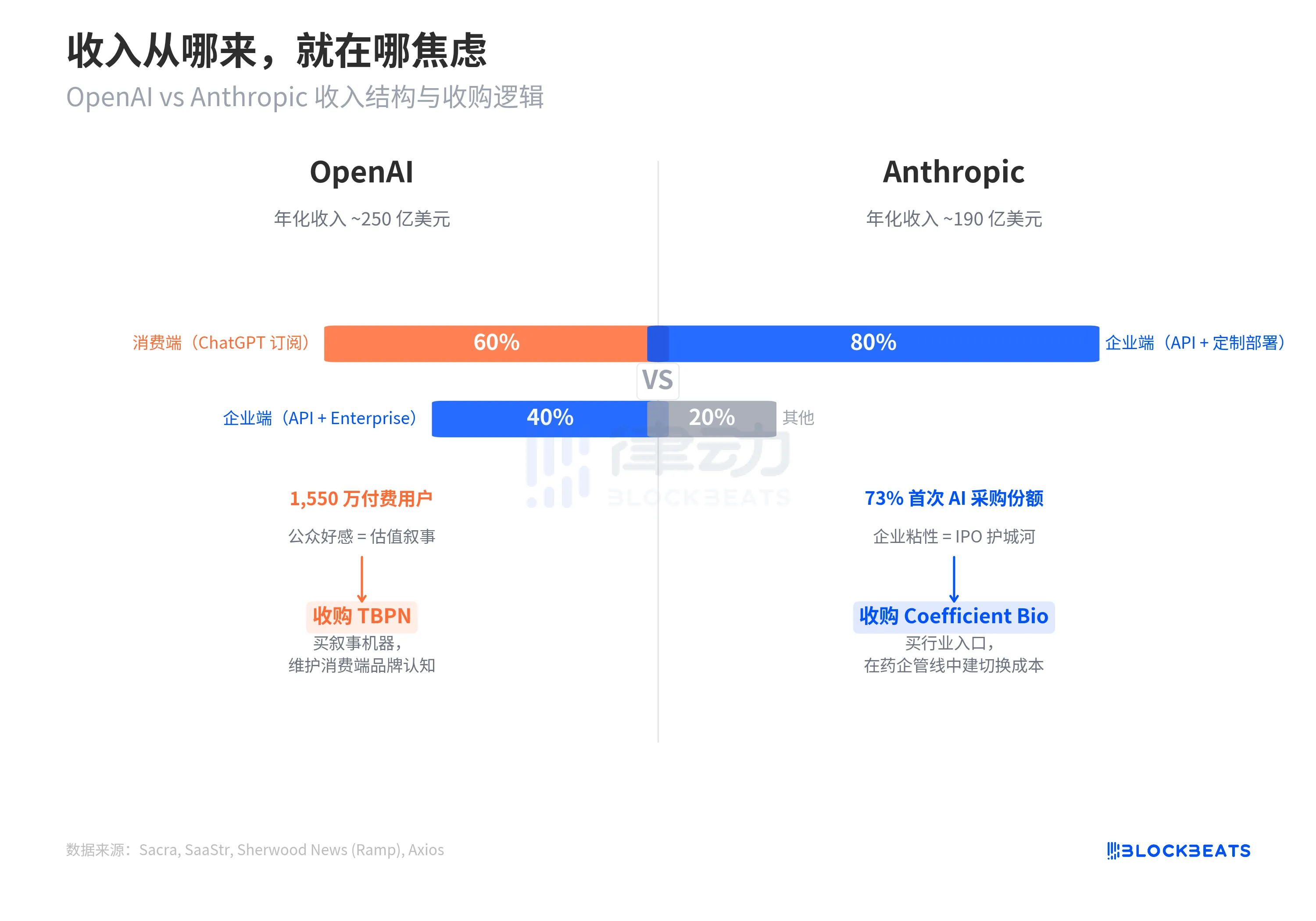
Anthropic's direction of anxiety is completely different. According to Ramp data cited by Sherwood News, Anthropic currently holds 73% of the first AI procurement enterprise customer share, up from 50% just 10 weeks ago. According to SaaStr, about 80% of Anthropic's revenue comes from the enterprise side. For enterprise customers, choosing an AI provider is a high-switching-cost decision. Anthropic's IPO narrative needs to prove that these enterprise customers will not run away.
Three Moves in Half a Year
Coefficient Bio is not an impulsive acquisition. Looking at it within the sequence of Anthropic's actions over the past six months, the logic is clear.
In October 2025, Anthropic launched Claude for Life Sciences, connecting to research databases such as PubMed and UniProt, allowing Claude to assist in literature reviews and experimental design. In January 2026, at the JPM26 conference, they launched Claude for Healthcare, obtaining HIPAA compliance certification, and officially entering the healthcare system. On April 2, they acquired Coefficient Bio, gaining AI capabilities for the entire drug development process.
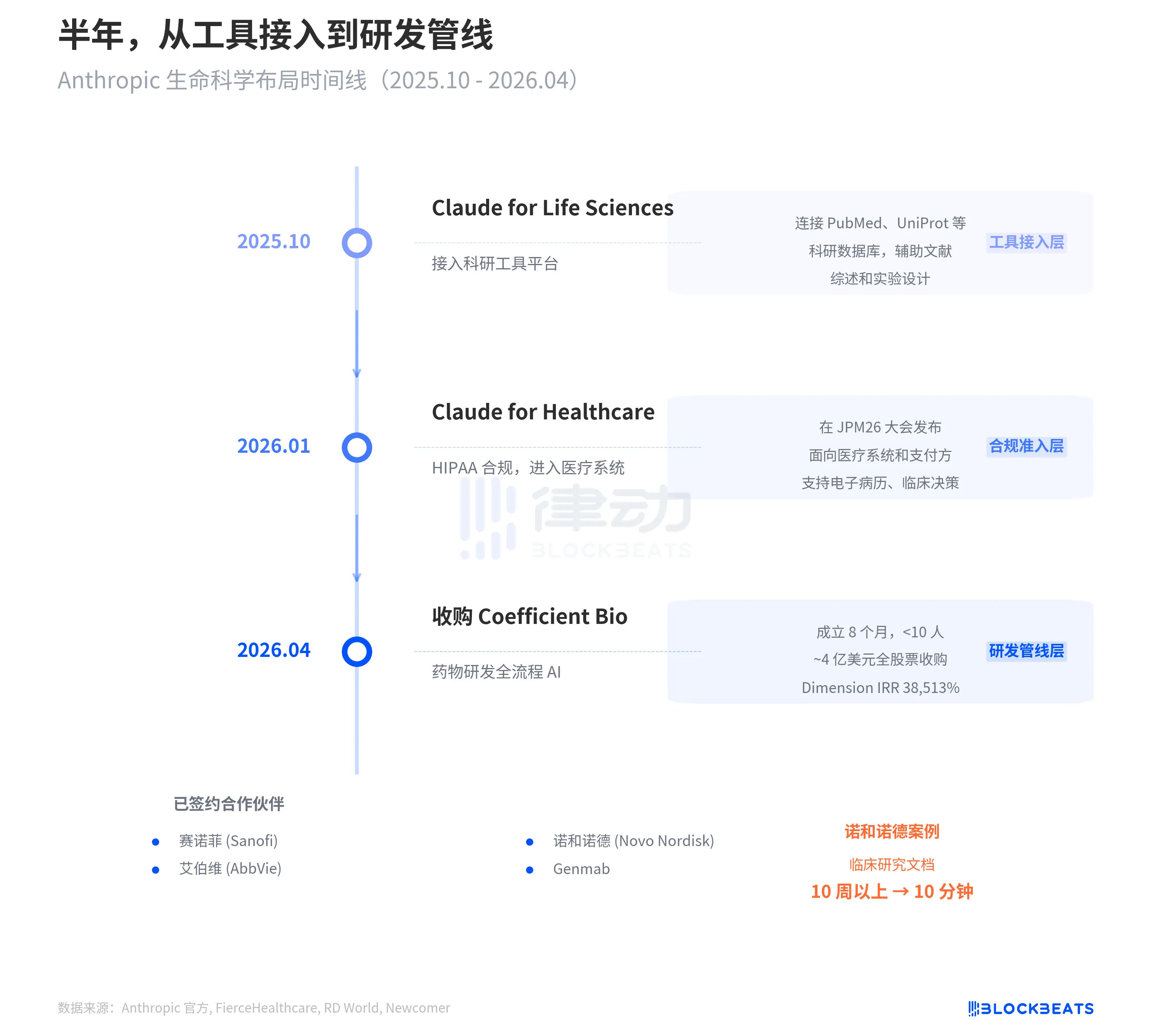
In six months, they advanced from tool integration to compliance admission, and then to the R&D pipeline layer. According to Newcomer reports, Coefficient Bio was founded only 8 months ago, with fewer than 10 employees, and held about 50% of its shares by the venture capital firm Dimension. Anthropic completed the acquisition with about $400 million in stock, with Dimension claiming in a letter to LPs that this investment has achieved an IRR of 38,513%.
This number itself indicates that Anthropic did not buy a company’s revenue or products, but rather a team plus an industry entry point. According to official reports from Anthropic and RD World, companies like Sanofi, Novo Nordisk, AbbVie, and Genmab are already using Claude's life sciences tools. The case of Novo Nordisk is particularly typical, with the time for processing clinical research documents reduced from over 10 weeks to just 10 minutes.
Two Balance Sheets, the Same Countdown
According to reports from WinBuzzer and The Tech Portal, Anthropic has hired Goldman Sachs and JPMorgan Chase as lead underwriters, targeting an IPO as early as October 2026, with a fundraising scale exceeding $60 billion. OpenAI's target is Q4 2026 or Q1 2027, with a valuation close to $1 trillion. According to Tom Tunguz's analysis, if OpenAI, Anthropic, and SpaceX all IPO in the same year, these three could absorb over $30 trillion in market liquidity.
Both are making final strategic adjustments before the IPO. According to CNBC, OpenAI CEO Fidji Simo announced internally the cancellation of Sora, Atlas browser, hardware projects, and instant checkout features, stating that the company "is like entering red alert," needing to focus on enterprise and agent products. Anthropic's path is to continuously deepen into vertical industries like life sciences, locking in enterprise customers through high switching costs.
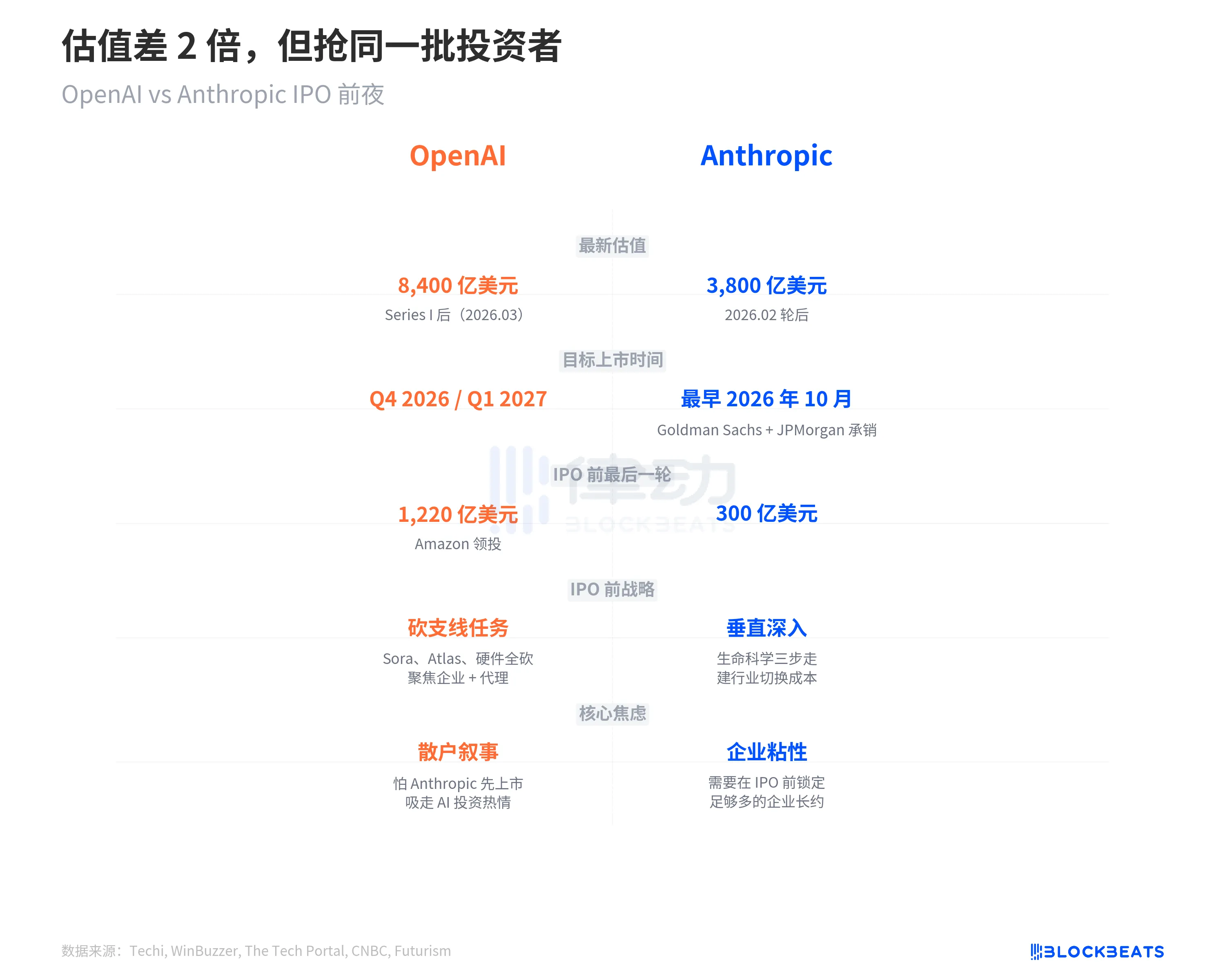
According to FinancialContent reports, the OpenAI board is concerned that if Anthropic goes public first, it will siphon off retail investors' long-standing enthusiasm for AI investments. The valuation gap between the two companies exceeds two times, but they are vying for the same pool of investors' money. Two acquisitions on the same day: one is buying a narrative machine, and the other is buying an industry entry point.
免责声明:本文章仅代表作者个人观点,不代表本平台的立场和观点。本文章仅供信息分享,不构成对任何人的任何投资建议。用户与作者之间的任何争议,与本平台无关。如网页中刊载的文章或图片涉及侵权,请提供相关的权利证明和身份证明发送邮件到support@aicoin.com,本平台相关工作人员将会进行核查。


