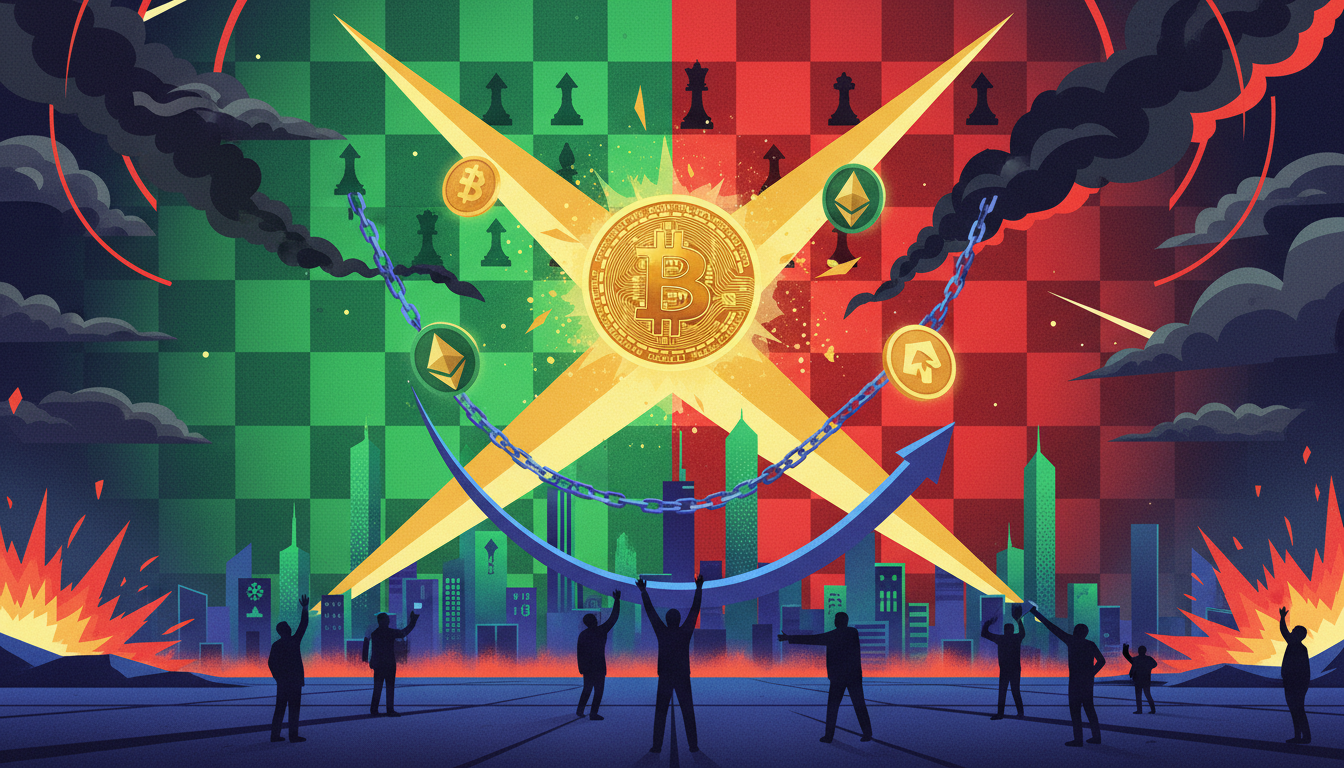
On April 6, 2026, Eastern Daylight Time, against the backdrop of Trump issuing an ultimatum to Iran and a sudden escalation in geopolitical tensions, Bitcoin surged within 24 hours to break through $69,000/USDT, with a daily increase expanding to about 2.5%-2.6%. During the same period, U.S. stock futures weakened overall, and gold prices fell below $4,620 per ounce, reflecting a rare divergence between the reactions of traditional markets and the cryptocurrency market to the same risk event. Capital began to reassess its position between “old-fashioned safe-haven assets” and “new hedging tools,” with Bitcoin being tentatively reshaped by some investors as a hedging asset under geopolitical risk, rather than merely a high beta risk target.
Ultimatum Moment: The Resonance Point of Panic and Bitcoin
As Trump's ultimatum deadline to Iran approached, the geopolitical situation was rapidly pushed into a high-pressure zone. Media outlets such as Planet Daily and Rhythm cited opinions from market participants that this timeline was seen as a “turning point for market sentiment”: previous cautious waiting began to give way to genuine panic over sudden events, with discussions on trading desks shifting from “will it escalate” to “if it escalates, where to hide.” This was not merely simple news noise but a collective re-examination of risk pricing methods.
In this psychological shift, risk appetite moved from inactivity to actively seeking safe-haven assets. The originally suppressed concerns were amplified as the countdown to the ultimatum progressed, with some funds starting to position themselves in anticipation of potential scenarios. The price curve of Bitcoin was highly synchronized with this emotional shift: while sentiment had not fully flipped, the increase remained below 1% when breaking $68,000 (according to OKX data), making the market resemble a test of upward space. However, as the ultimatum point approached step by step, the “emotional turning point” and the price turning point appeared almost simultaneously, leading Bitcoin to initiate a sustained upward trend.
This indicates that the current trend feels more like a politically driven story of cross-market resonance, rather than a typical technical breakthrough. Behind the price increase is the reordering of investors regarding “which asset can withstand declines during sudden conflicts”: some became short-term speculators, while others viewed this moment as a test of Bitcoin's narrative as a safe haven.
Bitcoin Surpasses $69,000: Diverging from Traditional Safe-Haven Assets
From the perspective of market rhythm, the acceleration of this round of increase is very clear. According to data from multiple trading platforms like OKX, Bitcoin first remained below 1% increase within 24 hours when breaking $68,000, resembling a gentle probe of previous resistance levels. But within the next 24 hours, the increase rapidly expanded to the range of 2.5%-2.6% (according to HTX/Bitget/OKX data), as the price successfully crossed $69,000, stepping over a round number that the market was paying attention to.
Foresight's market interpretation directly pointed out that this “breakthrough of key resistance levels is highly correlated with geopolitical risk events”. This is a statement filled with strong emotional color; it did not attribute this upward movement to Bollinger Bands or moving average crossovers, but explicitly bound price behavior to geopolitical tensions. This interpretation itself is part of the narrative: when media and analytical institutions began using “geopolitical risk driving upward” to describe the trend, Bitcoin was already pushed to the center stage of “safe-haven candidate assets.”
Conversely, on the same timeline, the feedback direction of traditional assets was almost completely opposite. U.S. stock futures fell by 0.7%-0.9%, reflecting a reevaluation of risk assets; meanwhile, gold prices fell below $4,620 per ounce, showing a weakening picture contrary to expectations of “safe-haven buying surge.” In this mismatch, Bitcoin instead broke upward, with price behavior starkly contrasting that of gold and U.S. stocks.
This reflects a key issue: are investors simply viewing Bitcoin as a substitute for “digital gold” to fill the temporarily vacated role of a safe haven, or are they constructing an independent position to hedge against both traditional financial and geopolitical risks? The former means Bitcoin has merely wedged itself into an existing safe-haven paradigm, while the latter points towards a deeper structural change—when traditional safe-haven assets themselves are also questioned, some funds are willing to take on volatility risks to bet on Bitcoin’s independence and tradability in extreme scenarios.
U.S. Stocks Retreat, Gold Under Pressure: The Moment the Safe-Haven Script Fails
If we pull back the perspective from Bitcoin, the traditional asset picture under this geopolitical event feels quite discordant. On one hand, U.S. stock futures weakened overall, with declines in the range of 0.7%-0.9%, fitting the classic pattern of “risk asset retracement in response to escalating conflicts”; on the other hand, gold prices unexpectedly fell below $4,620 per ounce, facing downward pressure at a moment that should enjoy safe-haven premiums, causing a clear gap in the traditional safe-haven chain. This combination of “things that should rise not rising, and things that should fall falling” rendered many inertia-based risk logic ineffective.
Meanwhile, energy commodities also found themselves in the spotlight. Research briefs indicate that WTI crude oil was reported as “increasing”, but the specific increase and driving logic remain to be validated—whether it's supply concerns, shipping risks, or purely emotion-driven premiums, the publicly available information is not sufficient. This reminds us that in a highly emotional trading day, secondary narratives about “oil surging” and “energy panic” can easily be amplified, while the data itself is full of gaps.
In this information-incomplete environment, capital flows present a new imaginative space of old and new channels alternating: some funds choose to reduce positions in U.S. stocks to compress risk exposure, but have not poured into gold as textbooks suggest; rather, they have partially shifted towards Bitcoin and other crypto assets, attempting to hedge against uncertainty in a more flexible and aggressive way. The traditional “stock market—government bonds—gold” safe-haven pathway was momentarily interrupted, replaced by a probe into “new pathways.”
This could simply be a short-term mismatch, or it may indicate that traditional safe-haven assets' pricing ability regarding some types of geopolitical risks is declining. The answer is far from clear. However, it is certain that if similar situations occur repeatedly—when geopolitical tensions escalate, gold reacts slowly, yet Bitcoin rises first—market memory will be gradually rewritten, and investors’ first reactions in the next crisis may differ entirely from the past.
Charles Schwab's Entry: The Backup Channel of Trillions in Funds
Behind the severe price fluctuations, deeper structural changes are paving the way. Research briefs indicate that Charles Schwab currently manages nearly $12 trillion in assets and plans to launch Bitcoin and Ethereum spot trading services in the first half of 2026. This means that in the future, the vast pool of medium and long-term funds in the U.S. can buy and hold crypto assets directly within their familiar brokerage accounts, without needing to “take a detour” through trusts, ETFs, or over-the-counter channels.
For traditional brokerages, transitioning from not touching crypto to opening up spot trading represents a fundamental change in product architecture and compliance logic. From an investor's perspective, this is equivalent to adding a “crypto section that can be bought and sold instantly” in the existing asset allocation menu: what originally required cross-institution, cross-account operations can now be completed within a single account system. Funds transition from “taking a detour to hold coins” to “directly holding coins in an account”, not only reducing friction costs but also shortening the time from “making a decision” to “executing an order.”
Combining this with the current geopolitical risk event, the potential impact becomes clearer. Once traditional giants like Charles Schwab complete infrastructure setup, each similar geopolitical conflict may quickly trigger part of the funds to flow towards Bitcoin: emotions fermenting in news alerts, investors completing orders on brokerage apps, and the entire chain being much shorter than today—with liquidity responses being more concentrated and having a magnifying effect.
From a structural perspective, the entry of such institutions combined with the narrative of geopolitical conflict will gradually reinforce a market memory: “Bitcoin = tradable safe-haven asset”. It does not need to replace gold nor must it become the first choice for all investors; as long as it is repeatedly used in times of crisis, and leaves visible traces in price, this role will gradually solidify.
Narrative and Game Intertwined: Who is Buying, Who is Hesitant
Returning to the trading of these 24 hours, various roles are intermingling in the market. Short-term traders are watching news alerts and price curves, using geopolitical escalations as fuel for swing trades, leveraging at key moments to amplify emotional fluctuations; while longer-term holders view the current surge as another opportunity to hedge against fiat and political risks, believing that this geopolitical pressure itself validates Bitcoin's value as a “systemic outside asset.” Meanwhile, a considerable portion of traditional funds remains cautiously observant, acknowledging the rising presence of Bitcoin in internal discussions, yet delaying its formal entry into risk-hedging frameworks.
In this process, the narrative of “Bitcoin as a safe haven” exhibits a typical self-reinforcing mechanism: price rises first → media and KOLs amplify the “safe-haven buying” narrative → more funds begin to believe in its hedging function and follow through with buying → prices further climb. This closed loop does not require fully real funding flow data for support; as long as price and discourse generate positive feedback, the narrative itself will continuously thicken.
However, from the magnitude of the data, the current 24-hour increase of 2.5%-2.6% resembles more of an “emotional amplification experiment” than a comprehensive risk migration. There has been no extreme single-day rise, and the sell-off in traditional markets is not indicative of systemic collapse, which gives Bitcoin's current surge a flavor of “testing” and “practicing”: it shows the market its resilience in crisis but exposes that it has yet to become a core safe-haven tool in mainstream asset allocations.
The controversy is equally clear: the more skeptical faction points out that Bitcoin itself is highly volatile, with its price peaks often occurring at the height of risk event emotions, rather than in the “post-conflict stage” when losses can be quantified. In their view, Bitcoin's so-called safe-haven attributes remain heavily speculative—more about betting on “others will buy in a more frantic time,” rather than hedging real asset losses. But regardless of support or skepticism, both sides must acknowledge that each of these 24-hour episodes pushes this debate closer to the center of mainstream financial discourse.
Where Will Bitcoin Stand in the Next Crisis
In summary, this round of events shows that Trump’s ultimatum to Iran has pushed market sentiment to one end of the high-pressure line. In the brief moment traditional safe-haven assets “failed,” Bitcoin, with its performance of breaking through $69,000 and a daily increase of 2.5%-2.6%, snatched part of the narrative of safety, marking a redefinition of its role at the price level.
Looking ahead, traditional giants like Charles Schwab entering Bitcoin spot trading will noticeably compress the time gap from “panic to order placement” in the coming years, potentially amplifying the speed and scale of triggers for similar market movements. However, this path is still deeply constrained by regulatory environments and market education: how the compliance framework evolves and how internal risk controls define "acceptable crypto exposure" will determine whether Bitcoin can truly be written into safe-haven manuals, rather than merely remaining a spontaneous selection by retail and some aggressive funds.
The follow-up observations need to focus on two verification clues: one is whether Bitcoin can stabilize above $69,000 after geopolitical tensions ease, or at least maintain relative strength without fully giving back gains; the other is whether funds will quickly flow back into U.S. stocks and gold when the situation stabilizes, erasing traces of this “Bitcoin as a safe haven.” Only when Bitcoin can retain some geographic premium afterward will the durability of the “safe-haven narrative” truly have passed a small test.
It is also crucial to remind readers that this analysis deliberately avoids including specific increases in oil or exact prices of Ethereum, etc., lacking full verification; the related drivers and inter-asset connections await further public documentation to validate. In a trading day amplified by emotion, carefully distinguishing between “stories believed by the market” and “logics proven by facts” is the first layer of risk protection that any participant needs to possess.
Join our community to discuss and become stronger together!
Official Telegram community: https://t.me/aicoincn
AiCoin Chinese Twitter: https://x.com/AiCoinzh
OKX benefit group: https://aicoin.com/link/chat?cid=l61eM4owQ
Binance benefit group: https://aicoin.com/link/chat?cid=ynr7d1P6Z
免责声明:本文章仅代表作者个人观点,不代表本平台的立场和观点。本文章仅供信息分享,不构成对任何人的任何投资建议。用户与作者之间的任何争议,与本平台无关。如网页中刊载的文章或图片涉及侵权,请提供相关的权利证明和身份证明发送邮件到support@aicoin.com,本平台相关工作人员将会进行核查。