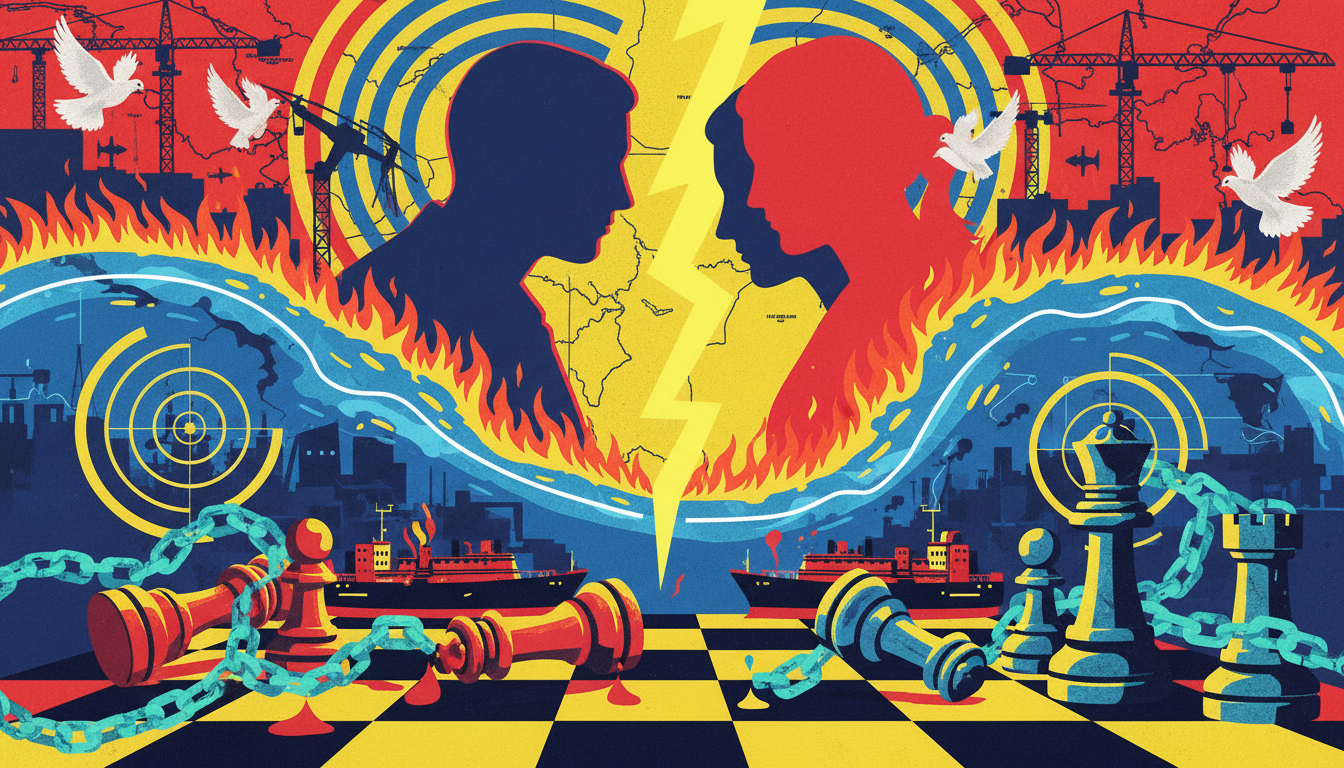
This week, in Eastern Eight Time, U.S. President Trump issued a hardline threat in a public statement, saying he would destroy Iran's bridges, power plants, and other critical civil infrastructure; almost concurrently, Iranian state television announced that Iran had launched missiles at Israel. One target extends from military facilities to the lifeblood of society, while the other directly touches the territory of a core U.S. ally. These two threads intertwine, pushing the malignant cycle of "extreme pressure - asymmetric retaliation" between the U.S. and Iran to a more dangerous level. In the foreseeable future, this round of escalations is not merely a collision of words and missiles; it is more likely to spill over into energy markets and regional security architecture: the Strait of Hormuz, oil and gas shipping routes, and security commitments to regional allies are all being pulled back into the risk perspective. This is precisely the narrative and logic chain this article seeks to deconstruct.
From Extreme Pressure to Dangerous Escalation of Destruction
Trump's approach to Iran is not a sudden shift toward hardline stances, but rather a continuation and amplification of the trajectory of "maximum pressure" policy. From withdrawing from the Iran nuclear deal to imposing layers of sanctions, he consistently compresses Iran's strategic space through financial blockades, energy export restrictions, and diplomatic isolation, packaging it domestically as an achievement against a "rogue regime" to solidify his image among conservative and nationalist voters. His hardline posture is itself an important component of his political identity.
However, this time, he explicitly named bridges and power plants as targets in his public address, stating, "They will have no bridges, no power plants. They will have nothing." This statement currently appears in only one media source but is sufficient to indicate an escalation in context—from sanctions on the government and military capabilities to direct threats against the basic conditions of social operation. Unlike previous focused pressures on nuclear projects, military institutions, or missile programs, this rhetoric directly points to the foundational networks upon which ordinary Iranians depend for survival, its symbolic meaning far exceeding a simple military intimidation.
On the domestic political front, he connects this extreme threat with the endorsement of "MAGA" supporters, asserting that such hardline statements gain support from his base. Domestically, this reinforces the image of a "strong man" who is "not weak"; externally, it sends a posture to adversaries that "I am not only willing but have electoral authorization to act even tougher." Domestic political mobilization and the hardline external stance reinforce each other, making an already high-pressure policy even harder to backtrack in the short term.
Civilian Facilities as Targets: Treading on the Red Line of War
The phrase "They will have no bridges, no power plants," once transformed from a slogan into a policy option, points toward a total paralysis of a modern state's societal framework. Bridges signify national transportation and logistics arteries, while power plants support hospitals, communications, water supply, industrial production, and all aspects of modern life. Systematically attacking these nodes would not only "hurt the adversary" but would create the risk of widespread humanitarian disasters and long-term social collapse.
From the general principles of international humanitarian law and warfare law, civilian facilities receive priority protection, with core norms like the "distinction principle" and "proportionality principle" restraining combatants from directly targeting civilians. Although there is a gray area of controversy regarding dual-use infrastructure and logistics hubs in practical terms, openly discussing systematic attacks with "letting them have nothing" clearly treads on the high-risk edge of legality and morality. Should this expression be seen as a practicable policy template, it would impact the entire wartime norms system.
For Iran, such extreme rhetoric significantly raises the probability of misjudgment and misinterpretation: without clarity on the U.S. red lines, it is easier to prepare defense and retaliation paths under the "worst-case scenario". In this expectation, any localized friction might be understood as a prelude to a comprehensive paralysis strike, prompting an early upgrade in response to gain "first-mover advantage." At the same time, allies and regional countries are also forced to face greater alignment and public opinion pressure: on one side is the U.S. openly threatening to include civilian targets in its strike scope, and on the other side is the regional public sentiment growing increasingly sensitive to civilian risks. In this squeeze, all parties' diplomatic space becomes passively narrowed, making it difficult to remain completely outside of the unfolding situation, even without any overt statement.
Iran's Missile Counterattack: A Dangerous Signal to Israel
At the same time, as Trump raised the tone of his threats, Iranian state television announced that Iran had fired missiles at Israel. Although public information did not provide specifics on the model, range, or quantity of missiles, this action itself constitutes a significant signal regarding the regional situation: Iran is no longer merely expressing dissatisfaction through proxies or external battlefields but has chosen to directly touch the domestic security of a key U.S. ally.
In terms of strategic narrative, this is a typical approach to "asymmetric retaliation." While the U.S. exerts maximum pressure through global military presence and economic sanctions, Iran demonstrates its limited but high-sensitivity long-range strike capability, trying to break the impression of being passively beaten. The targets of the missiles are Israel, not the U.S. homeland, which preserves the indirect challenge to U.S. influence while avoiding immediately crossing Washington's most absolute red lines.
Within the limitations of existing information, the only confirmable fact is the abstract layer of "launching missiles," not the onset of full-scale war. Through this method, Iran conveys both the determination of "if you continue to oppress, we also have the capability to strike at your allies' doorsteps," while controlling the actual intensity, avoiding directly declaring a state of full military confrontation. This sense of boundary reflects its ongoing effort to find a narrow middle path between demonstrating power and avoiding direct full-scale war with the U.S.
Gunpowder Scent Spreading Along Oil and Gas Lines: Expectations in Energy Markets
Once the perspective shifts from tactical actions to geopolitical maps, Iran's position immediately returns to the center of the global energy narrative. It is not only an important oil producer but is also located near the Strait of Hormuz, a crucial global choke point—large quantities of Middle Eastern oil and gas are exported through this route, and any rumors of regional tension escalate quickly in the market into associations of "shipping routes being threatened."
When news of missile attacks overlaps with the U.S. warlike rhetoric, expectations around maritime security, shipping insurance costs, and shipping route diversion risks will be rapidly repriced. Even if there is currently no public evidence indicating shipping routes are blocked, insurance companies and shipowners will, for risk management, increase premiums for vessels passing through sensitive waters or adjust route arrangements—these preemptive actions themselves will drive cost transference.
Within the energy market pricing mechanism, "expectations of supply being threatened" often reflect more quickly and directly on oil and gas prices than actual damage data. Prices primarily trade on future risk premiums, and only secondarily on physical losses that have already occurred. Currently, reliable public data regarding the scale of missile attacks and facility losses is significantly lacking, with many details marked as pending verification; in such a high-uncertainty environment, the market is more likely to construct scenarios around the "worst possibilities," raising prices ahead of time, then adjusting based on subsequent information.
In other words, even if the battleground remains within the bounds of limited strikes, financial and commodity markets are already settling for potential shocks, and this misalignment itself is a typical pathway for geopolitical risk to spread into the global economy.
A Malignant Cycle Forms: How Threats and Retaliations Amplify Each Other
If we reassemble recent events into a timeline, a clear rhythm emerges: the U.S. first threatens Iran with extreme rhetoric, not only continuing sanctions and military deterrence but also publicly pushing extreme options like “destroying bridges and cutting power” to the forefront; soon after, Iran announces it has launched missiles at Israel in response to the rhetoric of "worse consequences." Threats and actions counterbalance each other, forming a spiral of escalatory "tit for tat."
On Trump's side, by continually setting more severe, more extreme consequence thresholds, he tries to politically lock Iran’s negotiation space through high-pressure rhetoric; Iran, in turn, demonstrates its long-range strike capability, indicating it will not accept a unilaterally suppressed starting point before any negotiations. Both sides have elevated their starting points in negotiation and military terms to higher, less retrievable heights.
In the absence of mutual trust and stable communication mechanisms, such military and political signals are more likely to be interpreted by the other side as genuine escalation intent rather than negotiable chips. Each round of “new hardline statements” and “new retaliations” forces the other side to respond more vehemently to avoid appearing “weak” in domestic and international public opinion.
The result is a structural dilemma: each round of actions must be a bit harsher than the last to prove to themselves and others that they are not retreating. However, each escalation further compresses both sides' ability to de-escalate, making it increasingly politically difficult to "hit the brakes," while simultaneously raising the systemic risk of a misfire or a misjudgment leading to uncontrollable conflict to a new level.
From Words to Missiles: How Tight Can the Tension in the Middle East Get?
In summary, this escalation features three distinct characteristics: firstly, the U.S. publicly includes civilian infrastructure within its threat rhetoric, expanding the imagination of warfare from military and nuclear projects to the basic survival structures of civilian society; secondly, Iran directly strikes Israel with cross-border missiles, pushing the notion of “asymmetric retaliation” from proxy battlefields to a direct challenge to the homeland security of an ally; thirdly, the sensitivity of energy and shipping nerves leads to the market already re-evaluating risk premiums around worst-case scenarios under conditions of severe asymmetry and lack of details.
In the short to medium term, the situation may evolve along three possible paths: one is that threats and retaliations continue to escalate, missile and retaliatory actions further normalize, with red lines progressively tested, leading regional conflicts toward a more open and multi-participatory state; the second is that both sides, after experiencing a certain degree of limited retaliation, are pressured by costs and stress to return to some negotiation track, using backdoor contacts for a softer exit from their hardline fronts; the third is that through regional or global third-party mediation, they gradually cool down through mediation, ceasefire initiatives, or crisis management mechanisms, sealing off the most dangerous options.
Given the currently extremely one-sided and asymmetric nature of intelligence and public information, any statements about "decisive moments" or "ultimatum-style confrontations" must be approached with heightened vigilance: they often serve the mobilization and emotional management of all parties rather than truly reflecting the delicate boundaries of war and peace. What requires continuous tracking as critical signals are whether all parties begin to consciously release de-escalation rhetoric and leave room for dialogue, as well as whether there are any substantial military deployment upgrades or signs of shipping disruptions along energy corridors like the Strait of Hormuz.
These two lines—de-escalatory discourse and de-escalatory action—will determine whether the currently taut strings of the Middle East are further tightened or if there lies an opportunity for cautious loosening.
Join our community, let’s discuss and become stronger together!
Official Telegram community: https://t.me/aicoincn
AiCoin Chinese Twitter: https://x.com/AiCoinzh
OKX Benefit Group: https://aicoin.com/link/chat?cid=l61eM4owQ
Binance Benefit Group: https://aicoin.com/link/chat?cid=ynr7d1P6Z
免责声明:本文章仅代表作者个人观点,不代表本平台的立场和观点。本文章仅供信息分享,不构成对任何人的任何投资建议。用户与作者之间的任何争议,与本平台无关。如网页中刊载的文章或图片涉及侵权,请提供相关的权利证明和身份证明发送邮件到support@aicoin.com,本平台相关工作人员将会进行核查。