Text | Sleepy.md
Datong, Shanxi, a city that once supported half of its economy with coal, has now shaken off the coal dust, replaced it with a sharp pickaxe, and is heavily striking down towards another invisible mine.
In the office building of the Jinmao International Center in Pingcheng District, there are no longer any elevators, nor are there coal transportation vehicles. Instead, there are thousands of closely arranged computer workstations. The Shanghai Runxun Cloud Valley big data intelligent service base occupies several floors, with thousands of young employees wearing headphones, staring at screens, clicking, dragging, and selecting.
According to official data, by November 2025, Datong will have put into operation 745,000 servers, attracted 69 data annotation companies, bringing employment opportunities for over 30,000 people nearby, with an output value of 750 million yuan. In this digital mine, 94% of the workforce holds local residency.
It’s not just Datong. In the first batch of data annotation bases identified by the National Data Bureau, counties like Yonghe in Shanxi, Bijie in Guizhou, and Mengzi in Yunnan are prominently listed. In the data annotation base in Yonghe County, 80% of the employees are women. Most of them are rural mothers, or young people returning home who can't find suitable jobs.
A hundred years ago, the textile mills in Manchester, England were filled with dispossessed peasants. Today, in front of computer screens in these remote counties, young people sit for eight to ten hours a day, mechanically pulling frames, thousands, even tens of thousands of them, dreaming at night with their fingers in the air drawing lane lines.
They are engaged in a highly futuristic, yet extremely primal piecework task, producing the data feed necessary for colossal models created by artificial intelligence giants based in Beijing, Shenzhen, and Silicon Valley.
No one sees any problem with this.
A new assembly line on the Loess Plateau
The essence of data annotation is teaching machines to recognize the world.
Autonomous driving needs to recognize traffic lights and pedestrians, while large models need to distinguish cats from dogs. Machines lack common sense; human beings must first draw a box around an image, telling it "this is a pedestrian," for it to learn how to recognize on its own after ingesting millions of images.
This job doesn't require a high degree; it only requires patience and a finger that can keep clicking.
In the golden age of 2017, a simple 2D box could fetch over ten cents, and some companies even offered high prices of fifty cents. Annotation workers with fast hands could earn five to six hundred yuan by working more than ten hours a day. In county towns, this was undoubtedly considered a high-paying, decent job.
But as large models evolved, the cruel side of this assembly line began to surface.
By 2023, the unit price for simple image annotation has plummeted to three to four cents, a drop of over 90%. Even for more complex 3D point cloud images—those composed of dense points that require magnification countless times to see edges—annotators must pull a three-dimensional box that includes length, width, height, and angular deviation to precisely surround vehicles or pedestrians, and such a complex 3D box may only yield five cents.
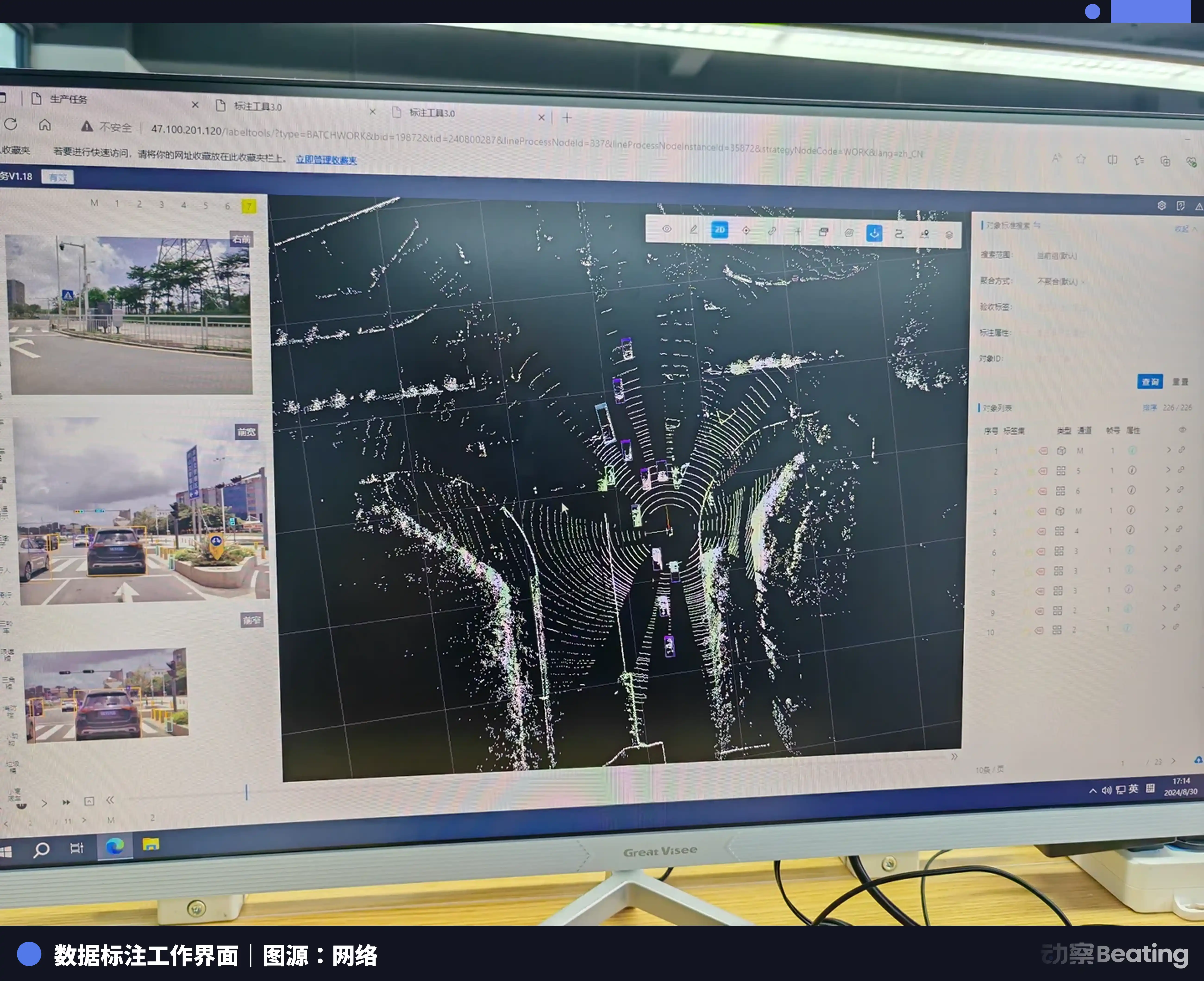
The direct consequence of the plummeting prices is an explosion in labor intensity. To hold on to a monthly salary of two or three thousand yuan, annotators must constantly increase their speed.
This is certainly not a lighthearted white-collar job. In many annotation bases, management is strict to the point of suffocation, with no phone calls allowed during work and phones required to be locked in lockers. The system accurately records each employee's mouse trajectory and dwell time; if they stop for more than three minutes, warnings will lash through the back end like a whip.
What’s even more frustrating is the error tolerance rate. The industry’s passing line typically hovers above 95%, with some companies even requiring 98%-99%. This means if you pull 100 boxes, making just 2 errors will lead to rejection and a rework of the entire image.
Dynamic images are sequential; vehicles changing lanes will be obstructed, and annotators must depend on intuition to find them one by one; in a 3D point cloud image, any object with more than ten points must have a box drawn around it. A complex parking lot project will always have issues pointed out during quality checks whether the lines are too long or missed. It’s common for an image to be returned for rework four or five times. When all is calculated, after an hour of effort, only a few dimes may be earned.
A data annotator in Hunan shared her settlement note on social media, showing that she drew over 700 frames in a day, at a unit price of four cents, totaling 30.2 yuan.
This is an extremely fragmented scene.
On one side, glamorous tech giants at press conferences discuss how AGI will liberate humanity; on the other, in the counties of the Loess Plateau and the southwestern mountains, young people mechanically pull frames on screens for eight to ten hours, thousands or tens of thousands, even dreaming at night with fingers drawing lane lines in the air.
Someone once said that the facade of artificial intelligence is like a luxury car rushing by, but upon opening the door, you find a hundred individuals pedaling bicycles inside, gritting their teeth as they push the pedals.
No one sees any problem with this.
Pieceworkers teaching machines "how to love"
After breaking through the bottlenecks of image recognition, large models entered a deeper evolution, needing to learn how to think, converse, and even exhibit "empathy" like humans.
This gave rise to the most core and expensive component in large model training—RLHF (Reinforcement Learning from Human Feedback).
In simple terms, it means having real people score the answers generated by AI, informing it of which answers are better and more aligned with human values and emotional preferences.
The reason ChatGPT seems "human" is due to countless RLHF annotators teaching it.
On crowdsourcing platforms, such annotation tasks are often clearly priced: payment per item is between 3 to 7 yuan. Annotators need to apply extremely subjective emotional scoring to evaluate whether an answer is "warm," "empathetic," or "considerate of the user's emotions."
A worker at the bottom earning two to three thousand a month, exhausted in the mud of reality, who even lacks the luxury to tend to their own emotions, must play the role of emotional mentor and value judge for AI within the system.
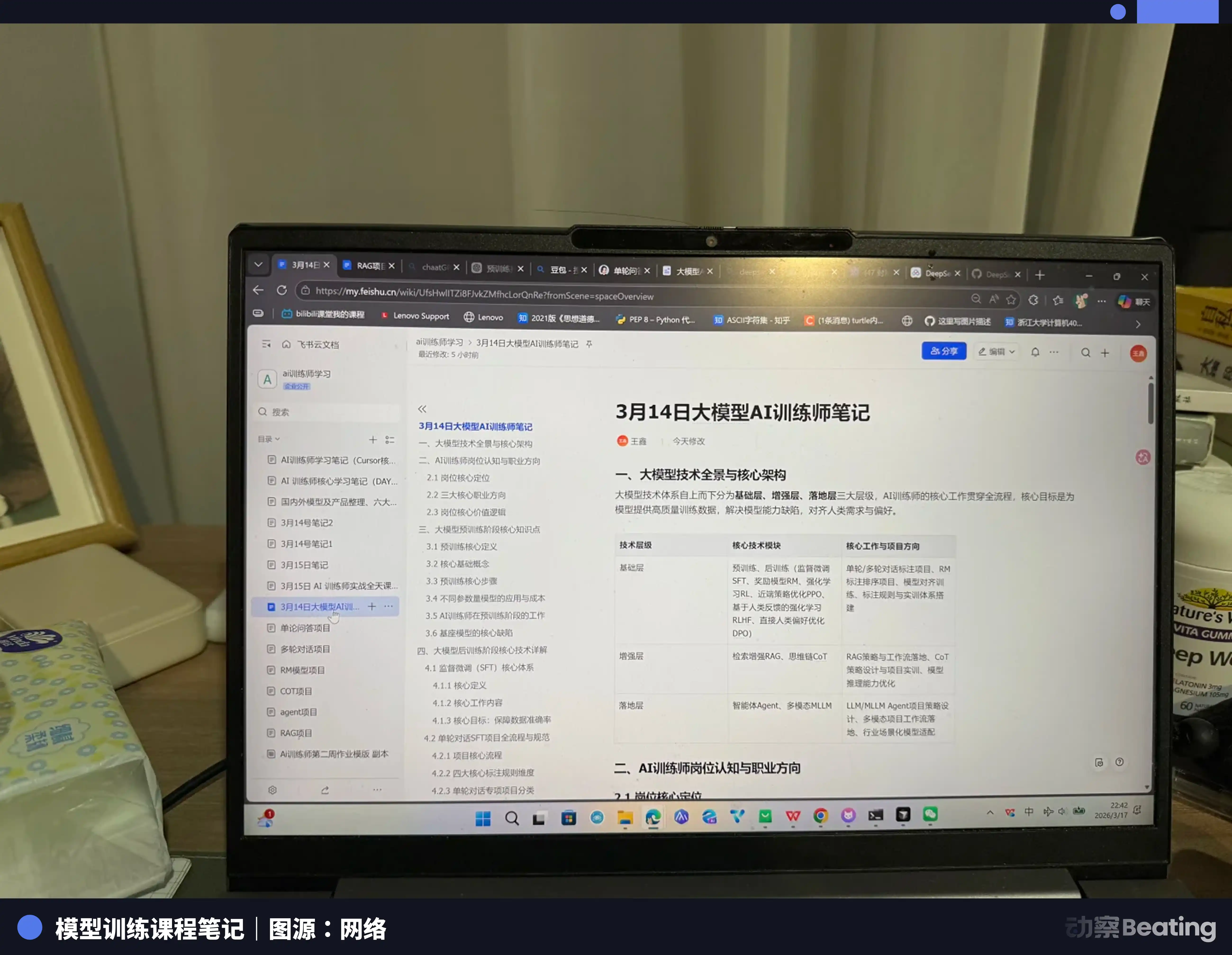
They need to forcibly break down complex and subtle human emotions like warmth and empathy into cold scores from 1 to 5. If their scores differ from the system’s standard answers, they are deemed below the accuracy threshold, leading to deductions from their already meager piecework wages.
This is a cognitive draining. The intricate and subtle emotions, morals, and compassion of humanity are being forcibly dragged into the funnel of algorithms. In the cold measurements of quantification and standardization, their last bit of warmth is squeezed out. As you marvel at the cyber colossus on the screen now capable of writing poetry and composing music, even exhibiting a sensitive exterior; outside the screen, those once vibrant humans degenerate into emotionless scoring machines through daily mechanical judgments.
This is the most hidden aspect of the entire supply chain, never appearing in any financing news or technical white papers.
No one sees any problem with this.
985 Master's and Small Town Youth
The bottom-level frame-pulling work is being crushed by AI's treads, this cyber assembly line is beginning to spread upward, swallowing higher-level intellectual labor.
The appetite of large models has changed. They are no longer satisfied with chewing through simple common knowledge; they need to devour human expertise and advanced logic.
On major job recruitment platforms, a particular type of part-time jobs has begun to frequently flash, such as "Large Model Logical Reasoning Annotator" and "AI Humanities Trainer." The thresholds for these part-time positions are extremely high, often requiring "985/211 Master's or higher," involving specialized fields like law, medicine, philosophy, and literature.

Many graduate students from prestigious institutions are attracted to join the outsourced groups of these big companies. But they quickly realize that this is not a leisurely mental exercise but rather a mental torment.
Before officially taking orders, they must read dozens of pages of grading criteria and standards documents, undergoing two to three rounds of trial annotations. After meeting standards, if their accuracy falls below average during formal annotations, they will lose their qualifications and be kicked out of the group chat.
The most suffocating part is that these standards are not fixed at all. When faced with similar questions and answers, scoring with the same thought process may yield completely opposite results. It’s like working on an endlessly unfinished exam paper that lacks any standard answer. There’s no way to enhance accuracy through self-effort or study; one can only stay stationary, exhausting both mental and physical energy.
This is the new exploitation of the large model era—class folding.
Knowledge, once regarded as the golden ladder to break barriers and climb upward, has now devolved into a more complex digital fodder served to algorithms. In the face of the absolute power of algorithms and systems, the 985 Master's in the ivory tower and the small-town youth on the Loess Plateau have encountered the most bizarre convergence.
They have both fallen into this bottomless cyber pit, stripped of halos, flattened in differences, all turning into cheap and easily replaceable gears on the conveyor belt.
It’s the same overseas. In 2024, Apple directly cut a 121-person AI voice annotation team in San Diego. These employees were responsible for improving Siri’s multilingual processing abilities; they once believed they were on the edge of the core business of a major firm, but instantly plunged into the abyss of unemployment.
In the eyes of tech giants, whether it's a frame-pulling aunt in a county town or a logic trainer graduated from a prestigious school, they are essentially interchangeable "consumables."
No one sees any problem with this.
The billion dollar Babel tower built on the sweat of a few cents
According to data released by the China Academy of Information and Communications Technology, in 2023, China's data annotation market size reached 6.08 billion yuan, with an expected 20-30 billion yuan by 2025. It is predicted that by 2030, the global data annotation and service market sales will skyrocket to 117.1 billion yuan.
Behind these figures is the valuation frenzy of technology giants like OpenAI, Microsoft, and ByteDance, amounting to hundreds of billions or even trillions of dollars.
But this overwhelming wealth has not flowed to those who truly "feed" AI.
China's data annotation industry presents a typical inverted pyramid outsourcing structure. At the top, technology giants tightly grip the core algorithms; the second layer consists of large data service providers; the third layer is comprised of various data annotation bases and small to medium-sized outsourcing companies; while at the very bottom are those blue-collar annotators earning piece rates.
Every layer of outsourcing shaves off a layer of profit. When large firms drop a unit price of fifty cents, after layers of extraction, the amount that a county-level annotator may receive could be less than five cents.
Former Greek Finance Minister Yanis Varoufakis proposed a penetrating insight in his work "Technological Feudalism": today's technology giants are no longer capitalists in the traditional sense, but "cloud lords."
What they own are not factories and machines but algorithms, platforms, and computing power; these are the digital territories of the cyber era. In this new feudal system, users are not consumers but digital tenant farmers. Every like, comment, or view we make on social media feeds data to the cloud lords for free.
Those data annotators distributed in sinking markets are the lowest layer of digital serfs within this system. They must not only produce data but also cleanse, classify, and score massive raw data, transforming it into high-quality fodder that large models can digest.
This is a covert cognitive enclosure movement. Just as the enclosure movement in 19th century Britain pushed farmers into textile mills, today’s wave of AI is pushing those young people who can’t find a place in the实体经济 into the front of screens.
AI has not leveled the class divide; it has instead established a "data and sweat conveyor belt" that stretches from the counties in central and western China straight to the headquarters of technology giants in Beijing, Shanghai, Guangzhou, and Shenzhen. The narrative of technological revolution is always grand and splendid, but its underlying reality is the mass consumption of cheap labor.
No one sees any problem with this.
A tomorrow that no longer needs humans
The most brutal outcome is fast approaching, quicker than ever.
With the leap in large model capabilities, those annotation tasks that once required human labor day and night are now being taken over by AI itself.
In April 2023, Li Xiang, the founder of Li Auto, revealed data at a forum showing that in the past, Li Auto needed to manually label approximately 10 million frames of autonomous driving images each year, with outsourcing costs nearing 100 million yuan. Yet using large models for automated labeling has reduced this task, which once took a year, to less than three hours.
The efficiency is 1000 times that of humans, and this was back in 2023. Just in March, Li Auto launched their new generation MindVLA-o1 automatic labeling engine.
A saying circulating in the industry captures the truth: "The more intelligent it is, the more labor it takes." But now, major companies' investment in data annotation outsourcing has already seen a drastic drop of 40%-50%.
Those small-town youths who have hunched in front of computers for countless days and nights, with bloodshot eyes, have personally nurtured a giant. And now, this giant is turning around and smashing their bowls of rice.
As night falls, the office buildings in Pingcheng District of Datong remain bright as day. The young people exchanging shifts silently swap tired bodies in the elevator. In this folded space tightly bound by countless polygonal frames, no one cares about the epic leaps of the Transformer architecture across the ocean, nor can anyone understand the roar of computing power behind hundreds of billions of parameters.
Their eyes are fixed solely on the progress bar in the backend that represents the "passing line," calculating whether the piecework figures of a few cents can stitch together a decent life by the end of the month.
On one side, the ringing of the Nasdaq bell and the continuous headlines from tech media celebrate the giants raising their glasses for the arrival of AGI; on the other, these digital serfs, who have physically fed AI, can only wait in agonizing sleep for that giant they raised themselves to casually kick away their bowls of rice on some seemingly ordinary morning.
No one sees any problem with this.
免责声明:本文章仅代表作者个人观点,不代表本平台的立场和观点。本文章仅供信息分享,不构成对任何人的任何投资建议。用户与作者之间的任何争议,与本平台无关。如网页中刊载的文章或图片涉及侵权,请提供相关的权利证明和身份证明发送邮件到support@aicoin.com,本平台相关工作人员将会进行核查。


