Original Title: Oil Is the War
Original Author: Garrett
Translation: Peggy, BlockBeats
Editor's Note: While the market still considers oil price fluctuations as a "result variable" of war, this article argues that what truly needs understanding is how war itself is being priced through oil.
As the Strait of Hormuz continues to be obstructed, the global crude oil supply system is forced to restructure—Asian buyers are massively turning to U.S. oil, and WTI has overtaken Brent, marking a structural change in pricing mechanisms and trade flows. The short-term price differential can be explained by contracts, but deeper is the question of "who else can supply."
The author further points out that the current market's key misjudgment lies not in price, but in time. The futures curve still implies a premise: the conflict will end in the short term, and supply will restore. But the more likely path is a protracted war of attrition. This means high oil prices are no longer a temporary shock but will evolve into a more lasting structural state, potentially rising to $120–150.
Within this framework, crude oil is no longer just a commodity but has become an "upstream variable" for all assets. Its repricing will gradually convey through interest rates, exchange rates, stock markets, and credit markets.
The market has priced in the occurrence of war but has yet to price in the duration of the conflict.
The following is the original text:
Trump gave Iran a 10-day deadline. That was a week ago. Yesterday, he reminded everyone again: only 48 hours left on the countdown. Tehran's response was: No.
Five weeks ago, on February 28, when Israeli and American aircraft bombed Iran, the market's pricing logic still viewed it as a "surgical strike": two weeks at most three weeks; the Strait of Hormuz would resume navigation; oil prices would spike and then fall back, and everything would return to normal.
But our judgment at the time was: No.
From day one, our core view has been that this war will escalate first and only later might cool down. The most likely path is ground forces getting involved, followed by a lengthy and exhausting conflict. The disruption time in the Strait of Hormuz will far exceed the assumptions the market is willing to incorporate into models. We have provided a complete logic in the duration framework, Hormuz pricing model, and war variable analysis.
The core judgment is simple: Iran does not need to win; it only needs to raise the cost of war to a level sufficient to force Washington to seek an exit path. And this "exit" will not be accompanied by a smooth reopening of the Strait.
Five weeks later, every key part of this judgment is steadily being validated. The Strait of Hormuz has yet to reopen. Brent crude is closing around $110. The Pentagon is preparing for several weeks of ground operations. Trump's war aims have slipped from "denuclearization" to "sending their opponent back to the Stone Age," but he still cannot clearly define what "victory" is.
The deployment of ground forces is the escalation turning point we have been tracking. The Marines and airborne forces have gathered in the combat zone; this moment is approaching.
But more critical than the next round of airstrikes or the next ultimatum is oil.
Oil is not a byproduct of this war; oil itself is at the core of the war. The stock market, bond market, crypto market, the Federal Reserve, and even your everyday food expenses—all are downstream variables. As long as the oil price is judged correctly, everything else will unfold accordingly; once the judgment is wrong, all other decisions will lose meaning.
WTI crude prices have just surpassed Brent for the first time since 2022, and this change has caught the market's attention.
Good, it should be this way.
WTI Above Brent: Everyone Is Asking What Happened
On April 2, WTI crude closed at $111.54, while Brent closed at $109.03. WTI has a premium of $2.51 over Brent, the largest price difference since 2009. Just two weeks ago, WTI was significantly discounted compared to Brent.
Everyone is asking: What happened? Here’s a brief version and a more truthful version.
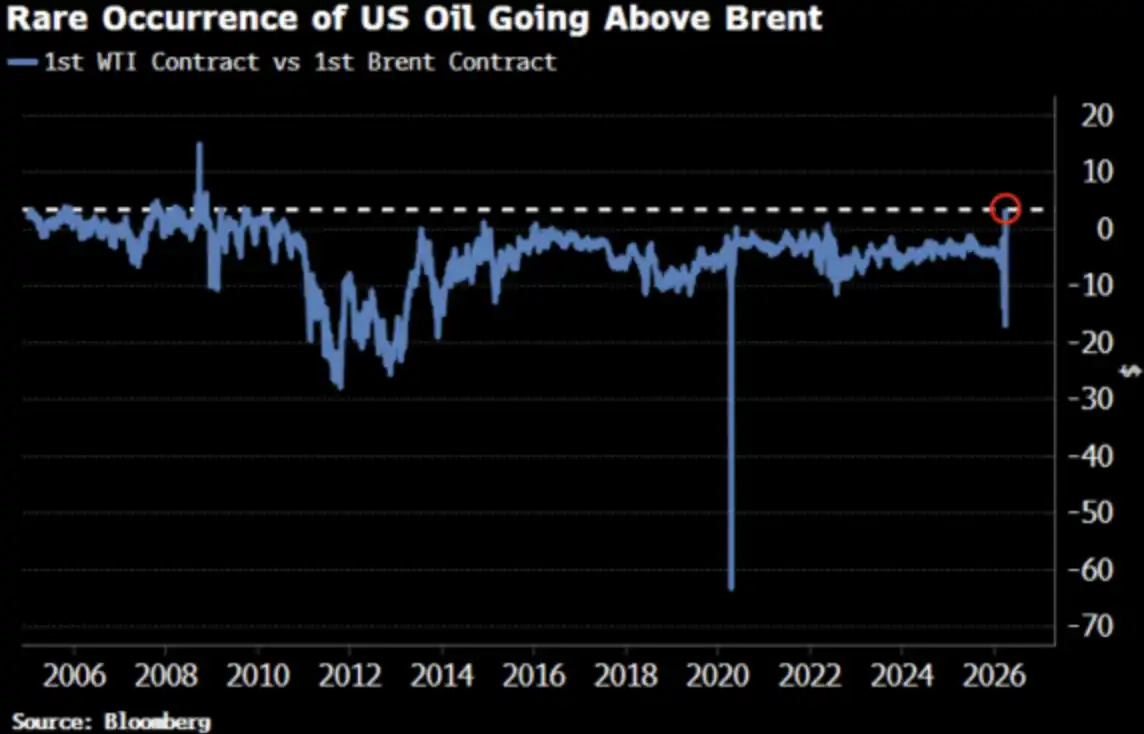
Brief Version: Mismatch of Contract Expiration
WTI's near-month contract corresponds to May delivery, while Brent's near-month contract has rolled over to June. In such tight supply conditions, "delivering a month early" just means a higher price—WTI simply has an earlier delivery time.
Adi Imsirovic, an oil trader with 35 years of experience currently at Oxford, stated that on top of historically high freights and insurance costs, buyers are willing to pay nearly $30 more per barrel for Brent crude available for early delivery. In his 35-year career, he has never seen such a situation.
This is a "mechanistic" explanation—it’s correct but incomplete.
True Version: The Price Curve Is Moving Overall
The convergence of WTI and Brent is not just a sporadic mismatch of near-month contracts. Bloomberg notes that this phenomenon is clearly visible across multiple contract months, threading through the entire forward curve. This means the entire price curve is being repriced.
What’s the reason? The shift in Asian demand. In late March, Asian refineries locked in about 10 million barrels of American crude for May loading; the previous week, they also procured about 8 million barrels. Kpler forecasts that U.S. crude exports to Asia in April will reach 1.7 million barrels per day, up from 1.3 million barrels per day in March. China, South Korea, Japan, and ExxonMobil’s refinery in Singapore are all buying U.S. crude—because it is currently "the only available supply."
The Strait of Hormuz remains closed. Abu Dhabi’s benchmark crude Murban—also the closest alternative to WTI—has disappeared from the global market. WTI is becoming the "marginal pricing oil" globally.
This is not a panic buy but a shift in the structure of liquidity.
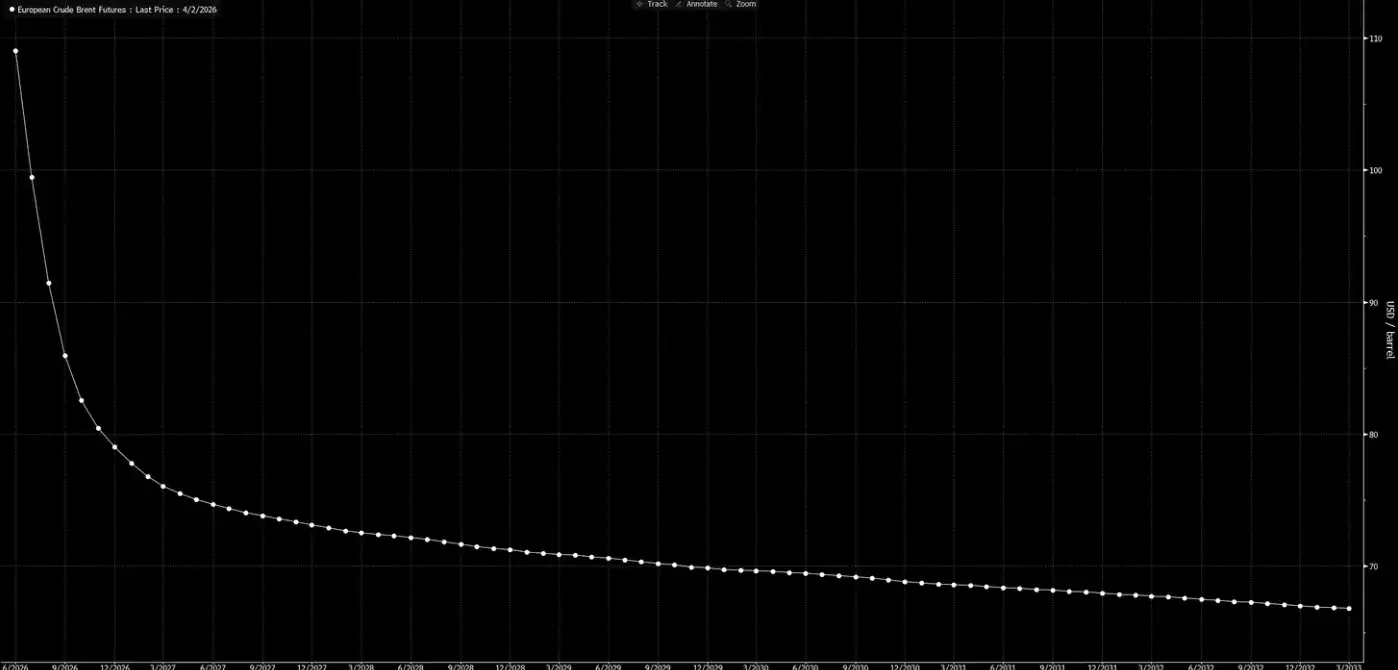
Now let's look at the forward price curve.
This curve is sending a signal: this is just a temporary shock, and before Christmas, everything will return to normal.
Our judgment is: this curve is "dreaming."
Three Possible Outcomes, One Baseline Path
We have proposed this analytical framework in the "Weekly Signal Playbook." So far, there have been no changes; if there has been a change, it is the probability of the baseline scenario further strengthening.
This war will ultimately end in one of three ways:
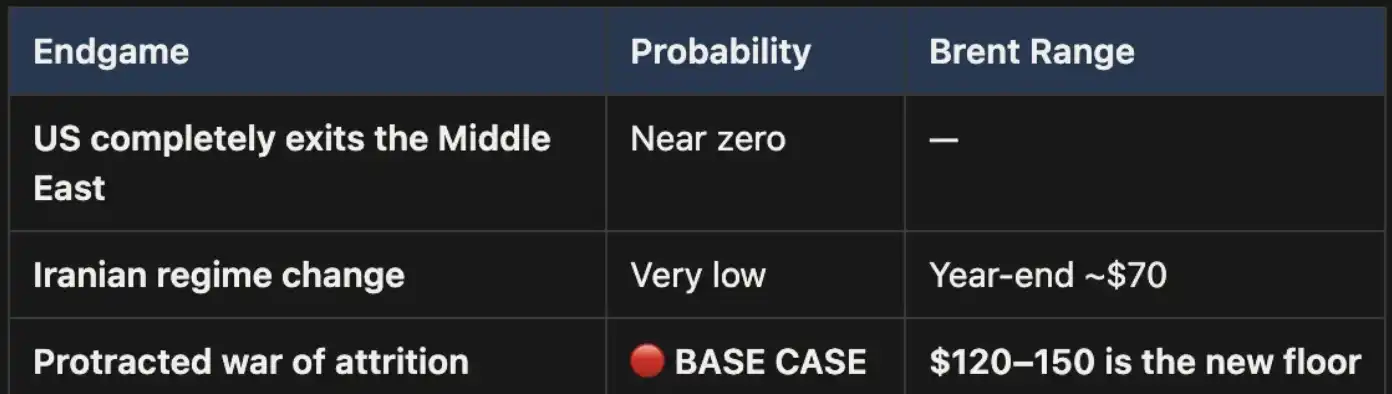
The chart lists three outcomes: 1. The U.S. completely withdraws from the Middle East; 2. Change of regime in Iran (similar to Iraq in 2003); 3. Long-term war of attrition.
Outcome 1 is politically nearly impossible to achieve.
Outcome 2 is also untenable: topographical conditions, manpower requirements, and the evolution logic of guerrilla warfare all indicate that this path comes at a high cost and is difficult to conclude. Iran’s land area is three times that of Iraq, its population nearly twice as much, not to mention the mountainous terrain that leaves no room for invaders. This is not 2003.
Outcome 3 is the baseline scenario and has a vastly higher probability. If the conflict evolves into a long-term war of attrition, the disruption in the Strait of Hormuz will continue, and oil prices will remain high. This high price will be structural rather than temporary. The current forward price curve is evidently undervaluing this point.
One point that many overlook is: if viewed solely from the oil industry itself, a long-term war may actually align with U.S. strategic interests. Oil production capacity in the Middle East will be damaged in the conflict, and global buyers will have to turn to North American energy as other alternative sources are nearly exhausted. Higher oil prices will also encourage U.S. producers to ramp up output—adding rigs and increasing shale oil investments. The following chart shows that nearly every major oil price spike in history leads to a surge in U.S. production in the subsequent 12 to 18 months.
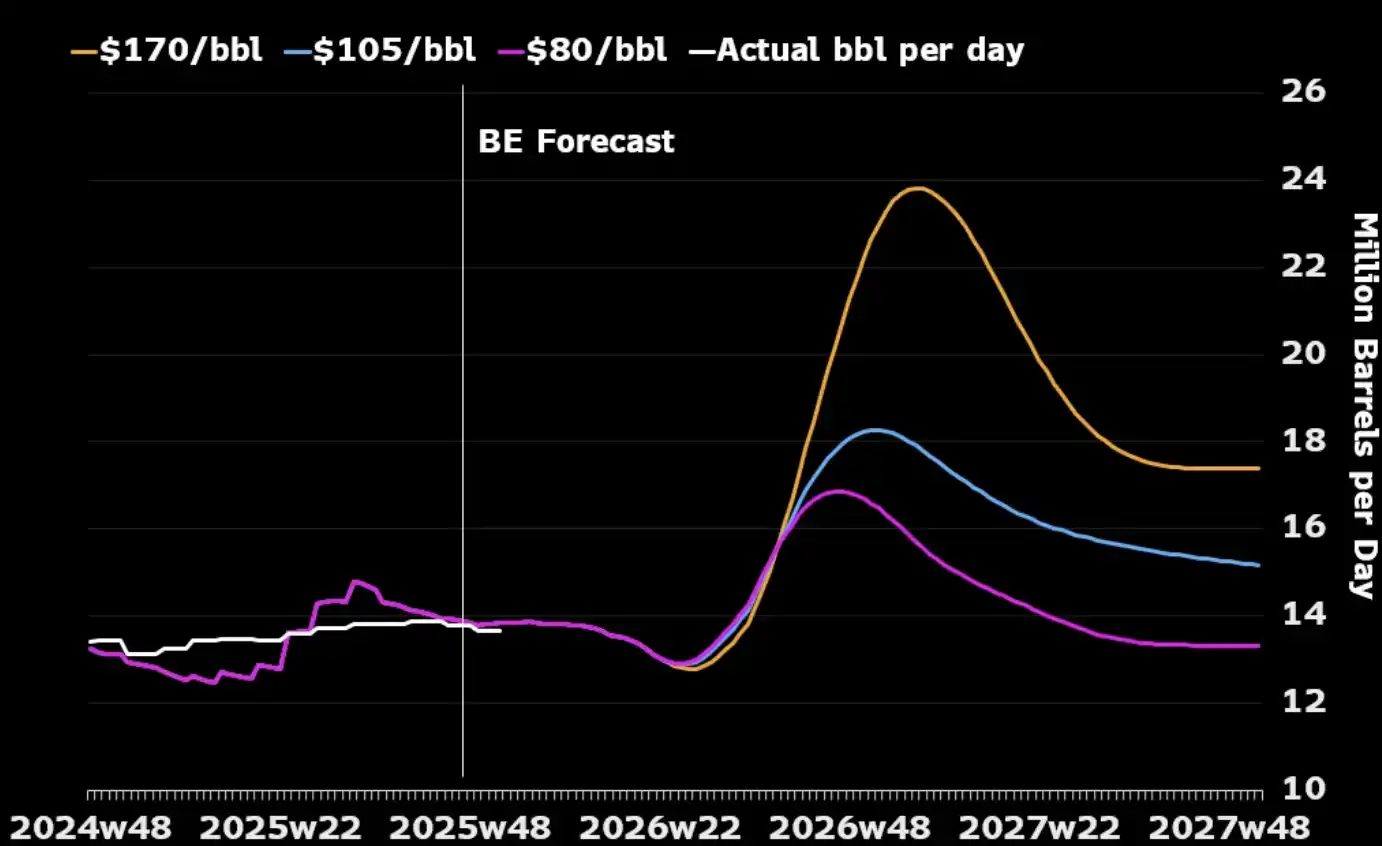
The only cost that the U.S. truly needs to manage is at the domestic level: how to avoid gasoline prices remaining above $4 per gallon for an extended period, thus triggering a political backlash. This is a "pain threshold," not a condition that determines whether the war ends.
The "Arithmetic" of Prices
In the case of the Strait of Hormuz being closed, Brent at $110 is not the ceiling but just the starting point. In our baseline scenario, as long as the Strait remains closed, oil prices will be maintained in the $120 to $150 range.
With each passing week, inventories are being depleted. UBS data indicates that global inventories had dropped to the five-year average by the end of March—and that occurred before the latest escalation. Macquarie gives the judgment that if the war drags past June and the Strait is still not open, the probability of oil prices spiking to $200 is 40%.
The near-month price differential (i.e., the differential between the last two Brent contracts) has widened to $8.59 per barrel. The market is paying about an 8% premium for "early one-month delivery"—a level of tension akin to that of 2008.
However, in 2008, there was no 15% of global supply physically blocked.
Today, nearly all models, all price curves, and all year-end forecasts from Wall Street are built on the same premise: this conflict will end, the Strait of Hormuz will reopen, oil prices will return to normal, and the world will restore to its previous state.
Our judgment is: it will not.
The back end of the forward curve has yet to catch up to reality. The market has priced in the "occurrence of war," but has yet to price in the "duration of war." Before the reopening of Hormuz, every pullback in crude oil is an opportunity. This is our core position, and it will not be hedged.
Oil is the first node. When "ground forces come in" and there is no quick victory—when the conflict evolves into the long-term war of attrition we have judged since day one—repricing will not stop at crude oil itself but will transmit successively to interest rates, exchange rates, stock markets, and credit markets. This is what is about to happen next.
免责声明:本文章仅代表作者个人观点,不代表本平台的立场和观点。本文章仅供信息分享,不构成对任何人的任何投资建议。用户与作者之间的任何争议,与本平台无关。如网页中刊载的文章或图片涉及侵权,请提供相关的权利证明和身份证明发送邮件到support@aicoin.com,本平台相关工作人员将会进行核查。


