Author: Deep Tide TechFlow
Deep Tide Introduction: Anthropic revealed on April 6 that its annualized revenue has surpassed $30 billion, more than doubling from about $9 billion at the end of 2025, and the number of enterprise customers with annual consumption exceeding $1 million doubled from 500 to 1,000 in two months. On the same day, Broadcom's SEC filing confirmed that Anthropic will obtain about 3.5 gigawatts of next-generation TPU computing power starting in 2027, marking its largest single commitment to computing power to date.
Anthropic released two significant figures on the same day.
According to Anthropic's official blog on April 6, the company's annualized revenue has exceeded $30 billion, more than doubling from about $9 billion at the end of 2025. On the same day, a filing submitted by Broadcom to the SEC disclosed that Anthropic will obtain about 3.5 gigawatts (GW) of next-generation TPU computing power through Broadcom starting in 2027, as part of the expanded cooperation among the three parties (Broadcom, Google, Anthropic).
Broadcom's stock price rose about 3% in after-hours trading.
(Image source: X user @damianplayer)
14 months from $1 billion to $30 billion, Claude Code is the core engine
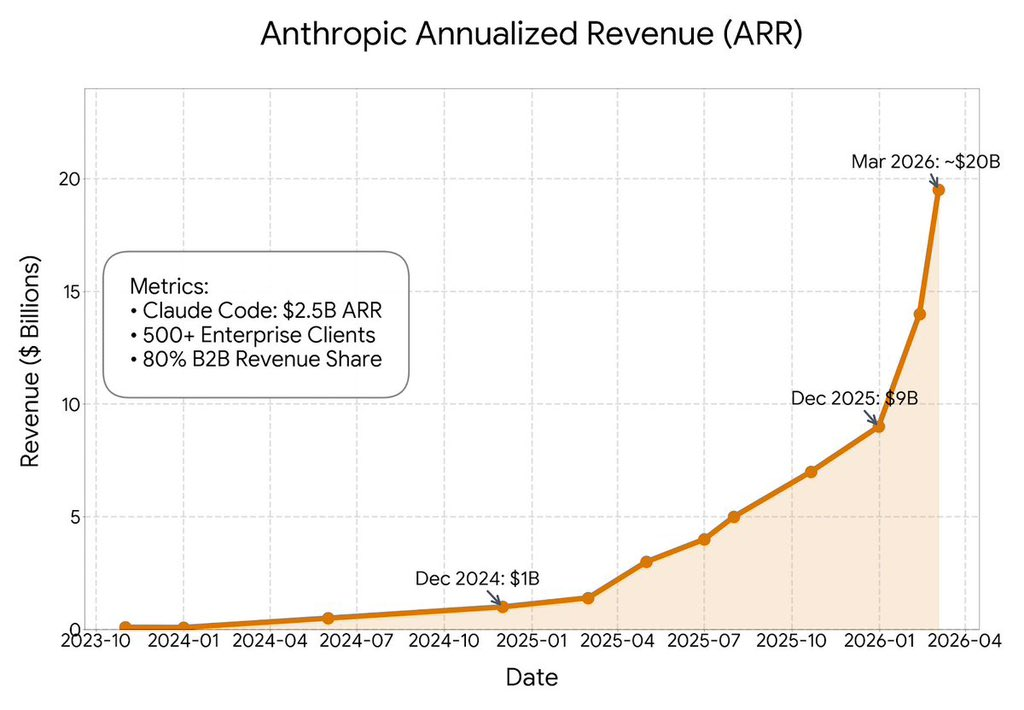
Anthropic's revenue curve has no precedent in the AI industry. According to publicly disclosed timelines and reports from multiple media including Bloomberg: about $1 billion in December 2024, about $4 billion in mid-2025, about $9 billion at the end of 2025, about $14 billion in February 2026, nearly $19 billion in early March, officially confirmed to exceed $30 billion on April 6.
Anthropic CFO Krishna Rao stated in a statement that the company is making "the most significant computing power commitment to date to match unprecedented growth."
Client data is equally fierce. In February this year, during the G round of financing, there were 500 enterprise customers with an annual consumption exceeding $1 million; less than two months later, this number doubled to over 1,000. According to previous disclosures by Anthropic, the core driver of growth is Claude Code, which was released in May 2025 and saw its annualized revenue exceed $2.5 billion by February 2026.
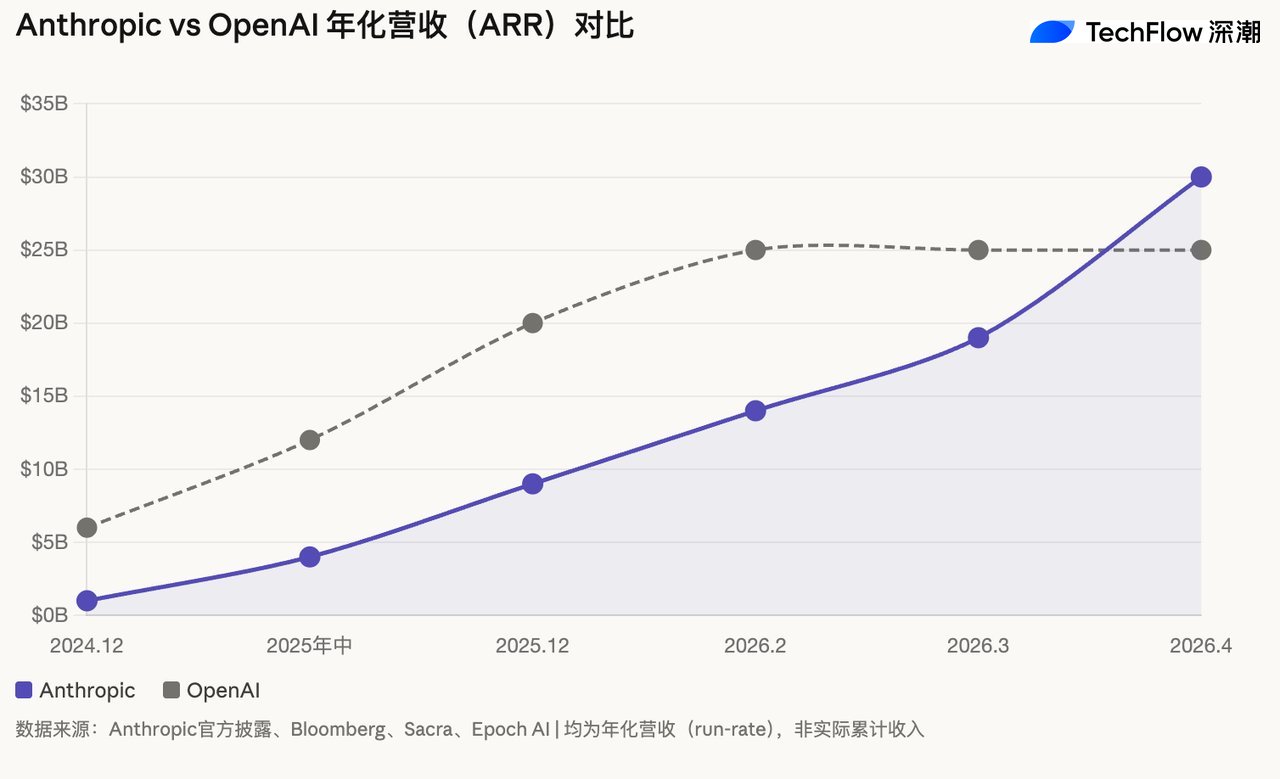
As a reference, OpenAI's annualized revenue is estimated by Sacra to be about $25 billion (as of February 2026). According to analysis by Epoch AI, since Anthropic's revenue surpassed $1 billion, its annualized growth rate has been about 10 times, while OpenAI's during the same period has been about 3.4 times. Based on this trend, the revenue crossover point between the two may appear in mid-2026.
It should be noted that the above are all annualized revenues (run-rate revenue), which is an estimated value of the recent monthly income multiplied by 12, not the actual accumulated revenue.
3.5 gigawatt TPU Agreement: The latest piece of Anthropic's computing power landscape
According to Broadcom's SEC filing, the core content of this agreement is: Broadcom will design and supply next-generation TPU chips for Google, with the supply relationship continuing until 2031; starting in 2027, Anthropic will obtain about 3.5 gigawatts of next-generation TPU computing power through Broadcom, as part of its "multi-gigawatt" computing power expansion plan.
Broadcom added a critical stipulation in the document: "Anthropic's consumption for expanding computing power depends on its continued commercial success." The three parties are also discussing deployment support with "operational and financial partners."
This is not Anthropic's first large-scale computing power agreement. In October 2025, Anthropic signed a cooperation agreement with Google Cloud to gain access to as many as 1 million TPUs, expected to bring over 1 gigawatt of computing power in 2026. Broadcom CEO Hock Tan confirmed during the December 2025 earnings call that Anthropic placed two orders for TPUs worth $10 billion and $11 billion respectively. Tan further stated in a March earnings call that approximately $21 billion in AI revenue is expected from Anthropic in 2026, exceeding $42 billion in 2027 (according to Mizuho analysts).
On the AWS side, Project Rainier was launched in October 2025, deploying nearly 500,000 Trainium2 chips across multiple data centers in the United States. Amazon has invested a total of $8 billion in Anthropic, with Anthropic engineers directly participating in the underlying kernel development of Trainium and providing design input for the next-generation Trainium3 chips.
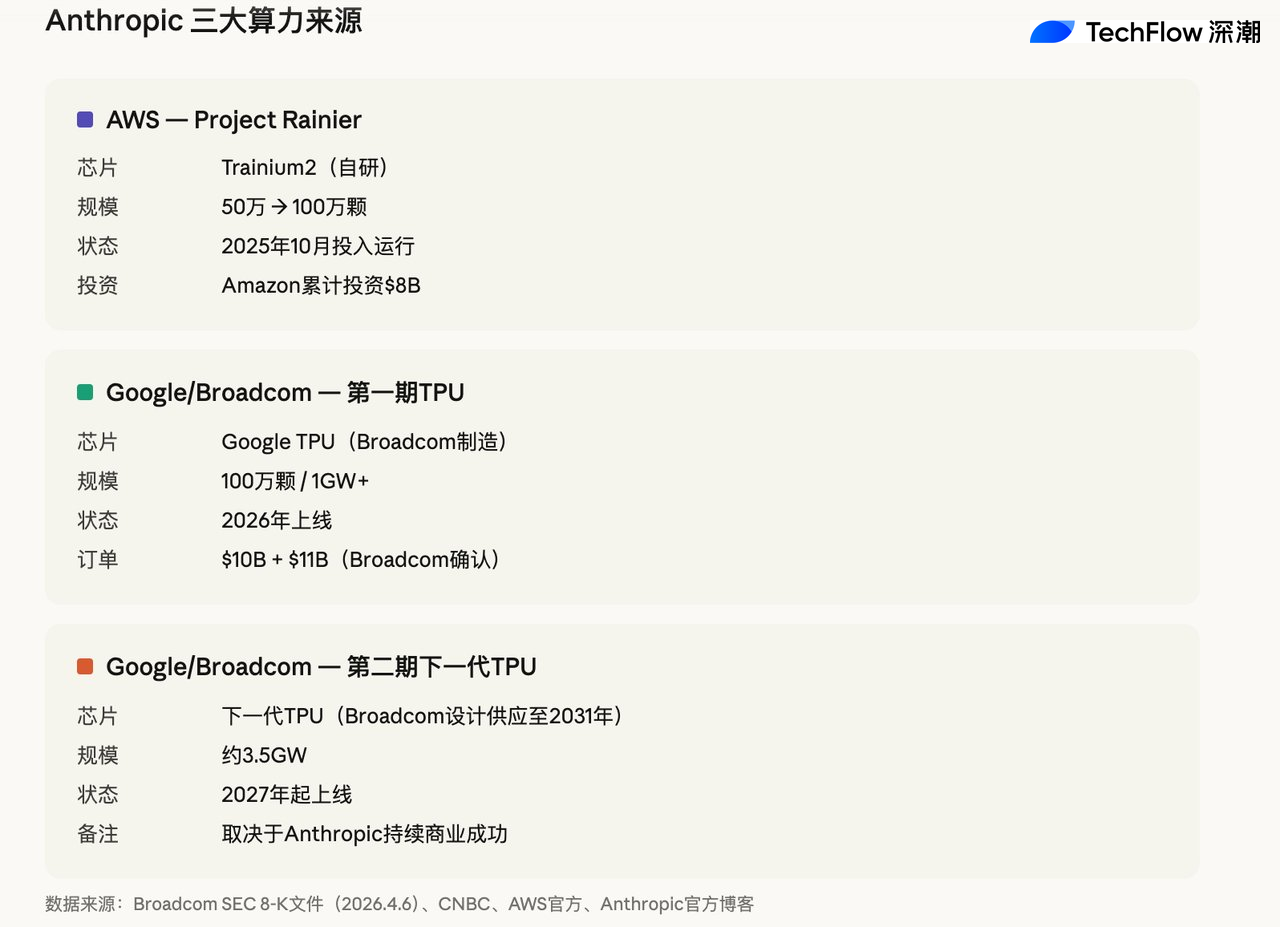
As of now, Anthropic's sources of computing power cover three chip platforms (AWS Trainium, Google TPU, NVIDIA GPU) and three major cloud platforms (AWS, Google Cloud, Microsoft Azure). Anthropic specifically emphasizes in its blog that Claude is "the only cutting-edge AI model available across all three major cloud platforms globally."
Contrasting Paths with OpenAI Stargate
Anthropic's computing power model sharply contrasts with that of OpenAI.
OpenAI chose an asset-heavy approach: in January 2025, it established Stargate LLC in collaboration with SoftBank and Oracle, aiming to invest $500 billion over four years to build a 10 gigawatt AI infrastructure. OpenAI retains operational responsibilities and design control, Oracle is responsible for construction, and SoftBank takes on financial responsibilities. As of now, Stargate plans for nearly 7 gigawatts of computing power, with total investment commitments exceeding $400 billion.
However, there have been control friction among partners during the advancement of Stargate. According to a report by Tom's Hardware in February this year, OpenAI, Oracle, and SoftBank had disagreements regarding the ownership of data centers, causing delays in some projects. In addition, OpenAI's total cloud service procurement commitments have exceeded $500 billion (Microsoft $250 billion + Oracle about $300 billion + AWS about $50 billion), with an expected cash burn of about $17 billion in 2026, and it won't achieve a positive cash flow until as early as 2030.
Anthropic is pursuing a light-asset approach of "not building data centers, not buying chips." Capital expenditures are borne by cloud service providers, allowing Anthropic to secure capacity and prices through long-term agreements as a customer, retaining flexibility to switch between multiple chip routes. The downside is not owning infrastructure, which may lead to higher long-term unit costs. Reports indicate that Anthropic's gross margin is about 40%, with an expected loss of about $14 billion in 2026.
The pros and cons of the two models remain undetermined. OpenAI bets on economies of scale and independent infrastructure, while Anthropic bets on supply chain flexibility and capital efficiency. However, one fact has become clear: in the AI computing power arms race, long-term computing power agreements are becoming a competitive element as important as funding and technology.
免责声明:本文章仅代表作者个人观点,不代表本平台的立场和观点。本文章仅供信息分享,不构成对任何人的任何投资建议。用户与作者之间的任何争议,与本平台无关。如网页中刊载的文章或图片涉及侵权,请提供相关的权利证明和身份证明发送邮件到support@aicoin.com,本平台相关工作人员将会进行核查。


