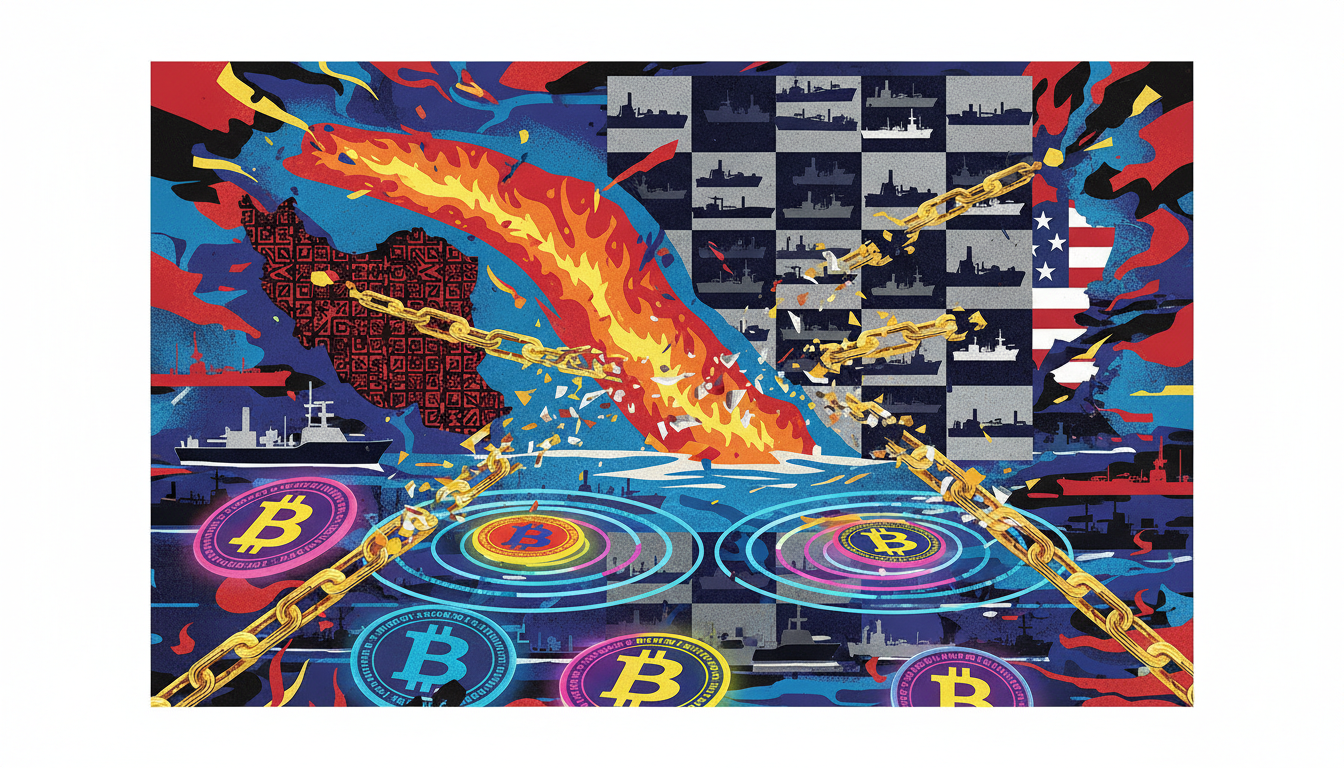
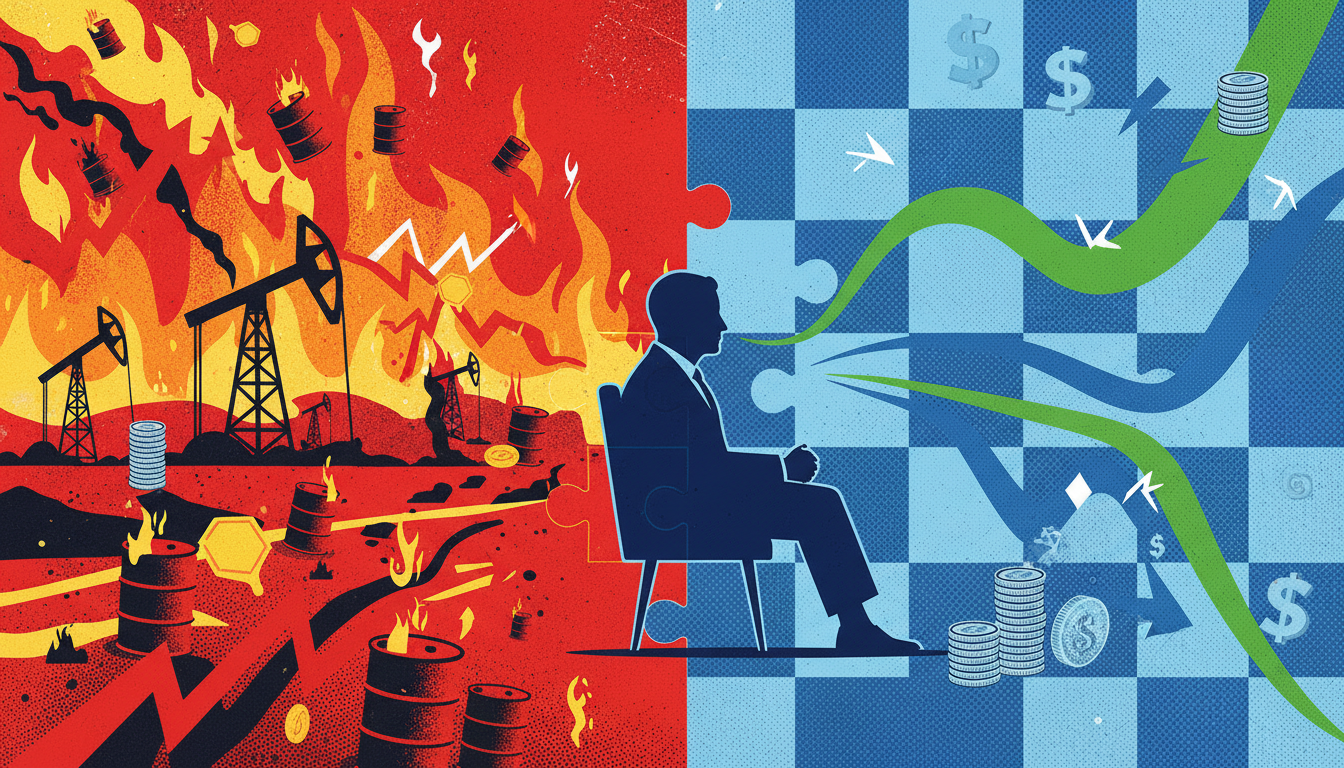
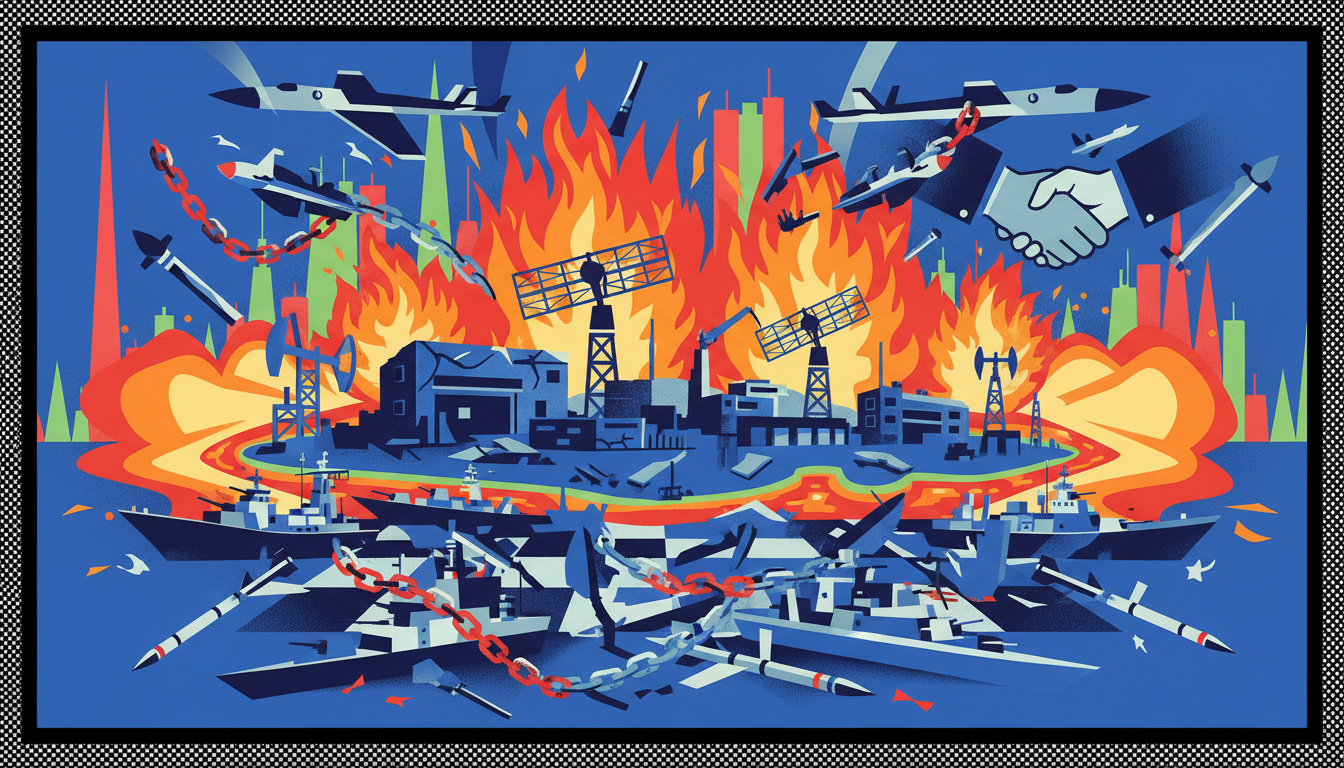
On April 7, 2026, Eastern Eight Time, the Iranian Revolutionary Guard publicly threatened to focus attacks on the energy infrastructure of the United States and its allies, claiming it would make it difficult for these countries to obtain oil and gas resources from the region in the coming years. This statement directly targets global oil and gas supply security, bringing the vulnerabilities of critical passages like the Strait of Hormuz back into focus, and quickly triggering a chain reaction among inflation expectations, risk aversion sentiment, and asset pricing. At the same time, BlackRock strategists indicated that the Middle East war might push up inflation, raising the annual CPI for March to 3.3%, while U.S. stock futures saw CRCL down 0.41% and MSTR down 1.27%, with crypto-related stocks generally weakening. The intertwining of revised inflation expectations and the selling pressure on risk assets set the stage for a core conflict regarding the ultimate direction of "safe-haven" flows.
From Restraint to Threats: Escalation of Signals from Iran
The statement from the Iranian Revolutionary Guard on April 7 is particularly damaging as it targets both specific objectives and a broad time frame: not just temporary pressure, but intent to make it difficult for the U.S. and its allies "to obtain oil and gas resources from the region in the coming years." This means the threat is no longer limited to tactical attacks but aims specifically at energy infrastructure and routes, intending to change the long-term dynamics of resource access in the region. For major economies that rely on Middle Eastern oil and gas, this assertion alone sufficiently alters the baseline assumptions regarding supply security.
The more crucial turning point is that the Revolutionary Guard specifically mentioned that it had previously exercised restraint due to so-called "friendly relations," but would no longer consider this factor. This shift from "restraint" to "no longer considering" essentially announces to the outside world that political buffers have been compressed, and past channels of intervention through diplomacy or relationships are no longer reliable. For the market, this upgrade in tone often transmits to risk pricing more rapidly than specific military actions, as it changes the subjective expectations of future "probabilities of action."
On the same day, the Iranian parliament announced that it was advancing a Strait of Hormuz Security Assurance Plan, adding a formal context to this rhetorical offensive. The details of the security plan have not been fully disclosed, but the legislative involvement indicates Iran's intention to elevate the issue of Strait control from tactical maneuvering to medium and long-term institutional arrangements. Iranian parliamentary spokesman Ibrahim Rezaei stated bluntly, "The Strait of Hormuz will not return to its previous state," which transforms what was once regarded as "event-driven" risk into a potential "new normal," proclaiming long-term risk premiums for global energy trade participants reliant on this route.
Energy Lifeline Threatened: Chain Reaction of Inflation Expectations
The Strait of Hormuz is a critical throat for global energy transport, through which a large volume of crude oil and natural gas must pass every day. Once the safety of passage and the stability of infrastructure are called into question, the market's initial reaction is not the actual interrupted tonnage but rather the risk premium for "possible interruptions at any time." By clearly targeting energy infrastructure and routes, Iran has turned supply chain instability from a fringe scenario to one of the mainstream, forcing oil and gas buyers to enhance their defenses in contract negotiations, inventory management, and alternative sourcing.
On a macro level, BlackRock strategists have already provided more direct pricing clues: under the expectation that the Middle East war will increase inflation, U.S. March CPI may rise to 3.3%. This figure reflects not just anomalies for a single month but indicates how geopolitical risks transmit through energy prices and logistics costs into the consumer basket and have been pre-locked by institutional funds. For monetary policy and bond markets anchored to inflation data, the situation in the Middle East is transitioning from a "news variable" to a "model parameter."
BlackRock's report also points out that geopolitical conflicts have begun to influence inflation expectations and the debt market, indicating that pricing is spreading from localized assets to broader interest rate curves and credit spreads. A positive feedback loop can easily form between energy risk and inflation expectations: threatened supply security raises costs, revised inflation expectations push up nominal yields and risk premiums, thereby weakening demand-side resilience in certain economies and increasing sensitivity to further geopolitical friction and policy uncertainty. Under this chain, whoever can find a new balance between rising inflation and slowing growth may find themselves on the favorable side of asset performance differentiation.
Dollar and Debt in Demand: Traditional Market's Safe-Haven Path
In light of the belief that "Middle Eastern wars will push up the dollar," the path of capital seeking safety has once again unfolded along familiar lines: when risks heat up, global capital tends to flow back to dollar assets, particularly U.S. Treasuries and high-quality assets pegged to the dollar. On one hand, the dollar's status as a global settlement and reserve currency makes it a natural beneficiary of the "cash is king" and "return to home port" psychological expectation during heightened geopolitical conflicts; on the other hand, the depth and liquidity of the U.S. financial market provide a sufficiently large anchorage for safe-haven funds.
BlackRock bluntly states in its report, "As the Middle Eastern war boosts the dollar, emerging market dollar-denominated debt appears quite attractive." This statement highlights the subtle shift from the institutional perspective: it is not simply a matter of embracing risk-free assets but prioritizing higher-yielding, yet still dollar-denominated, emerging market debt instruments against the backdrop of a stronger dollar, attempting to find a compromise between safety and yield. As the market rearranges debt allocation, it is effectively using the "external expansion" of dollar assets to hedge against multiple uncertainties in local currencies and markets.
In a scenario marked by rising inflation expectations and ongoing geopolitical tensions, the debt market’s trade-off between yield and risk is forced to reshape. Nominal yields need to sufficiently compensate for inflation and geopolitical premiums, while default and liquidity risks are constraining the upward space for yields. The result is that some high-risk assets are being squeezed out of allocation, while the weight of dollars and dollar-denominated debt in global portfolios is increasing. A stronger dollar and enhanced attractiveness of bonds are likely to exert potential pressure on global liquidity and risk asset valuations: on one hand, non-U.S. central banks find it harder to maintain easing amidst pressures on local currencies; on the other hand, the discount rate for valuations of stocks, crypto, and other high-volatility assets is forced upward, increasing the demands for risk premiums.
Sentiment First Hits Crypto Stocks: Initial Reaction of Safe-Haven Capital
As the aforementioned macro rearrangement has not yet fully materialized, U.S. stock futures have already provided a direct feedback: CRCL down 0.41%, MSTR down 1.27%, with crypto-related stocks generally weak. This drop is not shocking in absolute terms, but within the context of the message's arrival and the heating up of the safe-haven narrative, it carries directional significance. The market's first choice was to reduce exposure to crypto rather than wait for on-chain or spot prices to provide clear trends.
From the structural perspective, the pre-market selling pressure reflects a general reduction in allocations to the broad category of "risk assets," rather than a re-evaluation of the fundamentals of a specific company. Whether it is listed companies holding Bitcoin assets or enterprises engaged in trading, mining, or infrastructure, when macro panic escalates, they will all be bundled into the "high beta asset" basket. At this moment, investors are concerned not with their earnings forecasts for the next few quarters but rather with the potential maximum drawdown and liquidity risks in extreme scenarios.
As geopolitical and inflation expectations rise synchronously, the adjustments in weight among technology stocks, crypto stocks, and traditional safe-haven assets become particularly intense. Some investors will withdraw from overvalued growth tech and crypto-related targets, reallocating to dollar cash, U.S. Treasuries, or defensive sectors; others may hedge exposures through options and derivatives to significantly reduce risk exposure while keeping nominal positions unchanged. It is noteworthy that crypto exposures in traditional equity markets often reflect sentiment changes ahead of on-chain spot prices: the actions of institutions reducing allocations to a basket of "high-risk stocks" generally occur faster than their adjustments of single crypto asset positions in spot or derivative markets, creating suspense for possible subsequent declines or divergences in on-chain prices.
Crypto and Wall Street Crossroads: A Reconsideration of the Safe-Haven Narrative
Reviewing past stages of geopolitical conflict, the role of Bitcoin and other crypto assets frequently oscillates between the narratives of "digital gold" and "high-risk assets." In certain localized conflicts or capital control events, Bitcoin's cross-border and permissionless attributes have at times amplified its label as a "digital safe-haven asset"; however, in broader global risk aversion cycles, it often gets treated as a source of volatility to be "dumped first" alongside tech growth stocks. This narrative oscillation essentially reflects the mainstream funds' lack of a stable consensus on the risk and functional attributes of crypto assets.
Comparing the current environment, we see that the dollar and bonds are regaining favor, raising a counter-question regarding "whether crypto has already been viewed by the mainstream as a qualified safe-haven tool." If safe-haven funds prioritize flowing into the dollar and dollar-denominated debt during the first wave of shocks rather than into crypto assets, then the narrative of "digital gold" clearly has not yet become the mainstream pricing framework at the institutional level. For participants in the crypto market, it is necessary to rethink: in a cycle of concurrent macro pressures and geopolitical uncertainties, is crypto a hedging tool, a growth option, or some mix between the two?
As the impacts of energy and inflation intensify, several key variables in the crypto valuation framework will also be forced to adjust. Mining costs are affected by energy prices and equipment investments, shifting profitability ranges and shutdown prices, which will change miners' selling patterns and inventory strategies; on-chain activity typically faces pressure during a macro contraction, with fluctuations in trading demand and application enthusiasm putting network value and fee income under strain; funding costs are raised in changing interest rate environments, reducing the tolerance of high leverage and long-duration speculative funds. These interwoven variables will determine whether the market is willing to continue assigning high premiums to crypto assets or require a lower valuation to hedge against macro uncertainties.
Looking ahead, several key observation indicators will help to construct tracking paths: first, whether the actual inflation data aligns with or even exceeds the expected 3.3%, which will determine the market's re-pricing of the inflation effects from geopolitical conflicts; second, the official responses from the U.S. and relevant parties to the Iranian threats will influence whether the risks at the Strait of Hormuz and energy infrastructures are suppressed or further escalated; third, the degree of divergence between crypto spot prices and crypto concept stocks can be used to judge whether sentiment still predominantly centers on the "equity end" or has begun to spill over to the on-chain and spot end. For investors, these indicators constitute practical tools for identifying true capital preferences amid narrative fluctuations.
Shadows of War: Strangling Oil and Gas and Asset Differentiation
In conclusion, the Iranian Revolutionary Guard's threat to attack the energy infrastructure of the U.S. and its allies, combined with the Iranian parliament's advancement of the Strait of Hormuz Security Assurance Plan, solidified through the spokesman's assertion that "the Strait of Hormuz will not return to its previous state," collectively point to the structural evolution of Middle Eastern risks from short-term events to long-term uncertainties. Once energy corridors and infrastructure are incorporated into long-term strategic stakes, the baseline assumptions regarding the global supply chain and inflation expectations cannot revert to their “pre-war” state.
Within this framework, rising inflation expectations, demand for dollars and dollar-denominated debt, and the pre-market pressure on crypto concept stocks constitute the core trajectory of the current market chain reaction. Increased inflation expectations push up yields and risk premiums, with dollar assets reclaiming dominance in safe-haven logic, while crypto-related stocks, representing high-risk preferences, become the first targets of reduced allocations. Capital is rapidly moving among different assets, behind which lies a high level of uncertainty regarding future geopolitical situations and policy paths.
In a phase characterized by limited official responses and significant information asymmetry, investors need to acknowledge that geopolitical risks have indeed changed the macro pricing environment while remaining vigilant against dual risks of emotional excess and narrative misinterpretation. The market often tends to make the largest price adjustments when the information is most lacking, while the true medium- to long-term impacts typically only gradually reveal themselves after policy implementation and data verification. During this process, blindly betting on "the only correct narrative" is likely to amplify drawdowns, while dynamic adjustments based on data and behavioral hints are far more critical.
Looking ahead to the near term, the evolution of the Middle Eastern situation and changes in macro data, such as inflation and interest rates, will together shape the trajectories of differentiation between the crypto market and traditional markets. If the risks associated with the Strait of Hormuz and related energy infrastructure can be effectively alleviated, the inflation curve may stabilize at high levels or even decline, allowing risk assets to welcome a valuation recovery window; conversely, if the threats persist and evolve into real impacts, the dual pressure of energy and inflation will reinforce the safe-haven status of the dollar and debt assets, leaving crypto and other high-volatility assets facing a longer period of valuation compression and narrative re-evaluation. At this crossroads, what is more important is not predicting the direction but maintaining a clear perception of risk compensation and liquidity constraints amid every peak of emotional volatility and data discrepancies.
Join our community to discuss and grow stronger together!
Official Telegram community: https://t.me/aicoincn
AiCoin's Chinese Twitter: https://x.com/AiCoinzh
OKX benefits group: https://aicoin.com/link/chat?cid=l61eM4owQ
Binance benefits group: https://aicoin.com/link/chat?cid=ynr7d1P6Z
免责声明:本文章仅代表作者个人观点,不代表本平台的立场和观点。本文章仅供信息分享,不构成对任何人的任何投资建议。用户与作者之间的任何争议,与本平台无关。如网页中刊载的文章或图片涉及侵权,请提供相关的权利证明和身份证明发送邮件到support@aicoin.com,本平台相关工作人员将会进行核查。