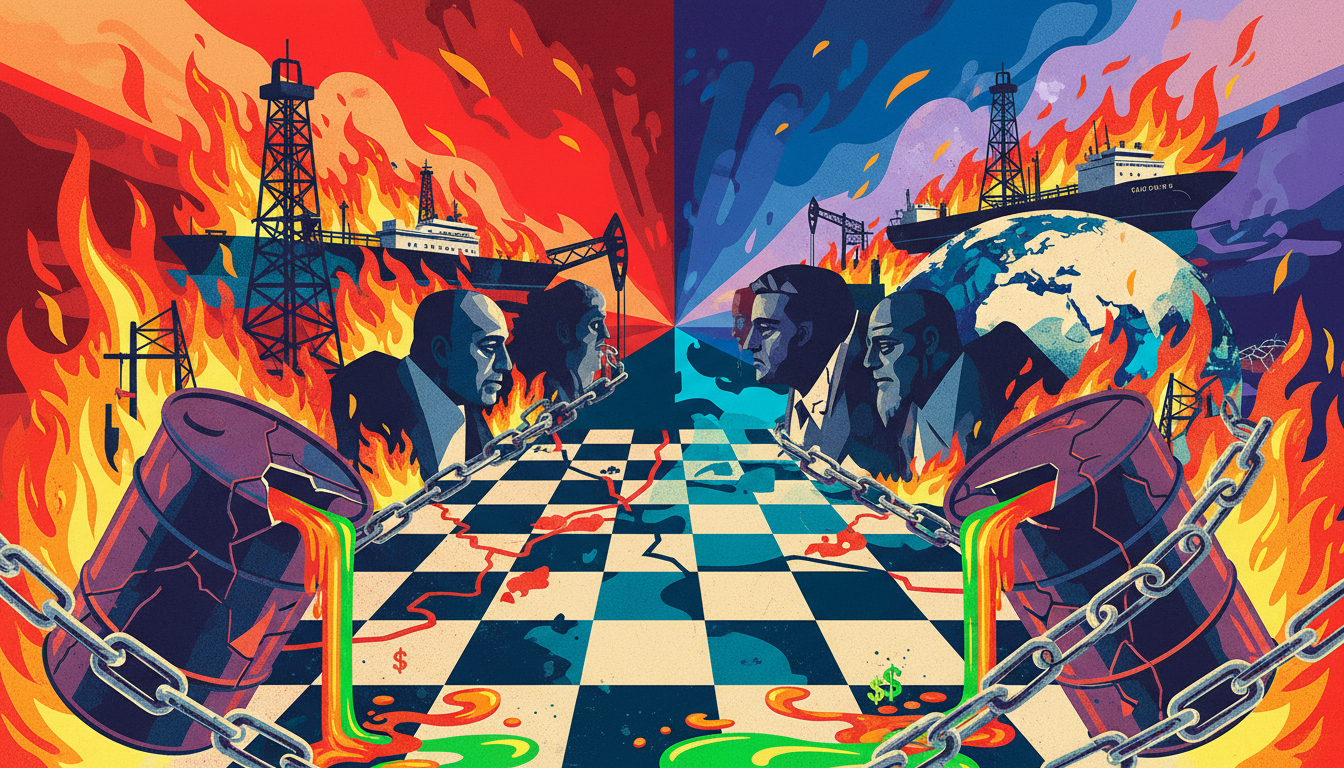
On March 21, 2026, in the early hours of Eastern Time, the U.S. military carried out high-density precision strikes against Iran's Khark Island, targeting and destroying at least more than 50 military objectives, including key facilities such as shelters, radar stations, and ammunition depots. This round of military action is not an isolated event, but rather embedded within a larger strategic framework set by the Trump administration, which has established a “deadline” for the Strait of Hormuz: increasing military pressure on one hand while forcing Iran to make choices in negotiations through countdowns on the other. At the same time, U.S. officials have repeatedly released information through channels emphasizing that the strikes intentionally avoid oil and other core economic facilities, attempting to limit the action to “battlefield signals” rather than an “escalation of economic warfare.” This limited escalation has already reflected in fluctuations in oil prices and risk assets in the early trading hours, where market sentiment was briefly tense but did not evolve into a full-blown panic.
From Ultimatum to Missile Strike: Path of Escalation
The precise strikes around Khark Island must be traced back to the “deadline” set by Trump for the Strait of Hormuz. According to the timeline, the White House first publicly demanded Iran reopen the Strait of Hormuz by Tuesday evening at 8 PM Eastern Time, materializing the time pressure into a specific point; thereafter, Iran responded with a missile strike on Saudi Arabia, attempting to showcase military resolve and leverage; subsequently, the U.S. struck Khark Island early on March 21. The ultimatum, regional attacks, and precise retaliation form a clear chain of escalation.
Iran's stance is equally filled with tension. On one hand, Tehran insists on its prerequisites, emphasizing that any substantive negotiations must be premised on the lifting of sanctions against Iran and security concerns, maintaining a traditionally hardline position; on the other hand, it has shown some flexibility in statements, acknowledging that discussions about “technical arrangements” through third-party communications are negotiable. This contradictory stance of “unchanging bottom line but negotiable operations” precisely reflects the tug of war under intense pressure—unable to show weakness in domestic politics while also hard-pressed to bear the costs of a full confrontation with the U.S.
Meanwhile, while the U.S. government is advancing its strikes, it has repeatedly emphasized that this action “does not represent a strategic shift.” On one hand, demonstrating its will to execute through missiles and aircraft, while on the other hand, characterizing it as a “limited response,” this self-restraint in description objectively intensifies regional uncertainty: all parties find it hard to judge where the U.S. red line actually lies, whether the future will remain within the “controllable conflict” range, or escalate with the next unforeseen incident.
Precision Strikes on Over 50 Targets but Avoiding
The military intensity of the strikes on Khark Island should not be underestimated. Multiple sources indicate that the U.S. military selected more than 50 military targets, encompassing key nodes such as shelters, radar stations, and ammunition depots, the strikes exhibiting high density and high precision. In terms of target types, this was a typical “degradative operation” action: radar and command-related facilities were suppressed, ammunition and logistical support were cut off, significantly weakening Iran's air defense and counterattack capabilities in this direction in the short term.
More critically, multiple verifications point out that this strike did not involve oil infrastructure. In other words, within the scope of the strikes, a clear distinction was made between “pure military targets” and economic facilities that could directly shake global energy supply. Whether oil storage facilities, transportation pipelines, or more broadly defined key energy nodes, all were deliberately excluded from the strike list. This choice to “avoid oil” is not limited by technical capabilities but results from political and strategic considerations.
At the tactical level, the U.S., through the design of “heavily damaging military force while retaining economic backhand,” sends different messages to various audiences: for Iran, this is a reminder that “you are now exposed to fire coverage,” but it also hints that as long as some adjustments are made regarding Hormuz and regional security issues, there is still room to avoid a full-blown economic war; for regional allies and global markets, the U.S. hopes to demonstrate its capability to precisely control the intensity of the conflict, preventing a complete plunge into an energy crisis. This practice of finely segmenting military and economic battlefields is a reflection of the U.S. intention at this stage to “maintain pressure without losing control.”
Vance's Statement and Trump's Deadline
Vice President Vance's statement shortly after the strikes added a vivid psychological warfare element to the operation. He openly stated, “The war will soon end, depending on Iran's wise choice,” which semantically implies persuasion and “offering a way out”—indicating that if Iran makes concessions on key issues, the current conflict can quickly come to an end; on the other hand, “depending on your choice” also contains apparent threats—if Iran persists on its current path, then more intense and even more destructive actions are lined up behind. The combination of persuasion and threat constitutes a typical American “carrot + stick” rhetoric framework.
Alongside Vance's rhetoric is the strict timetable set by Trump—demanding Iran to reopen the Strait of Hormuz by Tuesday evening at 8 PM Eastern Time. This “countdown” deadline turns the strikes on Khark Island into more than just a one-off punishment but into a “scenario rehearsal” used to amplify deterrence: as the time approaches, the pressure of choices Iran faces grows, and the anxieties of neighboring countries and markets accumulate, granting the U.S. greater dominance in discourse and control of pace.
At the same time, the U.S. reiterated that this round of action does not signify a fundamental adjustment in its overall strategy toward Iran. This narrative of “we are still willing to talk but ready to strike again at any time” leaves room for both paths in the narrative space: if Iran compromises before the deadline, it can claim “pressure negotiation success”; if Iran holds firm, then it can excuse “the other side's lack of cooperation” and continue to escalate strikes. The key to the strategy is not to lock in results in advance but to ensure that all options remain in Washington’s hands.
Pakistan's Mediation: Small Country Game
In this chain of escalation and pressure, Pakistan plays a notably subtle role. According to the publicly available sequence of events, shortly after the U.S. struck Khark Island, Pakistan began appearing in the news in various forms, becoming one of the few communication channels still open between the U.S. and Iran. There are stances emphasizing “serious concern about the situation” to the outside world, along with behind-the-scenes meetings, confidential briefings, and attempts to convey tentative position adjustments between the two sides.
Pakistan's difficulty lies in its entanglement in multiple identities: on one hand, it maintains a certain allied relationship with the U.S. in security and economics, needing to uphold foundational mutual trust on issues such as counter-terrorism cooperation and military aid; on the other hand, as a neighboring country to Iran, its domestic religious and ethnic structure, cross-border trade and energy needs require it not to fully align with Iran in public. Adding to the complexity of the entire South Asia and Middle East geopolitical landscape, Pakistan is, in effect, walking on a knife edge—needing to prove itself as a “credible mediator” while not becoming a “scapegoat” for domestic public opinion from either side.
It is under this structure that Pakistan's mediation provides a “buffer layer” for the heightened tensions. Through it, the U.S. can test Tehran's openness to negotiations on issues related to Hormuz, missiles, and nuclear topics without directly exposing itself to Iran's upper echelons; Iran can also, without losing its hardline image, utilize a third party to convey the boundaries of “acceptable proposals.” Military strikes, deadlines, and closed-door communications, leveraging this mediating role, are interconnected into a seemingly controllable escalation ladder—allowing intensity to increase gradually while also reserving mechanisms to brake at any time.
The Economic Aspect Under War: Employment Numbers
While the spotlight is focused on missiles and the Strait, a set of seemingly “calm” economic data provides another clue to understanding the confidence behind U.S. decision-making. Data from a single source indicate that the U.S. private sector added approximately 26,000 jobs weekly over the past four weeks, showing no significant short-term volatility. This means, at least according to this data, the domestic employment market in the U.S. has not experienced observable shocks due to tensions in the Middle East, with intrinsic economic momentum still continuing.
Relating this to the escalating war, one can understand why the White House dares to adopt a higher pressure stance militarily: when critical employment indicators are not flashing “warning lights,” the decision-makers face relatively controllable domestic pressures, thus reducing the political cost of employing limited military actions to maintain external deterrence. In other words, the judgment that “the economy can still bear” provides some hidden support for this round of pressure.
However, it is also necessary to emphasize that this ADP data comes from a single source, and the observation window covers only about a month, with the market’s immediate reaction to this data being quite limited. Simplistically interpreting the strikes on Khark Island as a sign of the U.S.'s “shift in economic warfare” against Iran does not only contradict the multi-source confirmations of “avoiding strikes on oil facilities and not representing a strategic shift,” but also overestimates the explanatory power of a set of short-term employment data. A more reasonable understanding is that the economic front currently does not impose hard constraints on the U.S. to “hit the brakes,” but this does not mean Washington has decided to proceed toward full economic confrontation.
The Next Steps of Parallel War and Negotiation
Overall, the U.S. precision strikes on Khark Island, on one hand, demonstrate a determination to exert tough pressure by knocking out over 50 military targets, while on the other hand, it maintains a certain level of strategic restraint by intentionally avoiding oil and key economic facilities. It resembles a signal operation of “promoting negotiations through warfare”: it aims to let Iran feel the cost while reserving enough space for potential easing and transactions in the future.
Looking ahead, several key observation points will determine the direction of this game. Firstly, Iran's specific response to the “deadline” regarding the Strait of Hormuz—whether it chooses to make technical compromises in details or continues to resist the countdown vigorously. Secondly, whether intermediary forces like Pakistan can drive some substantial breakthroughs in the background, linking the current military strikes to potential political arrangements rather than just remaining at the level of “calling for restraint” in statements.
At present, with military actions, ultimatums, and negotiation windows overlapping, U.S.-Iran relations stand at an unstable fork in the road: one path leads to a larger scale of conflict escalation, with more targets being added to the strike list, and the shock scope potentially spilling over into global energy and financial markets; the other path leads to a reluctantly accepted negotiation—both sides retreat half a step from the brink of harm and cost, exchanging asymmetric concessions for temporary easing. The night sky illuminated by missiles over Khark Island is merely the opening act of this round of competition, with the true course still to be determined by choices and rounds in the coming weeks.
Join our community to discuss together and strengthen together!
Official Telegram community: https://t.me/aicoincn
AiCoin Chinese Twitter: https://x.com/AiCoinzh
OKX Benefits Group: https://aicoin.com/link/chat?cid=l61eM4owQ
Binance Benefits Group: https://aicoin.com/link/chat?cid=ynr7d1P6Z
免责声明:本文章仅代表作者个人观点,不代表本平台的立场和观点。本文章仅供信息分享,不构成对任何人的任何投资建议。用户与作者之间的任何争议,与本平台无关。如网页中刊载的文章或图片涉及侵权,请提供相关的权利证明和身份证明发送邮件到support@aicoin.com,本平台相关工作人员将会进行核查。