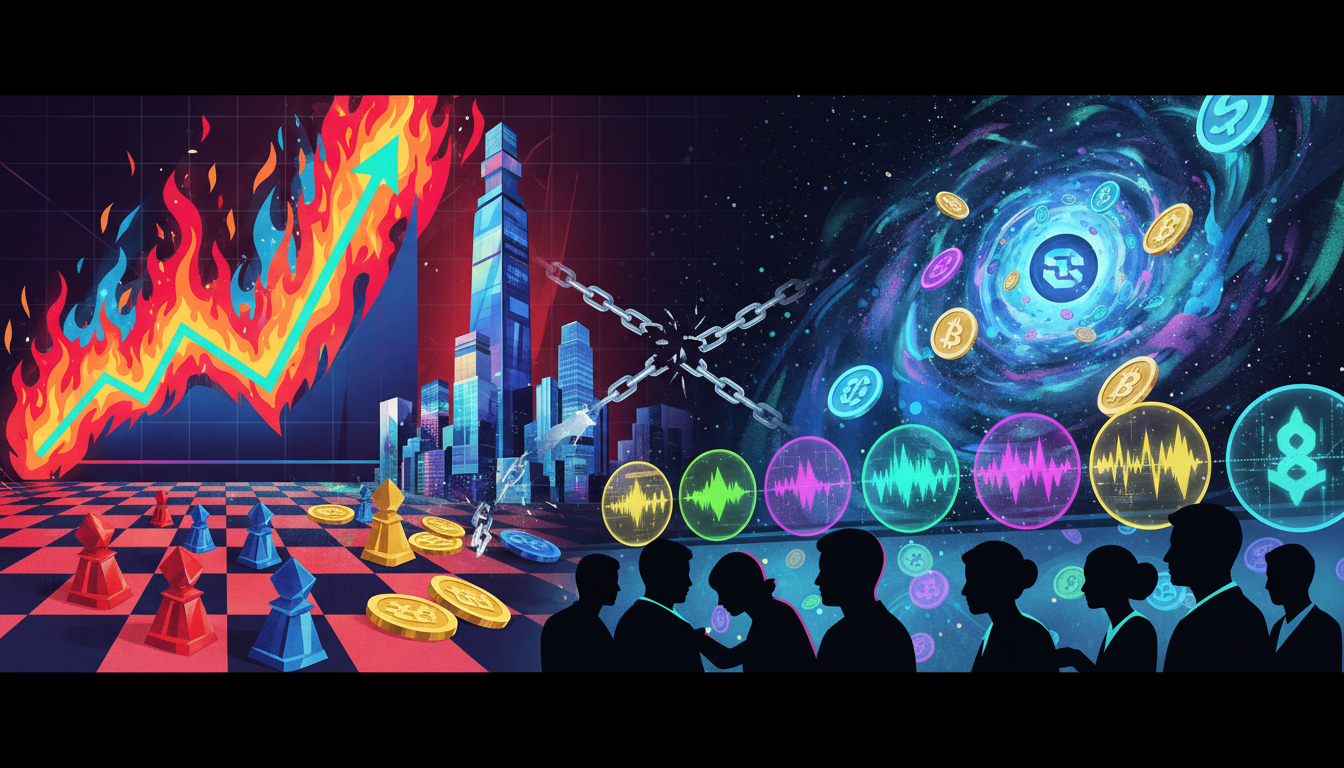
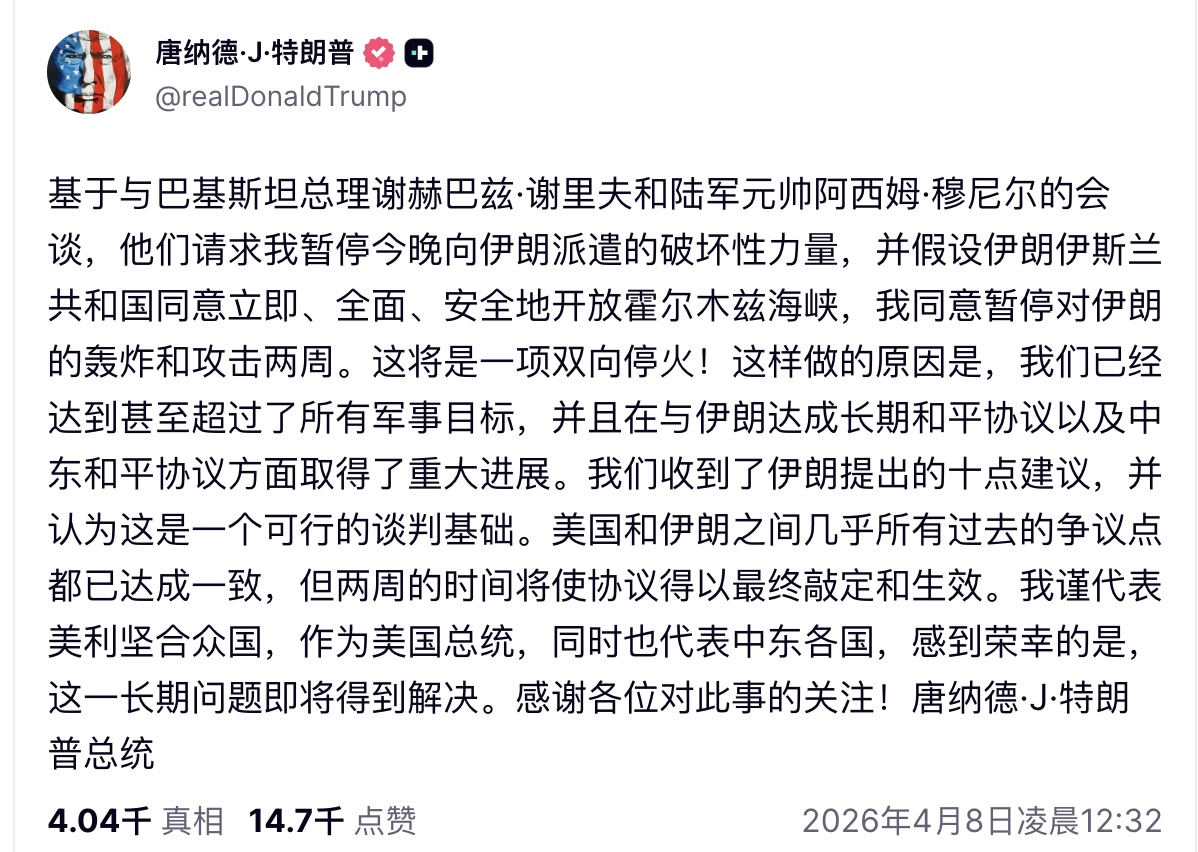
On April 8, around the time in the UTC+8 timezone, both the United States and Iran indicated a ceasefire, but various media reported that Israeli security agencies continued to strike Iranian targets, creating a stark contrast between diplomatic rhetoric and battlefield realities. On the same timeline, several Chinese cryptocurrency media outlets, including Golden Finance, TechFlow, Planet Daily, and Rhythm, almost simultaneously referenced Xinhua's report quoting the "Times of Israel", allowing the narrative of "continuing to fire under the ceasefire" to spread rapidly in the Chinese-speaking community. Surrounding this narrative, the market has provided three distinctly different pricing clues: a single account on Polymarket profited over 1 million dollars in religious and political prediction contracts, an aggressive position of 3 million USDC, 20x leverage BRENTOIL long appeared on HyperLiquid, and dramatic statements by crypto influencers on social media alongside real trading adjustments. The question is no longer just "will there be a conflict," but has transformed into: how is geopolitical risk packaged into the cryptocurrency narrative amidst the gaps of ceasefire and warfare, and how is it repriced through funds and prices?
Ceasefire Statement Unfulfilled: How Warfare is Retold
On April 8, with signals of a ceasefire released by the U.S. and Iran, it should have been a point for risk asset sentiment recovery; however, reports indicated that Israeli security agencies were still attacking Iranian targets, creating a reality conflict between the official ceasefire and actual actions. For the market, this "textual ceasefire, real firing" dislocation is more difficult to fit into traditional risk models than simple conflict escalation. More critically, in the Chinese information environment, the path through which investors encounter this event is highly homogenized—Golden Finance, TechFlow, Planet Daily, and Rhythm all cited Xinhua, which itself is quoting the "Times of Israel", meaning that mainstream Chinese narratives rely on an indirect chain of "media quoting media."
When the ceasefire comes from official rhetoric and the conflicts arise from secondhand reports, the combination can easily reinforce the market’s distrust of "paper peace." The ceasefire is seen as a bargaining chip rather than a stability expectation; any subsequent changes in firepower are interpreted as evidence "the agreement has no binding power at all." In such a narrative environment, the crypto community naturally tends to amplify this deviation into a long-term "geopolitical risk premium" backdrop: it’s not just about whether missiles are being launched now, but also about bundling the uncertainties of the coming months or even years into asset discount rates and volatility assumptions. Once this narrative becomes solidified, even if short-term combat does not genuinely escalate, the very imagination of "ceasefire could fail at any moment" is enough to continue supporting a portion of the risk premium's existence.
Oil Price Betting Heats Up: The Extreme Script of 3 Million USDC Leverage Longs
In this geopolitical contest, a particularly striking position appeared on HyperLiquid: a 3 million USDC, 20x leverage long on BRENTOIL, wagering high-risk chips on the direction of oil prices. Currently, the confirmed information is limited to the nominal margin size and leverage; the full nominal exposure cannot be accurately inferred without contract details. However, even just looking at these two numbers indicates this is not an ordinary speculator's position, but rather high-risk preference funds willing to pay for extreme scenarios.
The toll arrangements for the Strait of Hormuz have been mentioned by foreign media and financial data platforms (such as Jin10 Data, Associated Press, etc.) as part of the ceasefire agreement. For funds focused on energy and macro trading, such "seemingly technical" clauses are often seen as more operational signals: once the agreement fails, costs for traversing the strait rise again, and supply disruption risks increase, the elasticity of oil prices will far exceed the headlines. Thus, every detail update regarding Hormuz will be exaggeratedly interpreted by traders as a catalyst for repricing oil transportation risks.
Under this logic, that high-leverage BRENTOIL long likely targets a specific script: the ceasefire is challenging to maintain or poorly executed, raising concerns over the safety of oil transport routes, oil prices surge sharply in a short time, igniting the sentiment of energy stocks and resource-related crypto assets. It is essential to emphasize that this is merely a possible betting direction for a single large position and cannot simply be equated to "market consensus." It resembles a directional lottery ticket centered on tail scenarios—using high leverage to amplify a few people's judgments on extreme risks, rather than representing the whole market's unified belief that "conflicts will inevitably spread through oil transport routes."
Prophets in the Casino: Price Signals from Million Dollar Political Predictions
Mirroring the aggressive long position in oil derivatives is the "winner sample" in the prediction market. According to a single source of information, an account on Polymarket has accumulated profits over 1 million dollars in religious and political prediction contracts. These contracts cover events such as whether the ceasefire will be achieved and whether the conflict will escalate; what is traded is not the price itself but the probability of events occurring within a specific time window. The funds traded involve probabilities like "what's the chance" and "when will it happen," rather than the upward or downward direction of prices.
The structure of the prediction market inherently requires participants to make finer distinctions between "probability" and "timing": while some believe a ceasefire will fail within three months, others may bet over a year, with vastly different odds and returns. The account with million-dollar profits seems to have won, judging by public information, more from efficiency in information acquisition and scenario analysis—such as quicker interpretation of ceasefire clause details and longer-term observation of relevant political figures' behavior patterns—rather than simply holding insider information. In the absence of more on-chain and identity clues, attributing this sustained profit to conspiracy will only obscure what the prediction market genuinely deserves attention: how it compresses fragmented noise into tradable probability signals.
In contrast, traditional media's reporting pace on ceasefire and conflict progress tends to be slower and more cautious, requiring multiple confirmations and editing processes. The result is that often when media headlines declare "ceasefire achieved" or "tensions escalate," prices of related contracts on Polymarket have already undergone an adjustment several hours or even days prior. Prediction markets are not always correct; however, their price curves often provide an early glimpse of emotional turning points ahead of news headlines—making these "prophets in the casino" an important piece in the puzzle of understanding geopolitical risks for crypto traders who are accustomed to making decisions based on social media and on-chain market data.
Only Buy HYPE: Crypto Tycoons Play Narratives Against the Background of Warfare
In the context where macro and geopolitical risks are repeatedly rewritten, the “verbal artillery” and position changes of prominent figures in the crypto sphere are also regarded by the market as an emotional barometer. According to a report from Golden Finance, Arthur Hayes publicly stated: "The only token we are buying now is HYPE." This statement, sounding more like a joke, was rapidly disseminated and amplified by various crypto media, echoing his consistently macro-pessimistic narrative, serving as yet another proof of "only buying topics, not caring about fundamentals."
However, another side depicted by on-chain and platform data shows that Arthur Hayes recently transferred 265,000 ETHFI to institutional platforms, amounting to approximately 117,600 dollars at the time. In the macro context of ceasefire and warfare, this contrast of "talking only about HYPE, while quietly adjusting positions" is interpreted as a typical operation of crypto influences—public rhetoric reinforces a certain emotional structure while actual risk allocation gradually completes through more concealed channels. Whether to diversify position risks or prepare for potential narrative switches, this behavior itself reinforces a fact: narratives and positions do not necessarily align.
Meanwhile, another iconic figure in the community, CZ, recalled in an interview with CoinDesk SBF's attitude when he requested tens of billions, using the dramatic metaphor: "It's like ordering a Bologna sandwich." This exaggerated language has been repeatedly edited and referenced, bundled with macro risks like FTX blowup and regulatory responsibilities, becoming part of the collective memory of the crypto industry. In an environment where geopolitical risks are intensifying and warfare and ceasefires repeatedly emerge, such dramatic narratives easily intertwine with wartime news, forming a unique market sentiment: crypto assets seem not to be an independent financial world but rather a universal ticket to all macro spectacles—if one wants to "sneak peek" between war and ceasefire, one should keep a close eye on these storytellers and their underlying flows of funds.
Media and Oracles Race Against Time: Who Defines "Truth Comes First"?
Looking at the timeline from a broader perspective, a racing game centered on information has unfolded around these ceasefire announcements and ongoing strikes. On the traditional path, Chinese investors receive the reporting chain of Xinhua→"Times of Israel"; on the other hand, platforms like Polymarket and HyperLiquid are continuously "voting" through prices at a higher frequency. The former's advantages are authority and prudence, while the latter's advantages lie in granularity and immediacy: prediction markets can price specific dates and outcomes for specific events, while derivative platforms can quickly accomplish margin reallocations with each fluctuation of battle rumors.
Chinese crypto media sit at the intersection of these two systems, with their secondary and tertiary narrations around subjects like war, ceasefire, and oil prices being amplified on social platforms like Weibo, Telegram, and X, often spilling emotions originally contained in prediction contracts and leveraged positions to a broader retail audience. Each push starting with "Certain media quotes certain reports" inevitably adds layers of panic, anger, or excitement while disseminating information, further reinforcing a collective sense that "fighting could erupt at any time."
The “pre-price, post-verify” mechanism exhibited by prediction markets and derivative platforms in political events not only enhances pricing efficiency, allowing prices to reflect participants' subjective probability judgments regarding complex situations faster; it also magnifies the costs of misjudgment—once a source of information is discredited or an event's direction reverses, prices must correct themselves through more severe reverse fluctuations. The new role that the crypto market plays is serving as an emotional amplifier for traditional media narratives while, to some extent, becoming a "parallel oracle": using anonymous funds and on-chain transactions to provide another set of real-time probability scores against official and mainstream media narratives.
The Premium of Unquenchable Warfare: Where Will the Next Wave of Emotions Hit?
Reviewing this event chain: on one side is the U.S. and Iran publicly announcing a ceasefire, while on the other, Israeli security agencies are continuously striking Iranian targets, with the contest over the Strait of Hormuz’s toll fees and oil transport security positioned in between. These three forces combine to form the current geopolitical risk backdrop in the crypto market that cannot be ignored: ceasefire is no longer viewed as the endpoint of risk but rather the starting point of a new round of negotiations and contests; any action deviating from textual arrangements could potentially be interpreted as a trigger for the next round of risk premiums.
The 3 million USDC, 20x leverage long on BRENTOIL on HyperLiquid, along with the account on Polymarket profiting over 1 million dollars in religious and political contracts, jointly showcase a trend: Under geopolitical pressure, risks are not more dispersed but more concentrated and more narrativized, piling up on a few extreme positions and a handful of high-probability participants. The market no longer evenly pays for all possible scenarios but rather is willing to pay a premium for certain "dramatic scripts," allowing individual chips to achieve exponential amplification under specific circumstances.
This also implies that, in facing quotes from prominent figures like Arthur Hayes, the reporting chains in Chinese media, and the price signals from prediction markets, investors need to deliberately distinguish three layers: story, position, and price. The story dictates emotions and click-through rates, positions genuinely carry risks and returns, while prices represent real-time results after the two have interacted. Blending these three together can lead one to be swept up in narratives chasing highs and lows, or misallocating real risk exposure during hedging and positioning.
Looking ahead, should the conflict escalate again or ceasefires repeat, the assets that feel the impact first are likely still energy-related assets, prediction markets, and a number of high-beta crypto assets: the former directly transmits between fundamentals and geopolitical risks, while the latter two rapidly amplify emotions and leverage. For those already embedded in this "treat macro as a script, treat on-chain data as a market" environment, what truly needs upgrading may not be the reaction speed to the next piece of news, but rather the ability to understand how these narratives are priced, amplified, and rebalanced at the funding level.
Join our community, let’s discuss together, and become stronger together!
Official Telegram community: https://t.me/aicoincn
AiCoin Chinese Twitter: https://x.com/AiCoinzh
OKX Benefits Group: https://aicoin.com/link/chat?cid=l61eM4owQ
Binance Benefits Group: https://aicoin.com/link/chat?cid=ynr7d1P6Z
免责声明:本文章仅代表作者个人观点,不代表本平台的立场和观点。本文章仅供信息分享,不构成对任何人的任何投资建议。用户与作者之间的任何争议,与本平台无关。如网页中刊载的文章或图片涉及侵权,请提供相关的权利证明和身份证明发送邮件到support@aicoin.com,本平台相关工作人员将会进行核查。