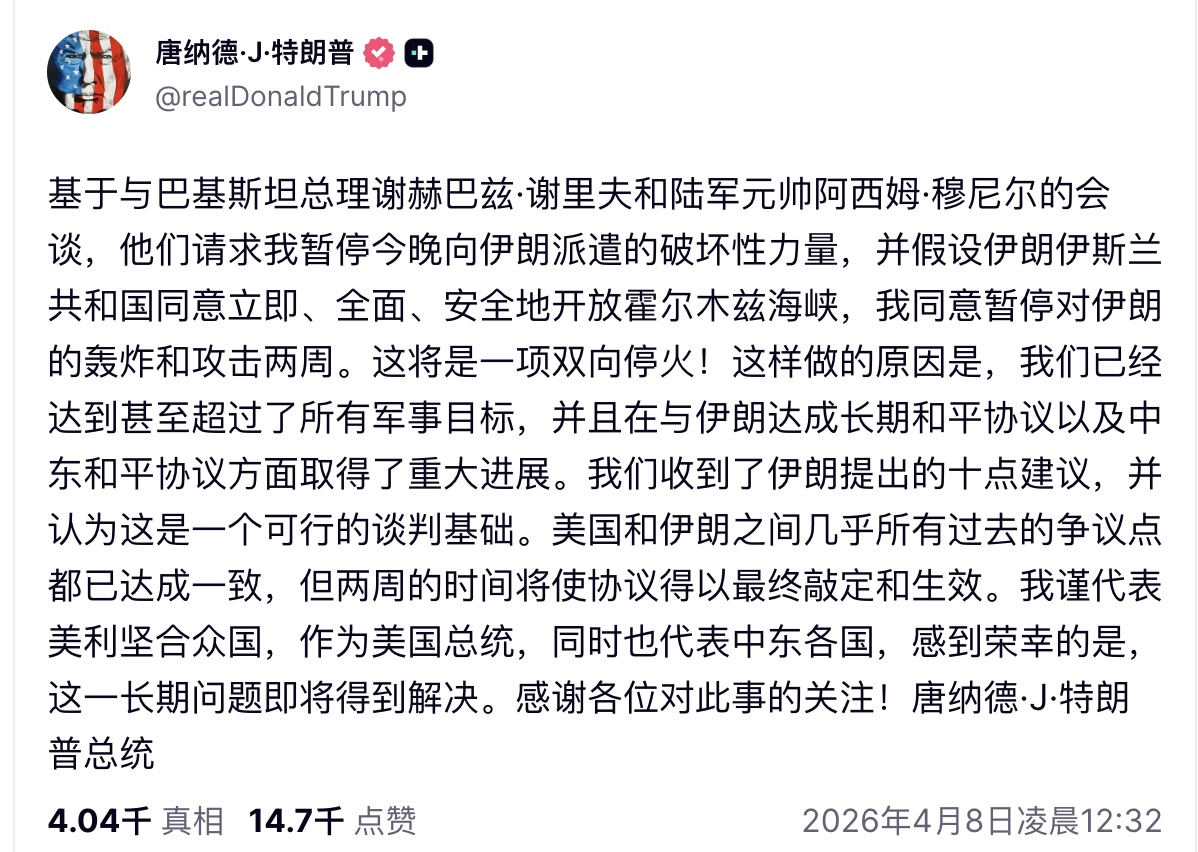
On April 10, 2026, under the mediation of Pakistan, the Iranian Supreme National Security Council and the U.S. government are set to initiate a two-week ceasefire negotiation in the Pakistani capital Islamabad. This meeting is formally defined as "ceasefire negotiations", but the atmosphere is far from a conventional peace process: Iran reiterates through official media its "complete distrust of the U.S.", while simultaneously agreeing to dialogue with the U.S. in a third country; it has been reported that the U.S. has proposed conditions including the demand for Iran to remove nuclear materials, touching upon the long-sensitive nuclear issue. On the battlefield, Iran has issued ceasefire orders to the military through state media, while Israeli media claims of ongoing strikes against Iranian targets (from a single source), creating a stark contrast of one side pulling back while the other continues to use force to shape leverage. It is against this backdrop of frontline tension that the market has referred to "negotiations under the gun" and has extended the view that a two-week time window could potentially alter the landscape of the Middle East crypto market (both are comments and views awaiting verification). Regardless of the outcome, this compressed negotiation process within two weeks is bound to reshape the boundaries of security in the Middle East and profoundly impact the pricing of risk sentiment in regional funds and crypto markets.
Ceasefire Order Issued: Iran Stops Fire to Gain Negotiation Space
Before officially entering negotiations, Iran sent a clear ceasefire signal through the national broadcasting agency IRIB: the military has been instructed to cease military actions against related parties. This action is interpreted by outsiders as a deliberate display of "restraint" by Iran before entering the venue in Islamabad—under the pressure of long-term sanctions and regional tensions, Iran needs to prove to potential neutral parties and onlookers that it is not the one actively escalating and is willing to transform part of its battlefield leverage into diplomatic leverage.
In contrast, according to single-source reports from Israeli media, Israel is still conducting strikes against Iranian targets, at least maintaining the narrative that "military actions are ongoing". This means that while Tehran chooses to take a step back in front of the gun, its opponent does not simultaneously hit the brakes, resulting in an asymmetrical picture of one side unilaterally ceasing fire while the other continues to use force. As this information currently only comes from a single channel, its specific scale and rhythm still need further verification, but it is enough to constitute a key background for the current negotiation atmosphere.
This "unilateral ceasefire" inevitably weakens Iran's position at the negotiating table: taking the initiative to cease fire means Iran has temporarily borne more military passiveness and deterrent pressure, while the "military means" that can be used as leverage are partially self-restrained. However, in the international public opinion arena, this decision gains Iran some moral upper ground—when one party announces a ceasefire while the other continues to use force, third parties are more likely to attribute "responsibility for de-escalation" to the party announcing the ceasefire, thereby providing Iran with discourse material in subsequent debates on sanctions and security arrangements.
It is also under this background of battlefield imbalance that the market and media have chosen to describe this round of negotiations as "negotiations under the gun": the ceasefire order has been issued, yet there is no guarantee that no new military friction will occur during the negotiation period; the military has been ordered to exercise restraint, but the shadows of missiles and drones have not dissipated. This asymmetry between the battlefield and the rhythm of negotiations amplifies the risk of unexpected conflicts occurring at any time during the process, and causes any probing by either side at the table to carry a stronger strategic uncertainty.
Complete Distrust Situation: Nuclear Materials Become the Hardest Leverage
Iran's public statement using the wording "complete distrust of the U.S." is not a momentary emotional outburst in diplomatic rhetoric, but rather a concentrated release after decades of mutual suspicion, sanctions, and nuclear disputes. From the long-standing confrontation following the Islamic Revolution to multiple rounds of economic sanctions and financial blockades, and to the signing and tearing up of agreements regarding the nuclear program, the Iran-U.S. relationship has always been structurally in a "cold confrontation model with a lack of trust foundation". This meeting in Islamabad is more about "forced management" pushed forward by crisis than any subjective readiness for reconciliation by either side.
Against this backdrop, the requirements for Iran to remove nuclear materials proposed by the U.S. have immediately come into the spotlight. It is important to emphasize that this condition also comes from a single source, with specific technical pathways, execution rhythms, and security guarantee mechanisms not publicly disclosed, and the outside world cannot confirm whether there are more detailed scheme designs. However, just the expression of "removal of nuclear materials" itself directly targets the nerve center of mutual suspicion between both parties.
The reason the nuclear material issue has become the most sensitive and least compromiseable leverage lies in its simultaneous involvement of three structural layers: national survival security, regional deterrence balance, and domestic political pressure. For Iran, the nuclear program is not only seen as a bottom-line deterrent but is also tied to national dignity and technological autonomy; any retreat on this issue could be interpreted domestically as a concession to the traditional adversary. For the U.S. and its regional allies, limiting Iran's nuclear capabilities is viewed as a bottom line to prevent regional proliferation and maintain its own security boundaries. Therefore, as long as both sides view the nuclear issue as a "life-and-death card," it is difficult to easily make reversible concessions in short-term negotiations.
In this highly distrustful atmosphere, this round of ceasefire negotiations is more akin to a "crisis management mechanism" attempt rather than a true reconciliation project. The more realistic goal for both sides is to lower the probability of uncontrolled conflicts breaking out in the following two weeks or even longer through some verifiable arrangements, rather than attempting to solve all structural contradictions within one session. In other words, this game is more about finding a "narrow road to avoid the worst outcome" without being seen as weak domestically, rather than pursuing the unimaginable total compromise.
Islamabad as the New Stage: Pakistan's Geopolitical Role
The choice to hold this two-week ceasefire negotiation in Islamabad, the capital of Pakistan, is not coincidental. Pakistan shares a border with Iran on one hand, maintains long-term interactions on security issues with the U.S. and multiple Gulf countries on the other, and has tight economic and strategic cooperation with major powers such as China. This multi-dimensional relationship provides a sort of "space that can be begrudgingly accepted by both sides" between Iran and the U.S.: it is neither a traditional pro-U.S. outpost nor simply viewed as a member of the Iranian camp.
In light of the confirmed fact of "Pakistan's mediation" by multiple reports, one can see a medium-sized country attempting to enhance its voice in the regional security architecture. By hosting this high-stakes meeting, Pakistan not only symbolically demonstrates its capability to coordinate complex conflicts but also secures more opportunities for dialogue in the future regarding energy transportation routes, security cooperation, and regional financial connectivity. This role of "security intermediary", if proven to have some stability, could continue to be replicated and expanded in future crises.
Whether the Pakistani Prime Minister issued a specific invitation through social media remains a matter of information awaiting verification, requiring further verification of relevant accounts and publication times. For the sake of caution, this article does not treat such news as a settled fact, nor does it deduce any personnel-related arrangements based on this, but only takes the confirmed dimension of "Pakistan as the host and mediator" as its analytical foundation.
If within the next two-week window, the Islamabad negotiations can achieve even limited ceasefire results, such as establishing some form of verifiable de-escalation mechanism or reaching consensus to expand participation to more actors, then Pakistan's position in the diplomatic landscape of the Middle East will be significantly elevated: diplomatically, it could be seen as an optional communication channel between multiple great powers; in terms of energy and transportation, a stable security role would help secure more investments related to pipelines and ports; in financial connections, it has the opportunity to strengthen its potential as a regional transit point for funds by leveraging its dual ties with Middle Eastern oil-producing countries and Asian economies.
Two-Week Time Window: A Compressed Test from Battlefield to Market Sentiment
This Islamabad meeting is set for two weeks, and the timing itself reinforces the color of a "crisis window" rather than an "open peace process". Within the limited 14 days, both sides must rapidly judge which issues can be temporarily frozen and which red lines cannot be crossed under the dual clocks of ongoing military friction and domestic political pressure. This compressed timetable makes each round of discussions feel more like a negotiating time period seized in a countdown rather than a slow-paced security dialogue.
Within this tense atmosphere, both the cryptocurrency and traditional financial markets quickly captured the uncertainty premium of the negotiations. Some crypto media described this round of discussions as "negotiations under the gun", and some analysts proposed the view that "the two-week time window may change the landscape of the Middle East crypto market". These judgments currently belong to market commentary and analytical expectations, still untested empirically, and should be regarded as emotional indicators awaiting verification, rather than definitive predictions of specific prices or capital flows.
From a macro perspective, the trends during these two weeks will transmit to the market through oil prices, regional funding risk preferences, and risk asset sentiment. If the ceasefire achieves phased results, even just establishing clear de-escalation mechanisms on a technical level, the risk premium for disrupted oil supply could marginally decline, and the risk discount for investments related to Middle Eastern sovereignty could also be gently corrected, leading to an improvement in the sentiment of risk assets driven by the narrative of "avoiding the worst-case scenario". Conversely, if the negotiations collapse and expectations for military escalation rise, the risk premium for oil prices will be raised again, regional assets will face deeper discount pressures, and global capital’s risk appetite for highly volatile assets may temporarily contract.
In terms of Middle Eastern funding and crypto trading behavior, geopolitical tensions have always been amplifiers of short-term risk aversion and speculative sentiment: conflict expectations often trigger part of the capital to shift towards assets that are easier to transfer across borders and rely less on single sovereign risks, while also attracting high-risk preferring traders to exploit price differentials amid volatility. This round of negotiations being compressed within a two-week window means that this amplification or mitigation of sentiment will also be released intensively within a limited timeframe—if the talks convey stable signals, speculative heat may quickly cool down; conversely, if expectations of a "breakdown" prevail, it could reignite cross-market volatility trading surrounding geopolitical conflict.
Domestic Political Constraints for the U.S. and Iran: Tough Image and Minimum Rationality
From the perspective of the U.S. government, engaging in ceasefire negotiations with Iran in Islamabad must maintain a delicate boundary of tough image among multiple domestic and foreign audiences. On one hand, the U.S. needs to prove to its allies, especially Israel, that it has not "let go" on key security issues and still insists on exerting pressure on Iran's nuclear program and regional behavior; on the other hand, different factions in Congress regarding the long-term stance on Iran, along with domestic voters' sensitive sentiments toward Middle Eastern involvement, also require the government to provide interpretable security benefits before and after any concessions. Therefore, even when entering the negotiation scene, the U.S. side will still emphasize its bottom line to avoid being characterized as "softening towards Iran" in domestic politics.
For Iran, this negotiation led by the Supreme National Security Council also faces dual restraints from hardliners within the system and societal sentiment. In the narrative of long-term sanctions and regional confrontation, publicly emphasizing "complete distrust of the U.S." serves as a political signal to maintain internal unity and appease dissenting voices: it ensures that even if Tehran makes tactical adjustments by stopping fire, it won’t be interpreted by internal hardliners as "showing weakness to the U.S.". This discourse framework sets a boundary for the negotiations—dialogue can proceed, but the tone of "principled distrust" will not easily change.
Because both countries' leadership must account to their respective domestic audiences, this round of negotiations is more likely to pursue "promotable phased results" in the short term rather than attempting to package and resolve all unresolved contradictions. For example, even achieving limited consensus on conflict de-escalation, unexpected control, or humanitarian corridors can be packaged as evidence that the government is "effectively safeguarding national interests" in a crisis, thereby winning some maneuvering space among voters, parliament, or within the system.
This domestic political constraint objectively compresses the feasible space for negotiation—the truly structural contradiction issues are often shelved or postponed, leaving limited operational space for negotiators. However, it is these very constraints that force both sides to maintain a certain minimum rationality in avoiding comprehensive escalation: once conflicts spiral out of control and the region escalates into a larger-scale confrontation, explaining to their domestic audiences why the existing crisis management window was not seized becomes difficult for both the U.S. and Iran. This "fear of being accountable for loss of control" political pressure inadvertently becomes a hidden motivation to push for negotiations to at least remain on the table.
Shadows of Conflict Not Yet Dispersed: What We May Really See in Two Weeks Is Just the Beginning
In summary, this round of ceasefire negotiations taking place in Islamabad carries threefold tension: firstly, while Iran's ceasefire order is announced, Israeli media claims to continue striking Iran (single source), creating an asymmetrical situation of one side pulling back and the other continuing to hit; secondly, under the open declaration of "complete distrust", Iran and the U.S. are still forced to sit at the same table, intertwining crisis management with domestic political needs; thirdly, the intervention of Pakistan as a third-party mediator adds new variables to the overall game—potentially serving as a buffer zone, or being drawn into more expectations and pressures at critical moments.
Two weeks later, reality may present various paths. The relatively optimistic scenario is reaching a limited ceasefire consensus or some form of de-escalation mechanism to reduce the pace of conflict escalation in the short term; another possibility is to postpone negotiations through technical arrangements, leaving more sensitive issues for the next round of discussions; the most pessimistic outcome would be the negotiation breakdown, accompanied by further military actions and rhetorical escalation. All these scenarios are projections based on existing information, rather than predictions for the future; the specific direction will still be shaped by battlefield dynamics, domestic politics, and third-party actions.
In focusing on Middle Eastern risks and market volatility, it is even more important to learn to distinguish between different levels of information: which have been confirmed by multiple parties, which come from a single source, and which are still in the stage of unverified social media or market commentary. Especially in an environment filled with emotional narratives, simply framing negotiations as "victories" or "failures" often obscures the complex security considerations and political calculations behind them, and can easily be over-interpreted as linear guidance for asset prices.
Even if this two-week window ultimately does not bring about dramatic turnarounds, this "negotiation under the gun" will still have a lasting impact on the safety and funding risk preferences in the Middle East for the foreseeable future. How all parties remember this meeting and shape its significance afterwards will influence the risk pricing of regional investors and global capital towards the Middle East for a long time—ultimately, the market will find new premium levels for this uncertainty through repeated cycles of conflict and negotiation.
Join our community to discuss and grow stronger together!
Official Telegram community: https://t.me/aicoincn
AiCoin Chinese Twitter: https://x.com/AiCoinzh
OKX benefit group: https://aicoin.com/link/chat?cid=l61eM4owQ
Binance benefit group: https://aicoin.com/link/chat?cid=ynr7d1P6Z
免责声明:本文章仅代表作者个人观点,不代表本平台的立场和观点。本文章仅供信息分享,不构成对任何人的任何投资建议。用户与作者之间的任何争议,与本平台无关。如网页中刊载的文章或图片涉及侵权,请提供相关的权利证明和身份证明发送邮件到support@aicoin.com,本平台相关工作人员将会进行核查。