Original author: Zhao Ying
Original source: Wall Street Watch
The achievement of the ceasefire agreement between the United States and Iran is progressing according to a repeatedly validated script.
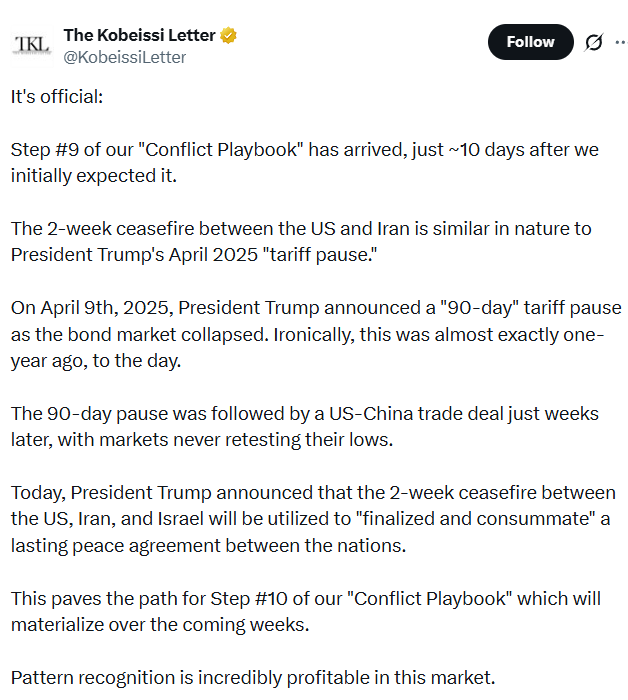
The independent macro research organization The Kobeissi Letter recently stated, following Trump's announcement of a two-week ceasefire agreement between the U.S., Iran, and Israel, the ninth step of its tracked "conflict script" has officially arrived, which is the achievement of the agreement and the construction of the narrative framework. This arrival is approximately ten days later than the organization previously anticipated.
The Kobeissi Letter stated that according to Trump's deal-making manual, every major confrontation framed by Trump ultimately concludes with the narrative of "maximum pressure in exchange for concessions."
This development's potential impact on the market cannot be ignored. The Kobeissi Letter pointed out that the tenth step—market violent repricing after the formal announcement of the agreement—will come in the following weeks. By then, investors who have been in defensive positions will face pressure to rapidly close their positions, the stock market may experience a sharp rise, and oil prices could plummet as expectations for the reopening of shipping channels are established.
Ceasefire and Tariff Suspension: The Same Logic
According to CCTV News, based on reports from Iran at 3:30 AM local time on the 8th, Pakistan's Prime Minister Shahbaz Sharif has invited Iranian and U.S. delegations to Islamabad for negotiations. Shahbaz Sharif also stated that the ceasefire between the U.S. and Iran will take effect at 3:30 AM Iran time (8 AM Beijing time) on the 8th. Trump stated that this ceasefire window will be used to "finalize and promote" the signing of a lasting peace agreement among all parties.
The Kobeissi Letter compared this two-week U.S.-Iran ceasefire to Trump's "90-day tariff suspension" announced in April 2025, believing the two are highly similar in nature.
On April 9, 2025, against the backdrop of intense turbulence in the bond market, Trump announced a 90-day suspension of tariff increases on most trading partners. In the following weeks, a U.S.-China trade agreement was promptly reached, and the market did not re-test previous lows. The Kobeissi Letter pointed out that the timing of this ceasefire announcement is almost exactly one year apart from the aforementioned tariff suspension.
The organization believes that this pattern is not coincidental. Since Trump took office in January 2025, he has followed a highly consistent negotiation logic concerning the trade war, Venezuela, Greenland negotiations, and Iranian issues: verbal pressure and maximum pressure in exchange for concessions, ultimately ending with "a deal."
Ninth Step: Constructing the Agreement Narrative
According to the 10-step "conflict script" outlined by The Kobeissi Letter, the core of the ninth step is the achievement of the agreement and the construction of the narrative framework.
The organization pointed out that every major confrontation within Trump's framework ultimately concludes with the narrative of "maximum pressure in exchange for concessions." Whether it’s trade agreements with the EU, India, company negotiations in the semiconductor and rare earth sectors, or several conflicts concluded by Trump in 2025, this model has been validated.
Regarding the Iranian issue, The Kobeissi Letter believes that if the Iranian government does not collapse, the final agreement may involve a ceasefire arrangement linked to nuclear issues, a regional security framework with accompanying enforcement mechanisms, or a sanctions adjustment plan conditioned on compliance benchmarks. The organization emphasized that "the importance of the specific architecture far exceeds that of the timing and narrative framework."
Tenth Step: Waiting for Violent Repricing
The Kobeissi Letter warns investors that the market repricing after the announcement of the agreement is often sudden, not gradual.
The reason lies in the current market participants being generally in defensive positions—high energy exposure, compressed stock risks, and high volatility due to latent uncertainties. Once uncertainty suddenly dissipates, these positions will be quickly liquidated, resulting in a concentrated market shock.
The organization cited historical cases from April, August, and October 2025, as well as January 2026, pointing out that after each tariff suspension or framework agreement announcement, the stock market saw significant sharp rises, while oil prices rapidly fell as expectations for the reopening of shipping channels were established. The Kobeissi Letter concluded: "Pattern recognition has extremely high profit value in this market."
免责声明:本文章仅代表作者个人观点,不代表本平台的立场和观点。本文章仅供信息分享,不构成对任何人的任何投资建议。用户与作者之间的任何争议,与本平台无关。如网页中刊载的文章或图片涉及侵权,请提供相关的权利证明和身份证明发送邮件到support@aicoin.com,本平台相关工作人员将会进行核查。


