Text | Sleepy.md
Every escape of human civilization starts like this.
In September 1620, 102 people squeezed into a wooden ship named the "Mayflower," setting sail from Plymouth, England, into the treacherous North Atlantic. The cramped cabin held not just luggage, but an entire set of political blueprints; they aimed to build a "city upon a hill" in the New World, a new world free from the constraints of the Church of England and the exploitation of corrupt aristocrats.
They did not come for adventure, nor for commerce, but were merely a group trying to escape their fate.
One hundred sixty-eight years later, in 1788, the first batch of British prisoners was exiled to Australia. At that time, Europeans viewed that continent as the edge of the world, a natural place of exile employed to discard unwanted individuals and let them fend for themselves. As a result, those abandoned prisoners rooted themselves there, built cities, and formed a nation.
Going further, the California Gold Rush in 1848, the great development of Siberia in the 1880s, the Brazilian rubber boom in the early 1900s... Each time human civilization attempted a "reset," it always followed the same script: searching for unclaimed land, announcing the arrival of a new order, and subsequently inundating it with capital, human flow, and technology, weaving a brand new logic of survival from harsh adversity.
Now it is Mars' turn.
But the difference is that the Mayflower had the tacit approval of the British government, Australia was already a colony of the British Crown, and the California Gold Rush was backed by U.S. federal land policies. This time, the driving force behind the process is no longer any national will, but a group of private capital, including venture capitalists, Silicon Valley entrepreneurs, former NASA engineers, and Elon Musk.
Colonialism driven by national will is colored by taxes, military force, and sovereignty logic; while colonialism born from private capital is inscribed with return rates, exit strategies, and narrative premiums. The civilizations nurtured by these two underlying logics are destined to differ vastly from the very beginning.
So, what are these people wielding private capital betting on?
While you are anxious about AI, they are discussing Martian mining rights
On an ordinary workday in 2025, Tom Mueller is pitching his new company to a group of investors.
Mueller is not an ordinary entrepreneur. He worked at SpaceX for nearly 20 years, personally designing the Merlin engines for the Falcon 9, the very engines that sent humans to the International Space Station, placed satellites into their intended orbits, and lifted SpaceX from the brink of bankruptcy into a commercial empire valued at a trillion dollars today.
At the end of 2020, Mueller left SpaceX and founded Impulse Space. The core mission of this new company can be summed up in one sentence: to deliver cargo to Mars orbit.
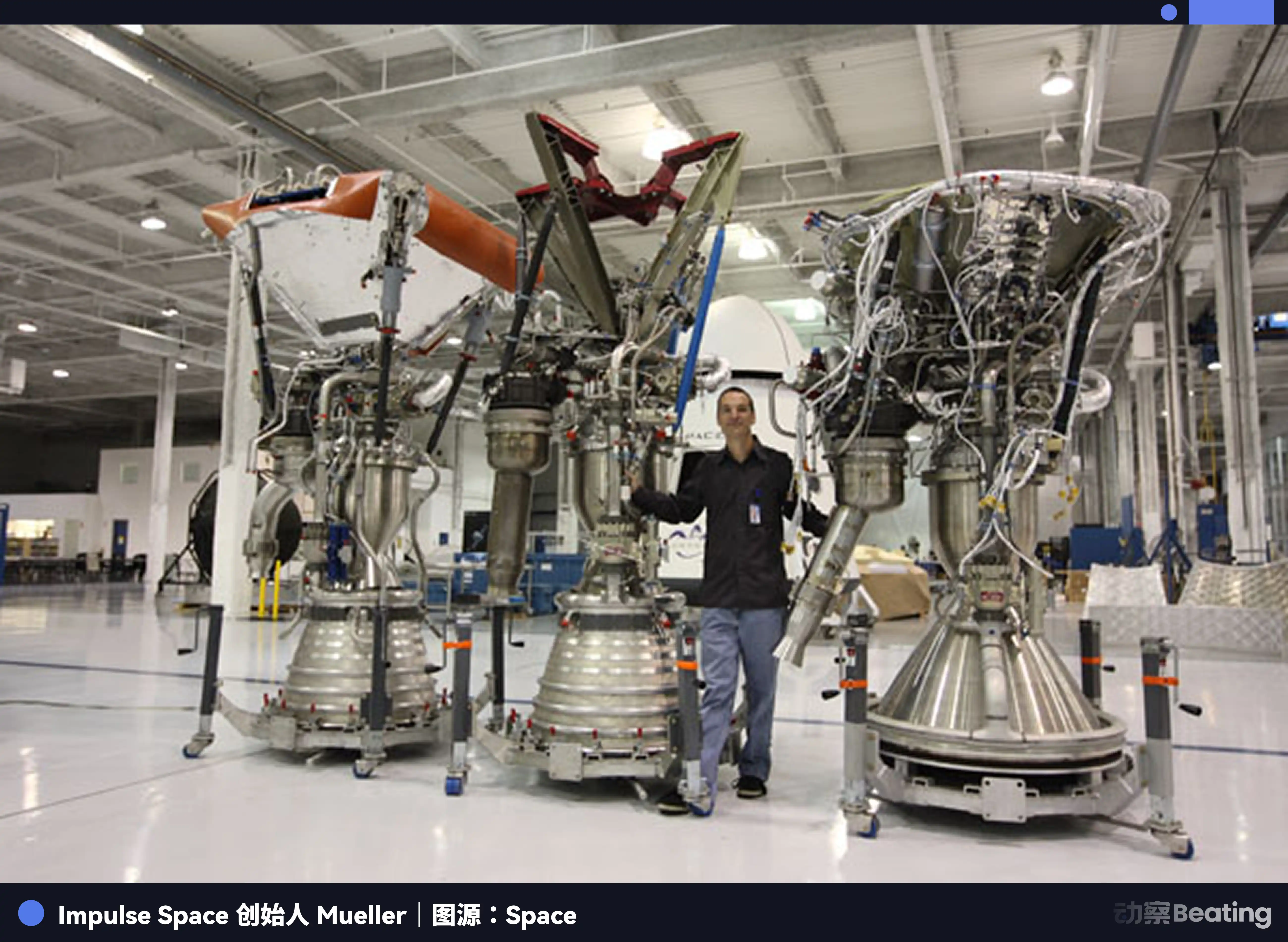
Yes, the target is not low Earth orbit, nor the Moon, but Mars orbit.
His target clients are those organizations and companies eager to deploy satellites, probes, and supply pods in Mars orbit. His logic is exceptionally clear: the infrastructure for Mars missions must start construction from this moment. By the time Musk’s Starship truly soars, there needs to be someone already waiting in that orbital path.
In June 2025, Impulse Space secured $300 million in Series C funding, raising its total funding to $525 million. The list of investors is quite glamorous, with Linse Capital leading the round, and Founders Fund, Lux Capital, DCVC, and Valor Equity Partners following. Founders Fund is Peter Thiel’s fund, and Valor Equity Partners is an early investor in Musk’s companies. This is by no means a group of frenzied retail investors driven mad by Mars fantasies, but rather some of the savviest capital in Silicon Valley.
Now, focusing on the present, the hottest topic in your social circle is "Will AI cost me my job?"
On the same planet and timeline, some are anxious about their current jobs day and night, while others are gaming the ownership of Martian mining rights. This is the most real cognitive time lag; different people are folded into different time dimensions, some living in 2025, some in 2035, and others in 2050.
This cognitive time lag is not a new phenomenon. In the early 1990s, when most Chinese were still debating whether to buy a color TV, a small group was already tinkering with the internet; by the early 2010s, while the majority were still pressing Nokia keyboards, others were developing mobile apps.
Each wave of technological advancement inevitably creates such time differences. Those who first opened their eyes are not necessarily smarter; rather, they find themselves in a vortex of information and capital that compels them to seek answers to the farther future.
However, this time the time lag is more pronounced than ever before.
The anxiety over AI is certainly real, yet it remains a concern bound to the "now." On the other hand, the Martian industry is a gamble on the "future," and this future spans not merely five years, but twenty or fifty years.
The Martian Industry Chain
When mentioning the "Martian industry," many people’s first instinct is to view it as an unreachable sci-fi, Musk's fanciful daydream, or Silicon Valley billionaires' money-burning toys.
This assertion was completely valid in 2015 and still broadly accepted in 2020, but by 2025, it is no longer tenable.
The current form of the Martian industry chain closely resembles the internet of 1998. At that time, the infrastructure had not yet been built, most companies were still burning cash, and the business model was not clear, but there was already sufficient real capital, real technology, and real talent operating within it. You could say it’s Still Early, but you absolutely cannot deny its existence.
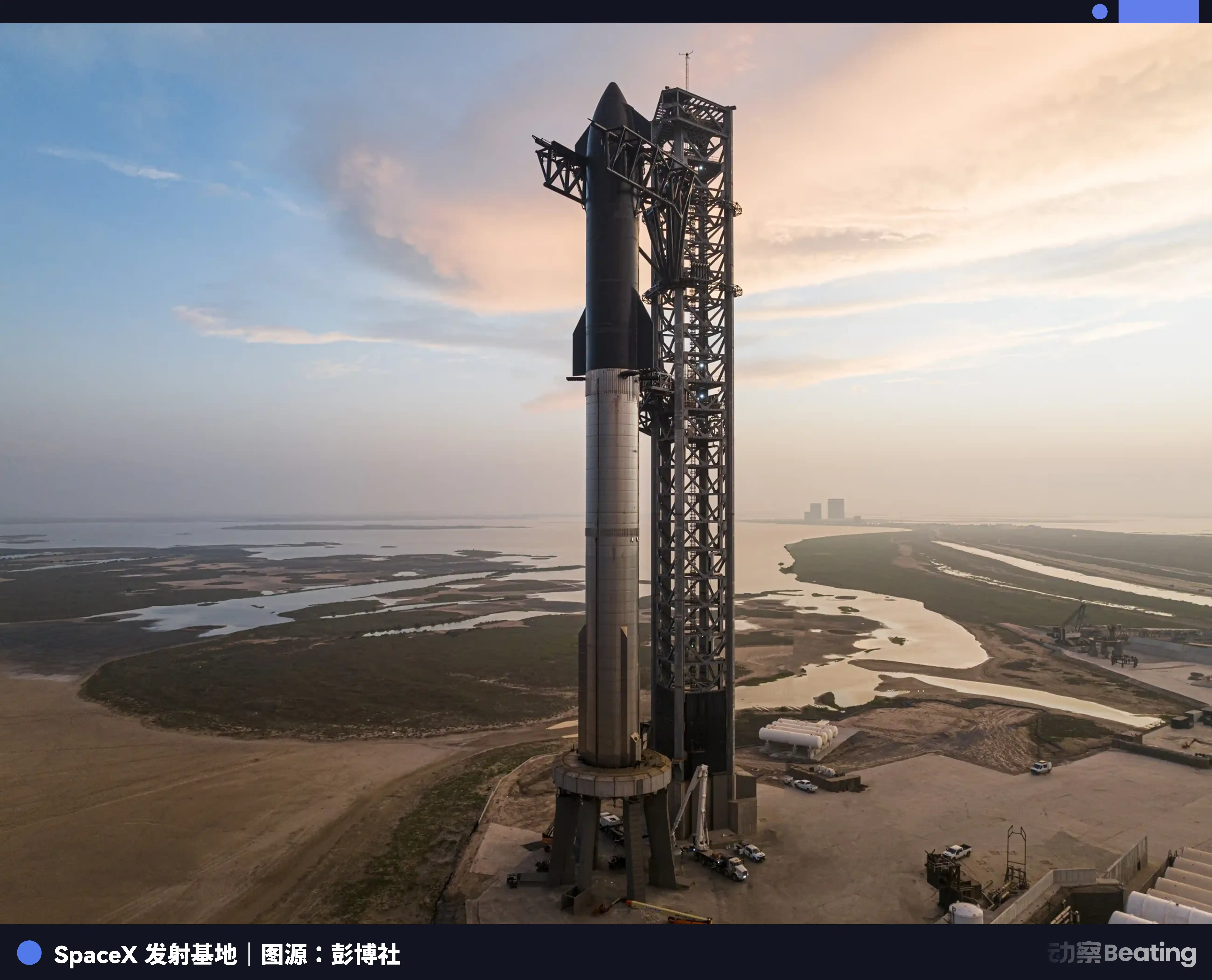
This industry chain spanning the stars can be roughly broken down into five layers.
The first layer: launch.
To send items from Earth to Mars, rockets are mandatory. In this foundational infrastructure, the leader is undoubtedly SpaceX's Starship, but another company named Relativity Space also warrants attention.
This company is focused on using robots to 3D print an entire rocket. Their rocket, Terran R, has 95% of its parts printed, from engines to airframe. Previously, Relativity Space held $2.9 billion in launch contracts. Their rationale is that traditional rocket supply chains are too long and fragile; once they enter a high-frequency, large-scale launch phase, component supply becomes a bottleneck. 3D printing can compress the supply chain to its limits, as all you need is a stack of raw materials and a printer.
The second layer: orbital transport.
Delivering goods from low Earth orbit to Mars orbit presents entirely different engineering challenges, requiring specialized propulsion systems and orbital planning. This is precisely the domain that Mueller's Impulse Space is tackling. They are developing propulsion systems capable of enabling spacecraft to perform precise micro-maneuvers in deep space. It’s an essential infrastructure for future Martian expeditions, just as logistics are vital to today's vast e-commerce empires.
The third layer: construction.
Once humans land on Mars, where will they live? The most interesting company in this layer is called ICON, a 3D printing construction firm. They have successfully printed residential and military bases on Earth and currently hold a NASA contract worth $57.2 million, focusing on how to use local materials to 3D print human habitats directly from Martian soil (basalt, perchlorate, sulfur). This plan is named Project Olympus.
Moreover, ICON has created a Mars habitat simulation module named CHAPEA for NASA in Houston, Texas. This full 3D-printed habitat spans 158 square meters, and in June 2023, it welcomed four volunteers. They are neither actors nor influencers but scientists and engineers carefully selected by NASA. During the 378-day Mars survival simulation, they grew their own food, had to wear spacesuits when venturing outdoors, and even their communication with the outside world was set to have a strict delay of 22 minutes one way, reflecting the actual communication delay between Mars and Earth.
On July 6, 2024, this long and lonely interstellar survival exercise officially concluded.
The fourth layer: mining.
What resources exist on Mars? Iron, aluminum, silicon, magnesium, along with substantial amounts of carbon dioxide and water ice. But more commercially appealing are the asteroids surrounding Mars. Those rocks are rich in platinum group metals that are exceedingly scarce on Earth—platinum, palladium, rhodium—elements that are critical to today’s new energy vehicles, semiconductors, and hydrogen energy industry chains.
A company called AstroForge is dedicated to mining these metals from asteroids. In February 2025, they successfully launched their first mining satellite, Odin, headed for asteroid 2022 OB5. A total of $55 million in financing is not much in the aerospace sector, but they are the first private company in the world to send a mining satellite into deep space.
The fifth layer: energy and resources.
Mars is barren, lacking fossil fuels, solar energy efficiency is only 43% of that on Earth, making nuclear energy the only realistic option. But a more epoch-making energy treasure lies on the Moon. There is a massive amount of helium-3 there, an isotope extremely scarce on Earth but plentiful on the lunar surface that is regarded as theoretically the most perfect fusion fuel.
A company called Interlune is ardently working on lunar helium-3 extraction technology. In May 2025, they officially signed a purchase agreement with the U.S. Department of Energy. This is not just a transaction; it represents the first government procurement contract in human history targeting resources from extraterrestrial celestial bodies.
Each of these five layers has operational companies, real financing, and hardcore technologies being implemented. In 2025, total financing for global space startups is nearing $9 billion, showing a year-on-year increase of 37%. This is not an abstract sci-fi fantasy but a real industry that is taking shape.
However, there is one question, a very real question: do these investors who have poured in hefty sums truly believe they will see tangible returns within their lifetime?
The grander the dream, the easier the money flows
Among these investors, few genuinely believe they will live to see the completion of Martian cities.
Josh Wolfe, a partner at Lux Capital, once said in an interview that their heavy bets on space enterprises are not about wagering on a specific delivery schedule, but rather they value that these companies, whether successful or not, will craft valuable technological byproducts while tackling interstellar challenges.
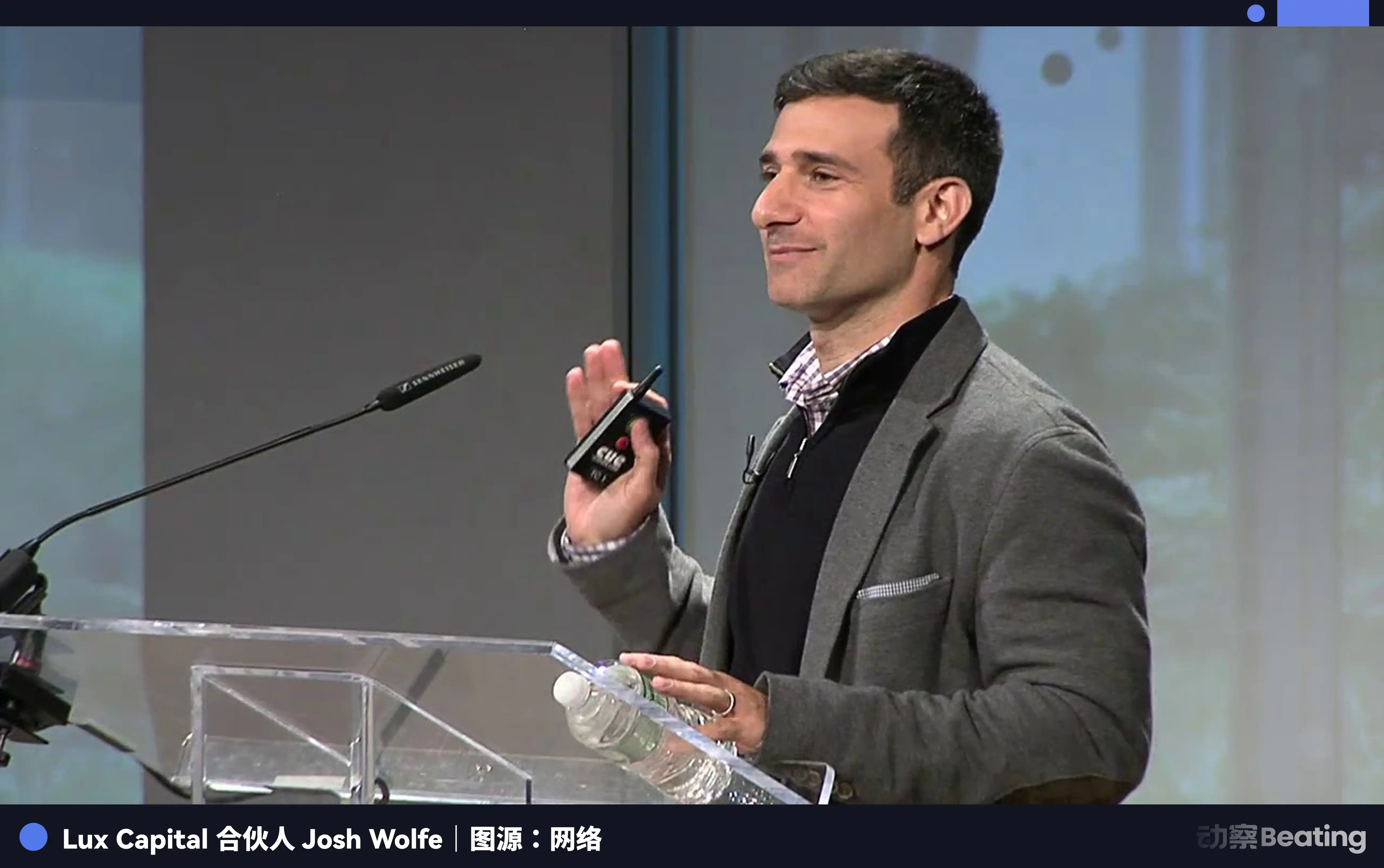
Interlune developing lunar helium-3 extraction technology means that, even if lunar mining never becomes a closed-loop business, the technologies they develop in low-temperature separation and vacuum operations will still have vast applications in Earth’s semiconductor and medical device fields. ICON's insistence on printing houses out of Martian soil means that even if the timeline for Mars colonization is pushed back fifty years, it is still acceptable, because their 3D printing technology has already proven its business model in the low-cost housing market on Earth.
This is fundamentally a "win-win" investment structure. Capital is not gambling purely on Mars; rather, it is using Mars as a name to hedge against the uncertainties of operations on Earth.
But this is just the first layer of this logic. The underlying second layer is even more intriguing.
On April 1, 2026, SpaceX secretly submitted an IPO application. The target valuation is $17.5 trillion, with a plan to raise $75 billion. If this number comes true, it would be the largest IPO in human history, exceeding Saudi Aramco’s $25.6 billion in 2019, Alibaba’s $25 billion in 2014, and surpassing everyone’s imagination.
In the IPO documents, three uses for the raised funds were listed: first, to push the launch frequency of Starship to "crazy limits"; second, to deploy AI data centers in space; and third, to fully drive both manned and unmanned Martian expeditions.
Note the order of this arrangement. Mars is last, but it is the ceiling of the entire valuation narrative.
If you remove Mars from SpaceX’s story, what remains? Just an ordinary rocket manufacturer and a satellite internet business named Starlink.
The valuation ceiling for rocket companies is likely in the same range as Boeing or Lockheed Martin, at a few dozen billion dollars. Starlink is a solid business, but in the increasingly clear competition landscape of the satellite internet sector, it absolutely cannot provide a $17.5 trillion valuation.
Only Mars, Mars alone, can serve as the ultimate narrative lever to force the valuation from "tens of billions" to "trillions."
This is the most extreme play of "expected economics." The narrative lever activates capital, capital goes in to fuel technology, technology solidifies the narrative, and then leads to larger scale capital raised. This flywheel is one Musk has thoroughly operated.
When SpaceX was founded in 2002, the market didn't believe that a private company could send people to the International Space Station. In 2012, when the Dragon spacecraft docked with the ISS for the first time, those who had mocked Musk began to change their tune. In 2020, SpaceX sent astronauts to space in the Crew Dragon, delivering on NASA contracts. Each technological milestone turned narrative into reality, and then reality spawned new narratives.
Within this closed loop, “belief” itself elevates to a productive force. Betting due to belief fuels funding into technology, technology validates faith, further igniting more fervent followership and a surge of hot money.
Yet this logic has one prerequisite: Musk himself must believe.
"No way to escape"
In June 2025, during an interview with New York Times columnist Ross Douthat, Peter Thiel made a profound statement: "2024 will be the year Musk stops believing in Mars."
Peter Thiel is one of Musk's oldest friends and one of his earliest investors. The two co-founded PayPal and fought through the harsh early days of Silicon Valley together. What he says carries much more weight than outsiders’ speculations.

According to Thiel, Musk's initial plan was to construct Mars into a political utopia of radical libertarianism. This concept had a very clear cultural anchor—Robert Heinlein’s famous sci-fi work, "The Moon is a Harsh Mistress."
The book depicts a group of prisoners exiled to the Moon, who, after breaking free from Earth’s regime, establish a spontaneous order and ultimately ignite revolutionary flames to declare independence. Musk wore out this book; he wanted to replicate that story on Mars, creating a special zone on Mars that is free from U.S. government taxation, devoid of EU regulation, and absolutely rejecting "woke culture." Everything operates under the most ruthless laws of a free market where the winners take all and the weak are eliminated.
This ambition Musk has never explicitly stated, but it serves as the underlying driving force of the entire Mars plan. Going to Mars has never merely been a technological expedition; it is, at its essence, a grand political escape.
Until one day, Musk had a conversation with DeepMind CEO Demis Hassabis. Hassabis casually dropped the line: "You know, my AI will follow you to Mars."
The implication was that there is no escape. When you migrate humanity to Mars, you also pack all of humanity's values, biases, power structures, and ideologies along. AI is the very condensation and amplifier of all these societal afflictions. The type of AI you cultivate on Earth will eventually take form on Mars. Mars has never been a pristine blank canvas; it is merely a copy of Earth, at a steeper cost and with harsher survival.
Musk fell silent for a long time before finally uttering, "No way to escape. Truly, no way to escape."
In Thiel's view, it was this conversation that forcibly pushed Musk into the political arena in 2024. Instead of establishing a utopia on Mars, it would be better to change power structures directly on Earth. This is the deep reason behind his full support for Trump and his deep involvement with DOGE (Department of Government Efficiency). Since running away is not an option, he might as well completely transform the very place he originally wanted to escape.
The Puritans on the Mayflower crossed the Americas, but they also carried the rigid class structure, racial biases, and power logic of England into their ship’s cabin. The "city upon a hill" they painstakingly built eventually became merely a reflection of the old world, where slavery, class rigidity, and religious grievances reignited, merely with a different rhetoric.
The exile land in Australia is no different; it perfectly replicated the class order of the British Empire, merely transferring the title of "nobility" to "free immigrants." Each time humanity attempted to rebirth a new order in the New World, it unconsciously implanted the genes of old civilization within.
Humans carry their ideologies with them; wherever they go, their ideologies follow.
The struggle to escape itself becomes an undeniable proof of their inability to flee.
If that's the case, does this trillion-dollar interstellar endeavor still hold significance? Under the shadow of civilization having nowhere to escape, is there anyone still participating in this Sisyphean expedition?
But the Starship still needs to fly
After Musk's "no way to escape" statement, he did not stop his forward motion.
By the end of 2026, the Starship still needs to fly, carrying Tesla Optimus robots to step onto Mars's red soil first, to pave the way for subsequent manned missions. In 2029, the countdown for manned expeditions will officially commence. To build a Mars city with a population of one million means pouring in a million tons of supplies, gathering a thousand Starships, and completing ten thousand launches, with the overwhelming launch costs alone reaching a staggering one trillion dollars. To this day, Musk continues to recite these enormous and dizzying figures under the spotlight.
But this is not just his story.
In March 2025, AstroForge's mining satellite Odin completely lost contact in deep space.
It was launched aboard SpaceX's Falcon 9 on February 26, 2025, as a secondary payload of mission IM-2, aimed at asteroid 2022 OB5. Its mission was to capture images of the rock’s surface to verify whether it indeed housed platinum group metals.
At the beginning of the launch, everything was normal. However, soon, the ground stations began to lose signal. The Australian main station went down, the backup stations were misconfigured, another station's power amplifier was mysteriously damaged before launch, and even a newly constructed mobile signal tower interfered, completely disrupting the reception frequencies. Thus, Odin vanished into silence, drifting in the dark expanse of space 270,000 miles from Earth, its fate uncertain.
Faced with this debacle, AstroForge CEO Matt Gialich wrote in the recap report: "At the end of the day, you’ve got to step into the ring and give it a shot. You’ve got to try."
With a self-mocking dark humor, they dubbed this failed mission "Odin't" (Odin + didn't). Shortly afterward, they decisively launched the grand plan for DeepSpace-2, a colossal object weighing 200 kilograms, equipped with electric propulsion and landing legs, this time aimed at truly landing on an asteroid.
This is the authentic texture of the aerospace industry. It is not the lightweight game of "fast iteration, embrace failure" seen in Silicon Valley, but a heavier, more desolate fate. When you cast your painstaking creations into deep space, once contact is severed, they become an unnamed speck of dust in the vast universe. You cannot know its final resting place, nor can you seek its wreckage; all you can do is swallow the vast silence and return to create another.
On July 6, 2024, in Houston, Texas. As the 3D-printed hatch slowly opens, four volunteers who completed their 378-day "Mars exile" return to the world.
Microbiologist Anca Selariu faced the camera and said, "Why go to Mars? Because it is genuinely possible to achieve. Deep space can firmly connect humanity and ignite the most radiant light in our souls. This is a small step for Earthlings, yet it suffices to illuminate the long nights of many centuries ahead."
Structural engineer Ross Brockwell frankly admitted that his deepest realization during this seclusion was: in the face of the boundless sea of stars, imagination and reverence for the unknown are the most precious qualities that sustain humanity's progression.
Meanwhile, medical officer Nathan Jones's gains from this long isolation were deeply introspective. He summarized his experience: "I learned to enjoy every season of the present and calmly await the arrival of the next season." Over the course of more than three hundred days, he learned to paint.
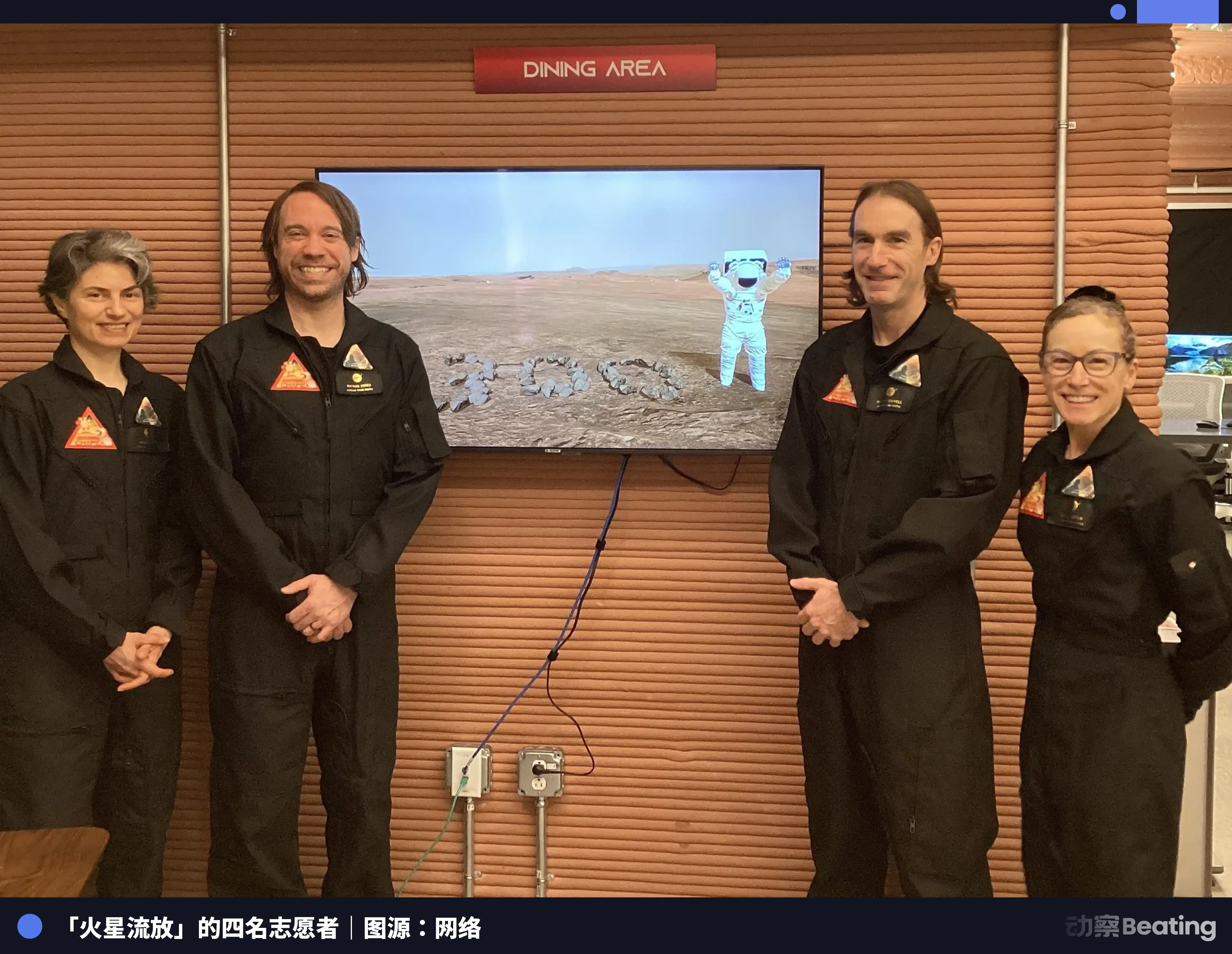
These four individuals are not Musk. They do not bear the myth of $17.5 trillion in capital, nor does anyone care about their brief remarks on social networks. They entered that room because someone had to go and try it first. Gialich launched that satellite because someone had to go and try it first. Mueller left SpaceX and started Impulse Space because someone had to go and try it first.
In response to Musk's pessimistic "no way to escape," these individuals did not run away, nor did they give up; instead, they went to experience what that place is really like.
After Selariu exited the capsule, she said, "I really appreciate being able to access information again anytime, but I will miss the luxury of disconnecting. After all, in this world, a person's value seems to be defined by their presence in the digital world."
She spent 378 days in a simulated Martian room, and upon returning to the bustling Earth, the thing she missed most was the tranquility there.
免责声明:本文章仅代表作者个人观点,不代表本平台的立场和观点。本文章仅供信息分享,不构成对任何人的任何投资建议。用户与作者之间的任何争议,与本平台无关。如网页中刊载的文章或图片涉及侵权,请提供相关的权利证明和身份证明发送邮件到support@aicoin.com,本平台相关工作人员将会进行核查。


