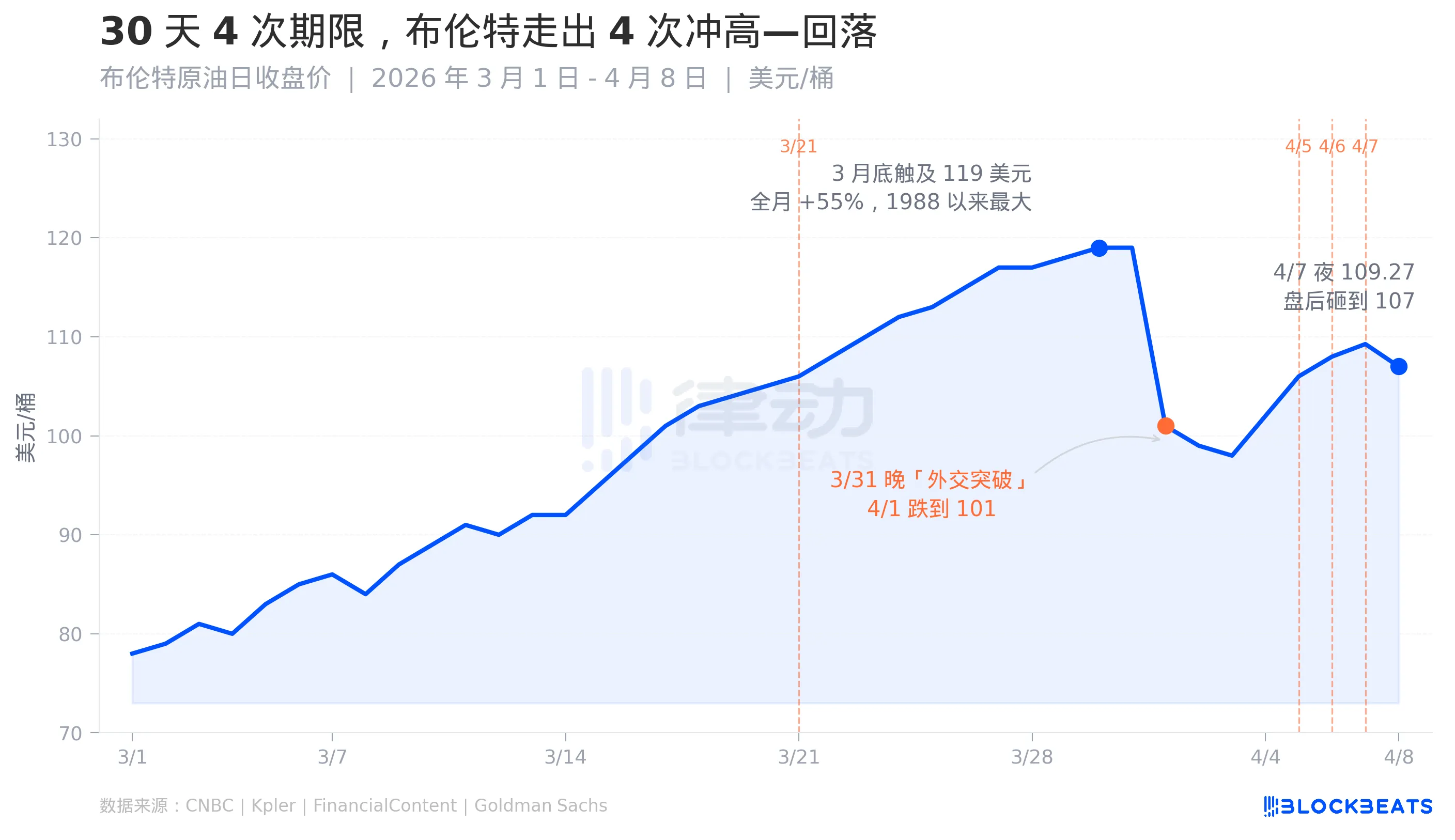
At 8 a.m. Beijing time on April 8, Trump wrote that line on Truth Social which was repeatedly quoted by various news agencies: "A whole civilization will disappear tonight, never to be restored." Almost within the same hour, on the post-market trading screen in New York, Brent crude oil plummeted from $109.27 to $107, as if the reset button had been pressed.
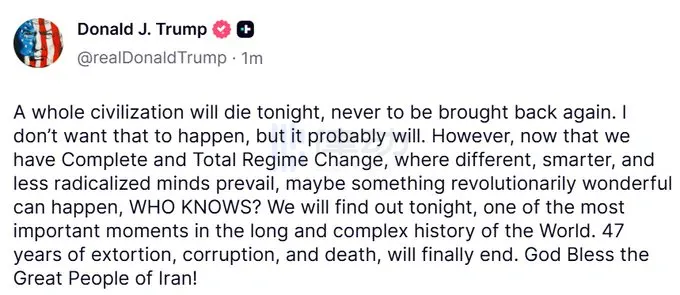
This was already Trump's fourth "ultimatum" to Iran within 30 days, and it was the fourth time he withdrew it just as the deadline was reached.
On March 21, he first threatened, "Reopen the Strait of Hormuz within 48 hours, or I'll blow up all the oil facilities," but he did not act;
On April 5, the deadline was extended to 8 p.m., but he did not act;
On April 6, it was again extended by 24 hours, but he did not act;
On April 7, at 8 p.m. Eastern Time, the threat escalated to "flatten all bridges and power plants," along with the phrase "the whole civilization disappears," yet he still did not act.
Instead, a two-week ceasefire agreement and a ticket to Islamabad for Friday materialized. Iranian Foreign Minister Amir-Abdollahian wrote on X: "For the next two weeks, safe passage through the Strait of Hormuz will be achieved through coordination with Iranian armed forces, considering technical limitations." Tehran simultaneously declared "victory."
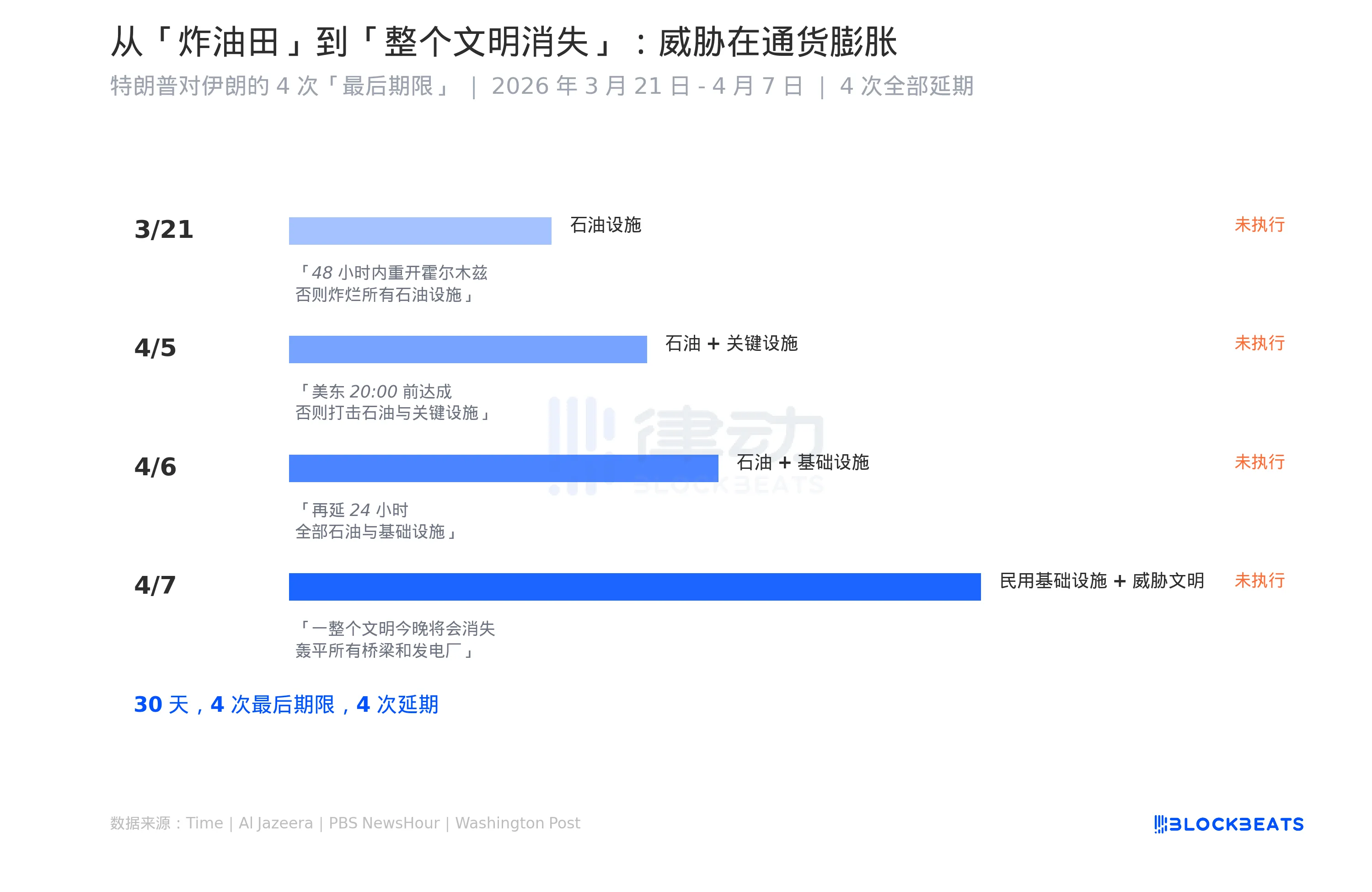
Four deadlines, four extensions. This itself constitutes one of the most dissectible phenomena in the current Middle East. Public opinion is currently discussing that night mainly on two inertial trajectories: one treats it as yet another diplomatic farce, shouting "the wolf is coming" for the fourth time; the other sees it as a trading opportunity in the oil market, watching Brent jerk back and forth between 109 and 107. Both perspectives are correct but evade a sharper question: if the ultimatum fails each time, who is it actually deterring?
The answer may be that it was not a deterrent from the start.
There is a basic physical property of deterrence: the credibility of signals diminishes over time. If you say "we'll strike tonight" and do not act, the next time the market will discount it, the third time allies will doubt it, and the fourth time enemies will simply ignore it. But what has happened over the past 30 days is completely the reverse; every time the deadline is reached without action, the wording of the next threat is even harsher, market reactions are more intense, and bargaining chips at the negotiation table are piling up more and more. From "blow up oil fields in 48 hours" to "flatten bridges and power plants" to "a whole civilization will disappear," the threat itself is inflating.
Rather than using deadlines to force Iran to concede, Trump seems more like he’s setting the tempo for the international news cycle and the global energy market. The deadline itself is a product, not a tool. What it aims to do is not change Tehran's behavior but impose a predictable rhythm on the entire geo-financial system, making hedge funds, oil traders, Middle Eastern allies, Israel, and even Iran itself adhere to his countdown. Each time the countdown hits zero without action, it is not failure; it is pressing the reset button to enter the next cycle.
In March, Brent crude oil rose about 55%, the largest single-month increase for this contract since its inception in 1988. Goldman Sachs estimates that at least $14 of this is pure "war premium," corresponding to the tail risk of complete closure of Hormuz. By the end of March, prices nearly approached $120, and then, in a "diplomatic breakthrough" on the evening of March 31, it swiftly retreated, opening at around $101 on April 1.
Immediately after Trump's first "48-hour ultimatum," prices resumed their upward channel. On the nights before April 5, 6, and 7, each saw a spike, with Brent reaching $111.51 and WTI touching $115.86 during trading on April 7. After Trump announced another extension once the deadline was reached, Brent quickly retracted to $107 in post-market trading. Spike, retreat, spike, retreat; this waveform repeated itself more than once over the past six weeks.
This behavioral pattern did not just emerge in 2026. Its prototype had already been fully enacted seven years ago.
On June 20, 2019, the Iranian Revolutionary Guard shot down a U.S. military "Global Hawk" drone over the Strait of Hormuz. Trump received military intelligence reports in the White House and approved precise strikes on three Iranian radar and missile sites. Jets were already in the air, and ships were in position. Using his own later words, the U.S. military was "cocked and loaded." Then, 10 minutes before the strike was to be executed, he asked the final question: How many people will die? The general's answer was 150. Trump said that this number was disproportionate to downing a drone, and he called it off.
The entire world took 48 hours to digest this event. Hawks criticized him for lack of resolve, doves praised him for restraint and rationality, and the media was busy debating whether those 10 minutes were real. But all these reactions treated the event itself as an impulsive emotional decision, without anyone realizing that this was a methodology, a way to manipulate the opponent's expectations and domestic political clocks using a "threat-retraction-repricing" cycle.
Today, seven years later, that methodology has been reused in a real battlefield that has been burned for six weeks, where Brent had surged to $120 and where 20% of the world's crude oil throughput remains in a semi-closed state. The only differences are scale and rhythm: a single retraction back then, four retractions this year; an unmanned drone back then, an entire civilization this year.
Another similarly fitting mirror comes from Northeast Asia. In August 2017, Trump declared to North Korea, "Fire and fury like the world has never seen," which escalated in September of the same year to "little rocket man" and "totally destroy." Then in March 2018, he suddenly announced he would accept Kim Jong-un's invitation for a meeting, shaking hands at the Singapore summit in June, and again in February 2019 in Hanoi, and in June 2019 at Panmunjom, where the two shook hands on the military demarcation line, with Trump crossing that cement line to become the first sitting U.S. president to step into North Korea. From fire and fury to a historic handshake, only 10 months elapsed.
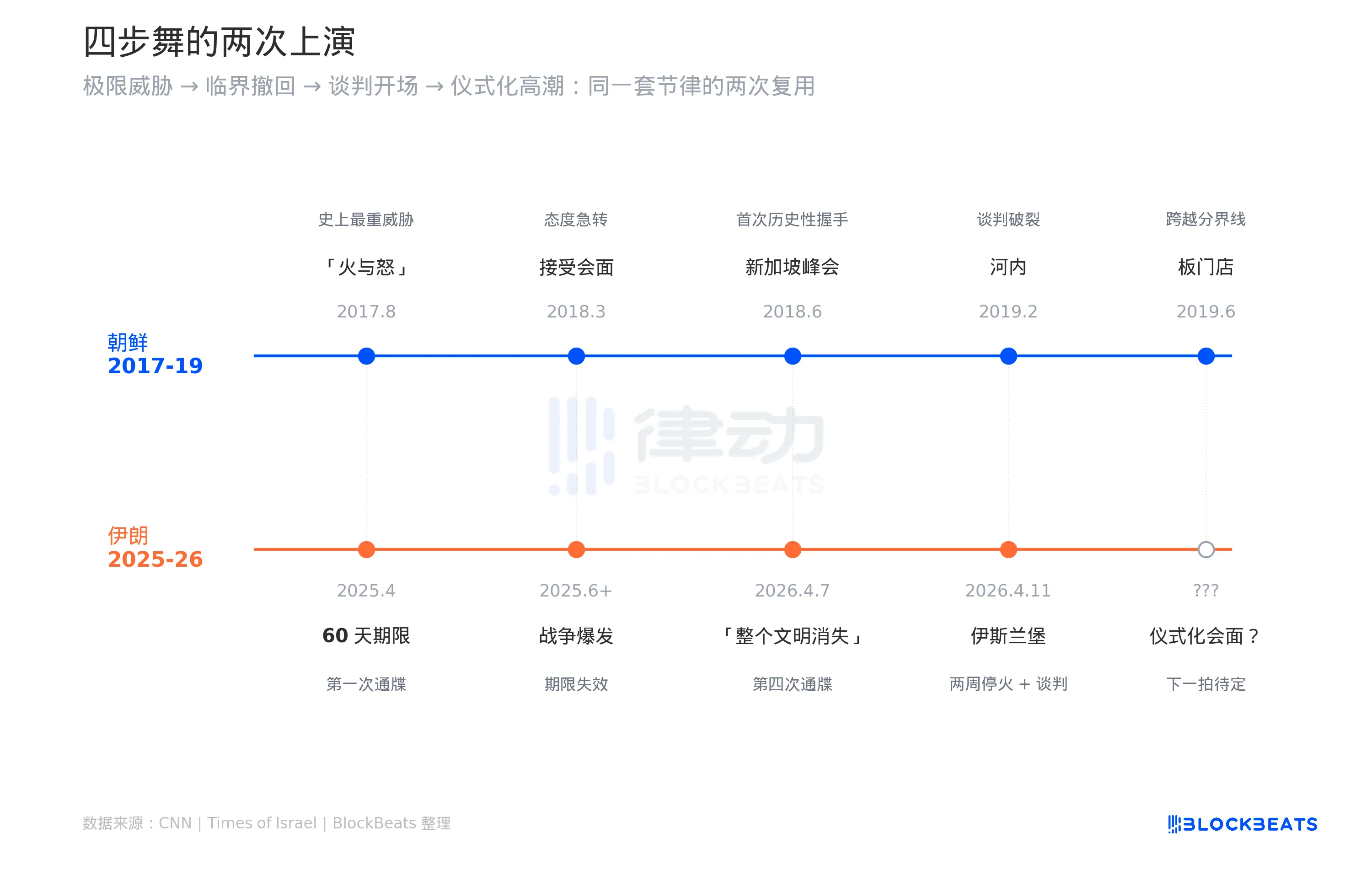
No war, no substantive breakthroughs in sanctions, not even any significant reduction of North Korea's nuclear capabilities; all there is is a complete re-use of a four-step dance: extreme threats, critical retraction, negotiation opening, and ceremonial climax. Each step in between is treated by the media and markets as an independent event to be priced in, and each step's pricing is reset by the next step.
Where does Iran stand in this dance today? The answer is: two-week ceasefire + Islamabad negotiations ≈ the night before the Singapore summit back then. If we were to overlay the timeline of North Korea's nuclear issue here, the next step would be a highly publicized ceremonial meeting, possibly in Islamabad, Muscat, or even at a symbolic border like Panmunjom. After the ceremony, substantive progress would be roughly equal to zero, but global attention, oil volatility, and the U.S. domestic political agenda will be re-centered on the next countdown.
免责声明:本文章仅代表作者个人观点,不代表本平台的立场和观点。本文章仅供信息分享,不构成对任何人的任何投资建议。用户与作者之间的任何争议,与本平台无关。如网页中刊载的文章或图片涉及侵权,请提供相关的权利证明和身份证明发送邮件到support@aicoin.com,本平台相关工作人员将会进行核查。


