Original Title: The Big Thing: We Are In A World War That Isn't Going To End Anytime Soon.
Original Author: Ray Dalio
Translator: Peggy, BlockBeats
Editor's Note: While the market is still repeatedly pricing short-term questions around "how long will the conflict last" and "where will oil prices go," this article attempts to pull the perspective back to a longer time scale. Bridgewater founder Ray Dalio believes that the current series of regional conflicts is stitching together into a yet-to-be-precisely-named "world-class conflict," whose evolutionary logic is more similar to the cyclical stages just before major historical wars.
The article deconstructs the current situation through the lens of "big cycles," into a series of synchronously occurring structural changes: realignment of camps, escalation of trade and capital conflicts, critical pathways being "weaponized," multi-theater conflicts unfolding in parallel, and the gradual pressure on domestic political and financial systems. Within this framework, the conflict between the US and Iran is no longer just a Middle Eastern issue, but becomes a lens through which to observe the global order's reconstruction—how it will affect ally trust, resource allocation, and strategic decision-making, subsequently spilling over to broader regions such as Asia and Europe.
More notably, the article emphasizes a commonly overlooked variable: the outcome of the war does not depend on absolute strength, but rather on the capability of each party to endure prolonged consumption. This judgment shifts the analysis from "who is stronger" to "who can last longer," placing the US in a more complex position—it is currently the most powerful nation, yet it is also the one most "overextended" in global commitments.
In the author's view, the market's implicit assumption—that the conflict will end soon and order will return to normal—may itself be the biggest misjudgment. Historical experience shows that wars often do not have a clear starting point, but rather gradually evolve from economic, financial, and technological conflicts, manifesting simultaneously in multiple regions. The potential conflict paths listed in the appendix (Middle East, Russia-Ukraine, Korean Peninsula, South China Sea) point to the same issue: the real risk does not lie in whether a particular conflict will break out, but in whether these conflicts will start to interact with each other.
As the world shifts from a "rules-based order" to a "power-based order," conflict will no longer be the exception, but may become the new norm. Understanding this transition is the starting point for judging all future variables.
Here is the original text:
I want to start by wishing you all the best during this challenging time. At the same time, I want to clarify that the picture outlined in the following observations is not what I wish to become real; it is simply what I believe comes closer to reality based on the information I understand and a series of indicators I use to objectively judge the state of affairs.
As an investor engaged in global macro investing for over 50 years, to cope with the incoming changes, I have had to study all the factors that have affected the market over the past 500 years. In my view, most people tend to focus on and respond only to the most eye-catching current events—such as the situation in Iran—while overlooking the larger, more important forces that are evolving over a longer time frame, which actually drive the current situation and determine its future trajectory.
At present, the most important point is: the war between the US, Israel, and Iran is only a part of this world war we are currently in, and this war will not end anytime soon.
Of course, what will happen in the Strait of Hormuz next—especially whether its passage control will be taken from Iran, and how much manpower and financial cost various nations are willing to pay for this—will have extremely profound effects globally.
Additionally, a series of other questions are also worth paying attention to: whether Iran still has the capability to threaten surrounding countries with missiles and nuclear weapons; how many troops the US will deploy and what missions those troops will undertake; how gasoline prices will change; and the upcoming US midterm elections.
All these short-term issues are important, but they also distract from the truly grander and more critical matters. More specifically, because most people are used to viewing issues from a short-term perspective, they now generally expect—which is also being priced into the market—that this war will not last long, and once it ends, everything will return to "normal."
But almost no one discusses a fact: we are in the early stages of a world war that will not end quickly. It is precisely because I have a different judgment framework regarding the situation that I want to explain my reasoning below.
Here are several significant issues I believe deserve attention:
Issues Worth Noting
1. We are in a world war that is not going to end anytime soon.
This may sound a bit exaggerated, but one thing is undeniable: we now live in a highly interconnected world, and multiple hot wars are simultaneously occurring in this world (such as the Russia-Ukraine-Europe-US war; Israel-Gaza-Lebanon-Syria war; Yemen-Sudan-Saudi Arabia-UAE war, which also involves Kuwait, Egypt, Jordan, and other related countries; as well as the US-Israel-Gulf Cooperation Council countries-Iran war). Most of these wars involve major nuclear weapon states. Furthermore, there are numerous significant "non-hot wars" occurring simultaneously, such as trade wars, economic wars, capital wars, technological wars, and struggles for geopolitical influence, in which almost every country is involved.
These conflicts collectively form a very typical global war, similar to historical "world wars." For example, past "world wars" typically consisted of multiple interconnected wars that often did not have clear starting dates or explicit declarations of war, but gradually slipped into a state of war unbeknownst to them. These past wars culminated in a typical world war dynamic mechanism that mutually influenced each other; the current wars are presenting the same structure.
I have detailed this war dynamic in Chapter 6, "The Big Cycle of External Order and Disorder," of my book Principles for Navigating a Changing World Order, published about five years ago. If you want to see a more complete explanation, you can read that chapter; it discusses the evolutionary trajectory we are currently experiencing and what is likely to happen next.
2. Understanding how all parties align and their relationships is very important.
To objectively judge how each side aligns, it is actually not difficult. We can clearly see this through various indicators, such as formal treaties and alliance relationships, UN voting records, statements from national leaders, and their actual actions. For example, you can see China and Russia standing together, while Russia is alongside Iran, North Korea, and Cuba; this group is generally opposed to the United States, Ukraine (the latter of which stands with most European countries), Israel, the Gulf Cooperation Council countries, Japan, and Australia.
These alliance relationships are crucial for judging the future situations of the relevant parties, so they must be taken into consideration when observing the current situation and projecting the future. For instance, we can already see the manifestation of this camp structure from the actions of China and Russia in the UN regarding whether Iran should open the Strait of Hormuz.
Moreover, many people say that if the Strait of Hormuz is closed, China will suffer particularly; this statement is actually incorrect. Because the mutual support relationship between China and Iran may still allow oil transported to China to pass; at the same time, China's relationship with Russia will also ensure that China can obtain oil from Russia. In addition, China itself has a large number of other energy sources (coal and solar), and possesses a substantial oil reserve, sufficient for 90 to 120 days of use. Another noteworthy point is that China consumes 80% to 90% of Iran's oil production, further reinforcing the power dynamics within the China-Iran relationship. Overall, in this war, China and Russia seem relatively to be the economic and geopolitical winners. As for the oil and energy economic aspect, the US is in a relatively advantageous position because it is itself an energy exporting country, which gives it significant leverage.
There are many methods to gauge these alliance relationships, including UN voting records, economic ties, and significant treaties. The patterns they present generally align with my description above. (If you are interested in reviewing these representative major treaties, you can refer to Appendix 1. Similarly, if you want to understand the major wars that currently exist or may occur, along with how my indicator system assesses their likelihood of happening or escalating within the next five years, you can refer to Appendix 2.)
3. Study historical similar cases and compare them with the current situation.
This method is seldom employed, yet it has proven extremely valuable both in the past and present, and may be the same for you.
For instance, whether looking back at several similar cases in history or logically deriving conclusions, it is not difficult to see how the United States, as the dominant force in the world order post-1945, performs in a war with Iran, a medium-strength country, how much money and military equipment it will expend and consume, and the extent to which it protects or fails to protect its allies will be closely observed by other countries; these observations will greatly impact how the world order will change in the future. Importantly, we know that the outcome of the war between the US, Israel—and now the Gulf Cooperation Council countries—and Iran will have significant implications for how other countries, particularly those in Asia and Europe, will act next, which in turn will profoundly influence the evolution of the world order.
These changes will unfold in ways that have repeatedly occurred throughout history. For example, by studying history, we can easily identify those overextended empires and establish metrics to gauge the extent of their overreach, observing how they are harmed by it. Presently, it is natural to consider what is occurring with the US: the US now has 750 to 800 military bases in 70 to 80 countries (by the way, China has only one) and bears a costly global security commitment that is easily exposed to vulnerability.
Meanwhile, history also clearly tells us that overextended great powers cannot successfully wage two or more wars on multiple fronts simultaneously; this situation will inevitably trigger skepticism about whether the US has the capability to conduct military operations on another front—as in Asia and/or Europe.
Thus, I inevitably consider further: what does the current war with Iran mean for the geopolitical landscape in Asia and Europe, and what does it mean for the Middle East itself? For instance, if certain problems arise in Asia in the future to test and expose whether the US is willing to meet challenges, I would not be surprised. The US will find it very difficult to respond effectively because it has already made numerous constraining commitments in the Middle East, along with the lack of public support for the Iran war as midterm elections draw closer, making it very unrealistic for it to engage in another war on another front.
This dynamic could lead to a scenario where other countries, observing the evolution of US-Iran relations, would readjust their judgments and behaviors, thereby pushing the reshaping of the world order. For instance, countries hosting US military bases within their borders that have long relied on US security commitments may likely adjust their strategies based on the actual experiences of Middle Eastern countries equally dependent on US protection in this conflict. Similarly, nations located near key straits that hold strategic significance, or those deploying US military bases in potential conflict areas (such as regions in Asia where US-China conflict may erupt), will closely monitor the developments of the Iran war and draw their own conclusions.
I can say with certainty that this kind of thinking is genuinely happening among national leaders and that similar scenarios have occurred multiple times during the analogous phases of the "big cycle." These judgments and adjustments from the leaders of various countries are part of a classic evolutionary path leading to large-scale wars—this process has repeated itself and is presently underway. In light of the current situation and by comparing it against this classic cycle of international order and conflict, I believe we have moved to Step 9. Do you feel similarly?
Here are the approximate steps of this classic evolutionary path:
· The economic and military power of the dominant world power begins to decline relative to the rising power, with both sides gradually approaching each other and confronting their differences economically and militarily.
· Economic wars escalate significantly, manifested as sanctions and trade blockades.
· Economic, military, and ideological alliances gradually take shape.
· Proxy wars increase.
· Fiscal pressures, deficits, and debts rise, particularly among those dominant countries that have overextended fiscally.
· Key industries and supply chains gradually become state-controlled.
· Trade chokepoints are "weaponized."
· New types of war technologies rapidly develop.
· Multi-theater conflicts begin to occur simultaneously.
· There is heightened internal demand for loyalty to leadership, and dissenting voices against anti-war or other policies are suppressed—as Lincoln quoted from the Bible: "A house divided against itself cannot stand," especially during wartime.
· Direct military conflicts erupt between major powers.
· To support the war, taxes, debt issuance, monetary supply, foreign exchange controls, capital controls, and financial repression significantly increase, with markets sometimes even being closed. (For the investment logic during wartime, refer to Chapter 7 of Principles for Navigating a Changing World Order.)
· Ultimately, one side prevails over the other, establishing a new order, designed and dominated by the victor.
Among a series of indicators I track, many show that we are at a stage in the "big cycle": the monetary system, aspects of domestic political order, and geopolitical order are all in a state of collapse.
These signals indicate that we are in a period transitioning from the "pre-conflict phase" to the "conflict phase," which is roughly similar to the historical points between 1913–1914 and 1938–1939. Of course, these indicators do not predict with precision; the picture they paint and the timing are not definitive.
These indicators are more of a directional hint. History tells us that wars often do not have a distinct starting point (unless significant military events trigger formal declarations of war, such as the assassination of Archduke Ferdinand, Germany's invasion of Poland, or the Pearl Harbor attack), and economic, financial, and military conflicts often commence before formal wars break out. Significant wars are frequently foreshadowed by a series of signals, such as:
1) Military and resource reserves begin to deplete;
2) Fiscal expenditures, debt, monetary supply, and capital controls continue to rise;
3) Opposing countries observe conflicts to learn each other's strengths and weaknesses;
4) The overextended dominant power is forced to address multiple dispersed and distantly separated conflicts.
These factors are critical, and the related indicators I am observing are already sufficient to warrant vigilance.
In this cyclical phase, the typical evolutionary path of conflict is not de-escalation but continual escalation. Thus, what happens next largely depends on the direction of the US-Iran conflict. For instance, some countries have already expressed increased skepticism regarding whether the US will fulfill its defense commitments; simultaneously, the recognition that nuclear weapons possess both defensive and offensive capabilities is driving policymakers in various nations to discuss obtaining nuclear weapons, expanding nuclear stockpiles, and enhancing missile and anti-missile systems.
I want to reiterate that I am not saying that the situation will necessarily continue to worsen along this cycle, ultimately evolving into a total world war. I do not know exactly what will happen next, and I still hope that the world will ultimately be built upon win-win relationships rather than destroyed by lose-lose ones. I have also been trying in my own way to promote such an outcome. For example, over the past 42 years, I have maintained very good long-term relationships with senior policymakers in both the US and China—as well as some outside the mainstream systems. Thus, historically and especially in the current highly adversarial period, I have been trying to support a win-win relationship in ways that are acceptable and acknowledged by both sides. The motivation behind this is partly due to my affection for the people on both sides, and partly because win-win relationships are evidently far preferable to lose-lose ones. Despite that, doing this has become increasingly difficult as some people believe "the friend of my enemy is my enemy."
At this stage of the "big cycle," just before the outbreak of major wars, inherent conflicts that cannot be resolved through compromise often propel the cycle forward from link to link, eventually culminating in violent outcomes. Therefore, understanding this typical structure of the big cycle and continuously observing what is happening in reality becomes very important. I provide you with this analytical framework in hopes that you can use it to compare the unfolding of real-world events, gain insight into what I see, and then decide how you want to respond.
Correspondingly, I believe there is one particularly important thing to clarify: the world order has shifted from one dominated by the US and its allies (such as the G7), based on multilateral rules, to one without a single dominant power maintaining order, increasingly adhering to "might makes right." This suggests we are likely to see more conflicts. Anyone who seriously studies history will realize that today's world order is closer to the state of affairs before 1945 than to the post-war order we are familiar with; and the implications of this are highly significant.
4. As history repeatedly shows, judging which country is more likely to win does not most reliably depend on who is stronger, but rather on who can endure suffering longer.
This point is also evidently a critical variable in the US-Iran war. The US President assures the American public that this war will end within weeks, at which point oil prices will drop, and life will return to its originally normal and prosperous state. However, whether a country can endure prolonged suffering has many observable indicators, such as public support rates (especially in democratic countries) and the ability of government leaders to maintain control (especially in authoritarian regimes where public opinion constraints are weak).
Victories in war do not come automatically when the enemy is weakened; victory only occurs when the opponent surrenders. You cannot eliminate all the enemies. During the Korean War, when China intervened with military power far weaker than the US, even with nuclear weapons, it is said that Mao Zedong once remarked: "They cannot kill us all." The meaning of this statement is straightforward: as long as there are people willing to fight, the enemy cannot truly win the war. The lessons from Vietnam, Iraq, and Afghanistan are starkly clear. True victory occurs when the victorious side can extricate itself while ensuring the defeated side no longer poses a threat. The US appears to still be the most powerful country in the world, but it is also the most overextended power, and it is the most vulnerable among major powers in enduring prolonged suffering.
5. All of this is unfolding in a typical "big cycle" manner.
The so-called "typical big cycle manner" means that events are primarily driven by five major forces: the monetary, debt, and economic cycles oscillating between monetary order and disorder; the collapse of political and social order triggered by wealth disparity and ideological division; the disintegration of regional and world order spurred by wealth disparity and ideological division; significant technological advances being utilized for both peaceful and military purposes, alongside financial bubbles that typically end up bursting; and natural events such as droughts, floods, and pandemics.
I do not wish to elaborate further here, detailing how the "big cycle" functions, how these five major forces drive change, or the eighteen deeper determining factors behind them. However, I still recommend understanding this framework, and I encourage you to read my book or the similarly titled YouTube video: Principles for Navigating a Changing World Order.
6. Having a good set of indicators and continuously tracking them is immensely valuable.
Many of the indicators I use to track these evolving situations have already been explained in Principles for Navigating a Changing World Order. I particularly recommend Chapter 6: "The Big Cycle of External Order and Disorder." If you also want to understand investment changes that are nearly unimaginable in peacetime but often occur during wartime, then I suggest Chapter 7: "Understanding Investment in War from the Big Cycle Perspective." I have recently shared these two chapters online, where you can read them.
This is my overall judgment of the larger situation up to this point. This judgment not only influences my investment decisions but also affects how I navigate other aspects of my life, and I will elaborate on these issues going forward. As previously mentioned, there are also two appendices attached: one with information about relevant alliances between countries and another providing a brief overview of current significant conflicts that exist or may emerge.
Appendix
Appendix 1: Relevant Treaties
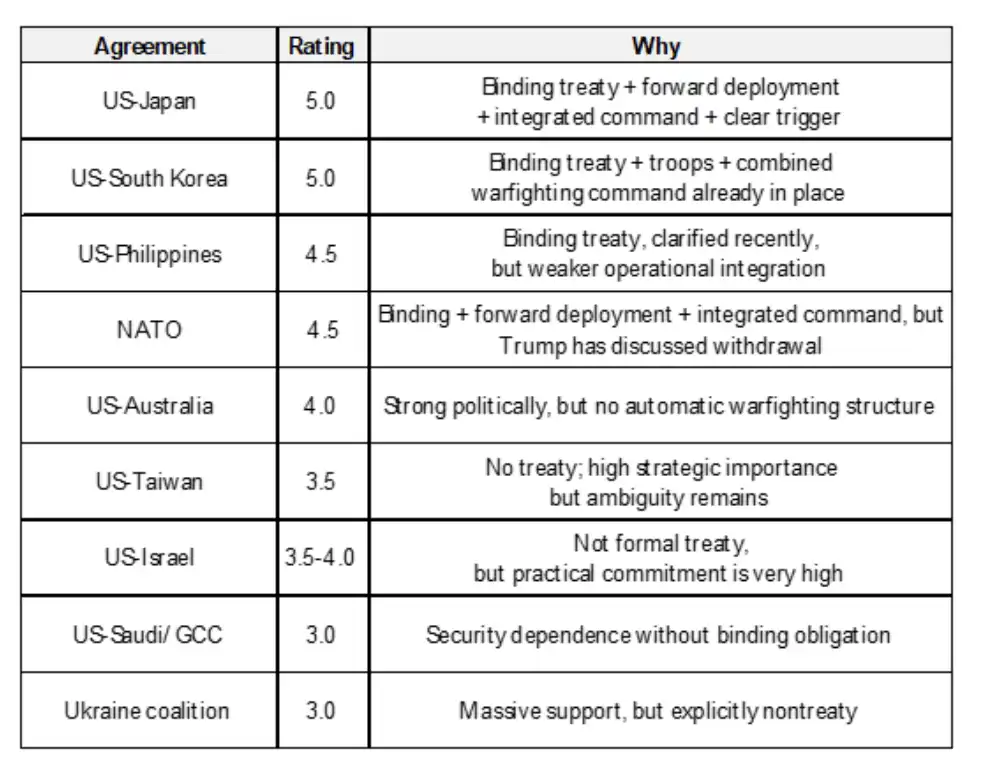
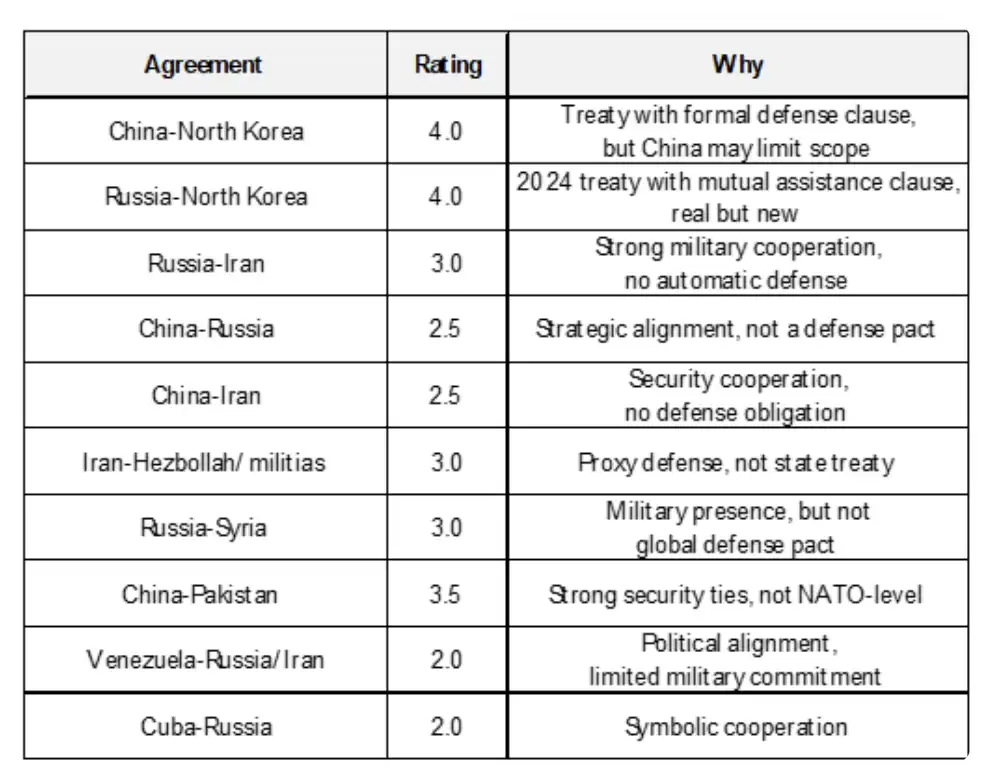
Below is a list of some of the most important treaties in my view, including a rating of the implied strength of commitment from 1 to 5, along with a brief explanation of each treaty. Overall, other indicators measuring alliance relationships—such as leaders' statements and actual actions—generally align with the relationships reflected in these treaties. However, it is becoming increasingly clear that all these treaties, especially those involving the US, may be subject to change, and real actions will ultimately carry more weight than the texts of agreements themselves.
1. Key Treaties of the US:
2. Key Treaties among China, Russia, Iran, and North Korea:
Appendix 2: Wars That Have Occurred and Potential Wars
Below is a list of what I consider to be the most important wars that have occurred or may occur, including my brief judgment of their situations and assessments of the probabilities of escalating into military conflicts within the next five years.
Iran-US-Israel War
This has already become an all-out war and appears to still be escalating, with resources continually being depleted on all sides. Key variables to watch include:
a) Who will ultimately control the Strait of Hormuz, Iran's nuclear materials, and Iranian missiles;
b) How much manpower and financial cost countries are willing to incur to win the war;
c) Satisfaction of countries involved with their alliance relationships;
d) Whether Iran's allies (such as North Korea) will directly intervene or support Iran through arms sales, or whether conflict will erupt in Asia, forcing the US to choose between fulfilling commitments and inaction;
e) Whether the Gulf region can restore peace and security.
Ukraine-NATO-Russia Direct War
This is an ongoing war involving almost all major military powers (excluding China) and carries high risks. However, for three years, the conflict has not expanded beyond Ukraine, which is a relatively positive sign, indicating that a larger-scale war has been temporarily averted. Currently, Russia is engaged directly with Ukraine, while NATO is providing arms support to Ukraine at significant financial costs, and military spending in Europe and preparations for war against Russia are on the rise. NATO's non-direct involvement and the parties' fear of nuclear warfare have temporarily curbed escalation. Risk signals to watch include: Russia attacking NATO territory or supply lines, direct military intervention by NATO, and unexpected conflicts between Russia and NATO member states. I believe the likelihood of these scenarios occurring and leading to war expansion isn't high, roughly assessed at 30%-40% over the next five years.
Korean-Related Wars
Korea is a highly provocative nuclear state and has shown a willingness to fight on behalf of allies against the US. It possesses missiles capable of carrying nuclear warheads and striking the US mainland (though current reliability is still limited), but this capability will significantly improve over the next five years. North Korea has close ties with China and Russia, potentially becoming effective proxy forces. At the same time, North Korea is very aggressive in showcasing and developing missile capabilities but is not inclined to sell such weapons to other countries. I estimate the chances of some form of military conflict occurring within the next five years to be around 40%-50%.
South China Sea-Philippines-China-US Conflict
The US has a defense treaty with the Philippines similar to NATO, and confrontations between Chinese coast guard and Philippine vessels have occurred multiple times, which may further involve US naval patrols. The threshold for triggering conflict is notably low—e.g., ship collisions, Chinese attacks on Philippine vessels, implementing blockades, or missile incidents—once such events occur, the US will face pressure regarding whether to fulfill treaty obligations. However, domestic voters in the US may not support such military intervention, which would put US leaders in a very difficult and symbolically significant position. I estimate the probability of this conflict occurring within the next five years to be about 30%.
Overall, among these potential conflicts, I see at least a 50% likelihood of one occurring within the next five years.
免责声明:本文章仅代表作者个人观点,不代表本平台的立场和观点。本文章仅供信息分享,不构成对任何人的任何投资建议。用户与作者之间的任何争议,与本平台无关。如网页中刊载的文章或图片涉及侵权,请提供相关的权利证明和身份证明发送邮件到support@aicoin.com,本平台相关工作人员将会进行核查。


