Written by: Deep Thought Circle
Have you noticed a strange thing: every time you ask AI to do the same task, you have to teach it again? Today, you ask it to sort data, and tomorrow, you have to start explaining the same task from scratch again. AI is clearly getting smarter; why are we still doing repetitive work?
On March 30, 2026, the product launch of a Silicon Valley AI company, CREAO, provided a different answer. Once released, this product topped the global trending list on the X platform for 5 consecutive hours, sparking a self-initiated discussion among numerous tech creators and developers from North America, Europe, Southeast Asia, and Latin America. After conducting in-depth research on this product, I discovered that what they do is different from all other AI Agent products on the market. This composite team from leading Silicon Valley companies like Google and Meta found a path that everyone else overlooked.
The Real Dilemma of Current AI Agents
I need to clarify a fact: the AI Agent space indeed gained traction from 2025 to 2026. Products like OpenClaw, Claude Code, Devin, and the domestic DeepSeek allowed many people to truly use AI Agents for the first time. But after using them, new problems arose, and these problems are far more serious than expected.
I have encountered such a scenario myself. Last week, I asked Claude Code to help me write a data scraping script, and it took about twenty minutes of back-and-forth dialogue to adjust the details before it finally worked. This week, I wanted to scrape data from another website using the same logic, theoretically only needing to change a few parameters, but I found I had to open a new chat window, re-explain my needs, and readjust the details. The AI does not remember how we collaborated last time; it can only start from scratch. This experience made me realize that the core problem faced by current AI Agents is not a lack of capability, but rather that every use is a one-time affair, used up and burned.
What troubles me even more is that these powerful AI Agents often "look for work to do." I just wanted it to help me scrape price data from three websites and record it in a spreadsheet, but it started analyzing price trends for me, generating visual charts, and even proactively offered to help me write a competitive analysis report. These features sound cool, but I don’t need them at all. AI showcases its capabilities instead of focusing on solving my specific problem. This generalization during demonstrations is impressive, but in practical use, it brings a tremendous cognitive burden—I have to spend time stopping it from doing things I don't need, repeatedly emphasizing that I only want the simplest data scraping.
Cost-effectiveness is also a big issue. When you ask a generic AI Agent to perform a simple repetitive task, it has to re-understand your intent each time, re-plan the execution path, and re-call various tools. This process not only takes time, but if you're using an API that charges by token, the costs can accumulate quickly. I've done the math; if I were to use Claude or GPT-4 to execute a simple data synchronization task that runs on a schedule every day, the API call costs over a month could be more expensive than directly hiring an intern to do it manually. This is simply unreasonable.
I've talked to some developer friends about this issue, and everyone's feelings are consistent: AI Agent abilities are rapidly evolving, but usability has degraded to some extent. In the past, we used automation tools like Zapier or n8n, which, although cumbersome to configure, could run stably once set up, without the need for repeated input. Now, with AI Agents, configuration has become simpler, but it requires reconfiguration each time. This is not progress; it’s replacing old complexities with new ones. The core contradiction lies in this: it is not that ordinary people can't use AI Agents, but that they cannot retain them or convert a successful dialogue into a reusable automated system.
CREAO's "Taming" Philosophy
When I first saw CREAO's product demonstration, my first reaction was: this is exactly what I've been looking for. They gave this product an interesting positioning: Agent Harness, which can be understood in Chinese as "Agent Taming." This term accurately describes what they are doing—not making AI stronger, but making AI's capabilities able to be solidified, tamed, and controlled by ordinary people.
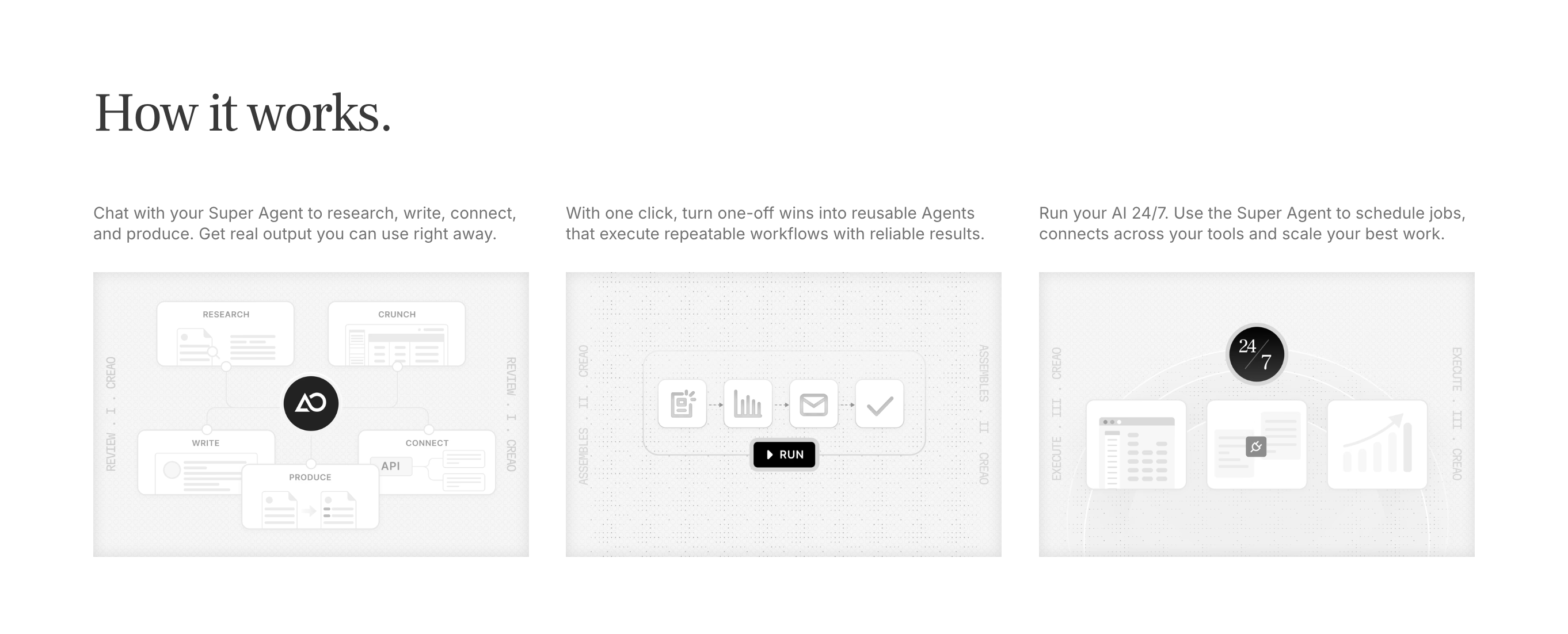
The core experience of CREAO is very straightforward. You describe a workflow in natural language, such as "every Monday at 9 AM, scan the price changes of three competing websites and record them in Google Sheets; if the fluctuation exceeds 10%, notify me on Slack." The system will do several things: understand your intention, automatically write the execution code, connect the tools you need (Gmail, Google Sheets, Slack, Feishu, etc.—they have already integrated over 300 platforms), and then the most crucial step— you can save this entire process as an Agent with a scheduled running time, after which it will run automatically according to your set time without requiring AI's involvement, executing with complete determinism.
This last step is the soul of the entire product. After the conversation ends, the system continues to run. This statement sounds simple, but it addresses a problem that the entire industry has been avoiding. Conversational AI products like ChatGPT and Claude lose everything once the window is closed. Developer tools like OpenClaw and Claude Code can perform complex tasks, but they require you to deploy and maintain them yourself. CREAO combines the flexibility of AI with the reliability of traditional automation tools, allowing a successful AI conversation to be transformed into a persistently running automated system.
I particularly appreciate the technical sacrifices they made. Many AI Agent products aim to make AI smarter, more general, and able to handle more complex tasks. CREAO chose the opposite path: they want to make the workflows generated by AI run independently of AI. This means they needed to solve the determinism problem of code generation— AI-generated code must be stable enough to continue executing without AI intervention. They also needed to solve the stability of multi-tool orchestration—how to ensure that data transfer between platforms like Gmail, Sheets, and Slack wouldn't go wrong when a workflow involves multiple platforms. These are problems that traditional automation tools have already solved, but in the context of AI Agents, these problems need to be re-solved, as workflows are no longer manually configured but are generated by AI based on natural language.
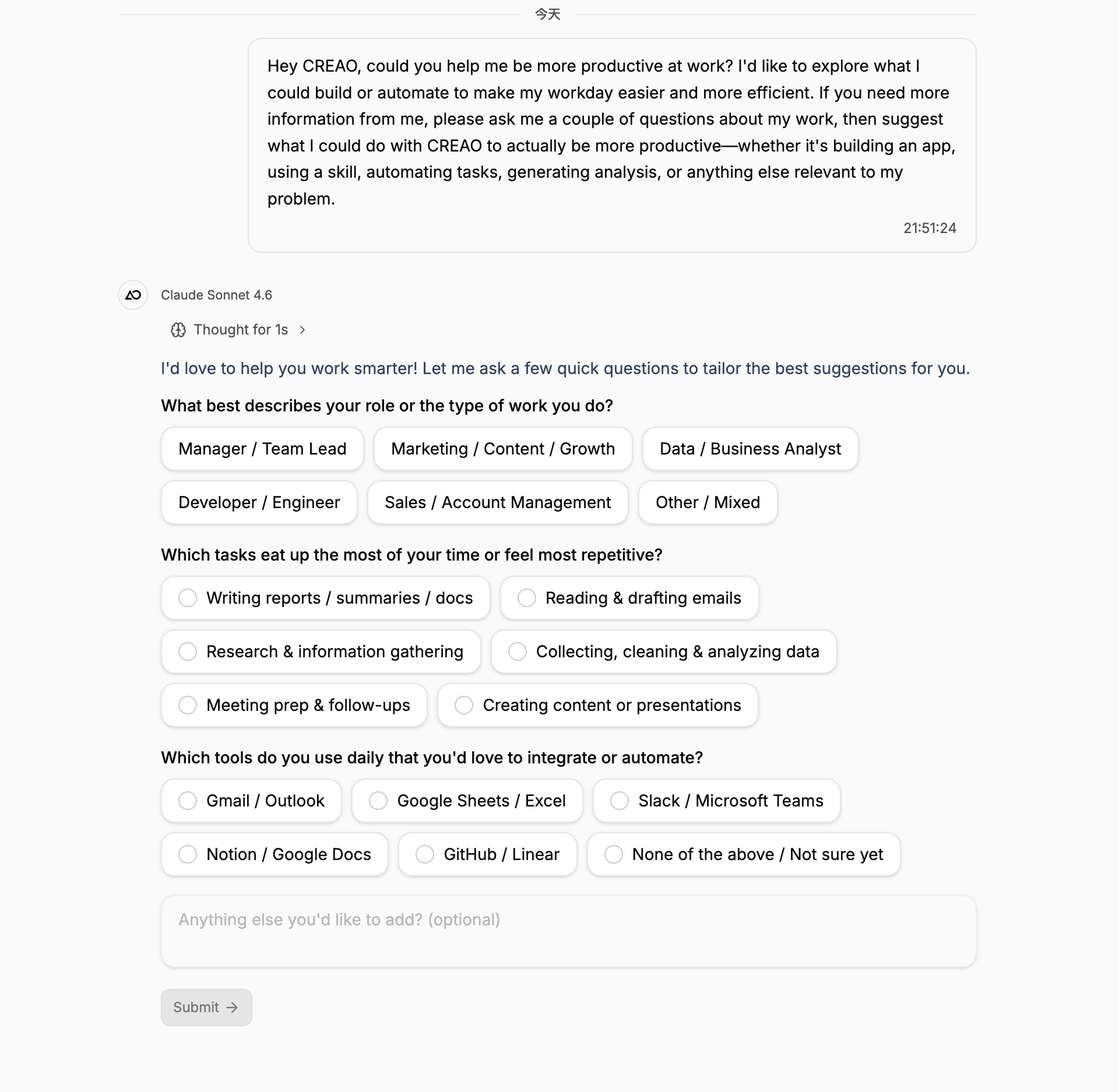
I tried it myself and the real experience is indeed different from other products. I naturally described a requirement: automatically summarize my important emails marked in my Gmail inbox every day at 5 PM, extract the sender and subject, and write it into a Google Sheets spreadsheet; if there are client emails, notify me in the Feishu group by tagging me. The entire configuration process took less than 5 minutes, and I could see CREAO generating code, testing connections, and validating logic in real-time. Once the configuration was complete, I clicked a "save as Agent" button, set it to run every day at 5 PM, and then forgot about it. The next day at 5 PM, I indeed received a notification in the Feishu group, and upon opening Google Sheets, I found the data organized according to my requirements. The key aspect of this experience is that I don't need to open CREAO's chat window at 4:55 PM every day to re-describe my needs. It's like a tamed assistant that knows what it should do every day and just goes ahead and does it.
The native integration of over 300 platforms is also an important product advantage. This means that for most common workflow scenarios, CREAO has already prepared the connectors, and users don't need to find API documentation, configure authentication, or handle data format conversion details. When you say, "write data into Google Sheets," the system knows how to do it. When you say, "send a message on Slack," the system knows how to do it. This level of seamlessness in experience cannot be compared to writing code yourself or using traditional automation tools. I believe this is precisely how the CREAO team understands consumer-grade products—reducing configuration costs so that ordinary people can quickly build their own automated systems.
Not the Strongest, but the Easiest to Tame
During my research on CREAO, I kept wondering: why have other companies making AI Agents not chosen this path? I later realized that this is a competition between two completely different product philosophies.
Take a look at Claude Code launched by Anthropic or Devin from Cognition; their goal is to create the most powerful universal Agent. These products hope AI can understand any demand, execute any task, and even autonomously make decisions without explicit instructions. This is a path to "make the Agent smarter." On this path, the product's value lies in AI's generalization ability—how complex a problem it can handle, how correctly it can make decisions in uncertain situations, and how closely it can mimic the working style of human developers. While this direction certainly has value, it inherently targets developers and professional users because only they need and can harness this level of flexibility.
CREAO chose another path: instead of becoming the strongest Agent, it aims to become the most easily tamed Agent for ordinary people. The value of their product lies not in how smart the AI is, but in how easily ordinary users can solidify AI's capabilities into their exclusive tools. In CREAO's product philosophy, a good Agent is not one that can do everything, but one that can consistently do one thing well, and can be reused. This convergence is precisely the quality that consumer-grade products need the most.
I think of a great analogy. A universal AI Agent is like an all-purpose consultant you can approach every time you have a problem; it can give you many suggestions, but you have to explain the background, describe your needs, and discuss solutions every time. CREAO creates a trainable assistant; you teach it once how to do something, and afterward, it will regularly handle it on its own without needing your repeated guidance. The former showcases the breadth of capability, while the latter provides the efficiency of use. For ordinary users, efficiency is far more important than capability.
This difference in product philosophy has already been validated by market response. On the day of CREAO's launch, over 50 leading tech KOLs worldwide simultaneously released in-depth experience content, covering multiple language markets, including English, Spanish, Portuguese, and Korean. This kind of multi-lingual spontaneous dissemination is quite rare; it indicates that the problem CREAO is solving is global and cross-cultural. No matter whether you are in North America, Europe, Southeast Asia, or Latin America, as long as you are an ordinary user who needs to handle repetitive workflow, you will be attracted to this product. The market has already voted with its feet—what people need is not more powerful AI, but more easily controllable AI.
I also noticed an interesting comparison. If you look at those products pursuing universal Agents, their demonstration cases are often "AI helped you complete a complex development task" or "AI autonomously analyzed a business problem and provided a solution." These cases are impressive but difficult to replicate. Ordinary users will feel "wow, that's amazing" but won't know how to apply it to their work. In contrast, CREAO's use cases are very specific: monitoring competitor prices, synchronizing data to spreadsheets, sending reports on schedule, organizing emails, and managing to-do lists. These are things everyone does every day, only now they can be automated. This difference in product positioning determines that CREAO inherently has a broader user base.
In the balance between conversational AI and traditional automation systems, CREAO has found a clever equilibrium. It retains the ease of use of conversational AI—expressing needs in natural language without requiring programming skills or researching complex configuration interfaces. It also inherits the reliability of automation systems—once configured, it can execute deterministically, without unexpected results caused by AI randomness. This balance is rare because most products sway between these two extremes—either too flexible, leading to instability, or too fixed, making them insufficiently intelligent. CREAO allows users to enjoy the flexibility of AI during the configuration phase and the determinism of automation during the operational phase.
Product Insights from the Silicon Valley Team
I am curious about what kind of team can create such a product. After deepening my understanding, I found that CREAO is headquartered in Silicon Valley, with a core team comprising Chinese AI elites from leading Silicon Valley companies like Google and Meta, as well as technical backbones from premier model startups and star internet enterprises in China. This is a genuinely composite team from China and the United States.
I believe this team's background is significant. Engineers from Silicon Valley giants have a deep understanding of underlying technologies and know how to build stable, reliable systems. Meanwhile, product managers and engineers from domestic internet and AI companies have a strong sensitivity to C-end user experience and know what kind of product design can truly lower barriers for users. The combination of these two characteristics creates a project like CREAO, which possesses both technical depth and product warmth.

According to my understanding, the CREAO team spent months specifically addressing one issue: how to sustain AI's output after a conversation ends. This problem seems simple, but there are many technical challenges behind it. AI-generated code inherently has randomness; the same demand description might yield completely different code when generated twice. How to ensure that this code is stable enough to continue running without human intervention? How to handle exceptional situations—if an API call fails, should the system retry, degrade, or notify the user? How to ensure that data transmission between multiple tools does not get interrupted due to format issues? These are engineering problems that traditional automation tools have solved in the past few decades, but in the context of AI Agents, these issues need to be reconsidered and resolved because the generation of workflows has changed.
What I particularly admire is that the CREAO team did not choose a simple solution. They could, like many AI products, save the generated workflows and let users manually trigger executions each time. This would significantly reduce the technical difficulty, but the user experience would suffer greatly. CREAO opted for true automation—scheduled runs, autonomous execution, exception handling, logging—these standard functions of traditional automation systems are all incorporated into CREAO, and they are achieved based on AI-generated workflows. This requires finding a precise balance between AI's flexibility and system stability, along with much engineering accumulation and product refinement.
Another impressive point is that CREAO's underlying architecture, execution engine, and integration protocols are all self-developed. In the current AI startup environment, many companies choose to quickly shell their products—based on OpenAI or Anthropic's API, adding a front-end interface to launch a product. This approach allows rapid market validation but makes it difficult to establish real technical barriers. The CREAO team chose the harder path, as they built from the bottom up, ensuring every part of the system is under their control. This technological investment may not show advantages in the short term, but in the long run, it is the only way to build competitive barriers.
It is also worth mentioning that CREAO has completed three rounds of financing exceeding tens of millions of dollars within a year, and after the product launch, it has attracted widespread attention from the capital market. This indicates that investors also see value in this direction—in the AI Agent space, it is not about whose model is the largest or whose Agent is the smartest, but about who can truly convert AI's capabilities into products that ordinary people can use; that is who will occupy the high ground in the market.
The True Endgame of the Agent Space
After studying CREAO, I have some new reflections on the AI Agent space. I believe the endgame of the Agent space is not about whose Agent is the smartest, but rather who enables the most people to have their own Agent. This is a fundamental cognitive shift.
In the past two years, the entire industry has been focusing on enhancing model capabilities, Agent frameworks, and developer tools. The competition has been about who can get AI to complete more complex tasks and who can achieve greater autonomy with less human intervention. This competition logic is quite marketable within the technical circle, as it aligns with engineers' aesthetics—pursuing extremes, challenging boundaries, breaking the impossible. However, from a commercial and product perspective, this may not be the most critical battleground. The truly important battleground is: how to lower the barriers to use, how to increase reusability, and how to enable ordinary people to enjoy the efficiency improvements brought by AI Agents.
The path represented by CREAO is essentially about pursuing "lowering the taming barrier" rather than "enhancing general capability." These two directions are not contradictory but serve different markets. For developers and professional users, what they need is indeed a more powerful universal Agent because their demands are inherently complex and variable. But for over 90% of ordinary users, what they need is a dedicated Agent that can stably solve specific problems, rather than an all-purpose assistant that has to be re-taught each time. CREAO is precisely targeting this 90% market.
I particularly agree with one point: reusability is the next battleground for consumer-grade AI. Currently, AI products on the market, whether it's ChatGPT, Claude, or various Agent tools, are basically one-time use—users ask a question, and the AI provides an answer, and the value of this conversation ends there. Even if the AI offers a great solution, when users encounter similar problems next time, they still have to ask again, wait again, and verify again. Under this model, AI's value grows linearly; using it 10 times yields a total value that just adds up to using it 100 times. However, if the AI's output can be reused—for example, if a configuration can run continuously after one setup—then the value grows exponentially—set it up once, use it a hundred times, without having to reinvest every time. What CREAO does is turn one-time consumption into reusable assets.
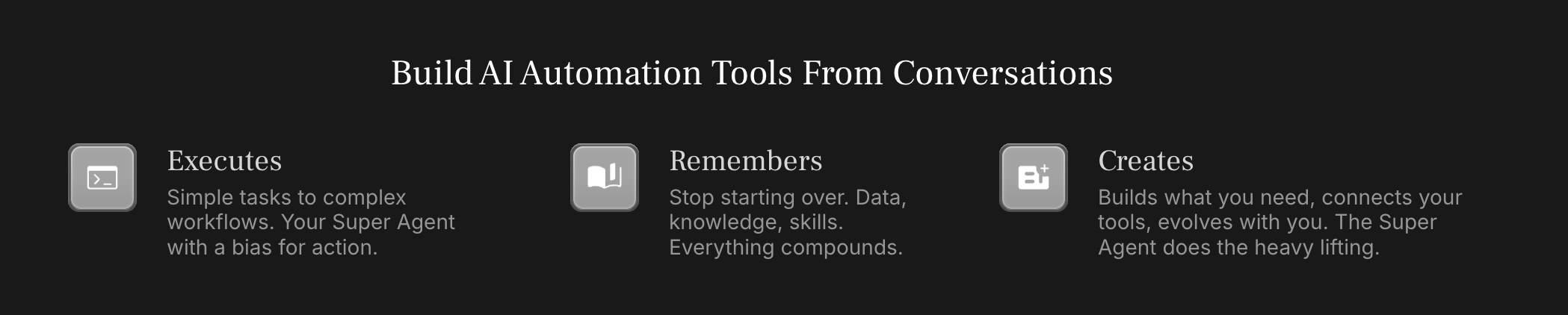
This reminds me of a classic transformation in the software industry. Early software development required writing code from scratch for every function. Later, function libraries, frameworks, and components emerged, allowing developers to reuse previously written code, significantly boosting efficiency. Further along, low-code and no-code platforms emerged, enabling even those who cannot code to build applications. The evolution pathway for AI Agents may be similar: initially requiring a fresh start with each conversation, followed by the emergence of Agents that can be saved and reused, and eventually possibly establishing an Agent marketplace where people can share and exchange their trained Agents. What CREAO is currently doing represents a critical leap from the first stage to the second stage.
My prediction is that AI Agents will diversify into multiple product forms, serving different user groups and application scenarios. There will be Agents focused on extreme universality for developers and professional users; there will be Agents focused on specific vertical fields like law, healthcare, and finance; and there will be platforms like CREAO that focus on consumer-grade automation. These directions are not competitive but rather symbiotic; they collectively constitute a complete AI Agent ecosystem. In this ecosystem, the consumer-grade track chosen by CREAO may be the one with the largest user base and the broadest commercial potential.
From "the strongest Agent" to "the Agent for most people," this is not just a shift in product positioning but a redefinition of AI's value. The value of AI should not only be reflected in how difficult a task it can complete, but also in how many people it can help improve efficiency, solve problems, and enhance their lives. Products like CREAO show me the possibility of AI truly reaching the masses. When everyone can have their own dedicated Agent to automate those repetitive, trivial, and time-consuming tasks in their daily work, AI will have truly fulfilled its mission—not to replace humans but to liberate them from mechanical labor so they can do more creative and valuable things.
免责声明:本文章仅代表作者个人观点,不代表本平台的立场和观点。本文章仅供信息分享,不构成对任何人的任何投资建议。用户与作者之间的任何争议,与本平台无关。如网页中刊载的文章或图片涉及侵权,请提供相关的权利证明和身份证明发送邮件到support@aicoin.com,本平台相关工作人员将会进行核查。


