- TRM Labs reports stablecoins drive 95% of illicit Latam inflows, forcing VASPs to upgrade tech next.
- The Sinaloa Cartel laundered $103B in 2025, pushing governments to enforce upcoming AML laws.
- Following these reports, Latam countries are enhancing their compliance standards.
Crypto regulations are advancing internationally, and Latam is not an exception, even with numerous documented threats. According to TRM Labs, a blockchain intelligence firm, regulations are coming to make cryptocurrency transactions and flows more secure in the region.
In a recent report, TRM Labs disclosed that stablecoins have become the dominant payment rails across Latam, accounting for 95% of inflows to sanctioned entities globally in a region that, due to its economic traits, is open to the adoption of these new technologies.
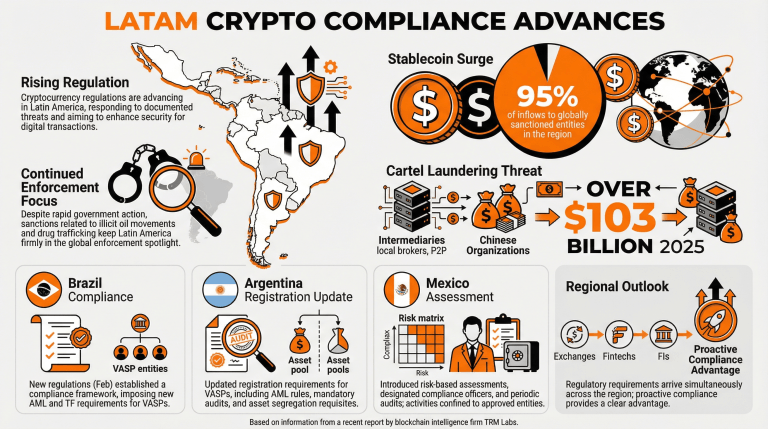
TRM Labs states that the threats are well-documented in the region, including flows linked to the Sinaloa Cartel, leveraging local brokers and P2P exchanges to launder funds using Chinese organizations as intermediaries to process over $103 billion in 2025 alone.
In addition, the institution highlighted that sanctions that remain in place related to illicit oil movements and drug trafficking keep Latam in the enforcement spotlight. Nonetheless, governments are moving quickly to plug these holes and strengthen compliance across the sector.
In Brazil, new regulations passed in February establish a compliance framework that includes new anti-money laundering (AML) and terrorism financing (TF) requirements for virtual asset service providers (VASPs) to receive authorization to operate.
Argentina also tightened oversight over the crypto market, with updated registration requirements for VASPs that include AML rules, audit, and asset segregation requisites.
Mexico also introduced risk-based assessments, designated compliance officers, and periodic compliance audits for entities, as virtual asset activities are still confined to organizations approved by the Central Bank of Mexico (Banxico).
TRM Labs concluded that “for exchanges, fintechs, and financial institutions operating in Latin America, regulatory requirements are arriving across the region simultaneously. Institutions building compliance infrastructure ahead of enforcement deadlines carry a clear operating advantage.”
免责声明:本文章仅代表作者个人观点,不代表本平台的立场和观点。本文章仅供信息分享,不构成对任何人的任何投资建议。用户与作者之间的任何争议,与本平台无关。如网页中刊载的文章或图片涉及侵权,请提供相关的权利证明和身份证明发送邮件到support@aicoin.com,本平台相关工作人员将会进行核查。


