Author: Guo Liqin
After more than six months of undercurrents, U.S. cryptocurrency legislation once again faces a critical moment.
On April 13, 2026, U.S. Senate will end its Easter recess. The week before, U.S. Treasury Secretary and other political figures, cryptocurrency industry representatives, and active legislators began to increase pressure on Congress, urging the advancement of the "2025 Digital Asset Market Clarity Act" (hereinafter referred to as the "Clarity Act").
In July 2025, President Trump officially signed the "Guidance and Establishment of the U.S. Stablecoin National Innovation Act" (hereinafter referred to as the "GENIUS Act") at the White House, which sets rules for the issuance and operation of U.S. dollar-backed payment stablecoins at the federal level. The law took effect on the same day it was signed. On the same day, the "Clarity Act" and the "Anti-CBDC Monitoring State Law" were also passed by the House of Representatives and handed over to the Senate, entering the next legislative process.
Compared to the already effective "GENIUS Act" and the succinct "Anti-CBDC Monitoring State Law," the cryptocurrency industry is especially eager for the "Clarity Act." The "Clarity Act" covers all digital assets associated with blockchain, transferring primary regulatory authority over cryptocurrencies other than stablecoins to a smaller, less resource-intensive regulatory body—the Commodity Futures Trading Commission (CFTC). This means a complete legal reversal of the Biden administration's stringent regulation of cryptocurrencies.
However, time is running out for Congress. Generally, the legislative process of a bill in the U.S. Senate is more difficult than in the House of Representatives. The Congressional Memorial Day recess will begin on May 21; if the "Clarity Act" does not achieve key progress in the Senate before then, it may fall into the political game cycle of the midterm elections, facing greater uncertainty. Public opinion generally believes that the coming weeks are a crucial window for advancing the "Clarity Act."
Scholar Sun Yuanzhao stated to "Finance" that the rhythm and timing of pushing the "Clarity Act" process is similar to President Trump's earlier push for the "GENIUS Act," but the situation is more urgent. If the "Clarity Act" cannot pass Congress before the summer recess (before August), it may very likely be stillborn. "Next, the legislators will be busy with the midterm elections and won't have any time to manage this," he said.
The price trend of Bitcoin can serve as a reference point for the cryptocurrency legislative process. Since Trump won the U.S. presidential election in November 2024, Bitcoin's price has soared from about $70,000 to a historic high of $126,000 in October 2025. However, since February 2026, due to factors such as the stalled progress of the "Clarity Act," Bitcoin's price has gradually fallen below $80,000 and $70,000, even dipping to $60,000 at one point, creating a new low in nearly 16 months, triggering over $2 billion in liquidations across the cryptocurrency market within 24 hours. As of press time, Bitcoin's price is above $70,000, but forecasting platform Polymarket shows that Bitcoin has an 82% probability of dropping below $65,000 within 2026, and the probability of falling below $55,000 has risen to about 60%.
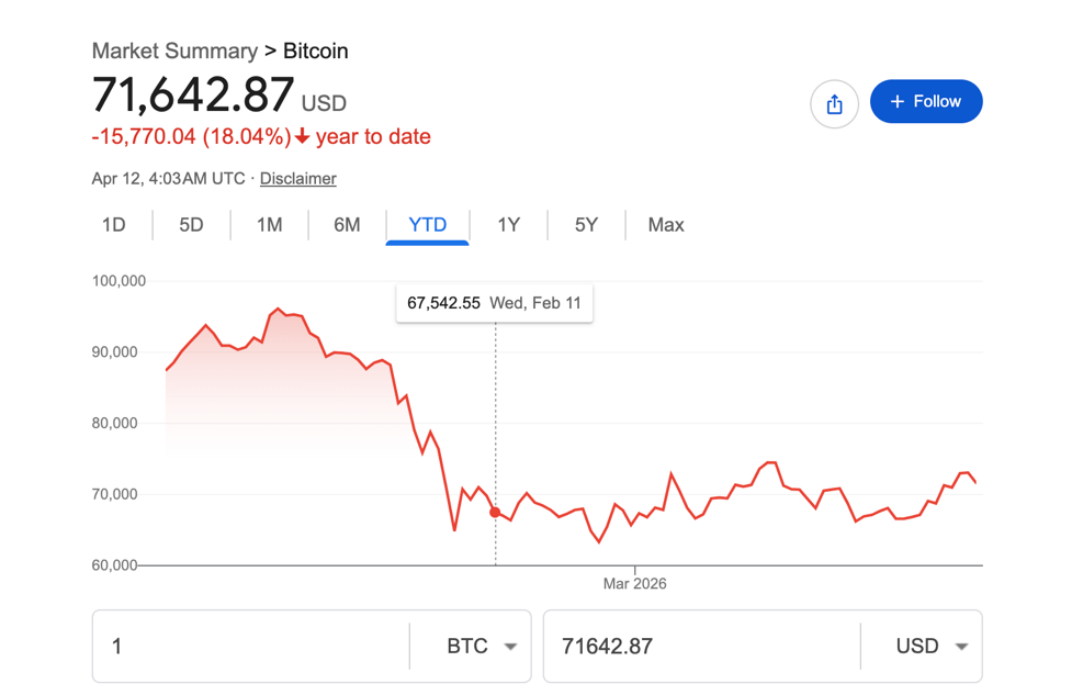
Bitcoin's price trend over the past year. Source: Network
Should interest be paid to stablecoin holders?
Looking at the upcoming voting arrangements in the U.S. Senate, there currently appears to be no agenda related to the "Clarity Act."
Sun Yuanzhao explained that before the parties coordinate internally, it will not be arranged into the public agenda. "But it cannot be ruled out that the Senate may add a vote on this bill next week under pressure," he said.
Cryptocurrencies generally include five types: stablecoins, central bank digital currencies (CBDCs), financial products and tokenized real-world assets (RWAs), uncollateralized tokens (Bitcoin, Ether), and meme coins (Trump Coin, Dogecoin).
In recent months, the "Clarity Act" has faced multiple resistances in the Senate. There has been intense debate between banking groups and cryptocurrency industry groups, focusing on whether to pay interest to stablecoin holders.
Although the "GENIUS Act" explicitly prohibits regulated stablecoin issuers from paying direct interest or returns, defining them as "payment stablecoins" similar to traditional currencies, many cryptocurrency platforms have found ways to circumvent regulations—offering rewards related to stablecoin payment activities.
The U.S. banking industry insists that these rewards have the same practical effect as traditional interest payments. Traditional financial institutions face strict deposit insurance regulations and stringent capital requirements. Banks fear that unrestricted stablecoin rewards could lead to a significant outflow of funds from traditional savings accounts. Banking lobby groups have been actively advocating for the "Clarity Act" to close the "third-party model loophole," preventing cryptocurrency exchanges, brokers, and affiliates from providing rewards or returns that are economically equivalent to interest on stablecoin balances. However, cryptocurrency practitioners argue that this prohibition stifles innovation and reinforces the monopoly of traditional banks.
The dispute between the two sides has forced the legislative process of the "Clarity Act" to come to a halt this year. A balanced solution is currently circulating: allowing rewards for peer-to-peer payment activities while restricting passive income on stablecoin balances, intending to protect traditional bank deposits while promoting innovation.
However, on April 8, the U.S. government suddenly intervened to apply pressure, completely shifting its stance toward the cryptocurrency industry, adding uncertainty to the future direction of the bill.
On April 8, U.S. Treasury Secretary Scott Bessent published a signed article in the media urging Congress to pass the "Clarity Act." He believes the "Clarity Act" is a necessary complement to the "GENIUS Act," clarifying the regulatory approach for cryptocurrencies (or "digital assets") at the federal level.
On the same day, the White House Economic Advisory Council released a report stating that banning stablecoin interest payments (including returns provided through platforms and affiliates) would almost not bring any substantial benefits to bank loans, instead harming consumers' real interests. This report is undoubtedly a powerful rebuttal to the banking industry's lobbying.
The U.S. banking industry believes that by pushing for stricter restrictions, they can better protect their deposit and loan business, especially for smaller financial institutions; however, the White House report refutes this argument with data.
According to the White House's baseline model, extending the ban on stablecoin issuers in the "GENIUS Act" to exchanges and third parties through the "Clarity Act" would only increase total bank loans by $2.1 billion. This accounts for only 0.02% of the total outstanding loans.
Of this minor increase, approximately 76% would flow to the largest banks. Community banks with assets under $10 billion would only see a loan capacity increase of about $500 million, an increase of only 0.026%.
The report suggests that even when considering all extreme assumptions, such as explosive growth of stablecoins, all reserves locked as cash rather than bonds, and significant shifts in Federal Reserve policy, the maximum scale of new loans generated throughout the system would only be $531 billion, about 4.4% of the total U.S. loans in Q4 2025. For community banks, even in these unlikely scenarios, the best-case scenario increase would only be 6.7%.
Another potential impediment to legislation is that the Trump administration wants swift passage of the "Clarity Act" but refuses to accept any "ethical clauses" that might restrict Trump's and his family's cryptocurrency businesses. The "ethical clause" refers to provisions advocated by some Democratic lawmakers to ban or limit U.S. senior officials from trading cryptocurrencies.
Treasurer and legislators applying pressure in turn
The time to successfully advance legislation is fleeting, causing nervousness among supporters of the legislation.
U.S. Treasury Secretary Bessent stated in his signed article that, besides stablecoins, the regulatory framework for the digital asset market remains unclear. The U.S. Securities and Exchange Commission (SEC) and the Commodity Futures Trading Commission (CFTC) have previously issued overlapping and sometimes contradictory demands to the industry, leading to a lack of clear guidance for cryptocurrency developers, exchanges, and investors. The two regulatory agencies have taken different enforcement actions, with regulatory targets constantly shifting with the political winds.
Bessent believes that this uncertainty has brought predictable consequences. An increasing number of cryptocurrency development projects are relocating to regions with clear rules, such as Singapore and Abu Dhabi, the capital of the UAE. In these areas, operators clearly understand when and how to register, what standards need to be met, and how to operate. "The returns of registering in the U.S. rarely exceed the risks," Bessent said.
Bessent also stated that the "Clarity Act" establishes a feasible registration pathway for trading platforms and intermediaries by clarifying regulatory jurisdiction, defining when digital assets are securities and when they are not. The act also proposes measures to combat illegal finance through information disclosure and custody rules to protect investors, and grants new powers to address abuses.
Republican Senator Cynthia Lummis of Wyoming is a co-sponsor and promoter of the Senate "GENIUS Act," serving as chair of the Senate Digital Asset Subcommittee, known externally as the "Cryptocurrency Queen." Since the introduction of the "Clarity Act," Lummis has been a supporter of the bill, repeatedly emphasizing its critical importance in preventing cryptocurrency companies from relocating due to regulatory uncertainty.
From April 10 to April 11, Lummis posted five consecutive posts on her social media account, urging Congress to pass the "Clarity Act."
"This is our last chance to pass the 'Clarity Act' before 2030. We cannot gamble with America's financial future," Lummis warned. Since Lummis's current term will end in January 2027, her warning carries more weight. Because after the 2026 U.S. midterm elections, the Democratic Party might regain control of the House of Representatives or the Senate, thereby hindering Trump's subsequent support for the cryptocurrency industry over the next two years.
However, Trump himself has not yet been seen applying pressure. In contrast, since March 2025, Trump has been urging lawmakers to pass the "GENIUS Act" before the August recess in various public settings.
Another significant change is that as of March 25, 2026, Trump's approval rating has dropped from 40% the previous week to 36%, the lowest since his return to the White House. Polls show that rising oil prices and widespread dissatisfaction with the war against Iran are the main causes of the decline in approval ratings.
Analysis from the U.S. law firm Morgan Lewis states that the "Clarity Act" in many aspects is based on the "21st Century Financial Innovation and Technology Act" (FIT21), which passed the House of Representatives in 2024 but did not progress in the Senate. The "Clarity Act" assigns most regulatory authority over digital assets to the CFTC, while still retaining some important duties of the SEC (U.S. Securities and Exchange Commission), including jurisdiction over investment contracts involving digital commodities.
From the perspective of the cryptocurrency industry, most cryptocurrencies should be classified as commodities rather than securities, so the industry does not have to comply with a series of securities laws. During the previous Biden administration, the SEC asserted that nearly all cryptocurrencies are securities and should be strictly regulated. In 2023, the SEC sued the three largest cryptocurrency exchanges—Coinbase, Binance, and Kraken, launching a legal campaign threatening the survival of the industry. However, since Trump's administration, the SEC has gradually withdrawn or suspended lawsuits and investigations against more than a dozen cryptocurrency companies or individuals.
In the U.S., a bill must be passed by both the House of Representatives and the Senate in the exact same text form, and then signed by the president to become law.
According to the official U.S. Congress website, the Senate received the "Clarity Act" on September 18, 2025. After two reviews, it was submitted to the Committee on Banking, Housing, and Urban Affairs. After several rounds of processes, on January 12, 2026, the Senate Committee on Banking, Housing, and Urban Affairs released a 278-page draft of the bill, awaiting internal review by the committee. The draft prohibits digital asset service providers from offering interest or returns merely for holding stablecoin balances but allows stablecoin rewards or incentives related to activities. This is also the most controversial part of the draft. Notably, on January 21, 2026, the Senate Agriculture Committee released a draft of the "Digital Commodity Intermediary Act" related to the "Clarity Act," which went through committee review by January 29, 2026.
According to U.S. legislative processes, after the draft of the Committee on Banking, Housing, and Urban Affairs passes internal review, the two drafts must be coordinated and merged before being submitted for a full Senate vote. Any bill approved by the Senate must also be coordinated (or replace the version of the bill) with the version of the "Clarity Act" previously passed by the House of Representatives before it can be voted on in the House.
免责声明:本文章仅代表作者个人观点,不代表本平台的立场和观点。本文章仅供信息分享,不构成对任何人的任何投资建议。用户与作者之间的任何争议,与本平台无关。如网页中刊载的文章或图片涉及侵权,请提供相关的权利证明和身份证明发送邮件到support@aicoin.com,本平台相关工作人员将会进行核查。


