Author: Yajin
Recently, I've encountered a few incidents that have given me some insight into the word "taste," which has been very popular lately. I record these thoughts to share with everyone.
1. A Full Resume with Shallow Understanding
This week, I interviewed an undergraduate student who applied to our group.
His resume looked impressive. He had participated in three research projects and had a paper. For an undergraduate, this output surpasses many master's students.
At the beginning of the interview, I asked him what motivated his first project. He gave a rather vague answer. When I probed for technical details, he could describe what he did, but he couldn't clearly explain why he did it. What problem did this work solve? What is the fundamental difference compared to previous methods? He could not answer these questions.
For the second project, it was a similar situation.
By the third project, I had an idea of what was going on. This student had done a lot, but he had never truly understood any of it. His research experience was not "I am interested in a problem and delving deeply into it," but rather the kind of behavior often encountered in social media platforms, where participation is just to "add research experience." He jumped from one project to the next for the sake of his resume, turning research into a points game.
2. Another Type of "Point Collector"
Around the same time, a friend mentioned a phenomenon in the hackathon community.
There is a type of participant who constantly attends hackathons. This weekend they are at this competition, next weekend at that one. Their resumes are filled with "XX hackathon winner," but if you take a closer look, the things they create are mostly similar: they apply an AI API, wrap a layer of UI around it, and make a demo. After the competition, the projects just die.
My friend calls these kinds of people "hackathon point collectors."
Hearing this term, I suddenly realized that it represents the same problem as the student I interviewed.
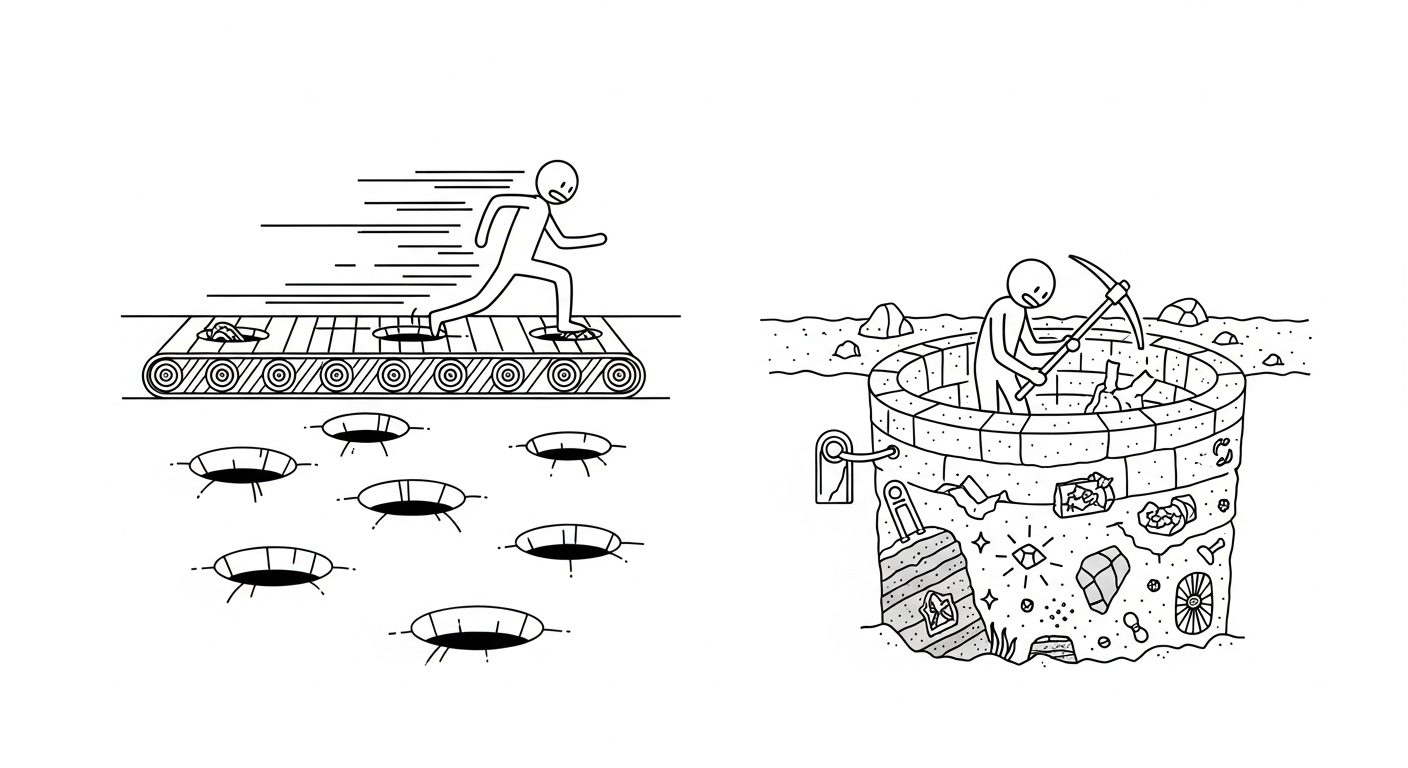
Superficially, one is in the academic circle and the other in the entrepreneurial circle, with completely different contexts, but the underlying core is the same: replacing depth with quantity, experience with understanding, and the numbers on a resume with true judgment.
This behavioral pattern has a more precise name: experience gathering.
3. The Upper Limit of Experience Gathering
Don't get me wrong, I'm not saying experience gathering is completely useless. For newcomers, trying broadly can help you understand the overall landscape of a field and find your interests.
But experience gathering has a hard upper limit: it can help you "know what exists," but it cannot help you judge "what is worth doing."
This limit can be seen in many areas.
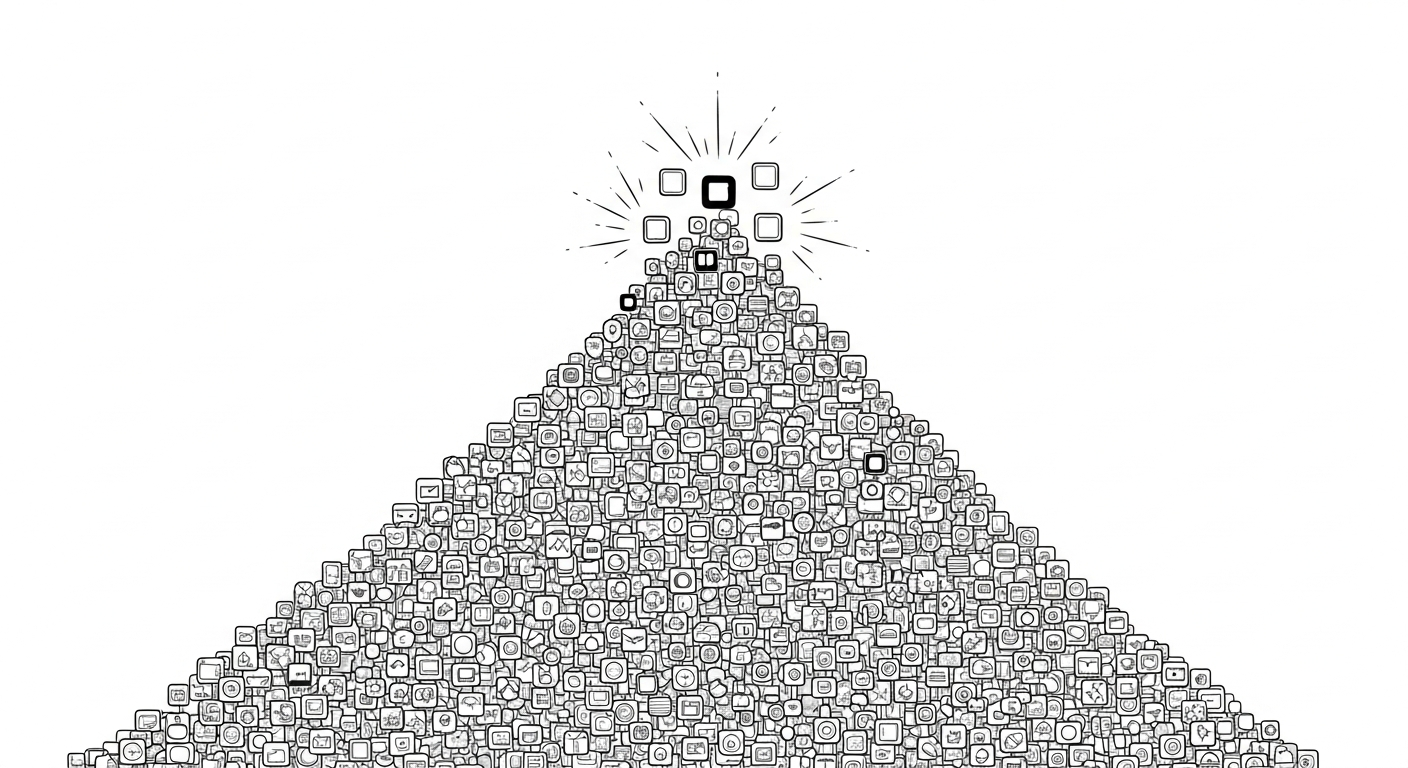
The Apple App Store has over 2 million apps. According to data from Business of Apps, nearly 1/4 of the apps have fewer than 100 downloads. [1] Developers work hard, but most have created something "that works" without anyone needing it.
The AI tools field is even more obvious. In the past two years, a multitude of AI wrappers have flooded the market, doing highly similar things: applying a UI layer to ChatGPT, adding a bit of prompt engineering, creating an "AI writing assistant" or "AI meeting summarizer." The vast majority have gone unnoticed, but a few products have survived and thrived. The difference between them and those dead AI wrappers is not technical ability or funding amounts, but taste.
4. What is Taste
The word taste is hard to translate. Taste, aesthetics, judgment — each translation captures only part of the meaning.
My understanding of taste is: the ability to pick out the one truly worthy endeavor when presented with 100 possibilities.

Steve Jobs said in a famous interview in 1995: "The only problem with Microsoft is they just have no taste. They have absolutely no taste. And I don't mean that in a small way. I mean that in a big way, in the sense that they don't think of original ideas and they don't bring much culture into their product." [2]
The emphasis of Jobs' statement is not whether the interface looks good. What he means is that Microsoft does not think about what constitutes truly original and culturally rich products. Microsoft can do anything, but it doesn't know what is worth doing most.
Of course, it would be wrong to say Microsoft is unsuccessful. Microsoft is very successful commercially, but its product line feels very fragmented. I work at CUHK, and the school uses Microsoft business solutions, including Microsoft 365, which we also used in our early company. To be honest, it's hard to use, and it's hard to elaborate. Sales of B2B products involve too many factors beyond the product itself, and taste is not the only variable in this scenario.
Richard Hamming told a story in his classic 1986 speech "You and Your Research." While at Bell Labs, he often asked his colleagues three questions during lunch: What is the most important problem in this field? What important problems are you working on? If what you're doing isn't important, why do it? [3]
Most people stopped eating with him when he asked the third question.
But Hamming’s logic is clear: It is more important to work on the right problem than to solve a problem correctly. "If you do not work on an important problem, it's unlikely you'll do important work."
Some might say, I don't want to become a scholar like Hamming, what does this have to do with me? The truth is, the principle Hamming discussed applies not only to top scientists. Whether in research, product development, or even just choosing a job, the core question is the same: What are you spending your time on?
That is taste. In academia, taste is the ability to choose the right research problems. In industry, taste is the ability to choose the right product directions.
5. Taste in Academia: A Personal Experience
In 2012, we published a paper on Android security at IEEE S&P, a top conference in the security field.
Looking back today, Android security has become a mature field studied for more than a decade, but the situation in 2012 was completely different. At that time, the Android system had only been out for a few years, and academia paid little attention to mobile security, with most security researchers still focused on traditional PC platforms.
At that time, as a PhD student, I lacked judgment about the direction. The choice to work on Android security was my advisor's taste. He saw that smartphones were becoming a mainstream computing platform and that security issues would explode as a result. This judgment was not obvious at the time, and many people wondered what was worth researching about security on phones.
It turned out to be the right direction. That paper has since been cited many times, and more importantly, it established our footing in the field of Android security. Many subsequent projects built on this foundation.
Conversely, if my advisor had not had this taste, we might have followed trends and worked on the directions that everyone else was pursuing at the time. We might have published papers, but it is very likely that they wouldn't have had that kind of impact.
This illustrates the value of taste in academia. Choosing the correct problem gives a sense of direction for years of subsequent work. Choosing the wrong problem means that no matter how hard you work, you’re just piling up numbers.
6. Taste in Industry: More Apparent in the AI Era
Taste in industry manifests in different ways: choosing products. It’s easy to make something "usable"; it’s hard to make something users "cannot live without."
The AI era has amplified this problem.
Because AI has greatly reduced execution costs. Previously, making a product required a team to spend several months; now, an individual can create a prototype in days using AI. Execution is no longer the bottleneck; judgment is.
This is similar to the conditions in the App Store. Development capability is no longer a threshold; most people lack direction. When everyone can make apps, making an app is no longer a competitive advantage. Knowing what kind of app to create is.
The examples in the AI tools field are the most intuitive. In 2024-2025, hundreds of AI productivity tools surfaced in the market. Most are doing similar things: calling large model APIs, adding a user interface layer, addressing a vague demand for "increased efficiency."
A few products at least found the right direction early on. For example, some teams chose to rethink "how programming should be done with AI assistance," while others aimed to redefine "what the search experience should be in the AI era." Whether these products will ultimately succeed remains to be seen, but the difference between them and those uniform wrappers starts with taste: choosing which problem to solve and for whom.
7. Where Does Taste Come From?
At this point, a natural question arises: Can taste be cultivated? Or is it innate?
Paul Graham provided an excellent answer in his article "Taste for Makers": taste is not a subjective preference; it is a judgment that can develop. [4]
He stated that good design shares common features: simplicity, solving the right problems, and appearing effortless while requiring a lot of hard work behind the scenes. The key to developing taste is "intolerance for ugliness."
There seems to be a paradox here: product makers often say, "Don't pursue perfection; launch first and iterate," which conflicts with "intolerance for ugliness," doesn’t it? I think it’s not contradictory. Taste lies in not compromising on direction; if the problem is wrong, executing it flawlessly is of no use, but at the execution level, creating a rough version first, quickly validating whether the direction is right, is a manifestation of taste: focusing energy on judgment rather than polishing something that might not even be worth doing.
Based on my own experiences and observations, I believe there are several pathways to cultivating taste:
Firstly, Have Extensive Exposure to "Good" Things.
Only after reading enough good papers can you identify what makes a paper bad. Using enough good products helps you discern what makes them good. The starting point of taste is experience.
Secondly, Work with People Who Have Taste.
My taste for Android security came from my advisor. He never explicitly taught me what taste is, but through every discussion, I gradually understood how he approached problems and judged whether a direction was worth pursuing.
Taste is hard to learn from books because it’s a form of judgment, not knowledge, but it can be conveyed through long-term interaction with people who have taste.
This is why working in good laboratories and with good peers is so important. When excellent people become your classmates/colleagues, you can grow through communication with them. Unfortunately, I have seen many people treat those around them who are excellent as enemies, letting jealousy blind their eyes and lose rational judgment.
Thirdly, Delve Deep into a Field.
The problem with experience gathering is you are a tourist in every field. Tourists see attractions; residents know which path leads where.
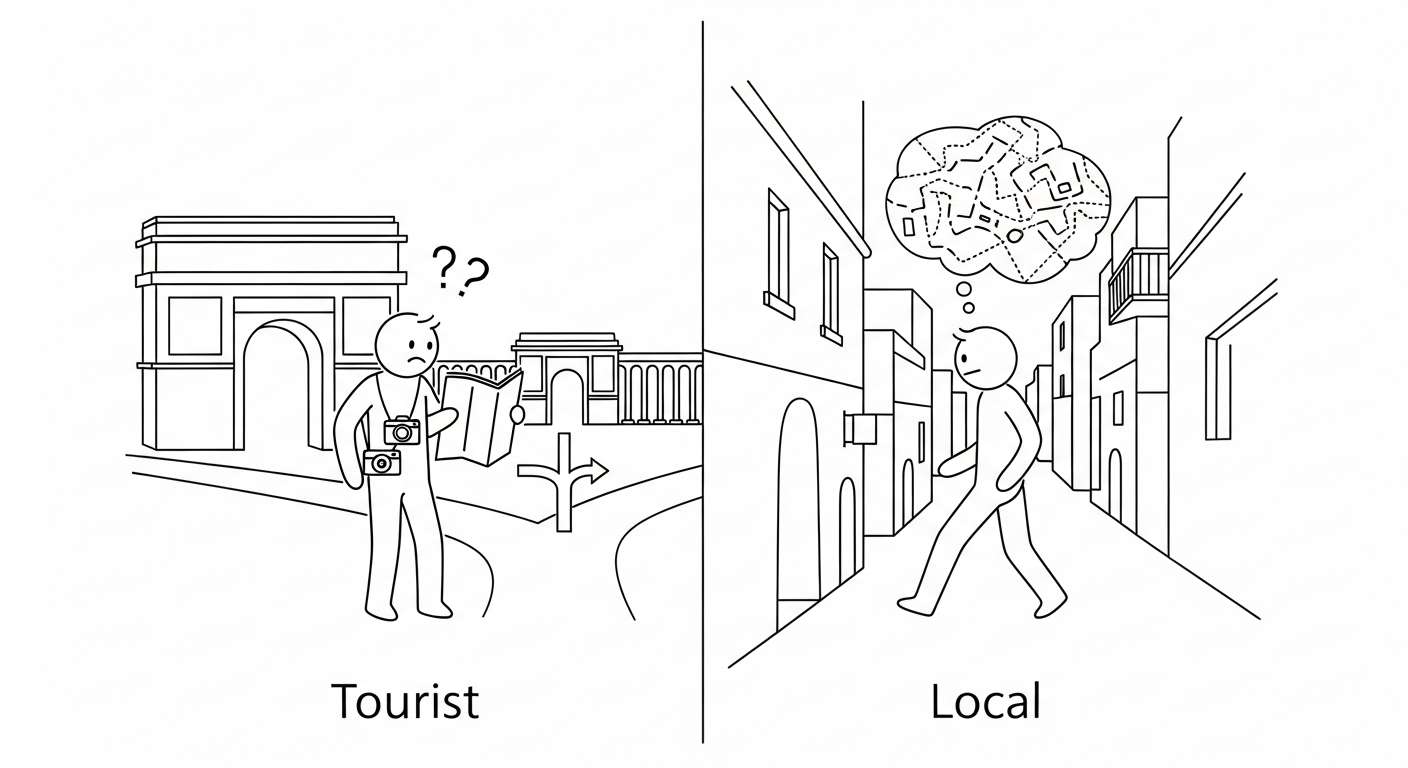
Doing deep work in a field will gradually establish a sense of what the true challenges in that field are and what are just surface problems. You will learn which methods are the right direction and which are dead ends. This sense is what taste is.
Fourthly, Learn to Say "Not to Do."
Taste ultimately comes down to choosing what not to do. For researchers, this means being able to reject topics that "can produce papers but are not important." For entrepreneurs, it means being able to reject directions that "have a market but are not worth pursuing."
8. Back to That Interview
Returning to the interview at the beginning of the article.
That student is capable and not unmotivated. His problem is that, over the past few years, no one has told him (or he hasn’t realized): completing three shallow projects is not as valuable as doing one deep one.
If he had concentrated the time and energy from the three projects on one truly important issue, genuinely understood the problem context, carefully thought about the design methods, and meticulously analyzed the experimental results, what he would have expressed during the interview would be completely different. The gain would not just be a skill but a deeper understanding.
Hamming said that taste is inexpressible and needs to be cultivated through practice and observation. I partly agree. Taste is indeed hard to teach in a single class, but you can create conditions that nurture taste: find a good problem, invest enough time, and work with people who have judgment.
For those who are currently focused on experience gathering, my advice is simple: stop. Find a problem that you truly care about. Invest two years into it. Your deep understanding of this one issue is more valuable than ten experiences on your resume.
References
[1] Business of Apps, "Apple App Store Statistics (2026)."
[2] Steve Jobs, "The Lost Interview," 1995 (PBS interview with Robert Cringely).
[3] Richard Hamming, "You and Your Research," Bell Communications Research, March 7, 1986.
[4] Paul Graham, "Taste for Makers," February 2002.
免责声明:本文章仅代表作者个人观点,不代表本平台的立场和观点。本文章仅供信息分享,不构成对任何人的任何投资建议。用户与作者之间的任何争议,与本平台无关。如网页中刊载的文章或图片涉及侵权,请提供相关的权利证明和身份证明发送邮件到support@aicoin.com,本平台相关工作人员将会进行核查。


