Author: David, Deep Tide TechFlow
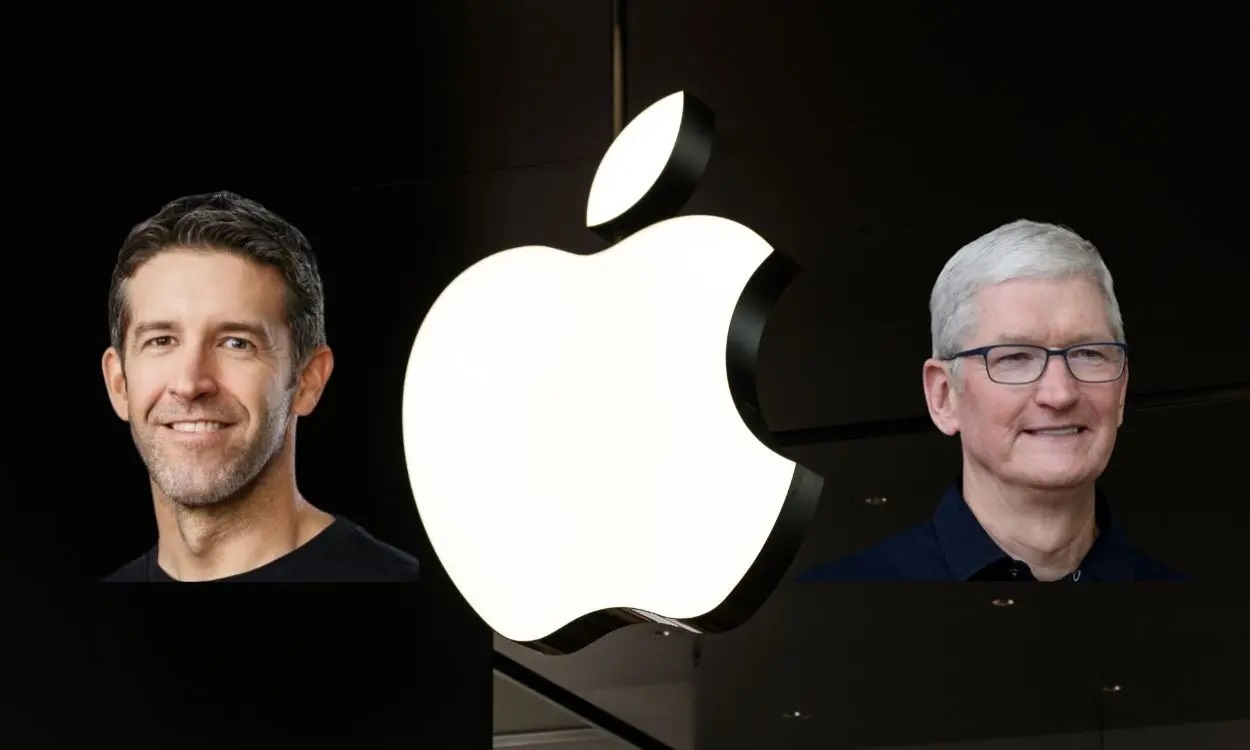
The world's highest-valued tech company, Apple, has just handed the CEO position to someone with almost no public image.
On April 20, Apple announced that Tim Cook would step down as CEO on September 1 and transition to executive chairman. His successor, John Ternus, is 51 years old and has been with Apple for 25 years, previously holding the title of senior vice president of hardware engineering.
After the announcement, Apple's stock price fell slightly by less than 1% in after-hours trading. The market's reaction was calm; perhaps everyone had anticipated it would be him.
Over the past year, Ternus has appeared more frequently at Apple’s product launches. Last year when the iPhone 17 was launched, he was the one welcoming the first customers at the door of the London flagship store.
According to Bloomberg journalist Mark Gurman, Apple's PR team has consciously been shifting the spotlight onto him since last year.
But if you don't pay much attention to Apple’s hardware events, you could hardly have seen him. He has no social media accounts and rarely gives interviews; when asked about succession rumors, he has only said five words:
“I like my current job.”
The CEOs who have left a mark in Apple’s history, like Jobs, were a combination of product intuition and marketing genius, while Cook was an expert in supply chain and operations. The two have completely different styles, but they share one thing in common:
Neither of them is an engineer.
But Ternus is. He has a background in mechanical engineering and has dealt with parts, molds, and production lines from day one of his career. Before joining Apple, he worked at a little-known company that developed VR headsets that still haven’t become mainstream.
And he is taking over Apple at a time when the company's biggest concerns may have little to do with hardware.
Low-profile hardware engineer
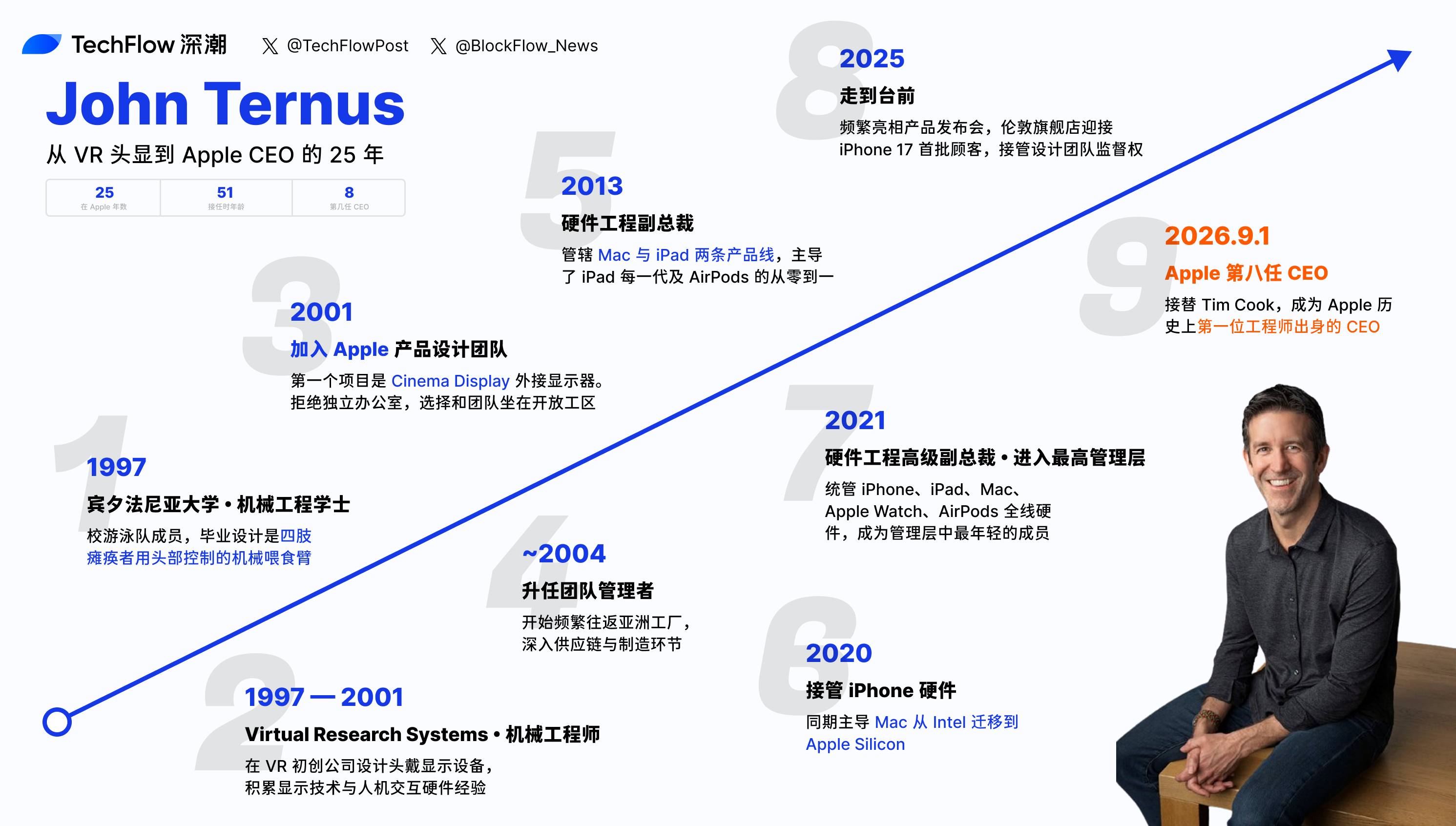
Ternus graduated from the University of Pennsylvania's mechanical engineering department in 1997. He was a member of the school swimming team and won championships in both the 50-meter freestyle and the 200-meter individual medley.
Public records show that his graduation project was a mechanical feeding arm that allowed quadriplegics to control the arm with head movements to eat.
After graduation, he went to work for a company called Virtual Research Systems as a mechanical engineer for VR headsets.
In 1997, the VR industry was still over twenty years away from Meta spending billions to create the metaverse, and Apple was even further from launching the Vision Pro. The company ultimately didn’t achieve much, but Ternus spent four years there, working daily with display technologies and human-computer interaction hardware.
In 2001, he joined Apple and entered the product design team.
That year, Jobs had just pulled the company back from the brink of collapse; the iPod had yet to be released, and the iPhone was still six years away. Ternus's first job was to work on the Cinema Display, Apple’s line of external monitors at the time.
According to the New York Times, his first boss at Apple, Steve Siefert, recalled that after Ternus moved up to management, he was assigned to a new floor and could have a private office, but he chose to stay in the open work area with the team.
When Siefert retired, he left his office to Ternus, who again declined.
Starting with displays, Ternus rose through the ranks. According to Apple's official introduction, he was involved in the development of the iPad from the ground up and every subsequent generation, as well as leading the hardware engineering for AirPods. He was promoted to vice president of hardware engineering in 2013 and became senior vice president of hardware engineering in 2021, officially entering Apple’s highest management tier.
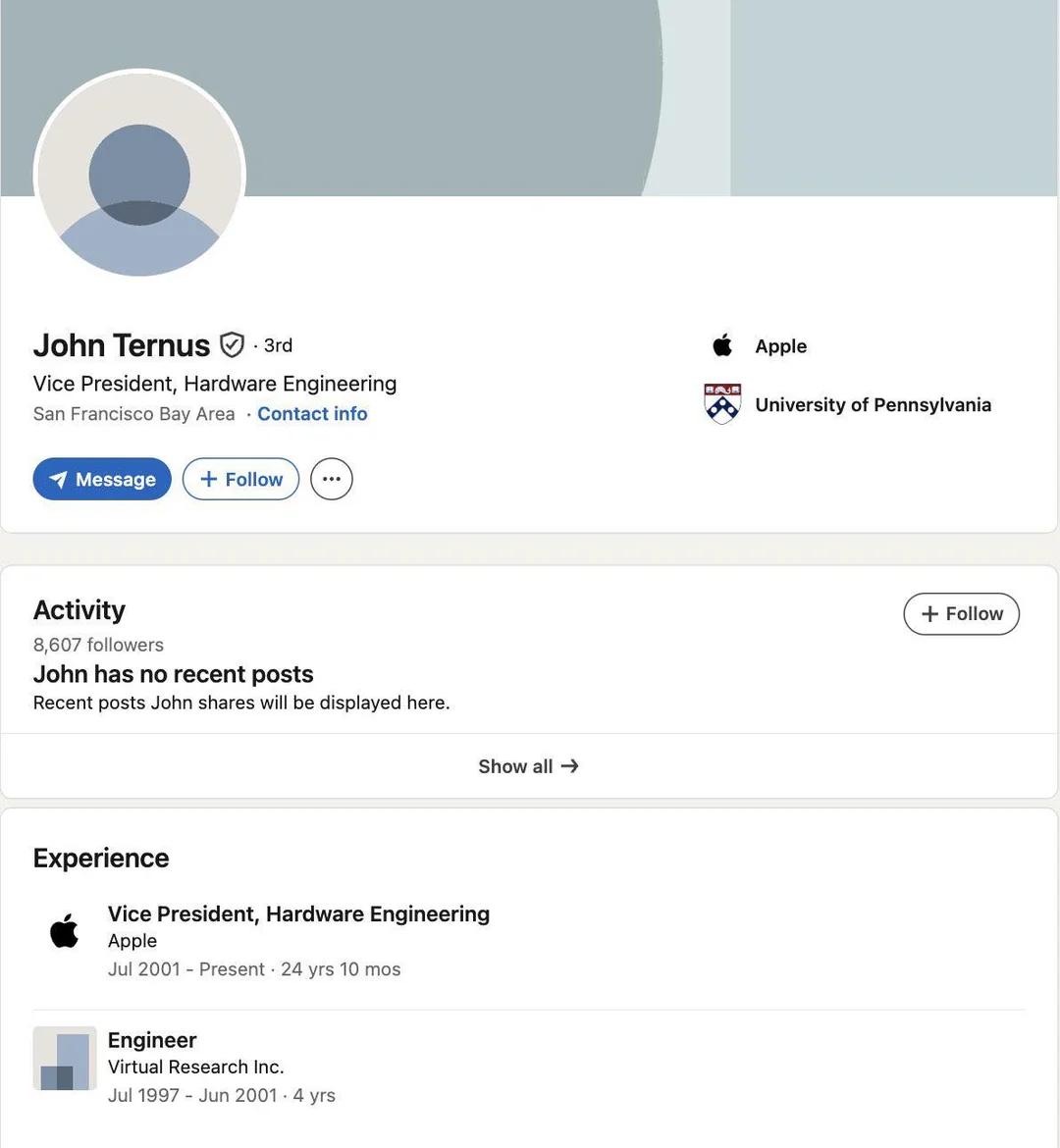
Checking his LinkedIn, I found Ternus's understated profile startling, as there is no photo or any posts. Perhaps up until now, he hasn’t cared much about managing his external image and has been more focused on working with hardware.
Internally, he also led a profoundly impactful initiative for Apple, migrating the Mac product line from Intel chips to Apple-designed chips.
In 2024, he returned to his alma mater Penn to give a speech to engineering graduates, where he said something that I believe is worth pondering in light of today's context.
“Always assume you are as smart as anyone in the room, but never assume you know more than they do.”
This statement might sound humble, but for someone about to take over the world's largest tech company, it likely reflects an engineer’s survival instinct: you can’t know everything, but you must know who does.
The legacy he is inheriting from this company is far more complex than just an office.
After Cook
Cook served as Apple’s CEO for nearly 15 years, leaving behind an impressive track record that would be legendary in any company.
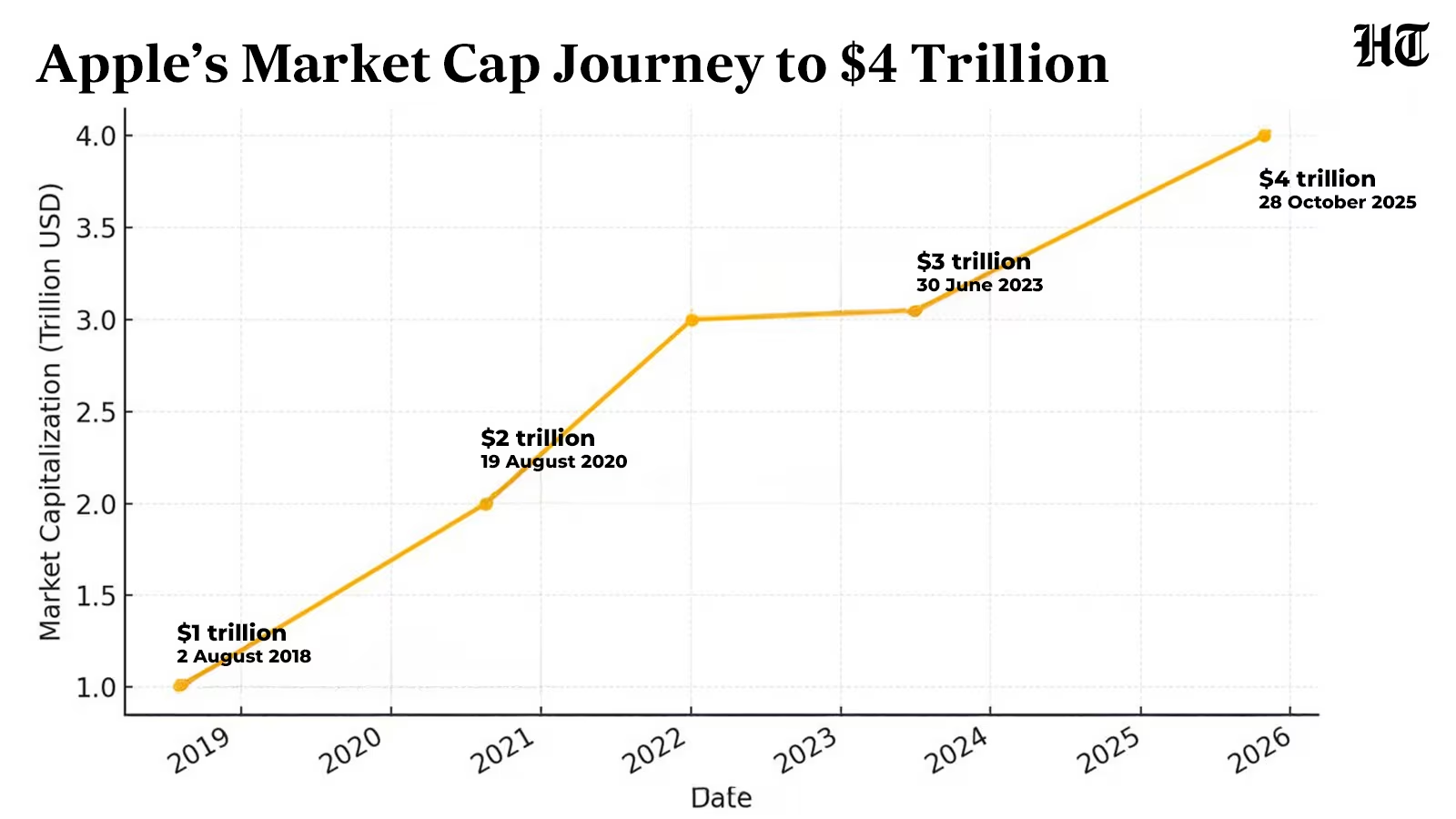
According to CNBC, when he took over the company from Jobs in 2011, Apple was valued at around $350 billion. Today, that number is 40 trillion—a more than tenfold increase.
According to Apple's latest fiscal year data, the company's annual revenue exceeds $400 billion, almost four times what it was when he took office. He also turned Apple's services business—app revenue from the App Store, iCloud, Apple Music—into a company generating over $100 billion in annual revenue.
A CEO with an operations background transformed a product-driven company into the world's most profitable machine. I believe Cook has already proven wrong the prediction that "Apple would collapse without Jobs."
However, he also left some unanswered questions.
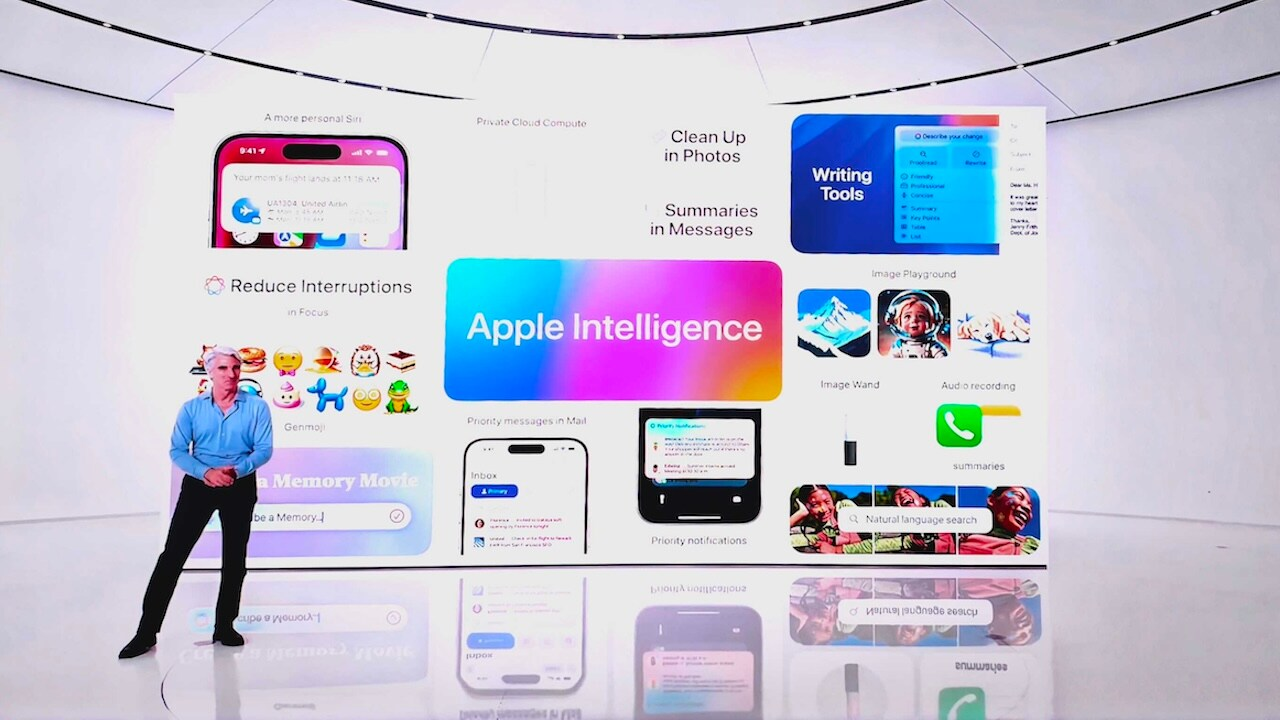
In 2024, Apple boldly announced Apple Intelligence, the company's formal response to the AI wave. The focus of the promotion was a brand new, smarter Siri voice assistant.
But that promise has yet to be fulfilled. Siri has been mocked for years throughout the AI race; users have had trouble even asking it to set an alarm, while competing AI assistants can write code, conduct research, and help manage schedules.
In January 2026, Apple made a noteworthy decision.
According to CNBC, the company announced a multi-year partnership with Google, using Google’s Gemini large model as the technical foundation for Apple's base model to power the next generation of Siri. Multiple media outlets previously reported that Apple was paying around $1 billion annually for this.
Prior to this, Apple had also tested technologies from OpenAI and Anthropic but ultimately chose Google. A company known for doing "everything in-house" opted to pay for external help regarding AI.
Additionally, this external aid plan itself has also been delayed.
The new version of Siri powered by Gemini was originally scheduled to launch with iOS 26.4; now, some functionalities may be postponed until this September alongside iOS 27. Apple has not delivered on any of the core AI functionalities it promised since 2024.
Cook made another not-so-successful gamble, Vision Pro. The mixed reality headset, priced at thousands of dollars, received a tepid market response upon its 2024 launch. Consumers were reluctant to spend so much money to strap a computer weighing over a pound to their faces.
The ventures Cook did not succeed in now fall into the hands of someone who knows this hardware better than he does. But while the issues with VR headsets can be resolved gradually, Ternus faces two more pressing concerns.
On June 8, Apple will hold its annual developer conference WWDC, where it is expected that the new version of Siri powered by Gemini will make its official debut. This will be Apple’s most important public test in the AI arena, and the person taking the exam will be an engineer who has spent his entire career in hardware.
In September, which is also the same month Ternus officially takes over as CEO, Apple plans to launch the company's first foldable iPhone, which may sell for over $2000.
According to Bloomberg, the mass production plans for this product have already encountered delays, and the supply chain is tight, with the initial supply likely being limited.
A software exam and a hardware exam are both putting pressure on this new CEO.
Eat hard, fear "soft"?
Apple is handing two exams at once to a person who has worked in hardware for 25 years. So the hardware exam, there may not be too much to worry about.
The delay in mass production of the foldable iPhone is a supply chain issue, while Ternus has been going back and forth between factories and production lines in Asia since 2004, which is his most familiar battleground.
By selecting him instead of someone with a financial or software background, Apple has sent a clear signal. It indicates that the board believes the physical form of products will remain Apple’s core competitive advantage in the coming years.
However, the other exam is different.
AI is currently Apple’s biggest shortcoming and is becoming a survival-level issue. The cruelest lesson in the tech industry in recent years has been that the impact of AI on software companies is far faster than anyone expected.
For now, Apple is not on the list of companies that could be replaced because its essence still sells hardware. But the problem is, if the AI experience running on iPhones is always a step behind Android, consumers will eventually vote with their feet.
And the new successor, Ternus, has no experience related to software or AI in his entire career. He is the type who can take the magnetic attachment concept for iPhone screens from idea to mass production, not the kind who can decide how Siri should interpret a sentence.
All the products he has handled at Apple—iPad, AirPods, Mac, Apple Silicon migration—are all triumphs defined by hardware. Whether the software is user-friendly has never been a question he needed to answer.
After September 1, that question will belong to him.
Apple's arrangements indicate that the company is also aware of this risk. After Ternus takes office, hardware engineering has been handed over to Johny Srouji, a veteran chip designer who has worked at Apple for nearly 20 years, whose title has been upgraded to Chief Hardware Officer.
Cook remains on as executive chairman, continuing to oversee global policy and government relations. Ternus is pulled out from specific hardware affairs, and his focus must shift towards AI and overall strategy.
The CEO needs to answer on direction. What role will AI play in Apple’s products? Will it become a subsidiary function of hardware like a camera, or will the hardware become a carrier for AI instead?
This is a question that Cook did not answer, or rather, his answer did not resonate in the market. Apple’s stock price has hardly increased this year, while Google’s rose by over 20% during the same period.
Cook is stepping down at a crucial moment for Apple’s transition to AI, which itself raises questions.
Now, this question has been passed on to Ternus. A person recognized internally at Apple as "the executive closest to the product" suddenly has to think about a question farthest from the product.
However, I am not pessimistic about this choice.
Engineers have an underestimated advantage: they are accustomed to acknowledging their ignorance and then finding someone who knows. In an era where CEOs compete to showcase "I know more about AI than AI does," a person willing to say "I don’t know, but I know who does" may actually walk a steadier path.
Of course, the market and consumers will not give him much time to validate this assumption.
免责声明:本文章仅代表作者个人观点,不代表本平台的立场和观点。本文章仅供信息分享,不构成对任何人的任何投资建议。用户与作者之间的任何争议,与本平台无关。如网页中刊载的文章或图片涉及侵权,请提供相关的权利证明和身份证明发送邮件到support@aicoin.com,本平台相关工作人员将会进行核查。


