Written by: Glendon, Techub News
Yesterday, the Hong Kong Securities and Futures Commission (SFC) announced a new regulatory framework to promote the trading of tokenized investment products (tokenized products) in a secondary market trial in Hong Kong. This already leading global compliance framework marks a significant step forward for Hong Kong's virtual asset regime, transitioning from "tokenized issuance" to "tokenized trading," and signifies that the construction of Hong Kong's digital asset ecosystem has entered a new phase.
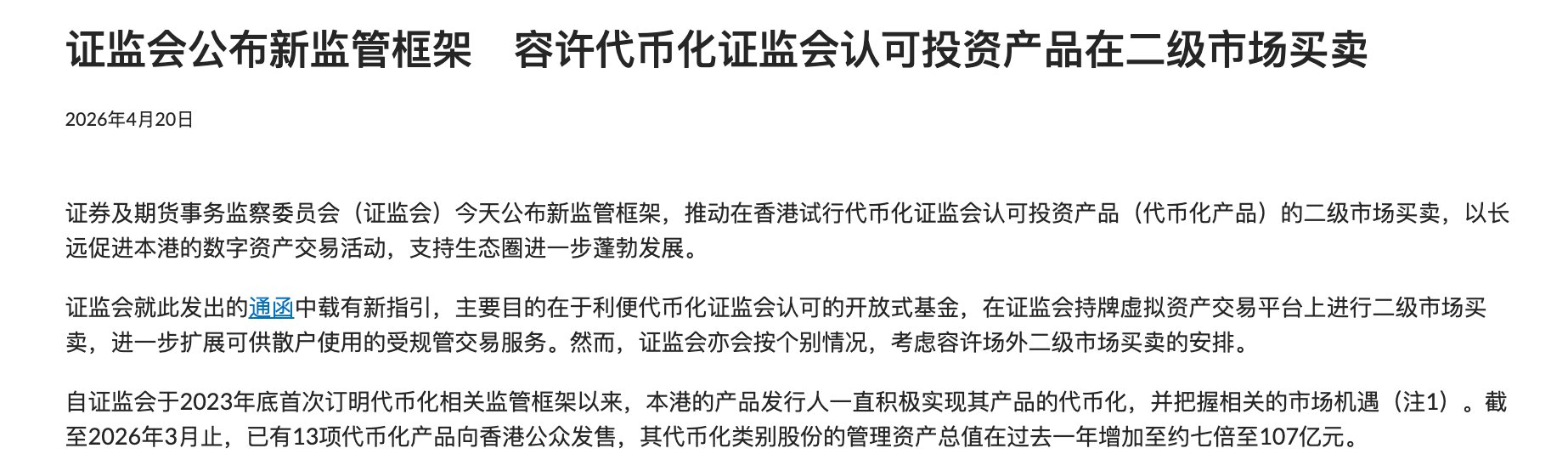
At the same time, the SFC also issued a circular regarding the secondary market trading of tokenized investment products approved by the SFC, providing more detailed regulations for this regulatory innovation. This article will interpret the content of the circular from six dimensions: background, trading channels, fair pricing, liquidity provision, information disclosure, and pre-consultation mechanisms.
Sevenfold growth in one year lays the foundation for the market
The introduction of the new framework did not come out of the blue. The SFC pointed out that since the initial announcement of the regulatory framework related to tokenization at the end of 2023, product issuers in Hong Kong have been eager to tokenize their products, hoping to seize the market opportunities this brings. As of March 2026, 13 tokenized products have been issued to the public in Hong Kong, with the total value of managed assets for these tokenized classes of shares reaching HKD 10.7 billion, an increase of approximately seven times in just the past year. In such a market context, opening the secondary market for trading is "timely" and will further promote the integration of tokenized products with the Web3 ecosystem.
It is noteworthy that this new framework is not applicable to all tokenized products, but primarily targets open-end funds recognized by the SFC, allowing them to trade in the secondary market on licensed virtual asset trading platforms (VATPs). The first batch of products is expected to consist mainly of tokenized money market funds, and the SFC will first observe the actual operation of these products before expanding the range of products as appropriate. This clearly reflects the SFC’s cautious approach of "starting with low-risk products and gradually expanding," piloting with highly liquid and structurally simple funds, which can respond to the urgent market demand for liquidity, while leaving space for the inclusion of more complex products later on.
A dual track structure centered around licensed platforms
Regarding the standardization of trading channels, the circular clearly establishes a "dual track" structure centered around "licensed platforms as the core and over-the-counter arrangements as a supplement" to ensure that trading occurs in a regulated, transparent, and compliant environment. Retail investors can conduct secondary market trading of tokenized products (i.e., buying and selling automatically matching on the screen) through the platforms provided by licensed virtual asset trading platforms.
To prevent "naked short selling" or settlement failures, the platform must first confirm that the client's account has sufficient funds or equivalent product holdings before executing transactions, which is to ensure market order and protect investors' rights. Additionally, synchronizing the launch of products is necessary to ensure smooth trading operations. This requires product providers to collaborate with trading platforms, jointly testing the trading process of tokenized products on the platform, covering operational mechanisms, risk monitoring systems, and technical integration, among other critical areas, to ensure readiness of the system.
Moreover, the SFC has also reserved flexible space for the trading needs of certain specific products. It clearly stated that it will consider permitting over-the-counter secondary market trading arrangements on a case-by-case basis, thereby providing flexible trading paths for tokenized products that are structurally complex or have lower liquidity. Regarding this, Ye Zhiheng, Executive Director of the Intermediary Institutions Division of the Hong Kong SFC, also mentioned at the Web3 Festival yesterday that the SFC will "proceed steadily" in introducing tokenized money market fund trading, and if the experience is good, will gradually expand it to all recognized authorized funds.
Fair pricing: Price deviation warnings and multiple monitoring mechanisms
Unlike traditional public mutual fund trading, tokenized products are traded outside traditional trading hours (such as nights and weekends), and the risk of price deviation from net asset value is undoubtedly a core concern for investor protection. China Asset Management (Hong Kong) stated in an interview with the Shanghai Securities Journal that after the first batch of tokenized products goes live, investors can expect to trade 24 hours a day and submit trading orders in real-time. To this end, the circular establishes a three-tier fair pricing protection mechanism.
The first is price deviation warnings. Licensed virtual asset trading platforms are explicitly required to implement effective risk management and supervision measures to prevent significant deviations between prices and net asset values (NAV), ensuring fair pricing for tokenized products on the platform. If the transaction price deviates significantly from the real-time or near-real-time indicative net asset value per unit, the platform must issue a warning to investors. The deviation threshold can be set differentially based on characteristics like product liquidity and volatility.
The second is investor education. The circular emphasizes that platforms must adequately disclose to investors that they can subscribe to or redeem tokenized product shares at net asset values through the primary market, while the trading prices in the secondary market may lead to premiums or discounts due to supply and demand dynamics. Clarifying this option helps investors "vote with their feet" in the event of price anomalies and serves as an important buffer for protecting investor interests.
The third is comprehensive trading monitoring measures. Platforms must implement automated pre-trade risk control (such as price range limits), regular post-trade reviews, and establish response mechanisms for abnormal fluctuations, including measures to prevent excessive price volatility, market manipulation, and monitoring suspicious violations of activity. These measures collectively form a dynamic, real-time risk prevention system, thus ensuring the orderly stability of this emerging market.
Market maker mechanisms and multi-party collaboration arrangements
Liquidity is vital for the healthy operation of the secondary market. The circular sets forth clear requirements for product providers, licensed platforms, distributors, and market makers, forming a collaborative liquidity assurance system.
Product providers must make every effort to ensure that each tokenized product has at least one market maker, and market makers must provide at least three months' prior notice before terminating services. Product providers must closely monitor the secondary market trading activities and liquidity of their tokenized products, maintain close communication with the appointed market makers, and develop appropriate contingency plans. Additionally, product providers must appoint distributors for tokenized products, and distributors must be entities licensed or registered by the SFC.
Licensed platforms are then required to take on the responsibilities of investor maker admission and ongoing supervision. Platforms must conduct due diligence and regularly monitor the performance of all market makers against the agreed terms, ensuring compliance with established standards in terms of bid-ask spreads, quoted values, minimum quote duration, and participation rates. When a market maker fails to fulfill its responsibilities, the platform must contact the relevant market maker for rectification. Additionally, product providers should establish arrangements with licensed platforms to facilitate the transfer of tokenized products between the primary and secondary markets. For instance, tokens subscribed through the primary market can be easily bought and sold in the secondary market, while tokens acquired in the secondary market can also be redeemed through the primary market.
This series of requirements actually enhances the market's arbitrage mechanism, helping to suppress significant price deviations from net values and improve pricing efficiency. In summary, the SFC has constructed a liquidity collaboration system of "product providers, market makers, platforms, and distributors," fully reflecting its regulatory approach of clearly defined responsibilities and risk anticipation. This can be considered a key institutional arrangement to promote the stable development of Hong Kong's tokenized product market.
Information disclosure and pre-consultation mechanisms
For investors, information disclosure is another pillar that protects their rights. The circular approaches this from two levels: one is the sales documents, and the other is the trading platform. The requirements from both sides are very detailed, aiming to make information "transparent down to the bottom."
On the sales document level, tokenized product sales documents must clarify several points: first, the risks associated with the secondary market, including liquidity risks, price deviation risks, price fragmentation risks (different trading channels may have different transaction prices), and reliance on market makers; second, the basic situation of the trading channels, including operational processes, how settlement occurs, how long settlement takes, preset funding requirements, and the differences between the secondary and primary markets; third, the arrangement of market makers, such as what rewards or incentives are given by product providers and platforms to market makers; fourth, the list of market makers for tokenized products and any affiliated entities serving as market makers, along with related potential conflicts of interest that need to be disclosed.
On the trading platform level, licensed platforms and connecting brokers must maintain a designated online interface, such as a website or App, to publish detailed arrangements for secondary market trading, and to release indicative net asset values in real-time or near-real-time. Additionally, for customers wishing to participate in secondary market trading, the platform needs to emphasize the associated risks. Moreover, before opening accounts for customers, the platform must have the customers confirm that they understand these risks.
Besides information disclosure, the circular also establishes a clear pre-consultation and approval mechanism. If a platform intends to launch a brand new product with tokenization features (including primary and secondary market trading), it must first consult the SFC; if an existing recognized product wants to add tokenization features, it not only needs to consult the SFC in advance but also obtain its approval. Each application will be assessed on a case-by-case basis, and the SFC retains the power to provide further guidance or add extra conditions at appropriate times.
As for intermediaries, including licensed platforms and intermediaries engaged in over-the-counter secondary market trading of tokenized products, they should notify their case officer at the SFC and discuss their plans before engaging in secondary market trading activities for the first time. The intention behind this is clear: to enable regulators to grasp the situation before the business actually begins, and to proactively prevent risks. Overall, the SFC implements a "transparent disclosure" and "pre-approval" approach in investor protection, ensuring that market transparency is maximized while providing a prudent entry for innovative businesses.
Conclusion
The issuance of this new regulatory framework by the SFC marks a key step for Hong Kong's tokenized product market from a "one-way channel" (limited to primary market subscriptions and redemptions) to a "two-way circulation market" (where investors can freely buy and sell among themselves). Previously, only primary market trading was allowed, and the formal opening of secondary market trading of tokenized products on licensed platforms significantly enhances product liquidity.
SFC Chief Executive Officer Alexa Lam described this framework as "another significant milestone in Hong Kong's process of building a digital asset ecosystem." Its importance lies not only in allowing traditional securities products to be traded at night and on weekends after being tokenized, but more importantly, in providing all-weather liquidity through regulated stablecoins and tokenized deposits, addressing the genuine needs of investors in a rapidly changing and uncertain market environment. In this new framework, four pillars of fair pricing, orderly trading, liquidity provision, and information disclosure jointly support the robust operation of the secondary market for tokenized products, allowing Hong Kong to secure a regulatory leading position in the global digital asset competition.
Of course, the implementation of the framework is just the starting point. Issues such as market maker enthusiasm, retail investor acceptance, and cross-platform interoperability still need to be tested gradually in practice. Whether Hong Kong can truly create an active compliant tokenized trading ecosystem through this remains something to look forward to and continue to monitor.
免责声明:本文章仅代表作者个人观点,不代表本平台的立场和观点。本文章仅供信息分享,不构成对任何人的任何投资建议。用户与作者之间的任何争议,与本平台无关。如网页中刊载的文章或图片涉及侵权,请提供相关的权利证明和身份证明发送邮件到support@aicoin.com,本平台相关工作人员将会进行核查。


