Original | Odaily Planet Daily (@OdailyChina)
Author | Azuma (@azuma_eth)

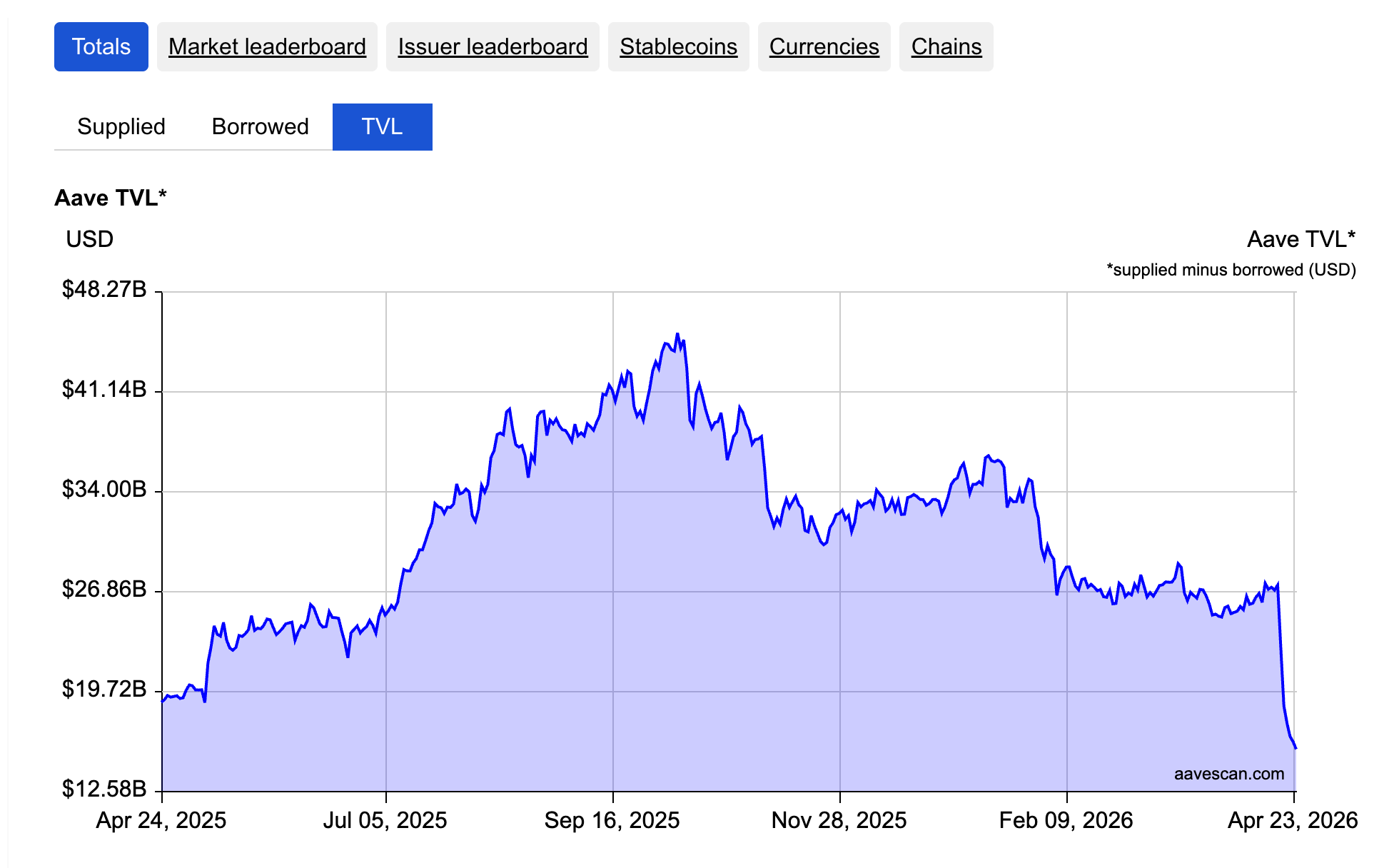
292 million dollars, this is the total amount of rsETH funds stolen from Kelp DAO; 17.2 billion dollars, this is the scale of funds that have flowed out from Aave since the incident occurred.
Aave is watching the community's panic emotions ferment for several days due to its extremely foolish crisis management strategy, and subsequently lost its once greatest advantage in the lending sector — a liquidity scale of hundreds of billions of dollars and the user perception label of "the safest DeFi".
- Odaily note: For the background, you can refer to "DeFi has been hacked again for $292 million, is even Aave unsafe now?"; "A three-party game under a $290 million hole: who will bear the costs, Aave, L0, Kelp?".
What mistakes did Aave make?
The details of the Kelp DAO hacking incident do not need further elaboration, and it is pointless to blame Aave for giving such a high LTV to rsETH; here, I mainly want to discuss Aave's response strategy from the perspective of a long-term AAVE user after the incident.
First is the issue of bad debt scale, Aave has calculated the accounts itself. Based on different disposal situations of rsETH, there might be two possible bad debts — if the stolen loss is deducted from the total circulation of rsETH, it is expected to generate a bad debt of 123.7 million dollars; if the value of mainnet rsETH is guaranteed, the total loss accounted into the Layer2 mapped version of rsETH is expected to generate a bad debt of 230.1 million dollars.
No matter which situation occurs, with the Umbrella, DAO treasury, and team funds, Aave is capable of covering it. I understand Aave's reluctance to bear this amount, wanting to push Kelp DAO, the primary responsible party, and LayerZero, the secondary responsible party, to bear as much as possible, but the problem is both sides will think the same — "You Aave are so wealthy, and the situation is so awkward, you should bear some more." Therefore, in the short term, it is difficult for these three parties to reach a consensus, which means a mutually beneficial solution is temporarily impossible.
But users cannot wait so long — Aave's yield level has always been uncompetitive in the industry, and users who choose to deposit in Aave are primarily driven by reputation, safety, and liquidity, but now the situation is that during the most tense days after the incident, Aave has not offered users any sort of bottom-supporting commitment, instead emphasizing "our code is fine," and how "Aave cannot control the accounting of rsETH" to shift the blame.
As a result, panic emotions have continuously fermented within the community, and users are finding ways to escape the risk; those who can withdraw are withdrawing directly, and those who cannot are borrowing from other pools, leading to a gradual expansion of the impact. So now Aave's situation is facing continuous capital outflow while multiple pools are experiencing liquidity exhaustion due to being fully utilized.
This awkward situation could have been avoided (at least not this bad) … Since Aave can afford the money, why not inject some reassurance into the community at the beginning to prevent a bank run? At most, 230 million in bad debt (possibly even less), this money cannot be borne only by Aave alone, and then it can negotiate with LayerZero and Kelp DAO later.
Now, to save at most 230 million dollars in commitments, Aave watches 17.2 billion dollars in stable funds flow away (the number may continue to grow), and this doesn’t even account for the drop in AAVE's price these days... In any case, it’s a huge loss.
What makes Aave feel worse is that the worse its situation becomes, the more relaxed LayerZero, Kelp DAO, and other counterparties will be because they will judge that Aave will have more motivation to solve problems quickly, which will only put Aave at a disadvantage in the competition.
Reaching this point, Aave has truly brought this upon itself.
Behind Aave, Spark is eyeing like a hawk
While Aave is in distress, its competitor Spark is in a flourishing position. What’s more ironic is that Spark is precisely the competitor that Aave "incubated" itself.
Spark was initially a lending protocol developed based on the open-source code fork of Aave V3 by Sky (formerly MakerDAO). Both parties actually use the same underlying code logic. In return, there was a profit-sharing agreement between Spark and Aave, but later Aave accused Spark of breaching the contract, and due to divergent routes, the two parties are currently in a purely competitive relationship.
Three months before the Kelp DAO theft, Spark had just removed support for rsETH (details can be found in "Fate on the same day: Aave embraced rsETH and lost nearly 200 million, while Spark exited unscathed"), whether this is strategic conservatism or stringent risk control, or can even be completely attributed to luck, the result is that Spark has not been affected by this incident — on this point alone, Spark can recklessly attack Aave's former "safest DeFi" label.
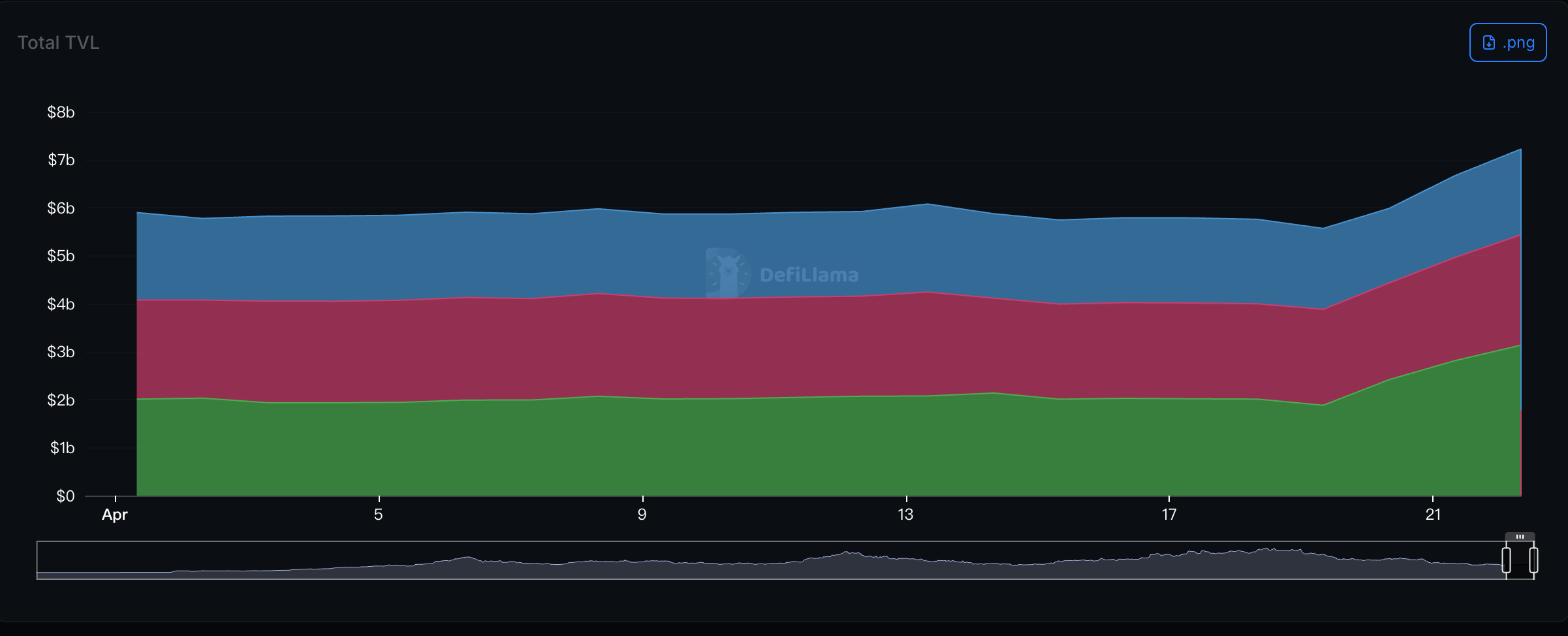
As a result, Spark has become one of the safe havens for Aave's capital outflow. Since the incident, Spark's TVL has increased by nearly 2 billion dollars (the green part in the graph below), and Sun Yuchen withdrew 53,665 ETH (worth 124 million dollars) from Aave on the day of the incident and subsequently deposited it in Spark. In recent days, the total deposit amount has reached 1.3 billion dollars — in the DeFi world, Sun's operation is truly worth learning.
On April 23, Upbit officially announced the launch of Spark (SPK) Korean Won trading market, SPK rose more than 80% in a single day due to this favorable news, greatly narrowing the gap in market value between itself and AAVE.
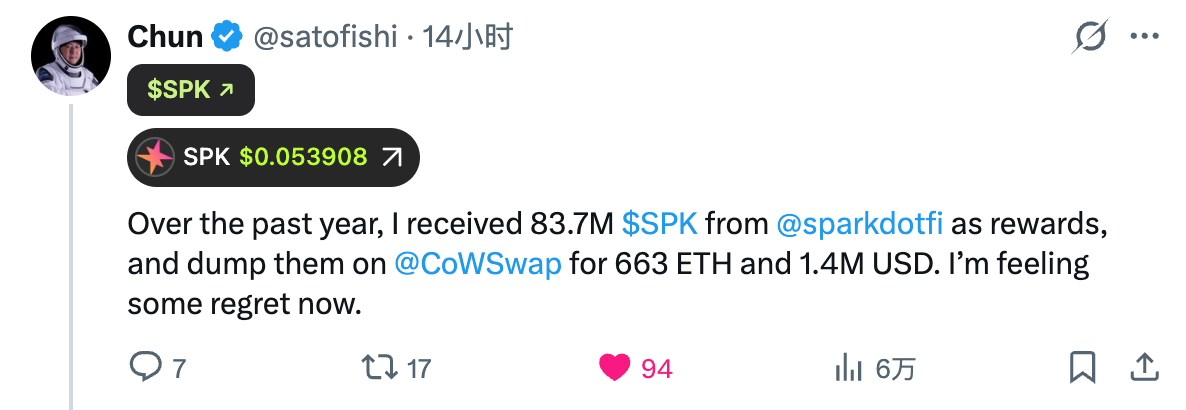
Even the founder of Fishpond, Wang Chun, expressed on X: "In the past year, I received 83.7 million SPK rewards from Spark and sold them on CoWSwap, getting 663 ETH and 1.4 million dollars. Now I feel a bit regretful."
Spark clearly realizes that this is a golden opportunity to seize market share from Aave. Since the incident, Spark's strategy officer MonetSupply has become one of the most vocal KOLs about the matter, posting dozens of messages a day. While their statements can help the public understand what happened to a certain extent, they objectively also exacerbated the panic surrounding Aave.
But this is pure business competition; MonetSupply just made the most correct choice.
Aave is losing the throne of DeFi lending
In the early hours of April 24, perhaps realizing the current serious situation, Aave's founder Stani announced on X that a relief plan called DeFi United would be launched, with collaborative partners including LayerZero, Ethena, ether.fi, Ink Foundation, Golem Foundation, Trydo, etc. Stani himself will also donate 5,000 ETH to solve the current problem.
But the funds have already flowed away, and user trust has been severely damaged. Solely relying on this belated statement, Aave will find it difficult to regain stable funds and user trust in the short term.
The DeFi lending sector has long shown a pattern of "one dominating, many strong." Aave has always had a seemingly solid leading advantage. But now, Aave has willingly given up its throne. Behind it, challengers are coming on strong, aside from the booming Spark, other competitors like Morpho, Jupiter Lend, etc., also hope to take a bite out of Aave.
Last year, Stani bought a five-story mansion in London for about 30 million dollars, one of the most expensive transactions in the UK’s depressed luxury real estate market over the past year. I don’t know if there’s a thing like "bad luck" involved, but with examples like Su Zhu, it seems that those who publicly consume in the circle tend to encounter misfortunes.
I can't guess what Stani is thinking in his five-story mansion today.
免责声明:本文章仅代表作者个人观点,不代表本平台的立场和观点。本文章仅供信息分享,不构成对任何人的任何投资建议。用户与作者之间的任何争议,与本平台无关。如网页中刊载的文章或图片涉及侵权,请提供相关的权利证明和身份证明发送邮件到support@aicoin.com,本平台相关工作人员将会进行核查。


