The real weakness of STRC is not the BTC price, but the mNAV.
Written by: Benji @ IOSG
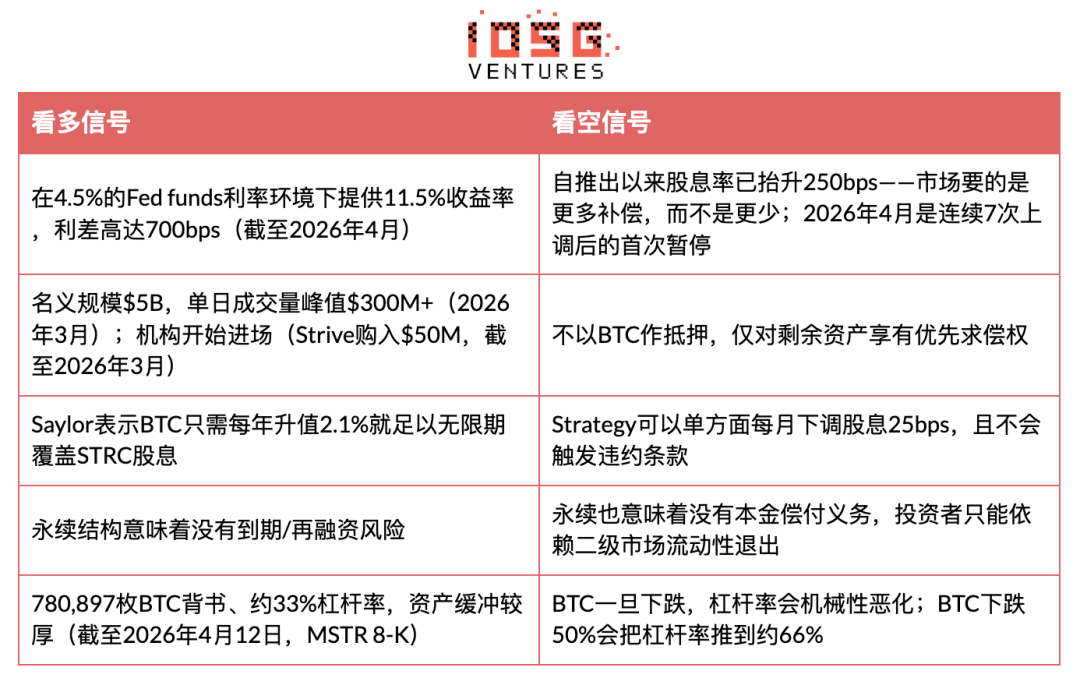
Core Viewpoint: STRC is a cleverly designed financing tool that transforms fixed income demand into buying pressure for Bitcoin. In a bull market, it can provide a floating yield of 11.5% with lower price volatility, but its risk structure is essentially equivalent to "selling a put option" on Bitcoin asset coverage, thus it cannot replace a true fixed income product when BTC declines.
The real weakness of STRC is not the BTC price, but the mNAV. Once MSTR's mNAV falls below 1.0 for more than 4 consecutive weeks, the flywheel will enter passive mode and a downward spiral within 3 months. We estimate the probability of this trigger occurring in the second half of 2026 to be around 70%, at which time STRC will have a buying entry point of $85 – $90. If the trigger does not occur, it means that Saylor has successfully created a brand new category of BTC-native credit tools.
Background
Strategy (formerly MicroStrategy) launched STRC ("Stretch"), which is a perpetual preferred stock with a target face value of $100, maintained at price stability through monthly floating dividends. As of March 31, 2026, STRC's nominal scale is $5B, with a peak daily trading volume exceeding $300M (data as of March 2026); since its launch, it has provided Strategy with over $3.5B for BTC purchasing and is its current most important financing vehicle. As of April 12, 2026, Strategy holds 780,897 BTC on its balance sheet, with a leverage ratio of 33%, and the remaining issuance capacity for STRC ATM is approximately $21.6B.
This tool is in a novel category: it resembles a money market fund (price stability, high yield), but the credit risk it bears comes entirely from a single company's BTC holdings.
Before elaborating on the argument, let's clarify "where we might be wrong."
If our analysis is wrong, it will be because: traditional fixed income allocators are really willing to accept reflexive risk for a 700bps spread; STRC scales up to $50 billion within 3 years, becoming the de facto BTC yield curve; Saylor successfully securitizes BTC into a yield-bearing collateral asset that institutional portfolios can accept. This outcome would represent the largest case of crypto merging into traditional finance to date—an entirely new asset class of $50 billion + that did not even exist before 2025.
In this optimistic scenario, the pause in dividends in April 2026 is not a warning signal but a characteristic: a mature tool begins to stabilize yields after the early price discovery is complete, similar to the process of early high-yield bond ETFs gradually repricing downward as institutional adoption occurs.
Argument Breakdown
STRC's core innovation: it transforms yield-seeking funds into buying pressure for BTC. When STRC trades around $100, Saylor issues new shares through the ATM (which accounts for about 40% of daily trading volume) and uses the proceeds to purchase BTC, then issues MSTR common stock at a price above NAV (mNAV > 1x) to complete deleveraging. The end result is: a daily trading volume of $100M in STRC can leverage about $120M in BTC purchases.
But the fragile part of this mechanism lies in its underlying cyclicality: STRC can stabilize at $100 because investors believe it can; and Saylor maintains this belief by continuously raising dividends. This anchor is not supported by collateral, but by confidence, maintained by a continuous dividend auction without a formal cap. Once this confidence breaks, the auction will become more and more expensive.
Evidence and Comparison: STRC vs. Other Bitcoin Exposure Tools
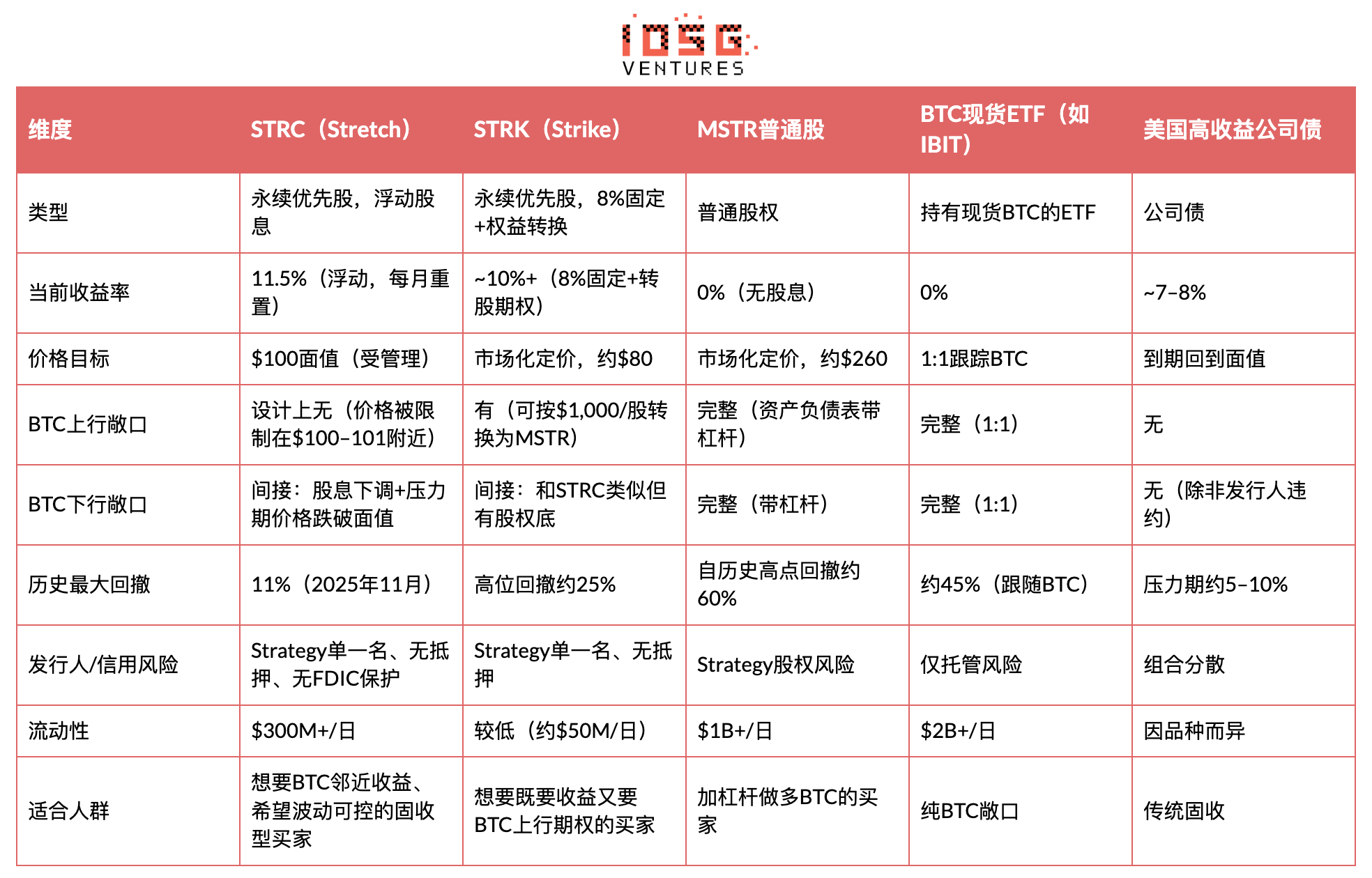
Key Insight: For Strategy, STRC transforms fixed income demand into fuel for BTC accumulation. For investors, it offers Sharpe-optimized returns under benign conditions, but it hides a BTC "sell put." NYDIG's description is very accurate: "It is similar to shorting a put option on Bitcoin asset coverage—exposing oneself to the downside risk of BTC declining and eroding the asset buffer in exchange for returns."
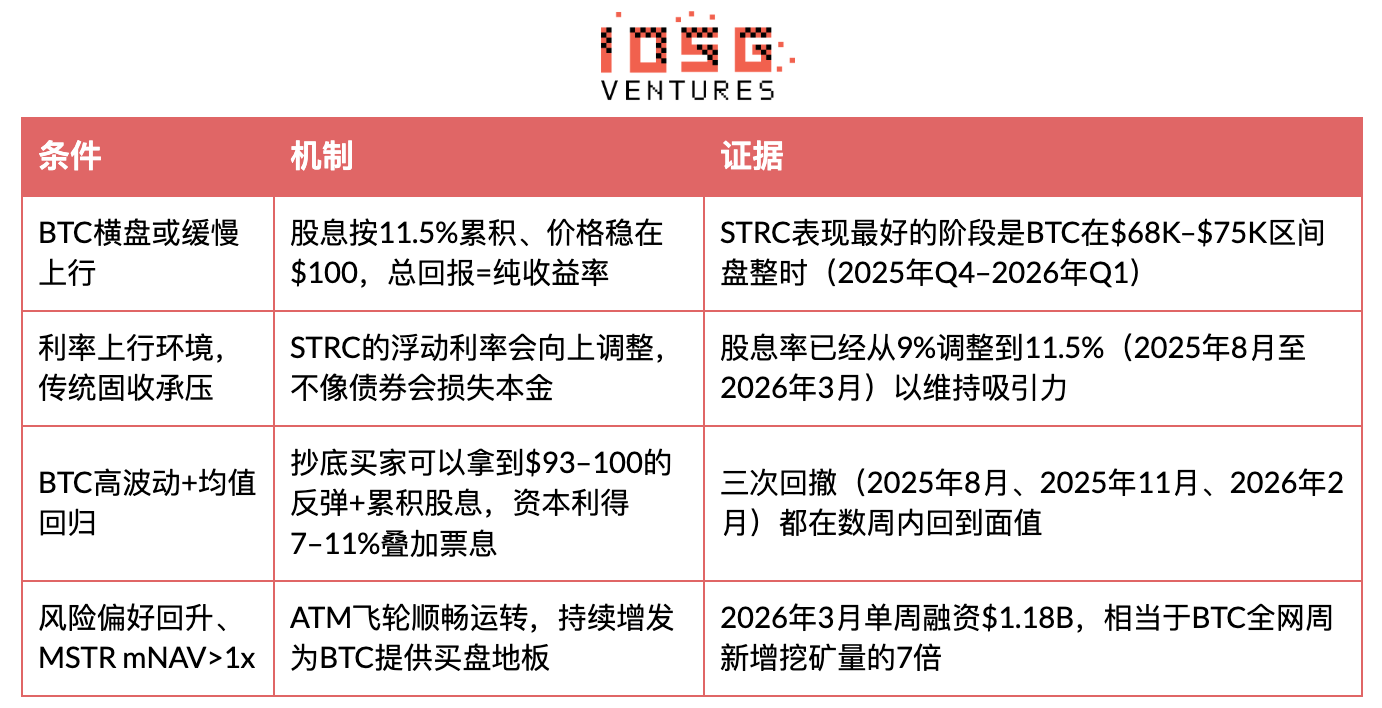
When STRC Performs Well
When STRC Performs Poorly
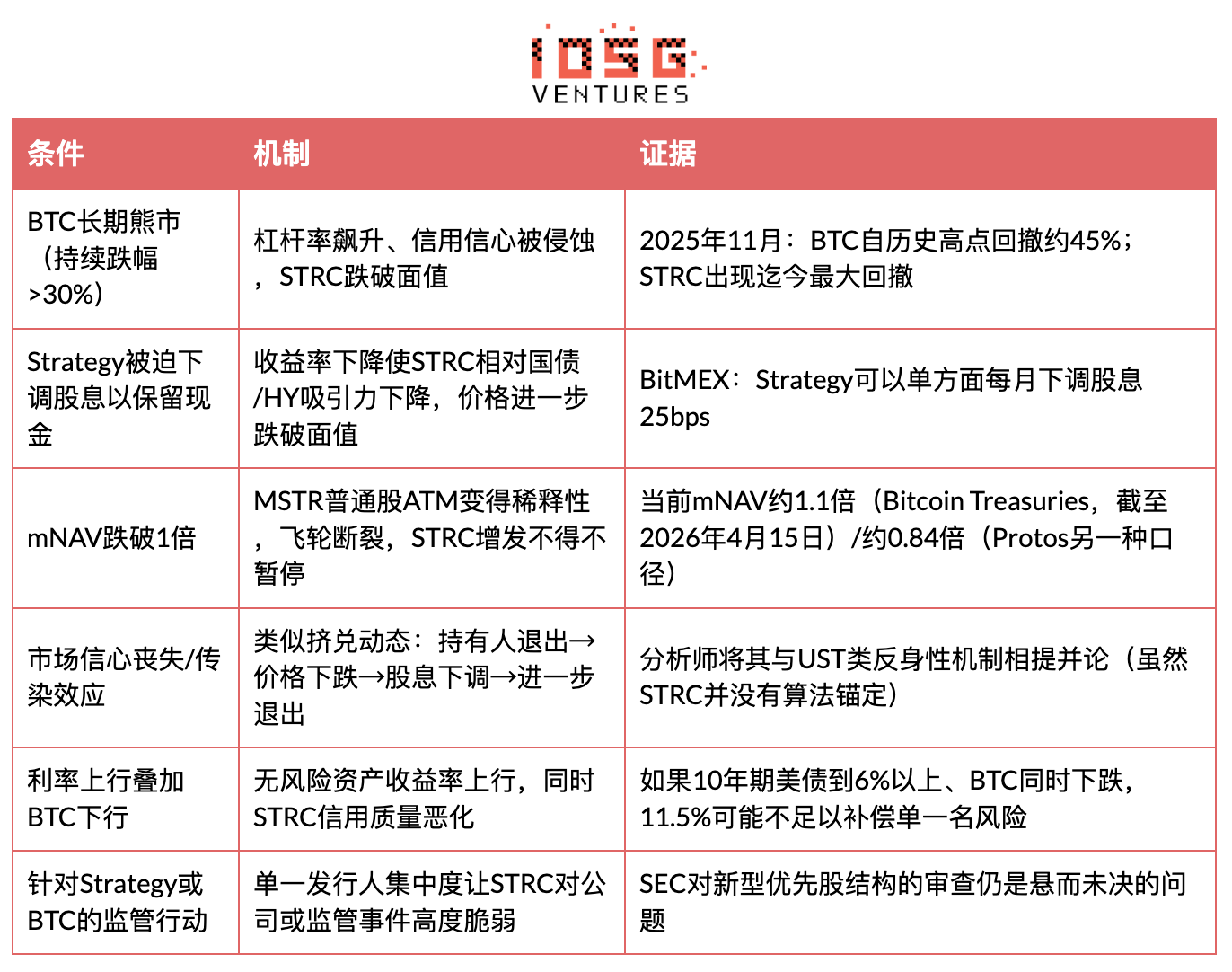
When STRC Might Collapse: Death Spiral Scenario
The key question is: will STRC enter a self-reinforcing downward loop? The answer is yes, but specific conditions must be met. This mechanism has three interlinked failure paths.
Phase One: BTC Decline Breaks $100 Anchor
When BTC plummets (for example, a drop of about 45% from historical highs at the end of 2025), Strategy's leverage will mechanically rise. Based on 780,897 BTC and a 33% leverage ratio (as of April 12, 2026, MSTR 8-K), if BTC falls another 50%, the leverage ratio will be pushed to about 66%. At this point, the credit quality of STRC deteriorates, as its priority claim on the remaining assets thins. The price drops below $100. This situation has occurred three times (August 2025: about $92, November 2025: intraday low, February 2026: about $93), but each time BTC quickly rebounded and pulled the anchor back up.
Phase Two: Dividend Adjustment Trap
According to the guidance submitted by Strategy to the SEC: if the monthly VWAP is between $95–$99, the dividend rate increases by 25bps each month; if it falls below $95, it increases by 50bps every month. From 9% to 11.5%, the dividend rate has cumulatively increased by 250bps in about 8 months (from August 2025 to April 2026), averaging about 31bps per month—this speed is faster than any similar company's preferred stock repricing in stable market conditions. April 2026 is the first pause after seven consecutive adjustments. Two interpretations: (a) demand stabilizes—bullish; (b) Strategy has hit the sensitivity ceiling of traditional fixed income buyers towards yield—bearish. This is the single signal worth tracking most in May and June, and is the turning point around the mNAV trigger framework described above.
If BTC remains sluggish, dividends must continue to be adjusted upward to attract buyers back to the face value vicinity. At a scale of $5B, every 100bps adjustment means about $50M in additional cash expenditure each year; if STRC expands to $20B (the authorized ATM limit), each 100bps cost becomes $200M annually. A continued bear market under the current adjustment pace for more than six months would push STRC's yield to 13–15%; at this level, the annual dividend expenditure for a $20B scale will exceed $2.6–3 billion, consuming a significant part of Strategy's BTC reserves' potential earnings, forcing it to choose between "continuing to adjust upward" and "abandoning the stability narrative."
Dividends have no formal upper limit, and this dynamic of "no upper cap" adjustments is precisely what bears are keeping a close eye on.
Phase Three: Flywheel Breaks After mNAV Falls Below 1
This is the real breaking point. Strategy relies on issuing MSTR common stock at prices above NAV (mNAV>1x) to purchase BTC and deleverage. If BTC declines deep enough that mNAV falls below 1, issuing common stock will dilute existing shareholders' value, and Saylor will not be able to deleverage through issuance. At that time, Strategy will face a threefold dilemma: (a) continue to issue STRC at a higher dividend rate and accept higher leverage; (b) unilaterally lower dividends per SEC filing requirements (25bps every month), allowing STRC's price to fall; (c) sell BTC to cash in on the declining market.
Saylor has repeatedly stated that he will never sell BTC. BitMEX Research's conclusion is that (b) is the most likely outcome: "Strategy will not sell Bitcoin; it will directly abandon the STRC to pursue stability narrative." The pressure will transfer entirely to STRC holders.
One early warning signal has already lit up: during the week of April 6 – 12, 2026, the MSTR's ATM mechanism issued $0— all financing was completed through STRC ($1.00B, 10,028,000 shares; MSTR 8-K). The mNAV has tightened to the point that Saylor is unwilling to risk diluting common stock. The preconditions for the third phase have been partially triggered—the flywheel is operating on one leg.
Quantifying the Collapse Scenario
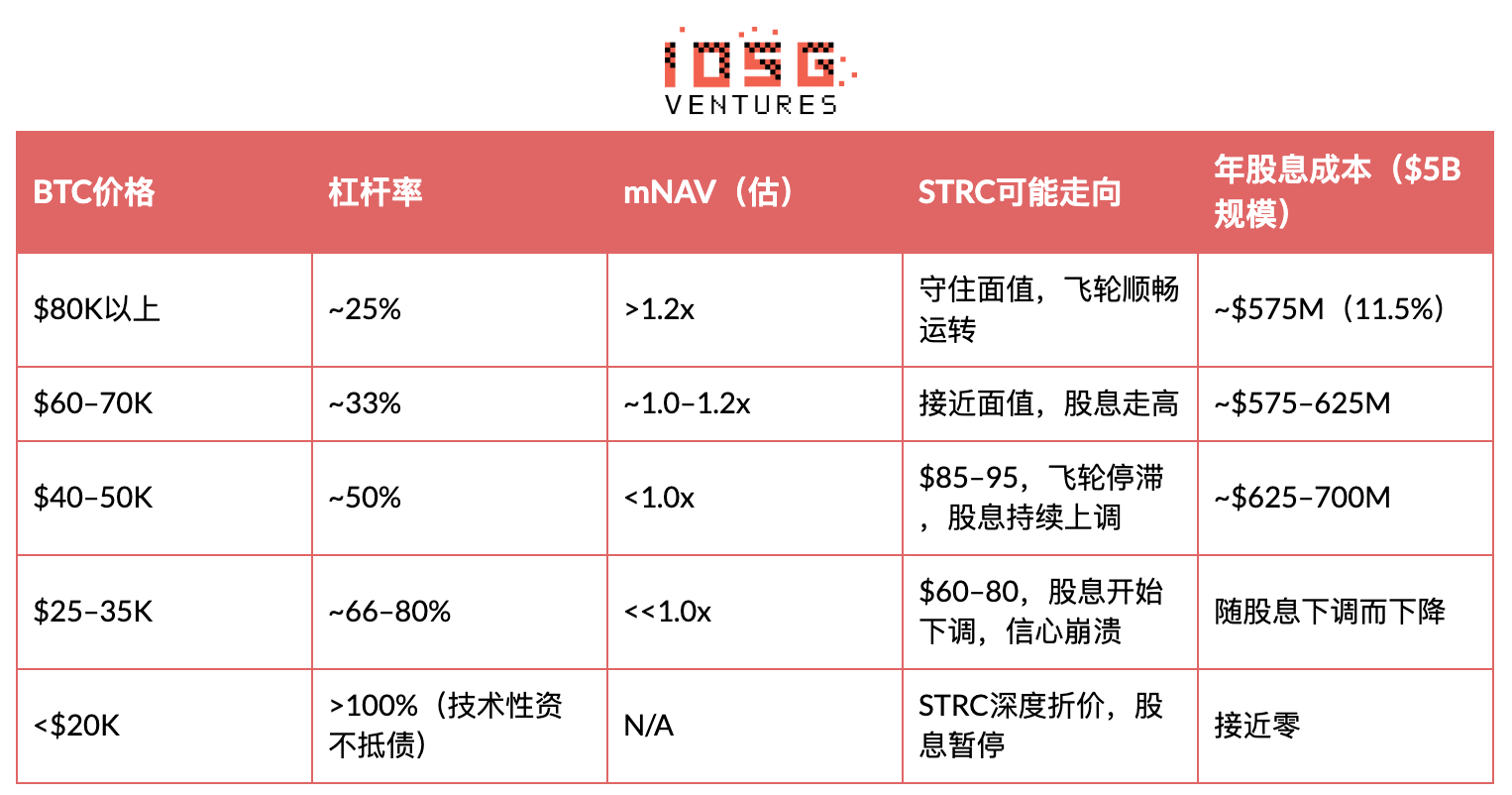
Why this is different from UST/Terra: UST relies on an algorithmic mint-and-burn mechanism, with the only support being the endogenous token (LUNA). STRC's support is real BTC, and Strategy has the discretion to choose to lower dividends instead of being forced into liquidation. The lower limit of STRC is not zero—rather, it is the priority claim on remaining assets during bankruptcy liquidation. However, if BTC drops more than 60% and remains low, this lower limit may be far below $100.
The key variable is time. Previously, every drawdown of STRC was repaired within a few weeks because BTC rebounded. A real collapse requires a sustained bear market (remaining below $50K for more than 3 months), allowing the dividend adjustment mechanism to operate long enough to erode confidence. The longer STRC remains below face value with continuous dividend adjustments, the more it resembles a company extending increasingly fragile debt at higher and higher interest rates—this pattern has a very clear ending in credit markets.
Capital Structure Priority: The order of liquidation is: convertible bonds (approximately $8.2B) → STRF → STRC → STRK → STRD → MSTR common stock. STRC ranks behind $8.2B of unsecured debt and STR F preferred stock.
Industry Views
"The risks of STRC are significantly higher than short-duration U.S. Treasuries... when the music stops, investors may feel somewhat offended." — BitMEX Research, "A Bit of a Stretch" (November 2025)
"A proper way to assess STRC risk is to look at it from governance and subordination order, rather than just focusing on payment risk." — Greg Cipolaro, NYDIG Global Research Director (March 2026)
"It is like shorting a put option on Bitcoin asset coverage—taking on the downside risk of BTC declines in exchange for returns." — NYDIG Research Report (March 2026)
The core divergence in analyst views lies here: the bullish side believes STRC is currently the safest way to obtain an 11.5% return in the market; the bearish side views it as a credit risk mispriced as a money market product. The core concern of the bears directly corresponds to the dividend adjustment mechanism described above: STRC will not default suddenly, but will slowly repricing— the longer BTC remains depressed, the more it will slide from a quasi-currency tool to a distressed yield product. This gradual decline is the true risk, not a collapse overnight.
Conclusions and Predictions
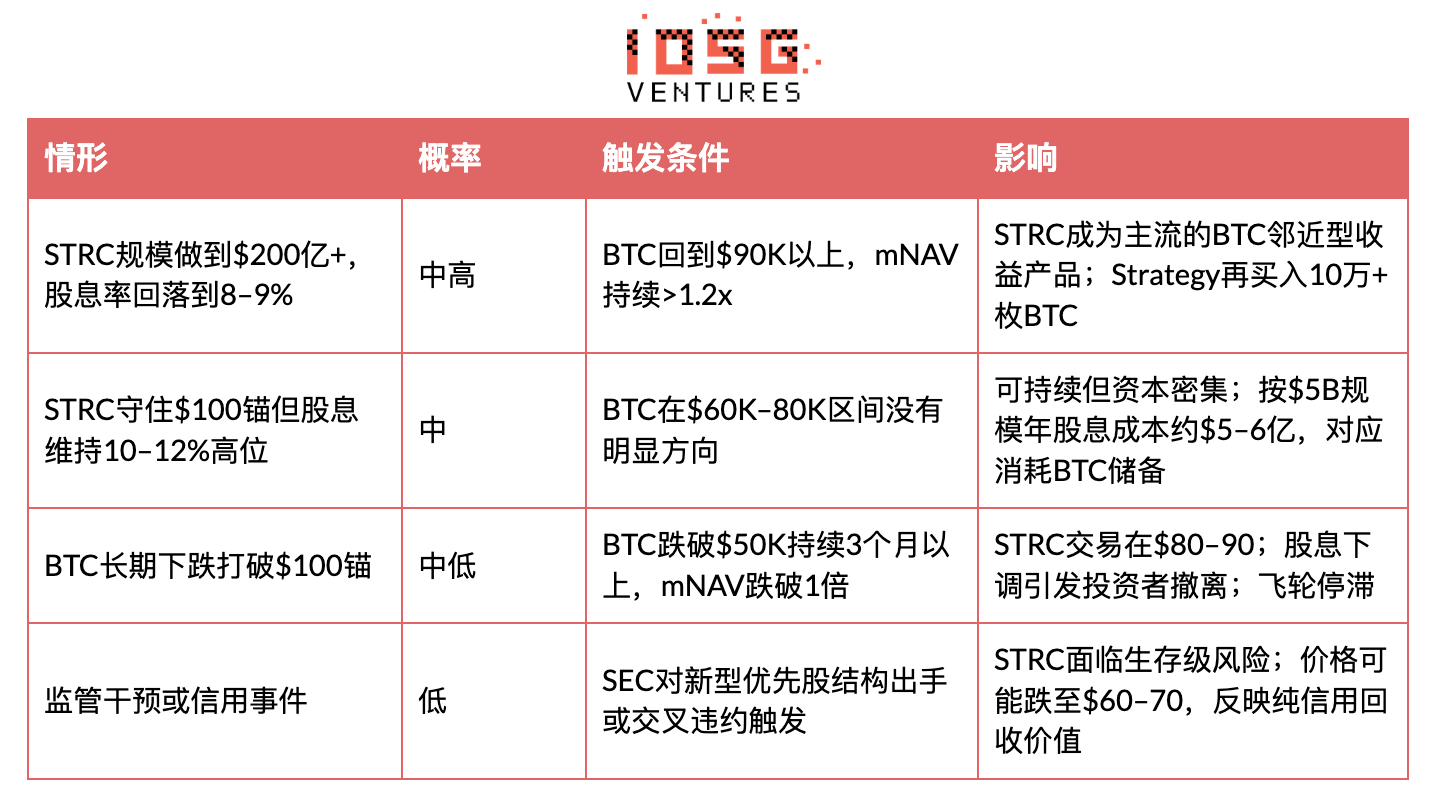
Bottom Line: STRC is a truly novel financial instrument that operates beautifully in the environment it was designed for—BTC is steady or rising, capital markets are open, mNAV>1x. In this state, it can provide 11.5% yield with controllable volatility, which is indeed attractive. But its downside structure is asymmetrical: earning ticket interest in good times while bearing concentrated, singular BTC credit risk in bad times. It is not a replacement for government bonds or diversified high-yield bonds, but rather a leveraged position betting on the continuous operation of Strategy's BTC accumulation flywheel—just packaged to appear as fixed income.
Three New Signals (as of April 2026)
Signal One: April's first pause in dividend increase (as of April 1, 2026, CoinDesk).
After seven consecutive increases (from 9% to 11.5%) between August 2025 and March 2026, Saylor maintained the dividend rate in April. Two interpretations: (a) demand stabilizes at this yield level—bullish; (b) Strategy has hit the sensitivity ceiling of traditional fixed income buyers regarding yields—bearish. This is the single signal worth tracking most in May and June, and is the turning point surrounding the mNAV trigger framework described above.
Signal Two: During the week of April 6 – 12, MSTR ATM share issuance was $0, with all financing completed through STRC ($1.00B; MSTR 8-K, April 2026).
At the current BTC price level, mNAV has tightened to the point that Saylor is unwilling to risk diluting common stock further by continuing to issue MSTR. Preconditions for the third phase of the death spiral have been partially triggered—the flywheel is operating on one leg.
Signal Three: Last week's BTC average purchase price was $71,902 per coin, below Strategy's historical cost of $75,577 per coin (as of April 12, 2026, MSTR 8-K).
Strategy is dollar-cost averaging into a weak market. The flywheel is still turning, but each marginal purchase is thinning the asset buffer rather than thickening it—this is the exact opposite of the accumulation dynamics seen in 2024 – 2025.
Investment Advice
HOLD, waiting for better entry points and BTC upward movement.
Current Status: HOLD existing positions, do not add to them until better signals appear. MSTR's mNAV has compressed to around 1.0x. STRC still holds at the $100 face value and pays a 11.5% dividend, reflecting that the dividend mechanism is still operating as designed. However, the margin of safety is very narrow.
Conditions for rebuilding positions: BTC exceeds $70–75K, and MSTR mNAV confirms above 1.1x for two consecutive weeks. At that time, STRC is eligible to re-enter the buy zone around the $100 face value. Historical data shows that buying below $95 in conjunction with subsequent BTC rebounds has contributed to 7–11% capital gains plus accumulated ticket interest— but this only happens in an environment where BTC can rebound within a few weeks (August 2025, November 2025, February 2026). Whether the current drawdown continues this pattern or indicates a more prolonged bear market is the true unknown.
Exit Signal: Initiate sell evaluation when any of the following occurs: (a) MSTR mNAV falls below 1.0 and remains below for more than two weeks; (b) STRC VWAP remains below $95 for four consecutive weeks; (c) BTC volume falls below $55K.
Sources
Strategy.com — STRC Product Page
https://www.strategy.com/stretch
CoinDesk — "The genius and the danger of STRC"
https://www.coindesk.com/business/2026/03/22/the-genius-and-the-danger-of-strc-how-strategy-s-new-funding-model-bends-so-it-doesn-t-break
Crypto Narratives — "Understanding STRC: How Strategy turns yield demand into BTC buying"
https://cryptonarratives.substack.com/p/understanding-strc-how-strategy-turns
BitMEX Research — "A Bit of a Stretch" STRC Analysis
https://www.bitmex.com/blog/a-bit-of-a-stretch
AInvest — "STRC's Sharpe Ratio of 3.08: Real Alpha or Structural Illusion?"
https://www.ainvest.com/news/strc-bitcoin-backed-preferred-equity-promises-11-5-yield-sharpe-ratio-3-08-real-alpha-structural-illusion-2603/
Investopedia — "Meet Stretch: Michael Saylor's New Tool"
https://www.investopedia.com/meet-stretch-michael-saylor-s-new-tool-for-using-bitcoin-to-pay-a-big-dividend-here-s-what-to-know-11921210
Blockonomi — "STRC Raises $1.18B in One Week"
https://blockonomi.com/strategys-strc-raises-1-18b-in-one-week-buying-seven-times-bitcoins-weekly-mined-supply/
Seeking Alpha — "STRK: Most Undervalued Bitcoin Security"
https://seekingalpha.com/article/4885379-strk-the-most-undervalued-and-versatile-bitcoin-security-today
CryptoTimes — "Strategy's Bitcoin Empire: How Preferred Perpetuals Are Redefining Corporate Finance"
https://www.cryptotimes.io/2026/03/21/strategy-inc-s-bitcoin-empire-how-preferred-perpetuals-strc-strk-strf-strd-are-redefining-corporate-finance/
Benzinga — "Saylor: STRC Achieved Better Risk-Adjusted Returns Than NVDA, TSLA"
https://cdn2.benzinga.com/crypto/cryptocurrency/26/03/51195736/michael-saylor-strc-stock-achieved-better-risk-adjusted-returns-than-nvidia-tesla
Appendix
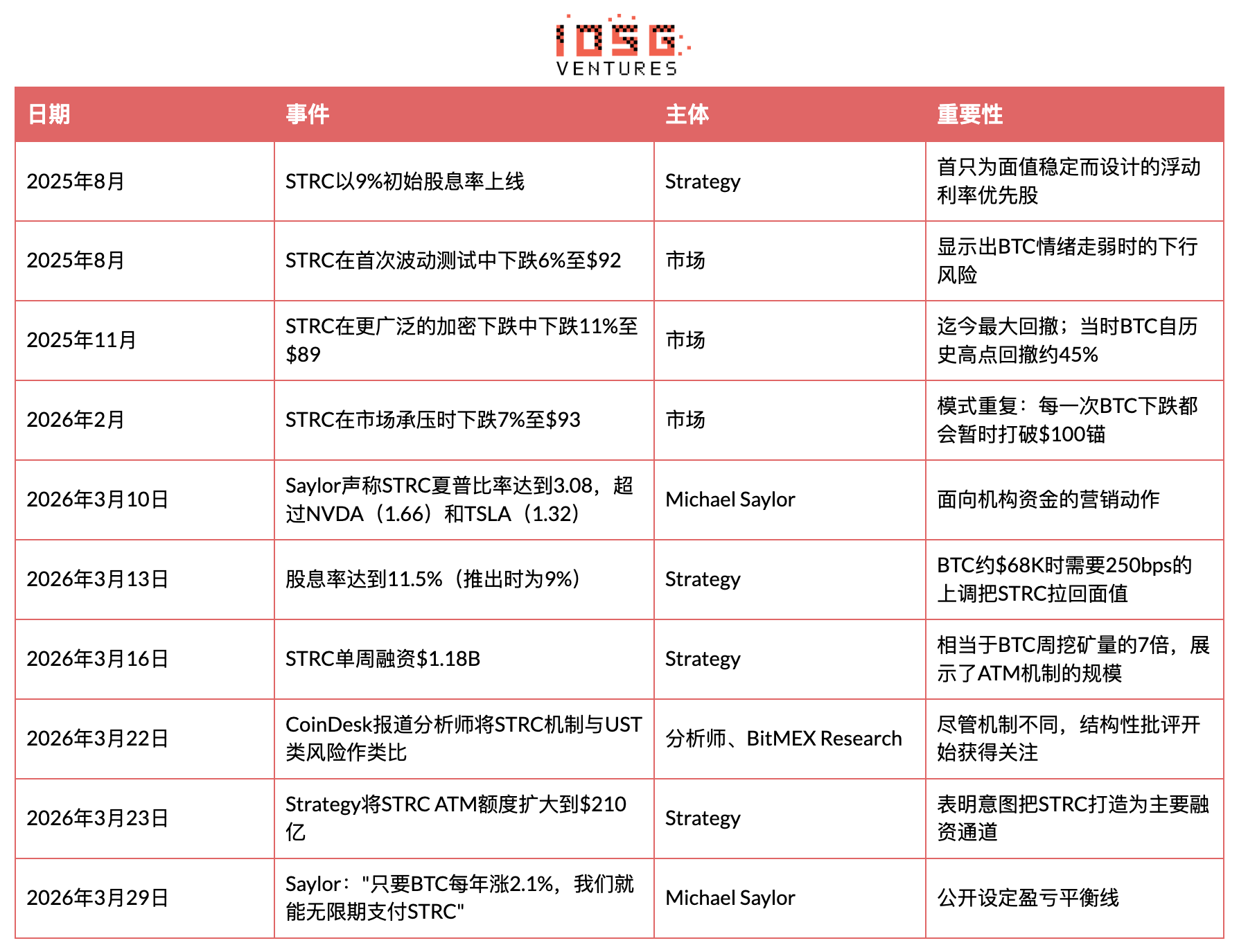
Timeline
Concentration of holdings—who can force a price break?
Strive's $50M purchase was mentioned, but it was not discussed whether STRC has a few large institutional holders—if they were to rotate out simultaneously, would it crush the average daily volume of $258M, pushing STRC self-referentially below face value. This is the "run" risk.
免责声明:本文章仅代表作者个人观点,不代表本平台的立场和观点。本文章仅供信息分享,不构成对任何人的任何投资建议。用户与作者之间的任何争议,与本平台无关。如网页中刊载的文章或图片涉及侵权,请提供相关的权利证明和身份证明发送邮件到support@aicoin.com,本平台相关工作人员将会进行核查。


