Differences Between Dual-Currency Investment and FCN
I have talked with many partners from different institutions before. Although many people on X do not appreciate dual-currency investments, in reality, many institutional clients really like dual-currency investments. Companies like Amber, Matrixport, Deribit, and even Binance and OKX have specific services for institutions and high-net-worth individuals. Moreover, beyond dual-currency investments, there is another investment method called FCN.
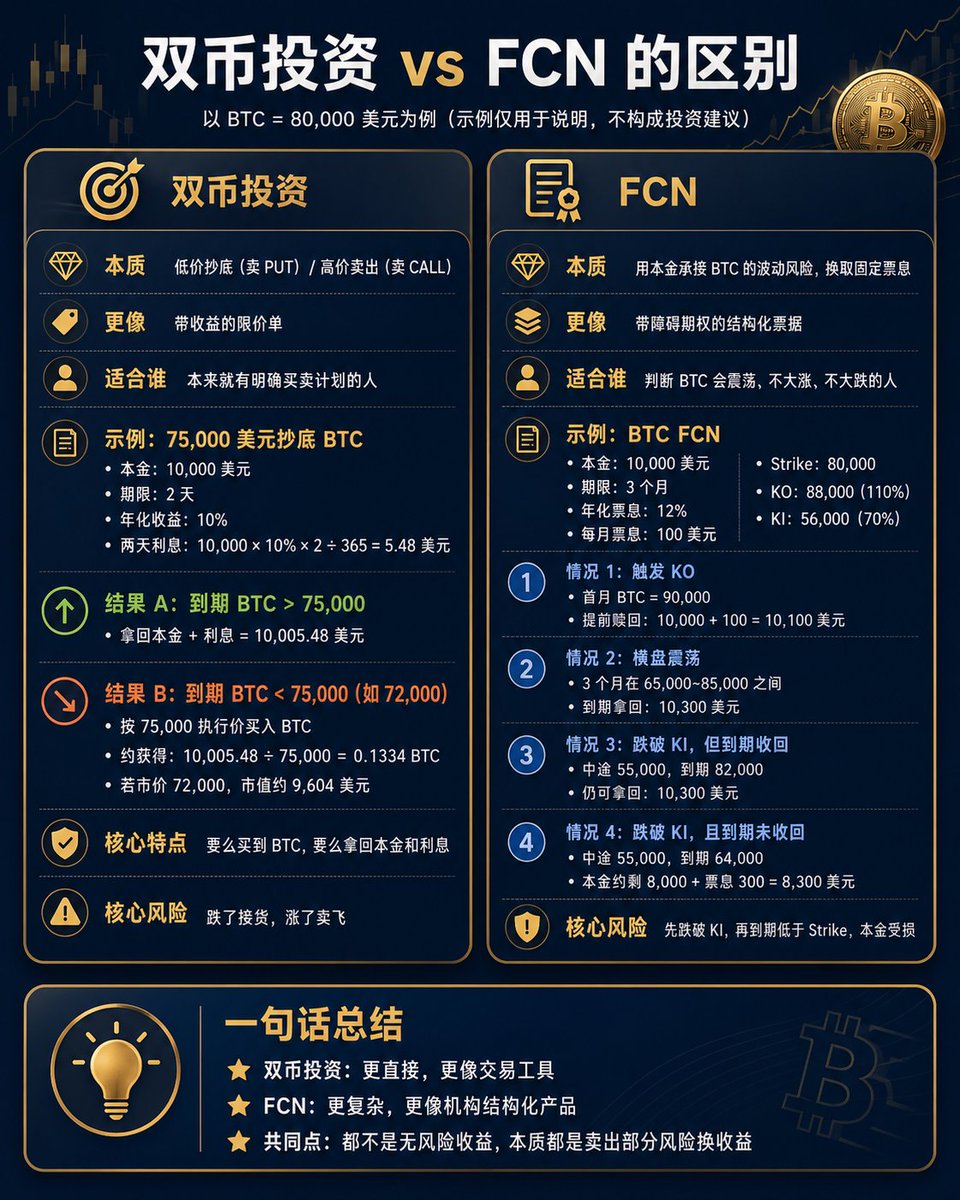
Dual-Currency Investment
I have introduced it many times. Essentially, it involves two strategies: buying low (selling PUT) and selling high (selling CALL).
FCN is a bit more complex.
It is like using the principal to bear the volatility risk of BTC in exchange for a fixed coupon. Structurally, it is more similar to a packaged structured note, integrated with barrier options, early redemption, fixed coupon, and principal risk.
For example, if the current price of Bitcoin is $80,000, I will illustrate the differences between dual-currency and FCN.
For example, if I want to buy Bitcoin at $75,000, I would use the low buy strategy of dual-currency, which means selling a PUT option and placing an order at $75,000 for 2 days, assuming an annualized return of 10% on an investment of $10,000.
When two days later, if the price of Bitcoin is above $75,000, I will not acquire the BTC but will redeem my $10,000 principal and receive interest.
Calculating at an annualized rate of 10%, the interest for two days is:
10,000 × 10% × 2 ÷ 365 = $5.48
So, I will get back a total of $10,005.48.
This is equivalent to having placed a limit order to buy BTC at $75,000, but since there was no transaction, I made a little premium.
However, if two days later the price of Bitcoin is below $75,000, for instance, dropping to $72,000, then I will be exercised.
This means my $10,005.48 will be converted to BTC at the strike price of $75,000.
I would approximately receive 10,005.48 ÷ 75,000 = 0.1334 BTC.
At that time, if the market price of BTC is $72,000, then the market value of this 0.1334 BTC would be approximately $9,604.
This means that although I earned $5.48 in interest, since BTC fell below my strike price, I would still incur a loss on paper.
The logic for selling at a high price is the same.
But in the case of FCN, there will be several possibilities.
For example, if BTC is currently $80,000, and I buy a BTC FCN, investing $10,000, with a term of 3 months and an annualized coupon of 12%, which is about 1% per month, I would receive $100 in coupons each month.
This FCN sets several key prices:
The first is the Strike, which is the initial price of $80,000.
The second is KO, which is the early redemption price, for example, $88,000, equivalent to 110% of the current price.
The third is KI, which is the knock-in price, for example, $56,000, equivalent to 70% of the current price.
At this point, the logic of the FCN becomes:
If BTC rises too quickly and exceeds $88,000, the product might end early.
If BTC neither rises nor falls, and fluctuates between $56,000 and $88,000, I would continue to receive coupons.
If BTC drops below $56,000, KI would be triggered, and a risk event would occur.
However, triggering KI does not mean immediate losses; the key depends on where the price of BTC is at expiration.
In the first scenario, BTC rises and triggers KO.
For example, on the observation day of the first month, if BTC rises to $90,000, surpassing the KO price of $88,000.
The FCN may be redeemed early at this point.
I would get back the $10,000 principal plus a $100 coupon for a total of $10,100.
In the second scenario, BTC remains stagnant.
For example, if for 3 months, BTC fluctuates between $65,000 and $85,000, not rising to $88,000 to trigger KO nor falling to $56,000 to trigger KI.
Then upon expiration, I would get back my $10,000 principal plus $300 in coupons for a total of $10,300.
In the third scenario, BTC dips below KI but recovers by expiration.
For instance, in the second month, if BTC suddenly dips to $55,000, dropping below the KI price of $56,000.
At this point, the FCN has already triggered a knock-in, and a risk event occurs.
However, by the time of expiration in the third month, BTC has risen back to $82,000.
Since the expiration price is above the initial price of $80,000, even though a KI was triggered in between, I can still get back the $10,000 principal plus $300 in coupons.
Thus, FCN does not incur an immediate loss just because it falls below KI.
In the fourth scenario, BTC falls below KI and does not recover by expiration.
For instance, in the second month, if BTC drops to $55,000, triggering KI.
By the time of expiration in the third month, if BTC is only $64,000.
At this point, BTC has fallen 20% from the initial price of $80,000.
Then my principal would incur a loss based on BTC's decline.
A $10,000 principal would be worth roughly $8,000 now.
Adding the $300 in coupons for three months, I would finally receive a value of about $8,300.
On the surface, I received a 12% annualized coupon, but as long as BTC drops significantly, the coupon cannot cover the principal loss.
If the expiry value of BTC is $40,000, which is a 50% drop from $80,000, my principal would likely be reduced to about $5,000, plus the $300 in coupons, totaling $5,300.
This is the core risk of FCN.
Thus, the biggest difference between dual-currency investment and FCN is:
Dual-currency investment is very straightforward.
If you want to buy BTC at $75,000, you simply sell a PUT option at $75,000.
If you want to sell BTC at $85,000, you sell a CALL option at $85,000.
You either acquire BTC or get back your principal and interest.
You either sell BTC or continue to hold BTC and interest.
Therefore, I always feel that dual-currency investment is most suitable not for "wealth management users," but for those who already have clear trading plans. If you intend to buy at a certain price or sell at a certain price, then dual-currency investment serves as a limit order with yield.
However, FCN is different.
The core of FCN is to use the principal to bear the downside risk of BTC in exchange for a fixed coupon. As long as BTC does not rise sharply to KO or drop sharply to KI, or if it falls below KI but eventually recovers, you can earn coupon income.
But if BTC experiences a significant decline, especially dropping below KI and not rising back to Strike by expiration, then the principal bears the loss from BTC's decline.
Therefore, FCN appears to be more of a wealth management tool, but is actually more complex than dual-currency investment.
#Bitget VIP, lower rates, greater benefits
免责声明:本文章仅代表作者个人观点,不代表本平台的立场和观点。本文章仅供信息分享,不构成对任何人的任何投资建议。用户与作者之间的任何争议,与本平台无关。如网页中刊载的文章或图片涉及侵权,请提供相关的权利证明和身份证明发送邮件到support@aicoin.com,本平台相关工作人员将会进行核查。


