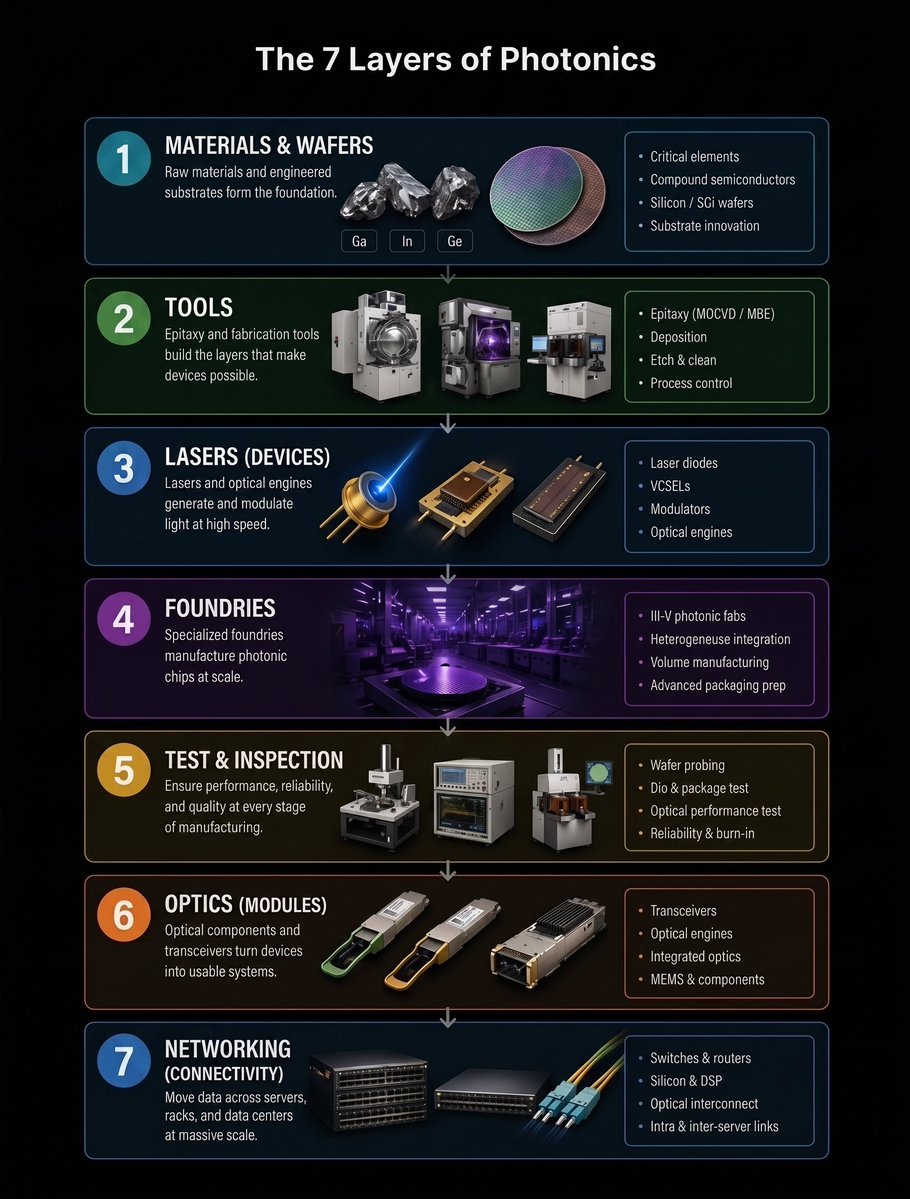
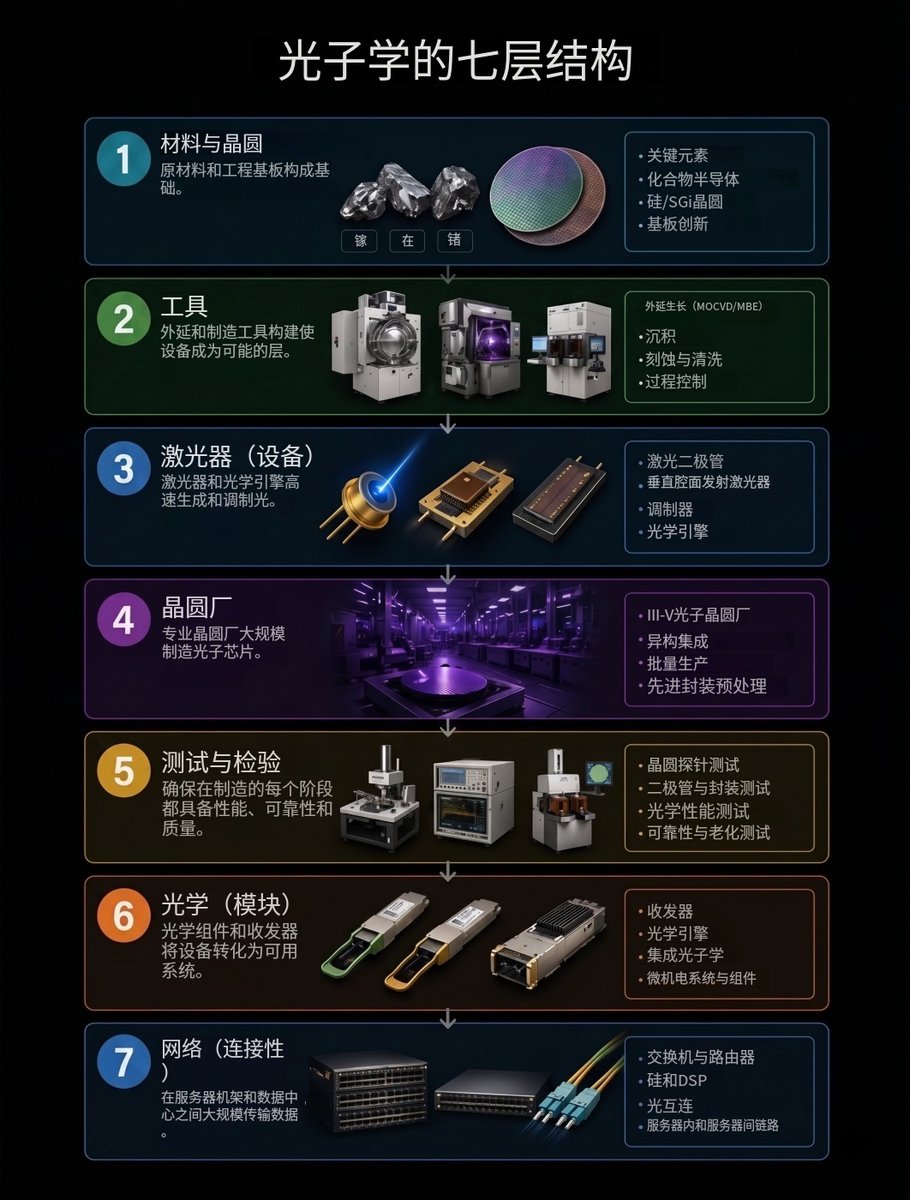
Recently, the optical module sector has seen a bit of a pullback, and many friends have started to worry, suggesting we discuss it. Just in time, the recent ChatGPT Images 2 was released, and I tested it for market research analysis images. For example, in 图1 below, the optical module breakdown produced with Images 2 looks really good.
Getting back to the point, we still have a long-term positive outlook on the core enterprises in the optical module field. The computing power battle in AI data centers has already shifted from GPUs to photonic chips. 🧐
Many people are still fixated on NVIDIA, unaware that the real bottleneck has long shifted to the optical interconnect and photonics industrial chain.
We can see this from the data: the power consumption of AI servers has skyrocketed from the traditional 5-10kW directly to 100kW+, and the data transmission between these computing power monsters relies on traditional copper wires? It simply can't handle it! Photonic chips are the next battleground for #AI infrastructure.
We have recently spent a lot of time mapping out the entire photonics industrial chain from start to finish. From the upstream materials and equipment, to the midstream lasers and foundries, down to the downstream optical modules and network connections, we have explored the core targets at each stage.
This is not some concept hype; it is a solid hard tech track, with clear investment opportunities at every level. Let's break it down and take a closer look at what opportunities are hidden in this industrial chain:
🔹 First Layer: Materials and Wafers - The Foundation of Semiconductors
This is the top of the industrial chain, mainly providing compound semiconductor materials such as indium phosphide and gallium arsenide. In simple terms, without these materials, nothing else can be handled.
• $AXTI (AXT Inc)
A vertically integrated substrate supplier, holding an important position in the InP (for optical communication laser) market. This guy is a player positioned at the source.
• $WOLF (Wolfspeed)
While mainly focused on silicon carbide power devices, it also has strong foundations in gallium nitride RF and optoelectronic substrates. A multi-legged approach.
• $COHR (Coherent)
A global leader in engineering materials and photonic devices. Not only does it sell materials, but it also vertically integrates downstream into lasers and modules, making it a real giant player.
🔹 Second Layer: Manufacturing Equipment - The Bottleneck
The manufacturing of photonic chips requires extremely precise photolithography and epitaxy growth equipment, which is truly the bottleneck. Lam Research (LRCX) and Applied Materials (AMAT), alongside ASML, are among the top three semiconductor equipment suppliers in the world.
• $ASML (ASML)
An absolute leader, nothing more to say. As silicon photonics technology moves towards smaller nanometer nodes, ASML's photolithography machines are indispensable. It exists at a monopolistic level.
• $AMAT (Applied Materials) & $LRCX (Lam Research)
Provide equipment for critical processes such as thin film deposition and etching. The logic for 2026 is clear: with the expansion of AI-driven wafer fabs, the visibility of these equipment suppliers' orders is extremely high. Solid.
🔹 Third Layer: Lasers - The Light Source Engine
Lasers are the core heart that converts electrical signals into optical signals, an indispensable key element, truly selling shovels for the kings.
• $LITE (Lumentum)
Provides indium phosphide lasers, EML lasers, and optical transceivers for high-speed data transmission ranging from 800G to 1.6T. It is a core supplier for NVIDIA and major hyperscale data centers, with a market share as high as 80%. Extremely competitive in the field of high-performance lasers in cloud data centers and telecommunications networks. Backed by major manufacturers, reliable.
• $SMTC (Semtech)
Specializes in high-performance analog, mixed-signal integrated circuits, IoT systems, and cloud connection services. It has significant advantages in laser driver chips and CDR, making it a key player in signal conditioning. Though not the most glamorous segment, it is indispensable.
🔹 Fourth Layer: Foundries - Manufacturing Capacity
With designs and materials in hand, who will produce? Foundries are the key links that turn blueprints into chips.
• $TSM (TSMC)
Actively laying out CPO (co-packaged optics) technology. TSMC's COWAS packaging technology, combined with silicon photonics technology, will be the default configuration for future AI computing power cards. A leader is a leader.
• $TSEM (Tower Semiconductor)
Based in Israel, specializing in analog and mixed-signal manufacturing, it has first-mover advantage in the silicon photonics foundry field and is a top choice for many startup photonics design companies. Small but beautiful.
🔹 Fifth Layer: Testing, Inspection, and Packaging - Quality Gatekeepers
Before photonic chips leave the factory, they must undergo strict testing and inspection. This step directly determines the yield rate.
• $AEHR (Aehr Test Systems)
Currently a star stock! The core logic is that photonic chips, especially lasers, require long “burn-in testing” before leaving the factory. As the volume of silicon photonic chips increases, the demand for AEHR's wafer-level testing equipment is growing exponentially. This is the big dark horse of the year.
• $ONTO (Onto Innovation)
Focuses on providing high-performance process control measurements, defect detection, photolithography technology, and data analysis systems in microelectronic devices, logic chips, DRAM memory, and advanced packaging fields, providing automated optical inspection that is indispensable in heterogeneous integrated packaging testing. A robust player.
🔹 Sixth Layer: Optical Modules - The Physical Performance of the System
This layer integrates optical chips, electrical chips, and optical fiber connectors into a "black box," which is also the stage closest to end applications.
• $AAOI (Applied Optoelectronics)
As data centers evolve towards 800G/1.6T, AAOI, as a module manufacturer with its own laser production capacity, shows clear cost advantages and production flexibility. A high-flexibility target.
• $GLW (Corning)
Corning is the king of optical fibers. No matter how the chips change, the final optical signal still needs to be transmitted through Corning's optical fibers. A winning presence.
🔹 Seventh Layer: Network Connections - The Endpoint of Value Realization
This is the last link in the entire industrial chain, and the endpoint of value realization. All technologies must ultimately be reflected in network devices.
• $AVGO (Broadcom)
The ultimate boss in the field of photonics! Broadcom not only has the world's strongest switch chips but also integrates silicon photonics technology CPO directly into its chips. It is also a leading company in ASIC custom chips, core partner of Google TPU. A true king.
• $ANET (Arista Networks)
A leader in AI data center network architecture, the largest buyer of optical modules and definer of application scenarios. The decision-maker on the demand side.
• $MRVL (Marvell)
The dual monopolist in the optical interconnect DSP field with Broadcom; its PAM4 DSP chips are standard for 800G optical modules. High technical barriers.
In summary, the photonics industrial chain is not some distant future technology but is currently happening in real time. The explosion of AI computing power has turned optical interconnects from "optional" to "essential."
From materials to equipment, from lasers to packaging, from optical modules to network connections, every layer has clear winners and a clear investment logic. My personal strategy is simple: once the optical module sector shows a pullback, buying on dips is a good opportunity!
This list includes:
• Robust industry giants (ASML, TSMC, Broadcom)
• High-flexibility growth targets (AEHR, TSEM, AAOI)
We don’t need to buy them all, but we should at least know where the key links of this industrial chain are and where the money is flowing.
The second half of AI is not just a game for GPUs; photonics is truly the real physical layer positioning battle. The time to position is now, wait for the wind to come. DYOR 🙏
Currently, the aforementioned companies are basically all on #MSX, and when trading US stocks, I choose to use the #RWA US stock tokenization platform #MSX to invest in the US stock market: http://msx.com/?code=Vu2v44
Early fans and partners of US stock investments can private message me. After filling out the form, they can enter the US stock exchange and discussion community for free (currently limited to 10 people per week, with assistant review, may take a little time, grateful 🙏)!
免责声明:本文章仅代表作者个人观点,不代表本平台的立场和观点。本文章仅供信息分享,不构成对任何人的任何投资建议。用户与作者之间的任何争议,与本平台无关。如网页中刊载的文章或图片涉及侵权,请提供相关的权利证明和身份证明发送邮件到support@aicoin.com,本平台相关工作人员将会进行核查。


