
Previously, OKX Wallet released OnchainOS and continued to iterate the open Agent capabilities, while launching a brand new Agentic Wallet. As AI becomes the new "user interface," how will the roles of blockchain like Ethereum change when Agents begin to autonomously trade and participate in governance as on-chain participants?
At the intersection of AI and Web3, a new interaction paradigm is forming.
This is the "Friends of OKX Wallet" series — Carnival Edition. This series records their judgments and thoughts at key nodes in the industry through dialogues with different builders. In this issue, OKX Wallet VP Paul Wan will converse with Vitalik about the long-term trends and underlying structures of AI and Web3, trying to understand: what role will blockchain play in the era of Agents?

The Evolution of Ethereum and Blockchain Roles in the Age of AI
Question 1: What primitives must an on-chain operating system provide in the era of Agents? What does today's Ethereum still lack?
Vitalik:
This is how I see it. Ethereum mainly provides two major functions for applications, one of which is a bulletin board, where anyone can publish data on the chain, and various applications can interpret this data in many different ways; the other is on-chain and off-chain computation, which includes financial applications, DeFi, and various other applications.
In the age of AI, fundamentally these uses remain essentially the same, the same use cases still exist, and these functions can continue to maintain their importance. But AI will definitely bring about significant changes in the way we interact with blockchain and other tools.
One important difference is that in the pre-blockchain era, users interacted through a specific interface, and that interface corresponded to a specific matter; whereas in the world of AI, especially with the current and future forms of AI, you can have a user-side AI invoking these different skills, combining things at once, while interacting with many different objects.
This also greatly increases the number of workflows interacting with Ethereum and other systems. So in my view, the metaphor of “operating system” is not completely accurate from certain angles. The operating system will still continue to exist, but it will become smaller and simpler; at the same time, we will have a bunch of different tools and skills, with AI helping users to use them and get things done. Blockchain is a natural choice; it enables applications for multi-party collaboration and allows different participants to collaborate effectively over the long term, without the need for prior trust or consensus.
Another key point is the Economic Layer. If AI becomes more decentralized, there will be many different AI entities built and controlled by different people, and they will need to interact with each other; and to make this interaction possible, an economic layer is needed. Because cooperation is either based on economic incentives and rules or on centralized control, these are essentially the two paths.
If we can build this economic system, we can better enable AI to interact in a decentralized manner. Just like a complete operating system has both runtime and software and infrastructure built on top of it. In a new economic system centered around Agents, we need a mechanism to discover, define, and match appropriate Agents. At the same time, users and their Agents can also interact with each other and build their own Skills, MCP, CLI, and strategies.
Question 2: How should we view L2 in high-frequency Agent trading scenarios?
Vitalik:
L2 is important, but we need to be more imaginative in how we build L2. The past approach has often been simply to replicate the EVM and scale it, but this method is not ideal. A better approach is to start from application needs and fill in the capabilities that L1 does not provide. Ideally, different functions should be distributed across different layers: accounts can be on L1, while high-frequency trading and matching can be on L2.
Moreover, L2 can also undertake privacy functions, such as Tornado Cash, Railgun, Privacy Pools, etc., which can be seen as "privacy type L2" in a sense. In the future, more L2 solutions will emerge developing in different directions.
Reconstructing the Relationship Between Humans and Agents
Question 3: When Agents can autonomously trade, hold assets, and even participate in governance, how should we redefine users? Especially from the perspective of on-chain governance, how do you think we should redesign mechanisms for these non-human participants?
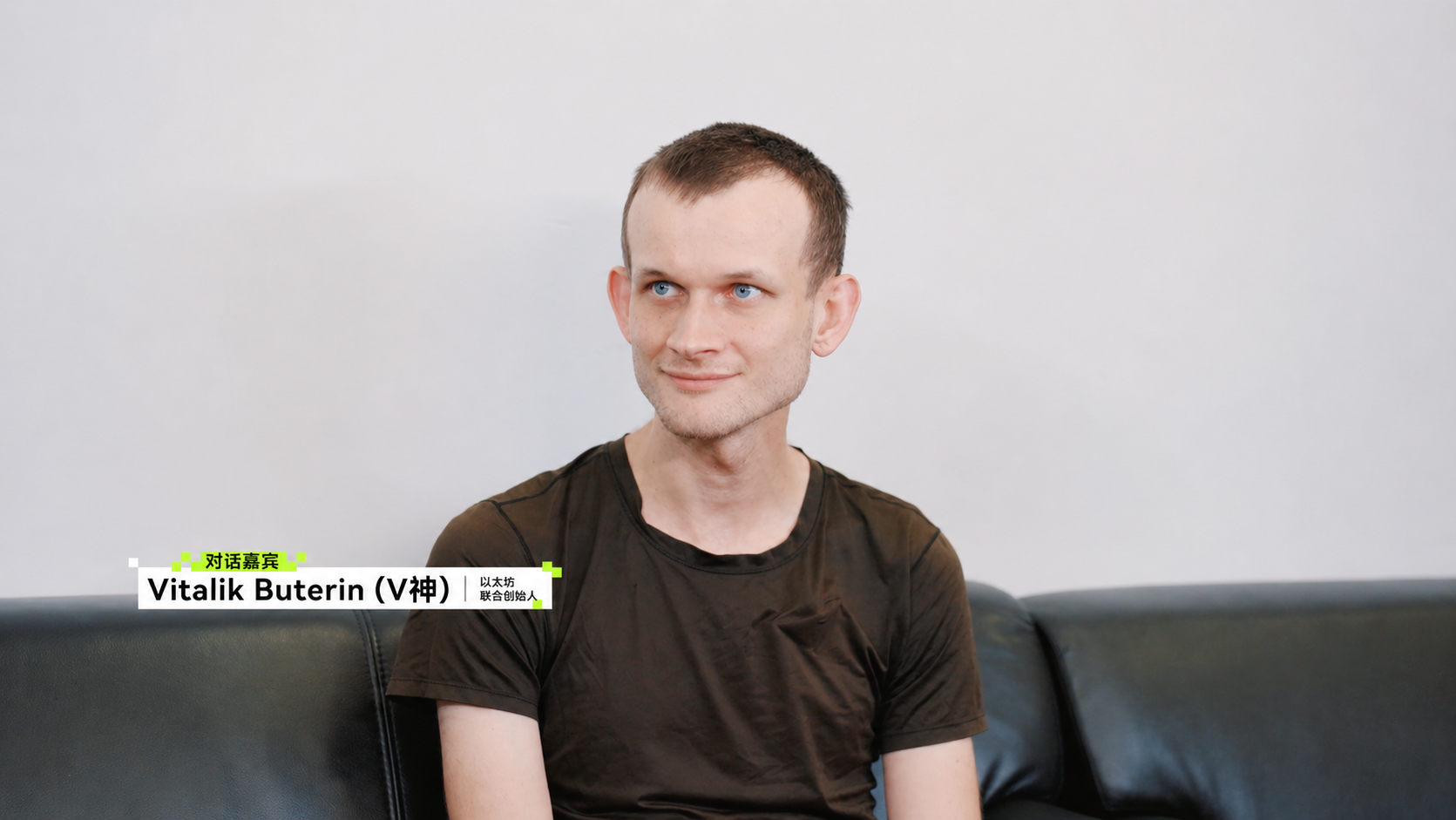
Vitalik:
I personally still view humans as users and see AI as a substitute for UI, a new way for people to interact with the chain.
It can be understood that before AI appeared, you might need to get information through multiple tools like Google, Wikipedia, Stack Overflow, etc., but now you can directly ask an AI, which will complete the operation and give you the results. This change will soon happen in blockchain interactions as well.
This means that our view of the infrastructure attributes will change, such as latency. In human interactions, low latency is usually very important; but for Agents, some scenarios require extremely low latency, while in some cases, latency is not actually important, such as when dealing with complex issues that can wait longer.
This difference will change the way we think about the interface layer. Take wallets as an example; the SDK remains the same, which is the API layer (for example, transfers, queries, privacy operations); but the product forms around it may change, and users may not even interact directly with the wallet but rather with the SDK.
Therefore, we will see a series of well-crafted packages that possess strong security and formal verification capabilities, equipped with Skills files, called upon by AI. So I think there will be significant changes in the layer between blockchain and users.
Question 4: If the actor in a transaction can be a human, an Agent, or a combination of both, how should we rethink on-chain identity? Is it possible to construct a unified framework that applies to humans, Agents, and mixed scenarios?
Vitalik:
The key to establishing on-chain identity is to deconstruct identity, only proving the necessary information required to complete a certain interaction. In most cases, fully revealing identity is meaningless; a more reasonable approach is to only disclose part of the information, such as proving reputation or funds' sources through zero-knowledge proofs.
At the same time, it should be easier to employ zero-knowledge proofs for on-chain behavior and assets, and wallets should better assist users in managing private data. Different applications should adopt different implementation methods to protect user information as much as possible while meeting demand.
Constructing a unified framework applicable to both humans and Agents is feasible. Agents can independently determine how tasks are allocated across different L2s, and their reasoning methods are fundamentally no different from humans, so the market will gradually find more reasonable allocation methods.
The Evolution Path of Agent Products and Native Standards
Question 5: What constitutes a good Agent product experience?
Vitalik:
A good Agent product should be intuitive and easy to use while operating as part of a larger ecosystem, rather than attempting to take over every aspect of users' lives. It must also prioritize privacy and security, as many systems still have shortcomings in this respect.
Ideally, we need more AIs that are aligned with user interests, which do not belong to a single company or application, but act on behalf of users. This can reduce attacks and exploitation. Additionally, applications need to be compatible with users' existing configurations, support personalization, and be able to interact with other tools while ensuring security. If all these can be achieved, it would be an ideal state.
Question 6: What is the development direction of wallets in the Agent era?
Vitalik:
AI can be used to build Ethereum itself, such as improving security through formal verification, which may even become a necessary capability in the future; on the other hand, AI can also serve as an Agent wallet, integrating various capabilities while ensuring privacy and security.
If this experience relies on third-party servers, true decentralization and privacy cannot be achieved. There also needs to be restrictions on AI behavior, which is a responsibility of wallets in risk control. More importantly, Ethereum should not be viewed as an isolated system, but should be integrated into a global AI, helping users complete various tasks at the operating system level, including on-chain interactions, internet searches, and local data management, thinking from a full-stack perspective.
Question 7: In the Agent economy, how should the public goods mechanism evolve? What will the future Native Agent Standard look like?
Vitalik:
The essence of public goods financing is a governance issue, and governance requires defining stakeholders. Every Agent is still operated by a human, thus humans remain central. AI and ZK offer new possibilities for governance, but AI also lowers attack costs, making many mechanisms more susceptible to automated attacks, so this is a direction that requires continuous exploration and iteration.
As for the native standard for Agents, there is currently no fully determined form, but an important direction is ZK Payments and ZK API. The core goal is that no matter what type of API request is initiated, each request itself is private and completely isolated from each other.
This is crucial because in AI scenarios, even if using pseudonyms or anonymous identities, as long as this identity is persistent, with information continually accumulating, it will eventually be re-identified, thus losing privacy. Therefore, mechanisms need to ensure that no links are created between requests.
The key to achieving this lies in utilizing zero-knowledge proofs while avoiding putting every request on-chain; otherwise, costs and latency will become unacceptable. Although latency may be tolerable in some scenarios, high costs remain a problem that must be solved. On this basis, bonding/staking mechanisms can also be integrated, preventing misuse on both the user and application sides without compromising privacy. There is still much work advancing in this direction.
Conclusion
Thanks to Vitalik for sharing his thoughts in this dialogue and providing us with forward-looking perspectives on the intersection of AI and Web3.
In the directions surrounding ERC-4337, EIP-7579, EIP-7702, OKX Wallet has been continuously promoting relevant exploration and innovation. At the same time, we are also closely monitoring the progress of Vitalik's latest proposed EIP-8141 and look forward to deeper cooperation in the foundational infrastructure of the Agent field.
Everyone's Web3 moment is different, but the reasons for choosing to stay here are often similar. Thanks to everyone willing to communicate and share during the carnival.
The carnival has briefly ended, but the dialogue will not end. We will see you in the next moment.
免责声明:本文章仅代表作者个人观点,不代表本平台的立场和观点。本文章仅供信息分享,不构成对任何人的任何投资建议。用户与作者之间的任何争议,与本平台无关。如网页中刊载的文章或图片涉及侵权,请提供相关的权利证明和身份证明发送邮件到support@aicoin.com,本平台相关工作人员将会进行核查。


