The impact of the UAE's withdrawal from OPEC and OPEC+ on oil prices
Previously, Brother Wu @qinbafrank has elaborated on the impact of the UAE’s withdrawal from OPEC and OPEC+. I see some friends in the comments are worried whether oil prices will continue to rise because of this.
But in reality, from a long-term perspective, the UAE's withdrawal from OPEC+ is not the core reason for rising oil prices; rather, it is likely to suppress oil prices.
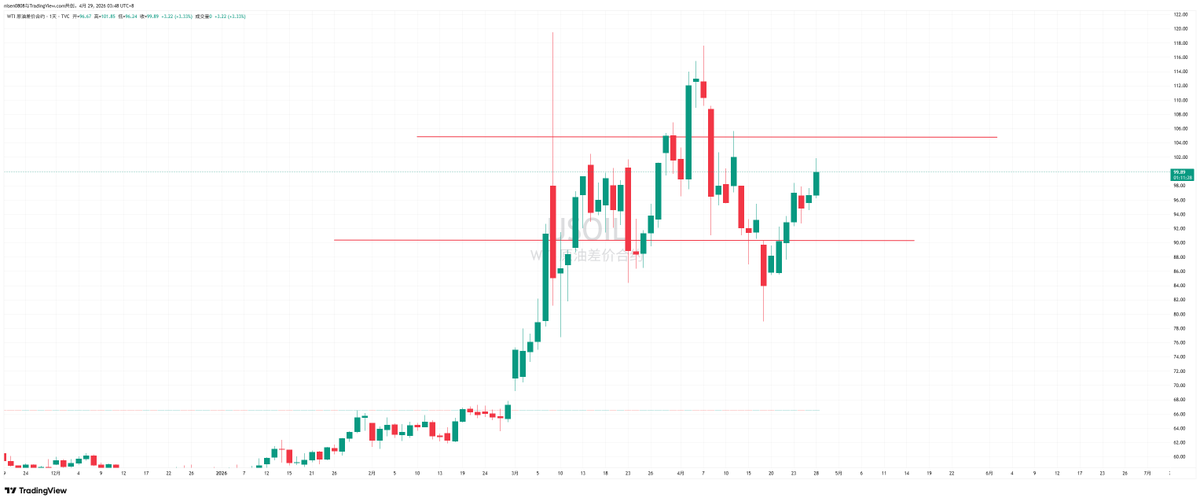
Today, both WTI and Brent have surpassed 100 dollars, which is essentially not because of the UAE's withdrawal, but because the market is trading on the risks of disruptions in the Strait of Hormuz.
In other words, the core of the current rise in oil prices is:
Transport disruptions + geopolitical risks + supply uncertainty.
It is not because the oil in the market will decrease after the UAE's withdrawal from OPEC+. On the contrary, the core reason for the UAE's withdrawal is not to reduce oil production, but to avoid being constrained by OPEC+'s production quotas.
Although the UAE previously had the capacity to increase production and exports, it could not casually raise production due to the OPEC+ production reduction framework. Now, if it withdraws from OPEC+, this restriction will be lifted, and the UAE will instead have greater room for production increases.
So in the short term, oil prices may continue to maintain high volatility due to the Strait of Hormuz, the situation in Iran, and shipping risks, or even continue to surge.
However, in the medium to long term, if the Strait of Hormuz becomes unobstructed and geopolitical risk premiums begin to decline, then the UAE's withdrawal from OPEC+ will actually become a boon for declining oil prices.
Because the market ultimately trades on supply and demand relationships.
If the UAE increases production, global oil supply will increase. If Saudi Arabia is also forced to adjust its strategy to maintain market share, then OPEC+'s price control ability will further decrease.
The most extreme situation is that oil-producing countries re-enter the game of whether to maintain price or market share.
If everyone chooses to maintain price, oil prices can remain high, but if some countries start to compete for market share, then oil prices will be significantly suppressed.
For the current situation, if the issue in the Strait of Hormuz is not resolved soon, oil prices will still carry a risk premium. But if the Strait of Hormuz gradually returns to normal and the UAE begins to release production capacity, then a drop in oil prices is inevitable; it is just a matter of time.
So my judgment is: the UAE's withdrawal from OPEC+, in the short term, is not the main reason for rising oil prices, and in the medium to long term, it could be a potential negative for oil prices.
My personal view is still to short WTI at high prices.
免责声明:本文章仅代表作者个人观点,不代表本平台的立场和观点。本文章仅供信息分享,不构成对任何人的任何投资建议。用户与作者之间的任何争议,与本平台无关。如网页中刊载的文章或图片涉及侵权,请提供相关的权利证明和身份证明发送邮件到support@aicoin.com,本平台相关工作人员将会进行核查。


