Original | Odaily Planet Daily (@OdailyChina)
Author | Asher (@Asher_ 0210)
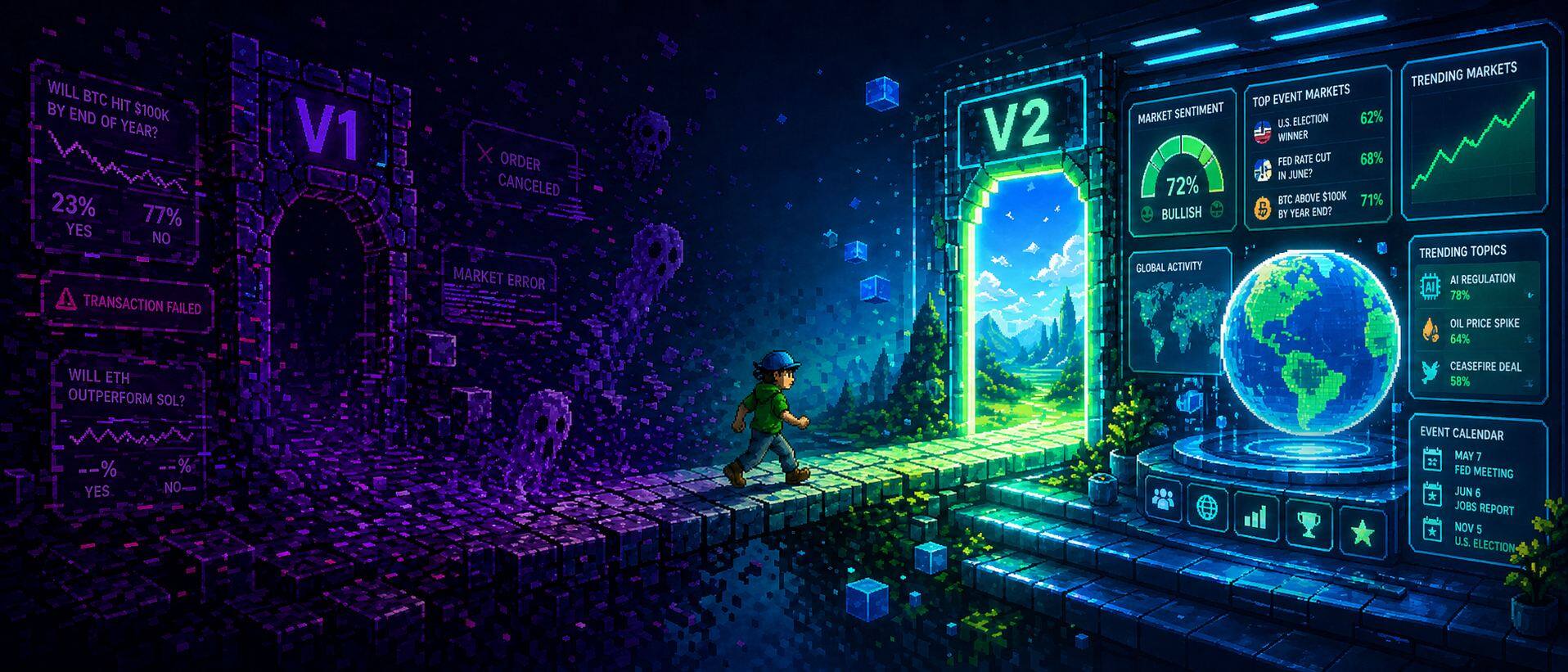
Last night, Polymarket entered a maintenance window, suspended trading, and cleared the order book, then officially launched CLOB V2.
According to previous disclosures from the official source, this upgrade includes new contracts, a new order book, a new collateral token Polymarket USD, and a new version of the CLOB-Client SDK. For users, changes like PUSD, SDK, and the order structure might not be immediately perceivable. The real point to pay attention to is the long-standing issue of Ghost Fills that have troubled Polymarket, which is commonly referred to by the community as the "ghost order" problem.
V2 indeed addressed this problem. The nonce mechanism that was most easily exploited has been removed, and the order structure and order cancellation methods have also been changed. However, this does not mean ghost orders have completely disappeared, because Polymarket's core trading model remains off-chain matching and on-chain settlement; as long as there is a time difference between these two steps, similar issues are difficult to eliminate entirely.
Why does an order show as completed but ultimately fails?
A ghost order simply refers to an order that appears to be matched successfully off-chain but ultimately does not complete settlement on-chain.
Polymarket employs an off-chain order book matching mechanism, followed by on-chain settlement. The advantages of this design are obvious: faster transaction speeds, lower costs, and it is more suitable for short-cycle, high-frequency prediction markets like the 5-minute market.
The problem lies precisely in this time gap. The off-chain order book shows that a transaction has been completed, but that does not guarantee successful on-chain settlement. In some short-cycle markets, users might see that their order has been completed, thinking they have bought in the desired direction, but when the transaction is actually submitted on-chain, the settlement fails. A transaction that appeared to be completed one second can be retracted by the system the next second.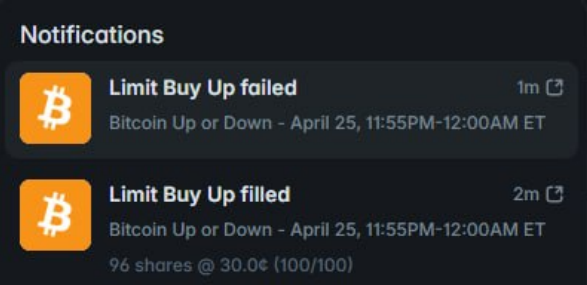
For users, the most frustrating aspect of this experience is not merely the failure but the uncertainty. They believe they have successfully bought or sold, only to find out at the last moment that the transaction did not occur; when they try to place the order again, the price may have changed, and they might have missed the trading opportunity.
The issue with the old version was the low cost of order cancellations
In V1, the easiest way for ghost orders to be exploited was through incrementNonce. A nonce can be understood as a status identifier within the order. Originally, it was meant to help the system manage orders, but in the old version, attackers could call incrementNonce to cause orders with old nonce to become invalid during on-chain settlement.
This provided attackers with a time gap to operate. Attackers could first have the order matched off-chain, causing the system to display "transaction has occurred"; then, before the settlement actually goes on-chain, they could update the nonce, causing those orders to ultimately fail. The result is that what seemed to be a completed transaction does not actually settle on-chain.
The crux of the issue is that this kind of operation has very low costs but can affect a batch of orders. Attackers only need to incur very low gas costs to cause orders that should have been executed to fail during the settlement phase. Front-end users see orders being filled first and then failing, which leads to unstable trading results, even causing users to miss the original trading price and opportunity.
The ghost order problem is not merely a front-end display error or an occasional on-chain failure; it directly impacts users' trust in the trading results.
V2 made fixes but did not eradicate the issue
The most crucial change in V2 is the removal of the original global nonce design. This means that the previous method, which affected a batch of old orders in one fell swoop through incrementNonce, has been blocked. Additionally, V2 simplifies the order structure, and order cancellations have shifted towards a more granular single order hash. Compared to the old version, the influence range of order cancellations has been significantly compressed, making it difficult for attackers to exploit low-cost operations to disrupt a large number of orders.
This is a substantive fix for the ghost order problem. The past issue was that attack costs were low, the impact range was large, and the replication threshold was not high. After V2, the path that was most vulnerable to exploitation has been removed. If attackers want to continue causing similar issues, they need to incur higher costs and depend more on specific system responses. Moreover, mechanisms like pauseUser introduce delays to minimize the chances of certain state changes being instantaneously abused during the matching and settlement window.
Overall, V2's direction is quite clear: first tackle the parts that are easily exploited by attackers, and then reduce the profit potential of similar attacks.
However, this does not mean that the issue of ghost orders has been completely resolved. The reason is that Polymarket has still not changed its basic model of off-chain matching and on-chain settlement. As long as orders are not completed in the same environment for both matching and settlement, there will always be a state difference between off-chain and on-chain. Changes in balances, authorization issues, changes in order status, cancellation actions, or failure in contract execution can all lead to an off-chain matched order failing to settle on-chain.
In other words, V2 addresses the most apparent and easily exploited attack paths from the old version, not the fundamental conditions that give rise to ghost orders.
Other updates are more to reinforce the trading system's foundation
In addition to ghost orders, V2 also introduces updates like PUSD, SDK, and 1271 signatures:
- PUSD is a new collateral stablecoin, with Polymarket migrating from USDC.e to Polymarket USD, which is backed 1:1 by USDC; ordinary users might not feel the change, but the handling of underlying assets will be more unified;
- The new version of the CLOB-Client SDK is mainly targeted at market makers, bots, and system integrators. After V2, relevant users need to upgrade their clients and re-sign orders with the new order structure;
- Support for the 1271 signature means that smart contract wallets, multi-signature accounts, institutional accounts, and more complex bot wallets can connect more smoothly to Polymarket.
Overall, Polymarket is not simply fixing a vulnerability; it is reshaping itself from a prediction market application to a foundational system that is closer to an exchange. As the number of market makers, API users, and automated traders increases, whether orders can be executed, settled, and fulfilled reliably will become more important than "whether the market is fun enough."
V2 is not the end, but the beginning of continuous fixes
After the launch of V2, Polymarket has at least blocked the most obvious attack path in ghost orders. The previous way of low-cost order cancellations affecting batches of orders has become difficult to replicate in the same manner. For a rapidly expanding trading platform, this is a necessary step.
However, the root cause behind ghost orders will not completely disappear due to a single version upgrade. As long as Polymarket continues to use the model of off-chain matching and on-chain settlement, the system will need to constantly address the discrepancies between off-chain states and on-chain results. V2 appears more like the first step—first solve the most obvious and easily exploited issues, and then through subsequent updates continue to enhance matching, settlement, monitoring, and risk control capabilities.
Prediction markets inherently trade in uncertainty, and if even the orders themselves are filled with uncertainty, users are not just facing market risk but system risk.
Related Content
Stuck Polymarket: The real test after the traffic dividend has arrived
免责声明:本文章仅代表作者个人观点,不代表本平台的立场和观点。本文章仅供信息分享,不构成对任何人的任何投资建议。用户与作者之间的任何争议,与本平台无关。如网页中刊载的文章或图片涉及侵权,请提供相关的权利证明和身份证明发送邮件到support@aicoin.com,本平台相关工作人员将会进行核查。


