Author: TechFlow
Currently, the Web3 public chain and DeFi ecology are deeply trapped in the industry's dilemma of subsidy competition and liquidity plunder. Most projects rely on high incentives and "vampire attacks" to compete for funds, making value-driven ecological growth increasingly scarce.
However, Mantle, through its heavyweight cooperation with AAVE, has created an industry miracle of a $1.4 billion TVL surge in just a month and a half, with zero treasury liquidity subsidies.
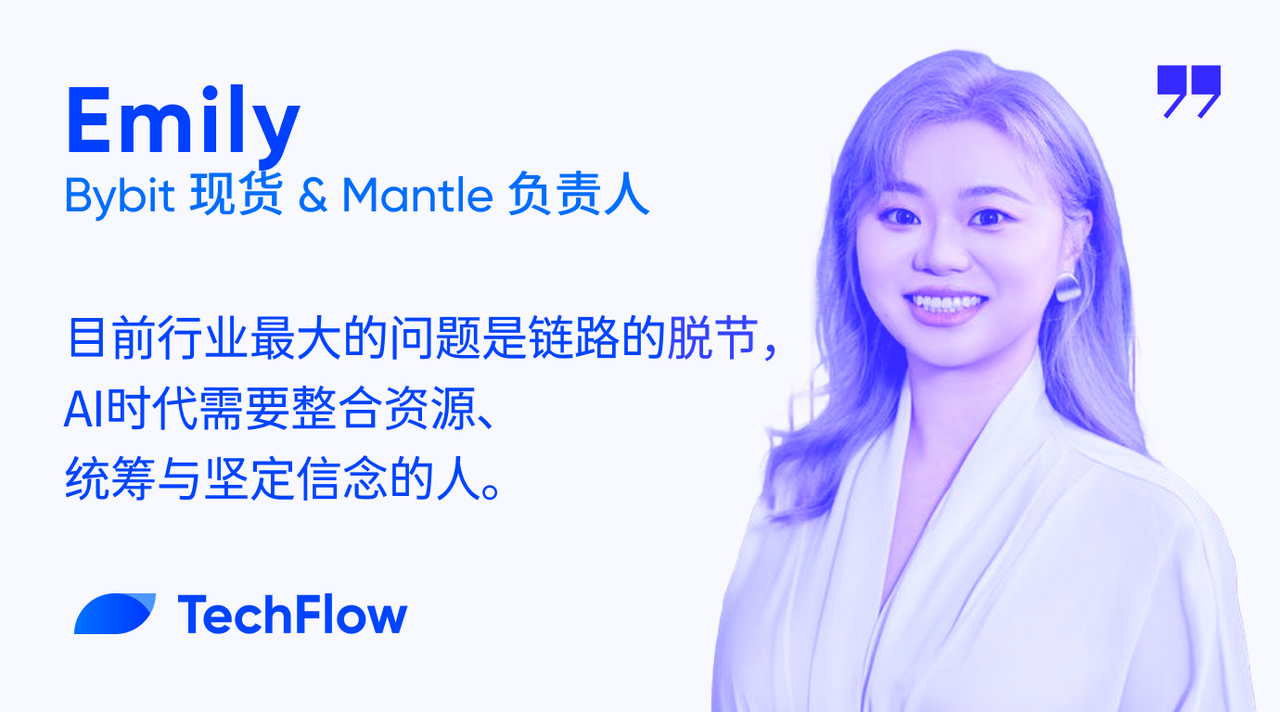
This time, we specially invited Bybit's spot & Mantle leader Emily for an in-depth dialogue. As a senior builder crossing three core tracks, Emily not only led this phenomenal collaboration but also serves as the head of listing for Bybit's spot market and the founder of Byreal, connecting the three major sectors of CEX traffic, public chain infrastructure, and innovative incubation to create a symbiotic ecological flywheel.
This interview will focus on the core logic of Mantle's subsidy-free growth, the practical results and core data of the three major ecological collaborations, and analyze Emily's key actions and decision-making thoughts in cross-border operations and ecological co-construction.
Part 1 | Starting with the $1.4 billion TVL: Why can Mantle attract funds without subsidies?
Q1: Very happy to invite Emily to participate in this interview. Welcome Emily, could you briefly introduce yourself?
Emily: Of course, thank you for the invitation. Hello everyone, I am Emily. You might know me from Bybit's live broadcasts. Currently, I am responsible for three things: Bybit's spot business, continuously building the Mantle network ecology, and I am also the founder of Byreal — Byreal is a native decentralized exchange based on Solana.
Although it seems I am doing three different jobs, for me, they all belong to the same mission: filtering quality assets, building the appropriate infrastructure for these assets, and designing liquidity paths that can support their scaling. I span centralized exchanges (CEX) and decentralized exchanges (DEX), while deeply cultivating the EVM ecosystem and the Solana ecosystem. That's me.
Q2: Recently, the cooperation between Mantle and AAVE is considered classic. In just one and a half months, with zero treasury liquidity subsidies, it leveraged $1.4 billion in TVL. Congratulations on achieving this result. What’s most commendable is that this growth did not depend on any incentives from Mantle, which is particularly striking. We all know that most public chains rely on high incentives and even "vampire attacks" to compete for liquidity. What do you think is the core secret to Mantle's growth?
Emily: Thank you for the introduction. I am very proud of this achievement, but I want to start with the timing because the market context adds weight to this achievement. If this achievement occurred during a period of overall market risk appetite rising, with a liquidity surplus during DeFi Summer, and the market advocating a new narrative, the figure would be impressive, but its persuasiveness would be greatly diminished. When Mantle Markets launched in February this year, the market was in a deep adjustment phase of de-risking, deleveraging, and deflating bubbles.
At that time, institutional partners were cautiously observing the crypto market, unwilling to invest. The market was genuinely yearning for real safety and real returns, not empty narratives. Initially, I wasn't particularly optimistic about the project's performance. But when we saw Artemis data showing that Mantle’s total deposits broke $1 billion in just 18 days, shattering Polygon's record of 24 days, both my team and I were stunned.
Looking back, this achievement confirmed my long-held belief: The core demand for DeFi has never disappeared; it can still attract real DeFi miners, institutional funds, and yield seekers. The market isn't that it no longer buys in; rather, it no longer buys into false growth. All investors and DeFi participants have become more discerning. To achieve this record, we did three key things right:
First, strategic transformation. Since August of last year, we no longer positioned Mantle as a typical Layer 2 network, nor did we ambiguously define it as a DeFi layer or liquidity layer, but instead clearly turned towards a public chain for real-world assets (RWA). Since then, all our construction and layout have revolved around RWA: building supporting infrastructure and inviting quality protocols and partners to settle on Mantle.
Second, binding heavyweight cooperation cases. AAVE is far from an ordinary partner; it is a leading protocol in the industry. AAVE settling on Mantle is a market credit reassessment and a key to building market trust. When a leading protocol settles on a public chain, it brings not just traffic and assets but also declares to the market: this public chain, this ecology is worthy of long-term capital allocation. That’s the second thing we did right.
Third, integrating resources rather than pushing forward in isolation. True growth is not just one team working hard; it revolves around core strategic cases, linking underlying assets and ecological partners, and achieving outcomes through a combination of market sentiment and internal execution direction. We also leveraged the synergy between the Mantle network and the Bybit ecosystem to jointly drive growth.
Q3: However, those who have experienced several bull and bear cycles in Web3 know that TVL built on liquidity is often fragile. As a key figure in Mantle's leap from 0 to $1.4 billion, what do you consider the ultimate indicators of a public chain's real moat and ecological health after stripping away the TVL metric? If you could travel back to a year ago at the crossroads of Mantle's cold start with your current understanding, what different choices would you make in ecological strategies or resource allocation?
Emily: You are absolutely right: TVL built on arbitrarily piling up funds is extremely fragile. If we remove the $1.4 billion filter, as an operator, I focus internally on two rarely mentioned but extremely critical metrics:
- Asset turnover rate: $100 million sitting in a single pool earning interest is called stagnant; but if that $100 million is collateralized and borrowed as stablecoins, the stablecoins being used as margin for perpetual contracts, and the yields from the contracts are reinvested into all-chain games, that’s active liquidity. TVL is just the reservoir’s capacity; turnover rate is the power of the water turbine generating electricity. What measures Mantle’s moat is the deep composability between protocols.
- Proportion of native yielding assets: How much of the funds on this chain are free from ‘Ponzi subsidies’ and genuinely anchor RWA or LST to generate real profits? The higher this ratio, the stronger the macro resilience of this chain.
Regarding different choices, if time could be reversed, I would completely abandon the obsession with "application-first" and fully shift to "asset-defined ecology."
This might be my biggest reflection from the past year. If I could go back to that crossroads of Mantle's cold start with my current understanding, there is one thing I would be far more resolute about: I would cut all resources trying to enlarge the ecology through ‘rolling DApps and rolling developer numbers’ and go all in on the ‘asset side’ from Day 1.
In the past few years, the SOP for public chains has been: first build the mainnet, then spend heavily on hackathons, asking developers to create DEXs, lending, and blockchain games, hoping applications will bring users. But the reality in Web3 is very harsh: applications have never generated assets; assets define applications.
If I could do it all again, I would devote all my energy to building hard currencies, deeply facilitating compliance fiat channels for RWA. First, let Mantle become the absolute ‘settlement center’ for quality yielding assets. When you hold quality, yielding underlying assets worth billions, you wouldn’t even need to seek developers; the top-notch DeFi legos across the industry would be eager to thrive on your land.
Q4: As a core advisor of Mantle, you are the driving force behind this collaboration. What were the biggest obstacles and challenges you encountered during the entire process of connecting, negotiating, and landing? Could you share one or two critical decisions or details that the outside world may not know but had a direct impact on the final result?
Emily:
The biggest challenge is not the technical integration but breaking down arrogance and rebuilding trust.
Leading protocols receive countless collaboration invitations daily; most negotiations ultimately fall into incentives, budgets, and liquidity support — “How much will you spend, how much will I spend, let’s make the launch data look good, and we’ll see about retention later.” This is the industry’s common approach, effective in many scenarios. But the problem is, once you rely too much on this approach, growth becomes distorted. If from day one, the core dialogue revolves around “how much to spend to create data,” it indicates that the underlying logic for long-term success has not yet been established, which is the most core issue.
Our ultimate solution was: don’t talk about subsidies, talk about assets. We shifted the focus to how to smoothly introduce the high-quality assets already settled in the Mantle ecology (like the immense liquidity of mETH) into AAVE through mechanism design. When the AAVE team saw we were not just making empty promises but had a clear asset flow path and real user needs, their attitude fundamentally shifted. Persisting without subsidies actually forced us to refine the underlying logic to perfection.
The second challenge was unifying the internal success criteria. Some people focused on TVL, others on launch data, and some on long-term retention. If the standards are not uniform, the teams will each fight their own battles. I always emphasized: first, unify core issues and goals, then find answers and advance construction. These two points were the toughest hurdles in this collaboration.
Part 2 | Bybit, Mantle, Byreal: Is an ecological flywheel really forming?
Q5: Next, let's talk about the multiple identities you mentioned earlier. We all know you wear three hats: head of Bybit's spot listing, core advisor for Mantle, and founder of Byreal. From reshaping Bybit's listing standards and upgrading Bybit’s Web3 layout to Mantle’s transformation into an RWA public chain, you have precisely captured the turning points of three major tracks. As a behind-the-scenes core figure, how do you identify these breakthrough opportunities? What strategies did you employ to complete these three transformations?
Emily: This is also a question I am often asked. People see that I span CEX and DEX, deeply work in EVM and Solana ecosystems, and hold multiple positions. Internally, I have a nickname "Mother of Dragons," as if I am raising three kids: one is already mature, one is still in its early toddling phase, and the other is a "teenager" — that is Mantle. But as I said, I am more like a bridge. Most people in the industry only view the market from a single perspective, either CEX or DEX builders; while I am fortunate to connect both CEX and DEX, and am rooted in both the EVM and Solana ecosystems.
This allows me to examine the market from a more comprehensive perspective. What I focus on is not whether a single product is good, or if token issuance is successful, or if a public chain is popular, but where the links are broken from creativity to product, from infrastructure to liquidity. These three roles make me increasingly convinced that the biggest issue in the industry is not the lack of creativity, innovation, or builders but the continuous disconnect between creativity - product - infrastructure - liquidity.
Simply put, there is a structural divide between the primary and secondary markets, and liquidity mismatches between on-chain and off-chain. Many projects fail not because their products are bad but because of poor growth path design — the launch, TGE, community growth stages lack overall planning. Let me illustrate some practical examples by combining my three roles:
First, from the perspective of being the founder of Byreal (a builder): Many excellent builders create logically sound, technically solid, and well-designed products with lean teams, but they rarely think in advance: Who are the target users? Where does the liquidity come from? Who can cooperate to enlarge the platform? If these questions are not clarified in the early stages, even if the product is of high quality, it is difficult to achieve PMF, and ultimately only shines for a moment. This is a mismatch issue I observed from the construction side.
Switching to the perspective of Mantle's ecology: A public chain or Layer 2 network cannot build a real ecology by passively waiting for projects to settle in. It is necessary to clarify what native innovations, core builders, and partners are needed for the ecology, and who can create a chemical reaction within the ecology. Coordinating public chain infrastructure, fund allocators, and multiple parties will determine how the market and builders perceive your ecology. A healthy public chain ecology is not built by stacking project numbers but by a combination of quality projects and assets, and reasonable liquidity path design. This is the market issue I see from the perspective of ecological construction.
Now switching to the Bybit CEX perspective: I am responsible for listing spot markets and review projects daily, but to be honest, quality projects are scarce recently. In the past few years, many projects had impressive data, high TVL, hot social media and community engagement, and endorsements from star institutions, but digging deeper reveals their token economics are weak, user retention is poor, and growth is entirely driven by short-term incentives and token releases. This is a lingering issue in the industry for years. Such projects may be popular for a moment, but they do not qualify to enter the large liquidity system and have no long-term value. I am not targeting specific projects; this is a common problem in the industry.
Combining these three perspectives, the core contradiction is clear: The primary market excels at storytelling, builders design products around narratives, while on-chain ecology provides the infrastructure for launch; the secondary market excels at amplifying liquidity, doing PR, and listing promotions, but nowadays must be extremely discerning about asset quality. Behind these problems lies the opportunity to eliminate the information gap, time gap, and link gap. This is why I often say: What I do is simple — connect new assets and new infrastructures, build ecology, and design liquidity paths.
I am well-versed in CEX’s liquidity logic and also know how to help products succeed in token issuance — TGE is the most important PR event in the entire project cycle. The current market is highly compressed, and projects do not have time to follow the steps: first build products, then grow, and finally look for CEX listings. After 2024, the market logic will have completely changed.
The market compression means core issues must be resolved in advance. When planning products, it is essential to ask: Is the product logic real? Is the demand real? Does it solve real user problems? Who are the target users? Who are the core partners? Does the product and token value capture match? Think through these questions before starting construction.
Q6: Thank you, Emily, for your insights. Your cross-role sharing is invaluable, and your perspective is unique, fully explaining the construction logic. With all these roles, do you feel overwhelmed? How do you balance different responsibilities?
Emily:
To be honest, I feel a bit ashamed — I don't see myself as a successful builder. In the past, I always evaluated projects from an auditor's perspective, but I lack long-term experience in product construction. So I chose to become a builder myself; only by building products can I combine the CEX listing perspective and fully narrate the industry logic.
Nevertheless, thank you for your concern. This is indeed three full-time jobs, corresponding to three completely independent teams with different goals, not different sections of the same team. I need to lead different teams to achieve their individual goals. The direction and goals of the three roles are different, which is the most challenging part.
Regarding balance, my method is to look for the "greatest common divisor" of these three roles. Bybit, Mantle, and Byreal seem to operate different businesses, but the underlying logic is consistent: they are all about seeking and amplifying quality Web3 assets. I don’t need to switch my brain back and forth between the three roles; I just need to use a unified investment and construction perspective to draw resources from different platforms to solve problems.
My marketing director helped me summarize a PPP success formula: Product, People, Partners. I excel in integrating these three types of resources, anticipating directions in the industry transition period, binding core cases, and linking resources and delivering results using the PPP formula.
These are my genuine insights, and I hope they help everyone. I always believe that products come first.
The product itself speaks volumes. And talent is core; all outcomes are produced by people. To do new things, you must find the right people. It's not about the size of the team but whether everyone is pushing toward the same goal; that’s the key.
Choosing the right partners can make the construction path much more efficient. This PPP formula is very practical; thanks to my marketing director for summarizing it.
Q7: The PPP formula is summarized very well. In your many roles, what impressed you the most and gave you the greatest sense of accomplishment during the AAVE and Mantle collaboration?
Emily: If we solely look at the headlines and data, people might think the most unforgettable moment was hitting $1 billion in TVL and breaking the record in 18 days. But for me, what really touched me was an earlier moment — when, just one week after launch, the TVL broke $400 million.
While $1 billion is a grand milestone, on February 19, when I saw $400 million TVL, I remember clearly that it was a signal — it told me that the ecology we wanted to build was running smoothly, and the market chose us based on its own trust, rather than relying on short-term activities or incentive drives. The moment when the system began to “self-operate” was my most fulfilling and memorable moment.
Part 3 | Future and Judgments, Who are you willing to bet on next?
Q8: Now let's move to the last segment and discuss the future and your judgments. We all know that the TVL growth and this cooperation are just the starting point. From a macro perspective, what do you think Mantle's next breakthrough point will be? Is it liquidity-staking derivatives (LSD), or the RWA public chain you mentioned, or another direction? After determining the track, it boils down to people. As the founder of Byreal, what qualities do you hope to strongly support in founders to seize the opportunities in these tracks?
Emily:
Alright, let’s first address Mantle's next breakthrough point and roadmap. If I must choose one core direction, I think it is still RWA (real-world assets).
Last year, we established the RWA direction; this year we must go all out to implement it. The reason is simple: DeFi cannot keep circulating internal funds; if the industry wants to expand, it must bring in real-world assets and real-world yields. This is the core value of RWA. Last year, I proactively laid out the RWA track, and on the first day of xStocks launching, I listed it on both Byreal and Bybit spot, giving us a first-mover advantage in the RWA field.
Today, RWA is not a short-term trend but a real trend of implementation. On Wall Street in New York, everyone is discussing stablecoins and RWA tokenization; this is a core strategy for long-term industry growth.
The second breakthrough direction is on-chain high-frequency derivative trading. Spot trading and lending are the foundational infrastructure, while derivatives and proprietary trading are core to maximizing capital efficiency. This will also be a core breakthrough point for all public chain ecosystems (not just Mantle).
The third direction must inevitably be AI. Everyone in the crypto industry is talking about AI. I recently shared a viewpoint on social media: cryptocurrency may not be designed for people, but for the sake of AI. AI is inherently suited for on-chain data and rules; the crypto network will become the settlement layer for the intelligent agent economy, operating natively on the blockchain. This is a core opportunity direction for the future.
After discussing the tracks, let’s talk about builders. I want to introduce a term: Polymath builders. This is a viewpoint I saw from Dan Koe's social dynamics — over the next 3-5 years, the industry will need polymath builders. I strongly agree with this viewpoint. During the early cycles of the industry, the market only rewarded two types of people: great storytellers and those proficient in designing token flywheels.
But now the logic has changed. With AI technology developing rapidly, everyone is using AI, and the skills required of builders have also fundamentally changed. Builders who understand AI and can effectively use AI will have infinitely greater advantages than those who do not understand AI. I will strongly support polymath builders — this does not mean demanding that one person be proficient in everything (products, technology, mechanism design, market promotion, etc.).
On the contrary, AI can help us process various types of information; what we need are people who can integrate all resources, coordinate the entire product lifecycle, and possess firm beliefs. These are the builders that the next generation of the industry needs the most.
免责声明:本文章仅代表作者个人观点,不代表本平台的立场和观点。本文章仅供信息分享,不构成对任何人的任何投资建议。用户与作者之间的任何争议,与本平台无关。如网页中刊载的文章或图片涉及侵权,请提供相关的权利证明和身份证明发送邮件到support@aicoin.com,本平台相关工作人员将会进行核查。


