On April 28, the UAE announced its withdrawal from OPEC and OPEC+, effective May 1, ending nearly 60 years of membership. On that day, Brent June futures jumped by $1.11 to $109.34 per barrel. This is the story currently seen in the financial media. However, Brent July futures only rose by $1.08 to $102.77, making it $6.57 cheaper than June. Together, these two figures tell another story.
The UAE is the third-largest oil producer in OPEC, after Saudi Arabia and Iraq. Its position within OPEC has always been awkward, with its capacity expansion outpacing quota updates. In 2023, due to dissatisfaction with its low quota, it delayed the entire OPEC+ production increase agreement for several months. This direct exit has been interpreted by the media as the biggest challenge to Saudi Arabia's leadership.
After the UAE's announcement, the market's judgment on oil prices was divided into two camps: spot prices surged, while long-term rates remained unchanged. The gap between these two pricing methods is the market's true response to the "UAE's exit."
Actual Production Capacity is 1.5 Times OPEC Quota
According to EIA data, the UAE's current actual production capacity is 4.85 mb/d (million barrels per day), but OPEC+ recently assigned it a quota of around 3.22 mb/d for 2025. The difference of 1.63 mb/d equates to approximately 30% of its capacity being artificially idle.
A similar gap exists in Saudi Arabia, which is about 25% (actual capacity 12 mb/d against a quota of 9 mb/d), while in Iraq and Kuwait it is only 10-15%. Among the 13 OPEC countries, the UAE is the most heavily suppressed member.
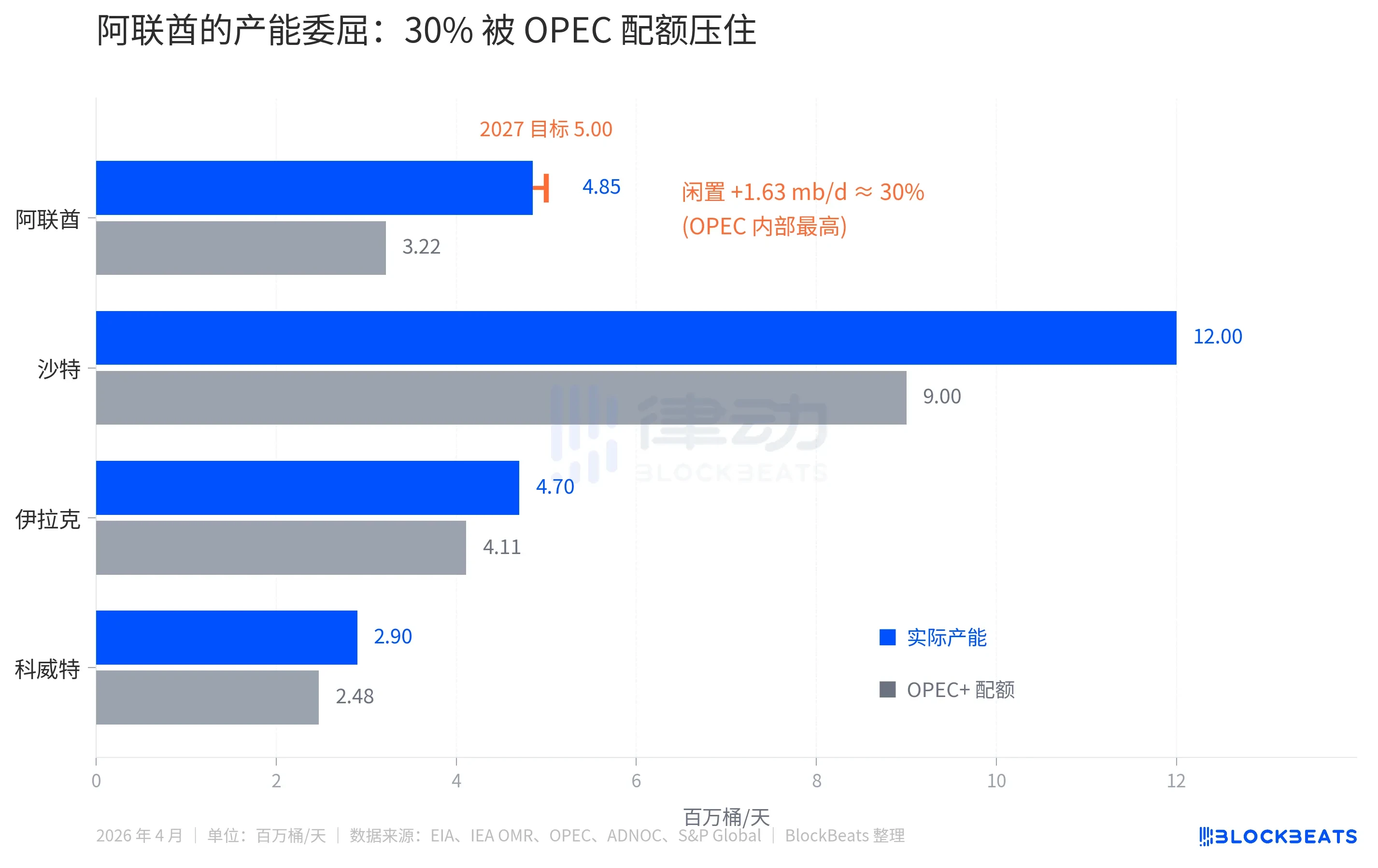
Dissatisfaction runs deeper. The UAE's national oil company, ADNOC, is accelerating its investments. According to ADNOC's announcement, the capital expenditure budget for 2023-2027 is $150 billion, and the capacity target of 5.0 mb/d has been moved up from 2030 to 2027. On one hand, they are investing to expand capacity, while on the other, they are held back from selling more by OPEC quotas, resulting in daily losses in millions of barrels.
This is the financial reason the UAE must exit. However, looking at this reason alone, common economic wisdom suggests that a member country with 30% idle capacity breaking free from quota constraints will mean it will produce more oil. More oil production translates to an increase in supply. An increase in supply is negative for oil prices.
Backwardation in Crude Oil Futures
On April 28, mainstream media's headlines read "Brent Soars." But the surge was only in near-term contracts. The long-term expectations shown by the orange dotted line remained essentially unchanged throughout April.
On April 28, Brent futures closed, with the June contract (front-month, equivalent to the "immediate oil price") at $109.34, and the July contract at $102.77, a price difference of $6.57. This futures curve shows a deep backwardation, with near-month prices pushed higher and far-month prices relatively cheaper.
The futures curve is not speculation; it reflects actual contract prices. It tells you that the market is currently willing to pay more for immediate oil than for oil a few months in the future. The underlying logic is simple: the market expects the Hormuz crisis to be resolved, OPEC supply coordination to loosen up, and the UAE's 30% idle capacity to enter the market.
Returning to the story throughout April makes it clearer. According to EIA Brent Dated spot data, on April 7, the spot price surged to $138.21 per barrel, the peak for the month, which was $35 higher than the long-term expectation of $102.77 on April 28. This $35 reflects the panic premium the market was willing to pay for "immediate oil." At that time, the US-Iran conflict had entered its ninth week, and shipping through the Strait of Hormuz approached full suspension, with about 20 million barrels of Middle Eastern crude oil transportation nearly reduced to zero daily.
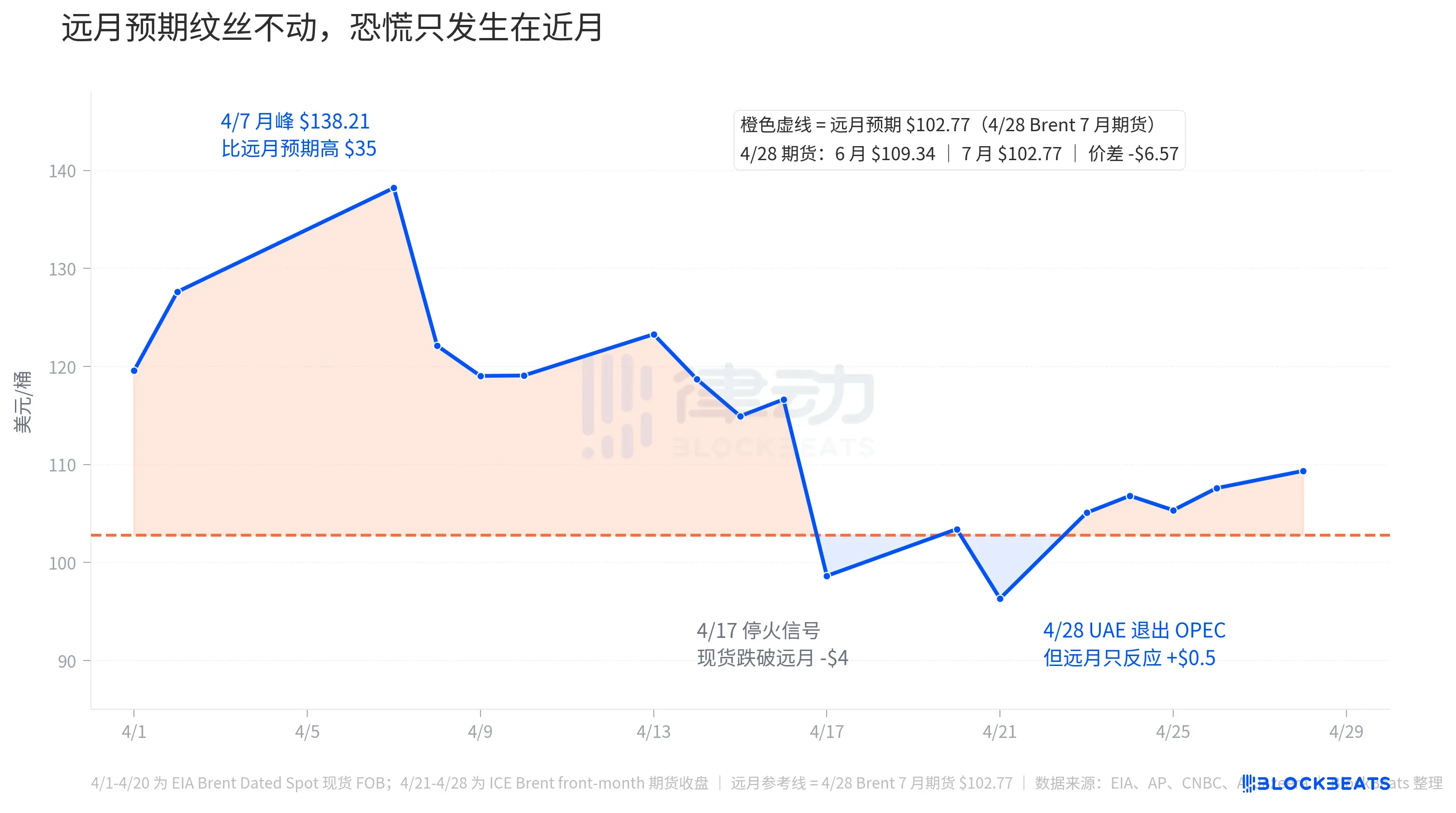
Then on April 17, signals of a ceasefire were announced, and Brent spot fell to $98.63 on that day, dropping about $4 below the long-term expectation. The market briefly believed the conflict would end and thus "future oil prices" became more expensive than "current oil prices." This unusual state lasted only a few days, as Brent fell to a monthly low of $96.32 on April 21, before rebounding on April 23.
Following the UAE's announcement of exit on April 28, Brent June rose again by $1.11 to $109.34, returning to $6.57 above the long-term expectation. But this is just a fragment of the early April panic premium. In other words, the market's panic reaction to the "UAE's exit" is far smaller than its reaction to the Hormuz crisis.
The long-term line conveys a more direct message. On the day the UAE announced its exit, July futures only rose by $1.08 to $102.77, nearly matching the increase of June futures. This indicates that the market believes the UAE's exit will have a near-zero impact on mid-term oil prices, being neither bullish nor bearish. The short-term spike is just headline noise combined with the psychology surrounding Hormuz.
Largest Exit in OPEC's Withdrawal Trend
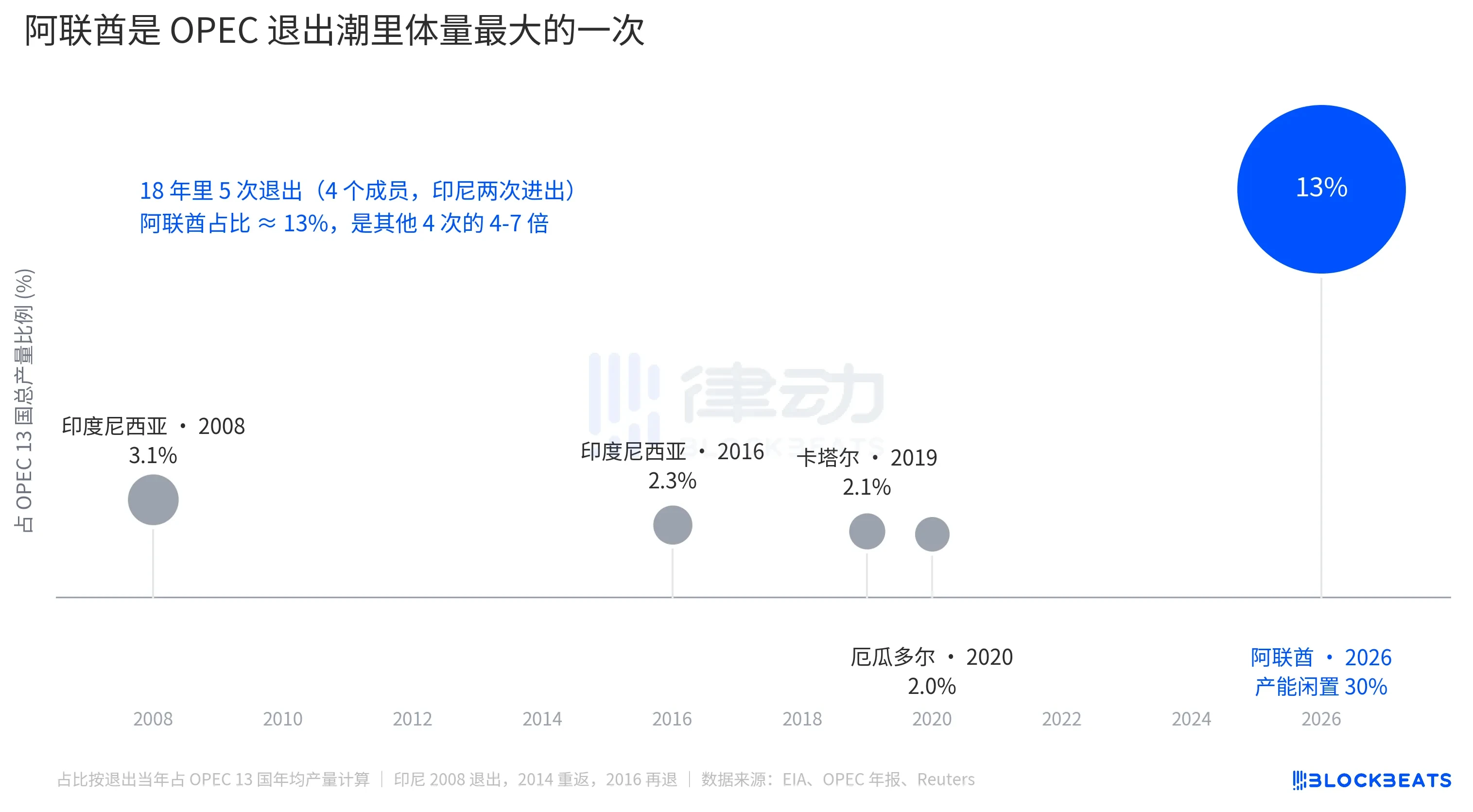
Indonesia first left in 2008 (returned in 2014 and exited again in 2016), Qatar withdrew in 2019 to shift to LNG, and Ecuador left in 2020 due to financial pressures. At the time of these four exits, the departing members each accounted for 2-3.1% of OPEC's total production. Each was interpreted as isolated incidents, and OPEC's market share was not significantly harmed each time.
The UAE's share is 13%. One withdrawal is equivalent to more than 1.5 times the cumulative exits over the past 18 years.
However, in terms of price influence, a large scale does not equate to a large impact. The 13% figure needs to be absorbed within the OPEC discipline framework led by Saudi Arabia, which still has about 25% idle capacity that can be released to hedge, and the production quotas of other OPEC+ members can also be adjusted. The market did not translate "OPEC losing 13% of capacity" into "future oil prices will surge."
The real structural impact comes at another level; OPEC's role as a "price stabilizer" has further weakened. According to IEA estimates, OPEC+'s overall idle capacity at the beginning of 2026 is about 4-5 mb/d, with the UAE contributing about 0.85 mb/d. After the UAE leaves, the idle capacity of the 13 OPEC countries will shrink to about 1 mb/d. This is the "ammunition" available to the market in the future when encountering supply shocks, with 1 mb/d being roughly sufficient to cover about 1% of global demand.
This is why long-term futures would only rise by $1—not because the UAE producing a few extra barrels would cause oil prices to drop, but because OPEC's capability as a price stability anchor has been stripped away a layer.
Mainstream reports have intertwined the UAE's exit with the rise scenario in Hormuz, making it seem like the dissolution of OPEC is pushing up oil prices. The futures curve has separated the two events. At the beginning of April, Brent spot was once $35 more expensive than long-term rates, that was the panic premium of Hormuz. On April 28, the near-far month price difference was only $6.57, the total of which includes the UAE's exit plus headline noise. The real pricing of the market regarding the UAE situation lies hidden in that almost unchanged long-term line.
免责声明:本文章仅代表作者个人观点,不代表本平台的立场和观点。本文章仅供信息分享,不构成对任何人的任何投资建议。用户与作者之间的任何争议,与本平台无关。如网页中刊载的文章或图片涉及侵权,请提供相关的权利证明和身份证明发送邮件到support@aicoin.com,本平台相关工作人员将会进行核查。


