Author: Joe Schmidt IV
Translation: TechFlow
TechFlow Introduction: a16z partner Joe Schmidt IV has written directly about Workday, the HR software giant with nearly $10 billion in annual revenue: the moat seems deep, but the underlying architecture remains stuck in 2005, unable to be saved by AI patches. The article breaks down why Workday’s four-tiered defense system (integrated binding, proprietary configuration, consulting ecosystem, long-term contracts) is simultaneously loosening and provides six key product features and implementation paths for AI-native HCM systems. This is a typical a16z investment thesis release, clearly calling out entrepreneurs: come build the next-generation Workday.
Workday is perhaps the most important yet least liked product in enterprise software. Over 10,000 companies use it, tens of millions of employees are trapped in it every day, with annual revenue approaching $10 billion and a market value of about $30 billion.
These numbers have nothing to do with how usable the product is. The daily routine of HR administrators looks like this: running reports across three pages, doing payroll cycles in Excel because the system is too complex, watching business partners step by step on Zoom to point through the promotion process, and waiting for IT to explain which integration has blown up this week.
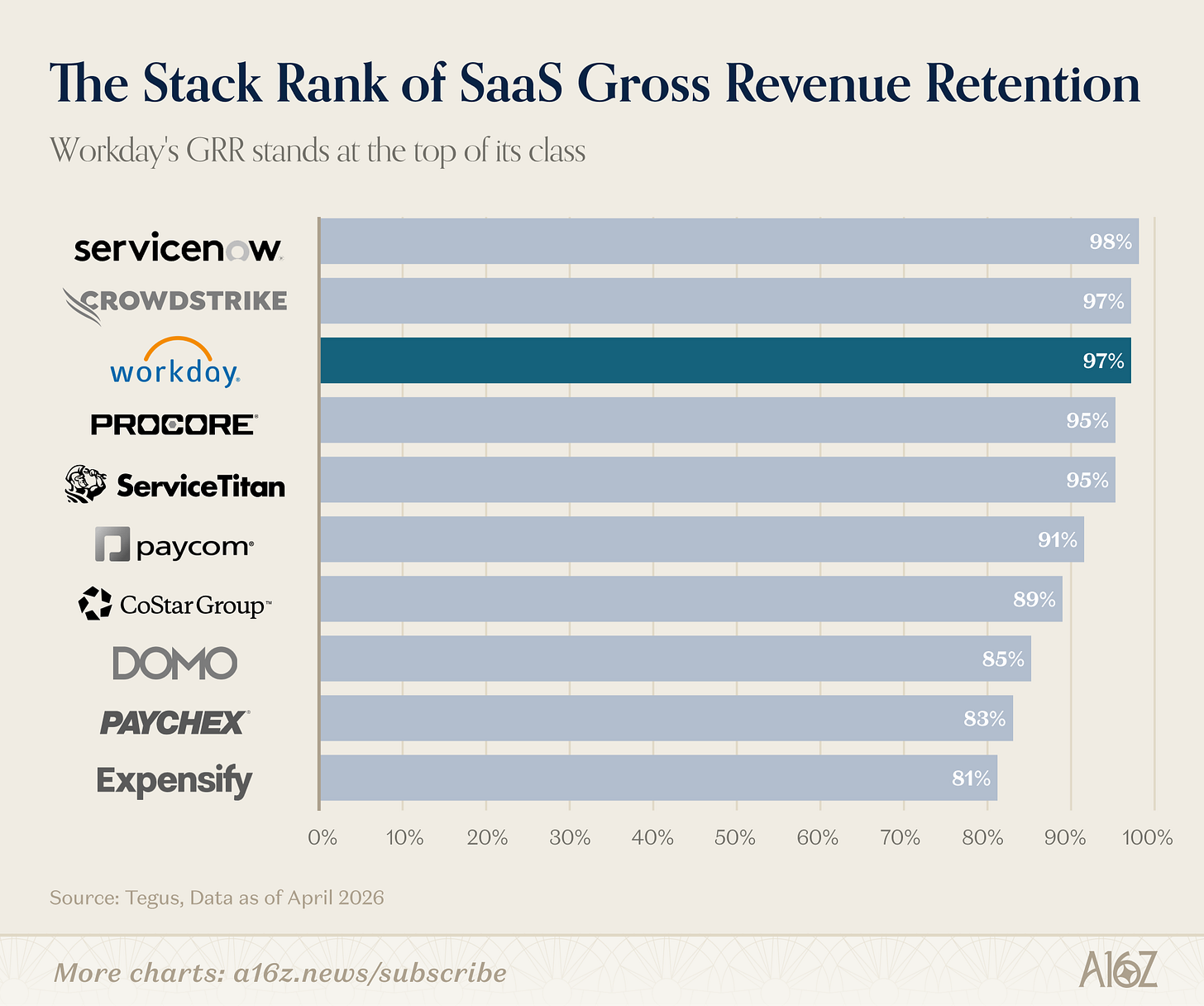
Customer renewal rates are close to 100%, and one might think this indicates the product is good. But Workday is different—the high renewal rate is because customers want to leave but can’t.
HCM (human capital management) is the last major enterprise software category without an AI-native challenger. This situation is about to change. A transformation greater than the platform migration that gave birth to Workday is underway, and Workday's end is near.
The Cloud Migration Created Workday
Workday itself is a product of platform transformation. In 2005, after the malicious acquisition of PeopleSoft, the dominant market player by founders Dave Duffield and Aneel Bhusri by Oracle, they bet that migrating from C/S architecture to multi-tenant cloud would reset the HRIS (human resources information system) category. They judged that Oracle and SAP would not catch up architecturally, and that all C/S architecture HRIS systems would become legacy maintenance businesses within ten years. At the same time, they saw large enterprises shifting from large upfront capital expenditures to predictable annual operational expenditures, changing from buying licenses and building data centers to a subscription model.
Workday won on two fronts simultaneously: it is the only mainstream HRIS designed with a multi-tenant cloud architecture from day one, and its pricing model perfectly coincided with corporate purchasing transitioning to a subscription model. Within ten years, it became the default choice.
Why Workday is So Hard to Shake
In the last twenty years, every serious attempt to attack Workday's enterprise market has failed, for the same reason: Workday's moat is not in the product itself, but in everything surrounding it.
Deep technology and human binding. Workday is at the center of hundreds of integrations—payroll, benefits, ATS (applicant tracking system), reimbursements, identity verification, finance, state taxes; none can be migrated cleanly. Each instance retains thousands of hours of muscle memory: a certain administrator runs the same performance cycle for four years in a row, and payroll managers have memorized a seventeen-step performance compensation process. Adding a new cost center can ripple through reports, integrations, job structures, pay grades, and benchmarking systems, and only when all systems and people update in order can it run smoothly.
Proprietary configuration layer. Workday’s configuration method is different from most enterprise systems. Integration is built using Workday Studio—a proprietary tool, with implementation cycles of 6 to 18 months, requiring certified consultants to operate. Reports run on Workday's own BIRT implementation, calculation fields use Workday's own expression syntax, and tenant configurations are mapped through the platform's unique business processes and security framework. These skills have no market outside the Workday system: there is no open-source community, no Stack Overflow; developers and their hiring clients are locked into their resumes.
Consulting cartel. More than 10,500 certified consultants are distributed across Accenture, Deloitte, Kainos, PwC, KPMG, and over 150 small service providers doing Workday implementations. A project takes 6 to 18 months, costing between $300,000 and over $1 million, with implementation costs often equal to 100% of the annual software fees. This service economy may be worth more than the product itself—it lobbies for Workday, absorbs customer complaints, and aligns the world's largest companies with vested interests in maintaining Workday.
Long-term contracts locking in. Workday locks customers into long-term contracts. Even if a customer wants to switch tomorrow, they can only be structurally forced to wait until the contract expires.
With these four layers combined, Workday has one of the highest customer revenue retention rates in enterprise software, making it one of the hardest products to displace for most large enterprises.
Why Now is the Window Period
Some may say: "It's been twenty years; challengers have come and gone, but Workday cannot be moved." That's true. New players either target startup customers (which is the path taken by Rippling and Gusto) or dive into difficult niche markets (like Deel's cross-border employment).
Workday has not been idle either. In 2025, it launched over 25 AI features under the Illuminate brand, rolled out a dozen agents, acquired Sana Labs and Pipedream, and introduced a usage-based Flex Credits pricing model, with companies like Accenture, Nike, and Merck signing on. AI ARR (annual recurring revenue) surpassed $400 million, with triple-digit year-over-year growth.
However, Flex Credits and "AI ARR" feel more like procurement innovation than product innovation. Signing for Flex Credits and running core HR processes with agents in a production environment are two different matters. The reason for the existence of Flex Credits is very realistic: every enterprise CIO and CFO has an "AI investment" line in their 2026 KPI that needs actual spending to demonstrate; during earnings calls for every traditional software vendor, "AI revenue" is the first number asked about. Flex Credits is a procurement structure needed by both sides—clients commit to a credit pool, counted as AI expenditure in their budgets; Workday records the commitment as AI ARR; as for which agent runs which process, that will depend on when Illuminate produces something useful. Both sides meet their KPIs, no one needs to commit to a specific deployment, and then celebrate the signing together.
You don’t just have to take our word for it. A large Workday service partner recently wrote, "Most organizations do not know these capabilities exist, let alone how to activate them." Customers have begun to resist paying additional token fees on top of already renewed subscription fees. Long-term Workday administrators we've spoken with have described Illuminate as: the same manual management tasks wrapped in a chat interface. Each Illuminate feature is an additional layer built on the same form approval engine—AI ARR can grow by triple digits, but the underlying product remains unchanged.
But this time is different. Three variables have changed simultaneously, exposing Workday’s vulnerabilities at last.
First, corporate IT is finally reassessing core systems. Large enterprises are conducting AI readiness assessments on systems like ITSM, ERP, and HCM that they once thought could be locked in for ten years. The pace of change in the AI technology stack has turned outdated architectures into liabilities. A company aiming to lead in AI cannot rely on an HRIS designed in 2005. When CHROs and CIOs ask, "What does the AI-native version of this look like?" and Workday's answer is selling consumption credits on the same engine, that is the breakthrough moment.
Second, the tools needed for rebuilding are now in place. The same movement is happening at the layer above enterprise tech stack: companies like Tessera are already performing AI-native SAP migrations at Fortune 500 scale—the complexity of ERP is an order of magnitude greater than HCM; a single ECC to S/4HANA upgrade could cost $700 million and take three years. HCM poses similar problems but on a smaller scale. Coupled with pre-configured deployment service teams owned by vendors themselves (rather than Accenture), the implementation layer is no longer the same moat it used to be.
Third, Workday can no longer internally seal the gaps. The company is betting on three directions: Illuminate is the agent product customers want, Sana is the new "work entry point," and the upcoming Agent System of Record will be the governance layer for all enterprise agents. All three are layered on the same form approval engine—this engine is powerful, but it is now twenty years of aging infrastructure that is difficult to configure and modify and cannot keep up with the real needs of modern HR organizations. Adding AI on top of that will not change the underlying layers.
Workday's true underlying asset—a trillion-dollar transaction data set—sounds substantial, but what really matters in operation is how that data connects to workflows, permissions, and integrations, and every layer of that tech stack is now a liability. Workday can add AI on top, but it cannot become AI-native without a complete overhaul—and a public company driven by installed volumes cannot afford to do that.
As we have discussed, the replacement cycle for Fortune 500 systems is about to open for the first time in twenty years, driven by the wave of enterprise-level AI replatforming. Currently, no next-generation HR solution is designed at the level of Fortune 500 HRIS systems. This is a unique opportunity that targets the enterprise-level market where Workday makes the most money—also the market where previous challengers have failed.
What an AI-Native Workday Should Look Like
We believe the opportunity lies in directly benchmarking Workday's HCM business, creating an enterprise-grade AI-native HR system for the next twenty years.
We envision the product having six characteristics:
- One-month deployment completion. Implementation is Workday’s biggest weakness and the core reason enterprises do not switch systems. A true enterprise-grade Workday implementation needs to cover payroll taxes in all 50 states, cross-border payroll in over 60 countries, ACA and SOX compliance controls, various pitfalls with benefit providers, union agreements, Workday Studio, BIRT reports, and Extend configurations. No one person understands everything, and most projects take 12 to 18 months due to fragmented knowledge among a dozen experts that must schedule and coordinate sequentially. Coding agents flatten that fragmentation. An agent can ingest the entire tenant (business process definitions, integration definitions, audit logs, payroll batches), rebuild the rules in natural language, verify against real-time integrations, preserve edge cases, and generate configuration drafts within days. Today's Workday is configurable within the constraints it allows; an AI-native HRIS should customize according to the company's actual policies, completing the work that previously cost six figures with consulting firms, through coding agents.
- Built-in HR workbench. The best HR administrators are essentially product managers—they know what CHROs truly need in cross-system reports, what payroll planning tools should look like, and what onboarding experiences should feel like. Today, these tasks cannot be done by one role. Pulling data cross-system requires data warehousing and data teams to do the mapping, and building a real workflow or application requires developers or a Workday Extend contract. The workbench compresses all these tasks into a single agent-native interface: ask a cross-system question and get an answer, describe an application in natural language and generate a usable version, propose a process change and see a preview of its impact. The HR teams we’ve interacted with are already trying to build such applications themselves—for example, an onboarding process where a manager automatically drafts a JD, assembles a 30-60-90 day plan, and coordinates IT to open accounts and provide devices.
- Agent-first. Besides having a portal, employees should interact with HR tools in their daily work. An employee on a business trip to Milwaukee should be able to ask in Slack who else is within 50 miles and get an answer in the same conversation. A manager approving time off should directly see the complete context of the employee (balance, recent leave, upcoming requests, team coverage) without having to switch to another dashboard. Consider a more complex scenario: creating a new department. Today in Workday, this takes several weeks: new cost center, job structure, headcount planning, benefits setup, payroll integration, approval processes. In an AI-native system, an HR operations leader should be able to describe in natural language (500 people in Austin and Dublin, reporting to this EVP, these job families, this pay band), and the system will automatically map all dependencies, identify downstream changes, generate configurations and go-live plans in one go. Furthermore, data should flow both ways: HR data should drive agent processes across the organization, not be locked in HRIS.
- Open. Integrating a new payroll provider is a 6 to 12 month custom integration through Workday Studio; adding a benefit provider is similar; pulling data into BI tools requires finding a consulting firm. The frontline personnel we’ve encountered are no longer waiting—they are building Claude MCP to pull data from Workday into the tools they actually use, routing approvals through Slack, treating Workday like a read-only system. What these teams genuinely want is an inherently open HRIS: customer-owned agents can directly read the HR data model, APIs are not blocked by credit pools, and the connective layer treats integration as a first-class product. The ecosystem's appeal comes from building the best agent builder on top of the data—that’s the fastest place to get work done.
- Security and permissions at the agent layer. HR data is the most sensitive in the company (pay, performance, sick leave, PII), and agents operating on this data need system-native fine-grained access control. A manager's agent should see team compensation; individual contributors' agents should not. External recruiting agents should see open positions but not compensation history for departures. Properly managing the permissions for each agent separates whether AI can truly interact with production HR data or be blocked by security policies—retrofitting this on a non-native architecture is almost impossible.
- Always-online compliance. The regulatory landscape relevant to HR data (EU AI Act, GDPR, data residency) is expanding faster than any single admin can keep up with. Inside Workday, the way they maintain compliance is for a seasoned HR leader to read newsletters and pray not to miss anything. An AI-native tech stack flips this logic: an always-online agent monitors regulatory changes across jurisdictions, flags what needs to change in the tenant, and drafts configuration updates. This is difficult to retrofit on 2005 architecture but naturally feasible on a 2026 architecture.
How to Get Started
Building all six characteristics will take time. The initial path is as follows.
Find a few Fortune 500 design partners that are assessing AI readiness in their HR tech stacks. Start by mapping out those unique, region-specific rules and edge cases in the tenant, then begin automating the manual work piled up around Workday (payroll spreadsheets, performance transitions, ticket queues), and once a full system replacement is on the agenda, pivot in.
Business architecture is crucial here. Workday's long-term contracts lock in HRIS budget items, but Fortune 500 HR organizations have adjacent budgets that are not locked in: HR operations, HR tech, transformation, innovation, consulting. A well-defined implementation project or automation subscription can smoothly sell into these budgets, with real SOWs and procurement processes, without having to confront Workday head-on during entry. By the time the renewal window actually opens, this company will already be in the tenant, delivering value that the CHRO can present. At that point, the issue will no longer be "trying a vendor they've never heard of," but "expanding a vendor they've already trusted into the budget they have to spend regardless."
Another factor: Workday will utilize its product portfolio to suppress startup competitors. Most Fortune 500 Workday tenants utilize the full suite (HR, Finance, Payroll, Adaptive Planning). CIOs will not dismantle an entire tech stack just for a challenger whose focus is solely on HR. The best strategy is to follow Workday’s earlier playbook against PeopleSoft: enter at the highest leveraged points, integrate with adjacent areas of the customer's existing systems, and build natively in strategic directions. New players can treat the client's existing Finance and Payroll instances as stable integrations supported from day one, replacing the Workday HR modules that customers genuinely dislike (performance, compensation planning, organizational restructuring, natural language reporting), and allowing the platform to develop over time in remaining areas. Sales can start with continuity: payroll runs as usual, integrations remain intact, and renewal cycles do not create operational vacuum for the company.
Each step dissolves a layer of defense: agent-native workflows replace two decades of muscle memory, natural language configuration allows XpressO to retire, pre-configured deployment teams bypass the consulting cartel, and adjacent budget wedges neutralize long-term lock-ins.
Don’t Expect Workday to Sit Idly by
Workday is already mobilizing. In the past fourteen months, the company has laid off over 2,100 employees, and co-founder Aneel Bhusri returned as CEO with a clear AI transformation mission. A $30 billion market cap company with over 10,000 customers and a service ecosystem that may be worth more than the product itself will not take this lying down.
Expect a comprehensive set of tactics: aggressively bundling Adaptive Planning, Payroll, and Finance clouds to make HRIS renewals appear to be packages that CFOs would not dismantle; offering significant multi-year renewal discounts mid-evaluation period for challengers; persuading consulting partners with nine-figure Workday businesses to spread FUD. They may create contractual friction during data migration attempts when clients try to exit the tenant method, and accelerate mergers when challengers gain real traction. While these moves will not resolve underlying architecture issues, any one of them could delay a design partner's project by a quarter—challenges that fail to account for the costs of this battle will burn runway on their part. The argument stands not because Workday will not strike back, but because its retaliatory architecture cannot be rebuilt into what Fortune 500 truly requires.
Opportunity
HR software is one of the few remaining tracks in enterprise software: incumbents have vulnerabilities, architectures need to be rewritten, and buyers actively seek alternatives. The global HCM software market is over $40 billion and growing, and Workday's single-company market cap peaked near $80 billion two years ago. We believe the AI transformation will give rise to an even larger company.
Moreover, the stakes are higher than just the business itself. As enterprises move toward a model of hybrid work between humans and agents running on the same systems, HRIS will become the underlying framework for the actual operations of the company—who reports to whom, who has what permissions, who earns how much, who is responsible for what, and who is within compliance. Building all of this on a 2005 architecture effectively sets an upper limit on how much AI can be deployed across the whole company.
At this moment, somewhere, an HR administrator is inputting 17 salary adjustments from Excel into Workday's performance cycle field by field, while a business partner watches on Zoom to ensure she hasn’t selected the wrong job code. This is happening today in every Fortune 500 company using a product that costs the company millions of dollars each year. Someone will inevitably build the next generation of Workday—a system designed for agents rather than form approvals. Once built, no one will look back.
免责声明:本文章仅代表作者个人观点,不代表本平台的立场和观点。本文章仅供信息分享,不构成对任何人的任何投资建议。用户与作者之间的任何争议,与本平台无关。如网页中刊载的文章或图片涉及侵权,请提供相关的权利证明和身份证明发送邮件到support@aicoin.com,本平台相关工作人员将会进行核查。


