- Circle minted $500 million in USDC on Solana, as flagged by onchain intelligence firm Arkham.
- Solana’s weekly USDC issuance hit $3.25 billion, pushing the network toward a 10% share of total USDC supply.
- USDC adjusted transaction volume surpassed USDT in 2026, with institutional demand cited as the primary driver.
Wednesday’s $500 million mint adds to a pattern of accelerating USDC issuance on Solana, a network that has historically trailed Ethereum in stablecoin circulation but is closing that gap rapidly. Solana is now approaching a 10% share of total USDC supply, territory that has long been Ethereum’s exclusive domain.
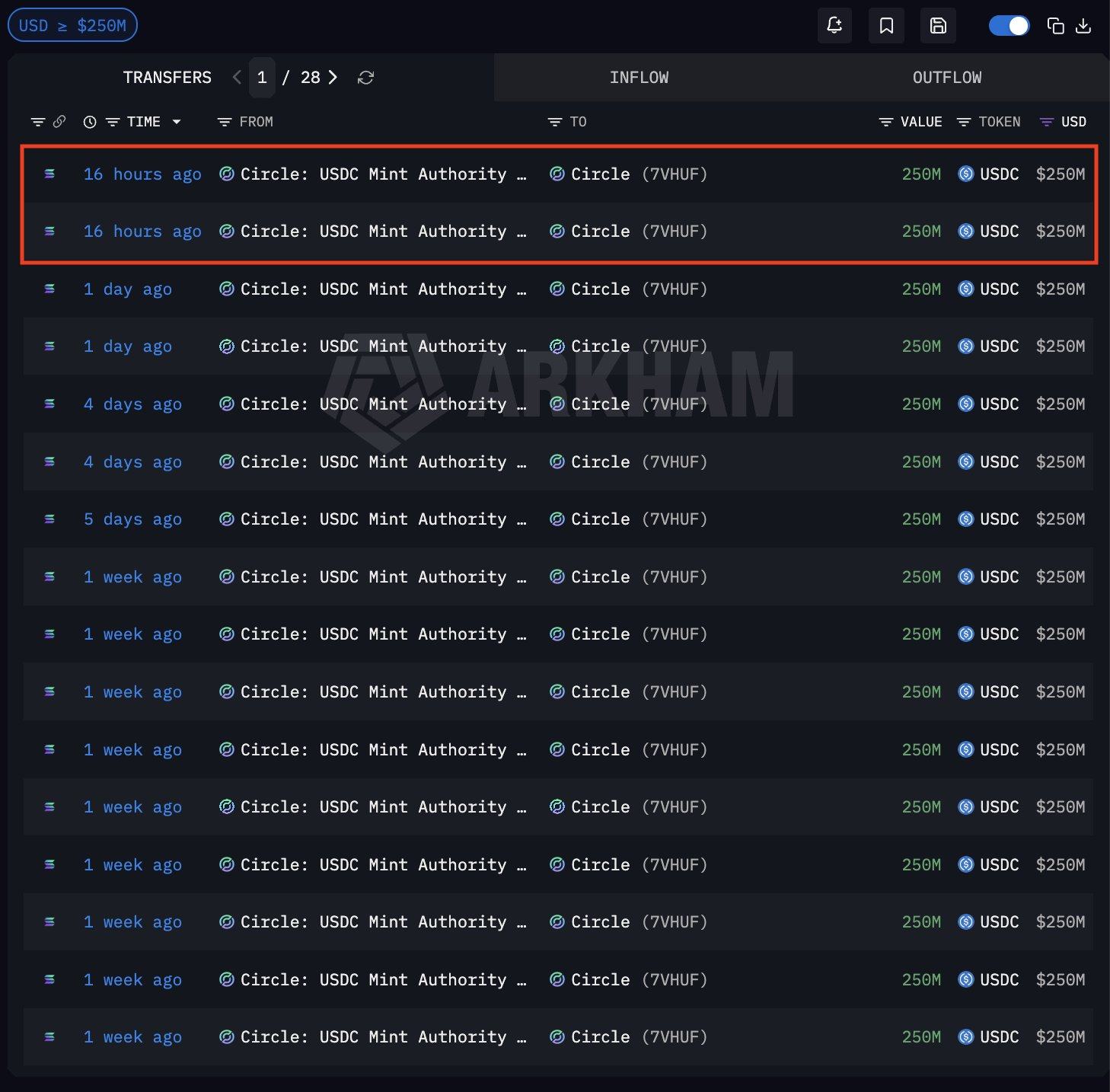
Image source: X
USDC initially launched on Ethereum and retains the majority of its total supply there, but Circle has moved aggressively to broaden the stablecoin’s reach. The company recently launched a cross-chain bridge enabling native 1:1 USDC transfers across EVM networks, and has steadily increased its Solana issuance cadence throughout 2026.
Unlike algorithmic stablecoins, every USDC minted is backed by an equivalent dollar held in reserve by Circle, meaning large minting events reflect real capital entering the ecosystem rather than manufactured supply. Wednesday’s $500 million represents institutional or commercial buyers converting dollars into USDC to deploy onchain.
The Solana expansion seems to be in line with a broader market shift, as earlier this year, USDC’s adjusted transaction volume outpaced that of USDT, with Japanese banking giant Mizuho raising its Circle price target in response. That trend further garnered steam as institutional users have continually gravitated toward USDC’s regulatory transparency and Circle’s expanding settlement infrastructure.
Circle has reinforced the demand pipeline on multiple fronts. For instance, its CPN Managed Payments platform, launched in April, allows banks and payment service providers to settle in USDC without holding digital assets directly (thereby opening a new class of institutional buyer that doesn’t route through traditional crypto exchanges).
Regulatory clarity has also played a role in all this, as the SEC and CFTC’s decisions classifying SOL as a digital commodity have reduced institutional hesitation around building on Solana, indirectly helping drive demand for onchain dollar liquidity across the network.
Whether Ethereum’s structural lead holds as institutional capital continues to diversify across networks remains one of the defining stablecoin questions of 2026.
免责声明:本文章仅代表作者个人观点,不代表本平台的立场和观点。本文章仅供信息分享,不构成对任何人的任何投资建议。用户与作者之间的任何争议,与本平台无关。如网页中刊载的文章或图片涉及侵权,请提供相关的权利证明和身份证明发送邮件到support@aicoin.com,本平台相关工作人员将会进行核查。


