Written by: Shao Shiwei
Polymarket is currently the largest prediction market platform in the world. According to publicly available data, its global user base has exceeded 30 million, and as early as the beginning of 2026, its monthly trading volume has remained around 1 billion US dollars. The range of predictions on the platform is extremely broad, covering many fields such as politics, sports, macroeconomics, finance, and cryptocurrency prices.
With the continuous expansion of the Polymarket ecosystem, a number of third-party tools have emerged. These tools are developed by entrepreneurs with the aim of helping platform users participate more efficiently in prediction market trading, filling in the gaps in functionality and experience of the native interface.
However, from the perspective of Chinese law, the situation needs careful scrutiny. As lawyer Shao pointed out in a previous article titled “What Regulatory Issues Does the Crypto Prediction Market Platform, Forwarded by Vitalik and Trump, Face?”, crypto prediction market platforms essentially offer binary options-type products.
Therefore, if Chinese entrepreneurs develop related tools around the Polymarket ecosystem, could they face legal risks domestically?
Three Types of Third-Party Tools in the Polymarket Ecosystem
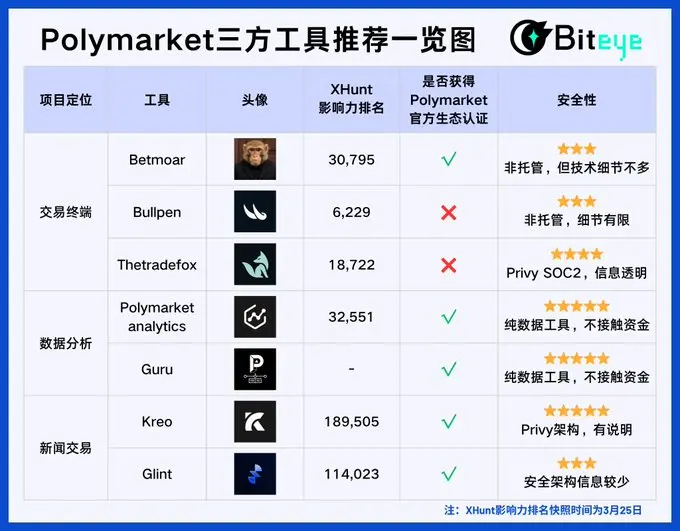
According to information compiled by the Changan I Biteye content team, the third-party tools emerging in the Polymarket ecosystem can be broadly categorized into three types: trading terminal tools, data analysis tools, and news trading tools. The tools developed by entrepreneurs primarily focus on these three areas. For the purpose of subsequently analyzing the legal risks of these tools, a brief introduction to each type is provided here.
1. Trading Terminal Tools
These tools primarily address the issues of inconvenience and limited functionality of the Polymarket native interface. They provide interfaces similar to professional cryptocurrency exchanges, with core functions including market overview, bulk order placement, stop-loss and take-profit settings, one-click copying of trades, as well as AI-assisted analysis and cross-platform arbitrage.
For users, the benefits include faster operations, stronger execution, and lower barriers—users can operate in bulk, set stop-loss and take-profit orders to control risks, and novices can copy strategies from experts through the copying function.
2. Data Analysis Tools
These tools are dedicated to solving the problem of market information opacity. They analyze publicly available on-chain data from Polymarket to build detailed profiles for each trading address, with core functions including trader leaderboards, wallet depth analysis (profit and loss, preferences), and identifying insider signals (such as marking newly created wallets with large positions).
With these tools, users can gain insights into the movements of “smart money” that involves large funds and sustained profits, identifying addresses that may possess insider information, thereby avoiding blind following.
3. News Trading Tools
These tools are customized fast news aggregators for Polymarket, addressing the issue of delayed news acquisition and disconnect from the market. They scan thousands of sources such as X (formerly Twitter), news websites, official press releases 24/7, and filter and score them using AI.
For users, the advantages of these tools include faster speed—major news can be pushed within seconds; more efficient decision-making—news is displayed alongside market data; and greater accuracy—AI automatically filters noise and annotates importance scores, allowing users to focus only on the most valuable signals.

Three Common Compliance Confusions for Entrepreneurs
From the entrepreneurs' perspective, these third-party tools have their significance and value. They believe their core objective is to help users track “smart money” and discover insider signals in order to make quicker and better decisions.
Thus, these products possess significant market potential and are more likely to achieve higher valuations and investments in financing.
However, as Chinese entrepreneurs, while viewing the growth potential of such businesses, there might be a hint of unease—if they engage in such activities, will they face legal risks domestically? Their confusions mainly focus on the following aspects:
Firstly, Polymarket has currently obtained the “Designated Contract Market” (DCM) license granted by the U.S. Commodity Futures Trading Commission (CFTC), transitioning from a legally gray platform to a federally regulated compliant exchange. Therefore, developing third-party tools for such a legally qualified platform should be legal, right?
Secondly, the functions of the aforementioned three types of tools are to provide trading terminals, summarize precise news information, and conduct purely data analysis, which do not involve funds, nor do they allow users to place bets or the platform to take a cut. Thus, should they not just be neutral software tools?
Thirdly, since the users of these products are primarily overseas users, it is inherently an overseas-facing product. Does this mean it does not involve violating Chinese laws?
Analysis by Lawyer Shao
Especially for entrepreneurs who have long lived abroad and are not familiar with Chinese law, it is understandable to have the above misunderstandings, but such misunderstandings are precisely the most dangerous.
The following will address two core issues:
Firstly, does overseas compliance mean that it is legal for Chinese entrepreneurs to develop such third-party tools?
Although Polymarket has obtained a compliant license abroad, from the perspective of Chinese law, such prediction market platforms have obvious gambling characteristics, and this is undisputed. According to the “Opinions on Several Issues Regarding the Handling of Cross-Border Gambling Crime Cases” issued by the two high courts and the Ministry of Public Security in 2020, providing software development, technical support, member development, and other services to gambling websites constitutes being an accomplice to the crime of operating a casino.
Therefore, it is not only actions involving user funds or helping the platform with funds payment and settlement that carry legal risks. Although the three types of tools have different functions, their purpose is to make it easier for users to utilize the functions of the Polymarket platform and address the shortcomings of its native interface. Objectively speaking, these tools provide technical support, traffic generation, member development, and attracting gamblers to the Polymarket platform. Thus, developing derivative third-party tools for such platforms entails legal risks related to gambling.
Secondly, if the tools and products target overseas users, does that mean it does not involve risks under Chinese laws?
If these products can be accessed domestically via VPN, or even if no measures have been taken to block domestic users, then based on the principles of personal jurisdiction and territorial jurisdiction, whether the entrepreneur is located domestically or abroad, they may still face risks under Chinese criminal law. Different charges may apply depending on the nature of the personnel involved and their behavior patterns, ranging from being an accomplice to the crime of operating a casino or illegal business to potentially involving charges such as illegal utilization of information networks and assisting information network criminal activities.
Risk Reminders for Entrepreneurs
It is often the most regrettable when such entrepreneurs touch the legal red line. Many of them possess excellent backgrounds and overseas study experiences and are developers of Chinese descent who have lived and worked abroad for many years.
In their understanding and environment, Polymarket itself has obtained a compliant license, belonging to a platform that operates legally, and there are numerous similar third-party tools in the market. In such cases, it is difficult for them to recognize the risks associated with their actions.
Therefore, for entrepreneurs aspiring to delve into the Web3 field, it is recommended to fully understand domestic laws and market policies, rationally evaluate the potential risks of their entrepreneurial projects, and make cautious decisions.
免责声明:本文章仅代表作者个人观点,不代表本平台的立场和观点。本文章仅供信息分享,不构成对任何人的任何投资建议。用户与作者之间的任何争议,与本平台无关。如网页中刊载的文章或图片涉及侵权,请提供相关的权利证明和身份证明发送邮件到support@aicoin.com,本平台相关工作人员将会进行核查。


