Author: Claude, Shenchao TechFlow
Senchao Guide: Alphabet reported a first-quarter revenue of $109.9 billion, a year-on-year increase of 22%, exceeding Wall Street's expectations across the board. Google's cloud business surpassed $20 billion for the first time with a growth rate of 63%, and backlog orders nearly doubled in one quarter to $462 billion. CEO Pichai acknowledged that the company was "constrained by computing power," and cloud revenues could have been higher. Full-year capital expenditures were raised to a maximum of $190 billion, and after-hours stock prices surged about 7%, standing out among tech giants reporting earnings on the same day.
Google's parent company Alphabet delivered a first-quarter report card that was hard for Wall Street to pick apart.
According to CNBC on April 29, Alphabet's first-quarter revenue reached $109.9 billion, a 22% year-on-year increase, surpassing Wall Street's expectation of $107.2 billion. Earnings per share were $5.11, far exceeding the consensus estimate of $2.63 from FactSet analysts. After-hours stock prices soared about 7%.
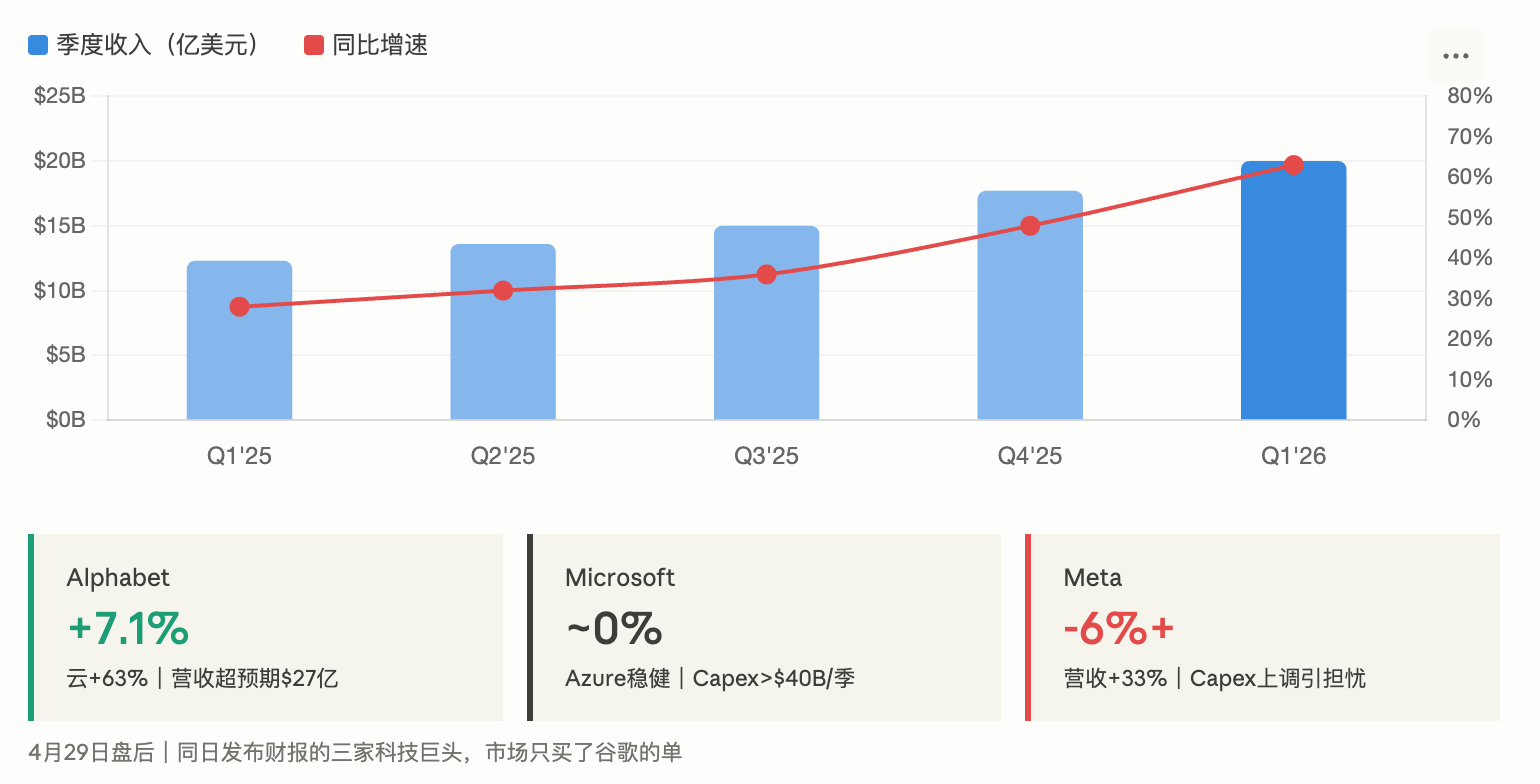
However, what truly ignited market sentiment was the explosive growth of Google's cloud business. Google Cloud reported first-quarter revenues of $20.03 billion, a 63% year-on-year increase, far exceeding Wall Street's expectation of $18.05 billion. CEO Sundar Pichai bluntly stated during the earnings call: "We are constrained by computing power in the short term, and if we could meet demand, cloud revenues could have been higher."
Google Cloud's 63% Growth Rate Outpaces Peers, Backlog Orders Double in a Quarter
Google Cloud's performance is one of the standout figures in this season's tech earnings reports.
The $20.03 billion in quarterly revenue represents a 63% increase from $12.26 billion in the same period last year, with growth accelerating significantly from the 48% in the fourth quarter. Operating profit for the cloud business jumped from $2.2 billion in the same period last year to $6.6 billion, with the operating profit margin expanding from 17.8% to 32.9%.
What excites the market even more is the scale of backlog orders. CFO Anat Ashkenazi disclosed that cloud backlog orders reached $462 billion, nearly doubling from the previous quarter. She stated that more than 50% of the backlog is expected to convert into revenue within the next 24 months.
The core engine driving this growth is AI. Pichai noted, "Enterprise AI solutions became the primary growth driver for cloud business for the first time this quarter." Revenue from products based on self-developed generative AI models grew nearly 800% year-on-year. Pichai revealed that the number of deals in the range of $100 million to $1 billion doubled compared to last year, with several orders over $1 billion signed.
In the cloud computing market, according to Synergy Research Group data, AWS leads with about 30% market share, followed closely by Azure with 25%, while Google Cloud ranks third with a 13% share. However, Google Cloud's 63% growth rate far exceeds AWS's 19%, rapidly narrowing the gap with the top two.
The "Quality" of Doubled Net Profit: $36.9 Billion from Investment Gains
The most eye-catching and most warranting asterisks number in the earnings report is net profit.
Net profit for the first quarter was $62.6 billion, an 81% year-on-year increase, with earnings per share of $5.11, up 82% year-on-year. This number far exceeded analysts' expectation of $2.63.
However, there is significant inflation within this figure. According to Alphabet's Q1 8-K filing, net profit included $36.9 billion in equity securities gains (primarily unrealized appreciation of investments in private companies), of which $28.7 billion was included in net profit, contributing $2.35 per share. Excluding these investment gains, operational performance remains strong, but not as exaggerated as the headline figure suggests.
Operating profit is more solid: consolidated operating profit for the first quarter was $39.7 billion, a 30% year-on-year increase, with the operating profit margin widening by two percentage points to 36.1%.
Capital Expenditure Revised Upwards, Raised to a Max of $190 Billion for the Year
Alphabet's investment in AI infrastructure continues to accelerate.
First-quarter capital expenditures reached $35.7 billion, more than double last year's $17.2 billion. The full-year capital expenditure guidance was revised upwards from the previous $175 billion to $185 billion, to $180 billion to $190 billion; this upward revision mainly reflects the acquisition of the Intersect data center completed in March. Ashkenazi also stated that capital expenditures in 2027 are expected to be "significantly higher" than in 2026.
This quarter, about 60% of technology infrastructure investments were used for servers, with 40% for data centers and networking equipment. Ashkenazi attributed the spending rationale to "unprecedented internal and external AI computing power demands."
This stands in stark contrast to Meta, which released its earnings report on the same day: according to Fortune, Meta raised its capital expenditure to $125 billion to $145 billion, but its stock price fell over 6% in after-hours trading. Alphabet's stock rose about 7% in after-hours trading, reflecting a starkly different judgment from the market regarding the return prospects of AI investments by both companies.
Search Advertising Grows Steadily, YouTube Slightly Below Expectations
Google's traditional cash cow remains solid.
Total revenue from Google ads was $77.25 billion, a 15.5% year-on-year increase. Of this, search and other advertising revenues were $60.4 billion, a 19% year-on-year increase, mainly driven by the retail and financial services sectors.
YouTube advertising revenue had a minor blemish this quarter: it recorded $9.88 billion, an 11% year-on-year increase, slightly below analysts' expectations of $9.99 billion.
The momentum of subscription business is worth noting. Alphabet currently has 350 million paid subscribers, with YouTube Music, Premium, and Google One being the core contributors. Revenue from subscription platforms and devices reached $12.4 billion, a 19% year-on-year increase.
Wiz Acquisition Finalized, Waymo Milestone, Gemini Penetration Accelerated
Alphabet's strategy in AI and autonomous driving is advancing simultaneously.
The acquisition of cloud security platform Wiz was officially completed in March and will be accounted for in Google's cloud division. However, this acquisition is expected to exert a "low single-digit percentage" drag on Google's operating profit margin for the remainder of 2026.
AI product penetration continues to accelerate. Gemini Enterprise's paid monthly active users grew by 40% quarter-on-quarter, with self-developed models processing over 16 billion tokens per minute, a 60% increase from the previous quarter. Gemini App's monthly active users have reached 750 million.
The autonomous driving subsidiary Waymo also reached a critical milestone. Waymo completes over 500,000 fully autonomous rides weekly and operates in 11 major cities across the U.S. In February of this year, Waymo completed $16 billion in external financing, achieving a valuation of $126 billion.
Additionally, Alphabet announced a 5% increase in its quarterly dividend to $0.22 per share.
免责声明:本文章仅代表作者个人观点,不代表本平台的立场和观点。本文章仅供信息分享,不构成对任何人的任何投资建议。用户与作者之间的任何争议,与本平台无关。如网页中刊载的文章或图片涉及侵权,请提供相关的权利证明和身份证明发送邮件到support@aicoin.com,本平台相关工作人员将会进行核查。


