Original |Odaily Star Daily(@OdailyChina)
Author|Golem(@web3_golem)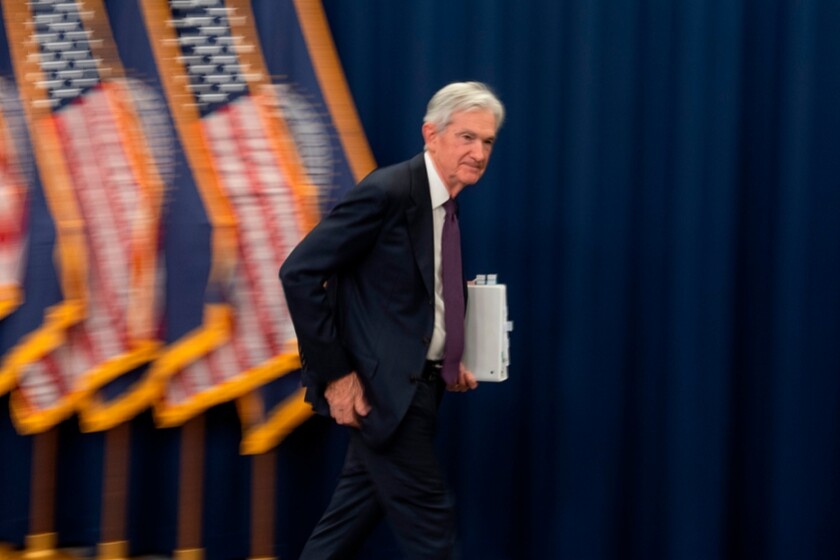
At 2 a.m. Beijing time on April 30, the U.S. Federal Open Market Committee announced the latest interest rate decision, deciding to maintain the federal funds rate target range at 3.5%-3.75%. The Fed kept rates steady as expected, but what unsettled the market was that this time 12 voting members participated, and the decision was passed with a rare split vote of 8 to 4. This marks the highest number of dissenting votes in a Fed rate decision and policy statement since October 1992.
Meanwhile, at the press conference following the rate announcement, current Fed Chair Powell stated that this would be his last press conference as chair. However, after the expiration of his term (on May 15), he will continue to serve as a Fed governor for an indefinite period. (Odaily Note: Powell's term as a Fed governor runs until January 2028)
The information from this FOMC meeting is significant. On one hand, the rare four dissenting votes indicate a deepening hawkish stance within the Fed. On the other hand, Powell's break from the tradition of exiting the governorship at the end of a chair's term sends a strong message to Trump, making it clear that attempts to politically pressure the Fed for rate cuts will not succeed.
Fed's Hawkishness Deepens
According to the FOMC statement, among the four dissenting votes against maintaining the rate, Fed governor Mester voted as before against keeping rates unchanged, supporting a cut of 25 basis points. The other three dissenting votes came from Cleveland Fed President Mester, Minneapolis Fed President Kashkari, and Dallas Fed President Logan, who opposed including language of "accommodative bias" in the monetary policy statement, which clearly suggests a stronger opposition to signaling potential rate cuts in the future.
This rare internal division stems from the global oil supply contraction due to the U.S.-Iran conflict, and the continued surge in oil prices may exacerbate the already high inflation in the U.S. Powell admitted at the press conference that there was intense debate within the committee, stating, "The number of officials supporting a shift to a neutral bias has increased, and perhaps the next meeting will consider changing the current accommodative bias." He also emphasized that the market is overreacting to the officials' opposing votes, and opposing the language that maintains an accommodative stance in the statement does not mean that the officials lean towards raising rates, "People are not saying we need to raise rates now; it's more about discussing whether the Fed should maintain a neutral position on the policy outlook."
However, the market generally believes that the public disclosure of this internal disagreement signifies that the Fed's hawkishness has indeed deepened. In the past, the Fed tended to view price increases triggered by geopolitical events as "temporary shocks." For example, when the Trump tariff policy affected commodity trade in 2025, the Fed classified it as a "one-time price increase effect," which did not hinder the eventual decision to cut rates.
Now, the Fed's attitude toward the oil price surge caused by the U.S.-Iran conflict is changing. Although the U.S.-Iran conflict has been ongoing for about two months, there has been no substantial progress in peace negotiations, the Strait of Hormuz remains under control, and oil prices continue to be high. Under these circumstances, more Fed officials now believe that high oil prices have shifted from being short-term impacts to long-term persistent pressures, hence their policy positions have become more cautious.
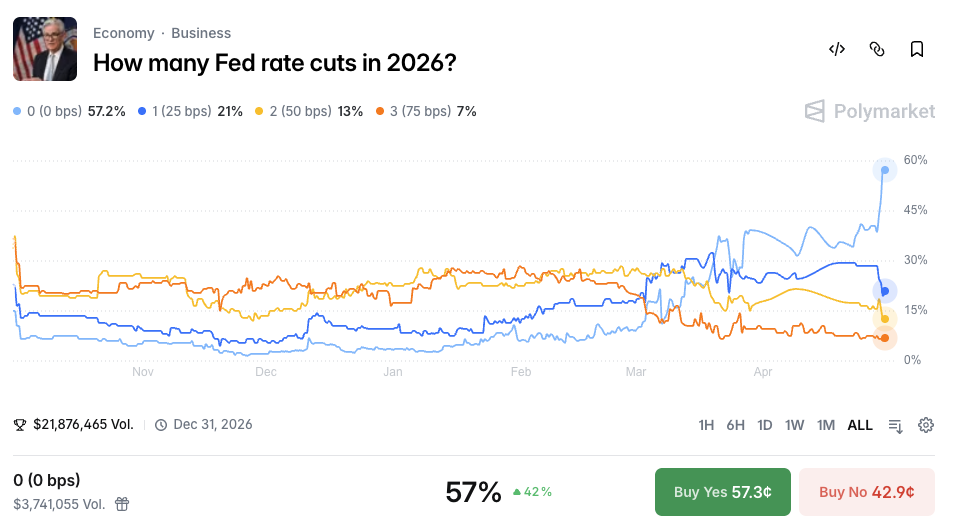
In this Fed statement, the Fed's description of inflation has also changed from "slightly elevated" to "elevated," indicating growing concern among Fed officials about the potential transmission effects of oil prices and their impact on overall price levels. While these statements and tendencies do not necessarily imply that the Fed will decide to raise rates at the next meeting, they do indicate that the difficulty of cutting rates is increasing. According to monitoring from the Odaily Seer prophet channel, the probability of "the Fed not cutting rates in 2026" on Polymarket has risen from 38% to 57%, an increase of 19%.
However, some viewpoints suggest that the emergence of the four dissenting votes during this FOMC meeting may be intentional, aimed at warning the soon-to-be-inaugurated new Fed Chair Waller that the Fed's independence must be upheld, and not to blindly follow Trump's orders to cut rates, or else we will cast dissenting votes.
Trump's Political Pressure for Rate Cuts Falls Flat
Just hours before this meeting with significant disagreements within the Fed, the Senate Banking Committee had already advanced Waller's nomination for Fed Chair. After the Department of Justice announced the end of the investigation into Powell last Sunday, Thom Tillis also shifted to support Waller, and ultimately the Senate Banking Committee passed the vote with a partisan 13 to 11 result, submitting Waller's nomination to the full Senate.
With the key obstacle of Republican Senator Thom Tillis removed, Waller is highly likely to be confirmed by the Senate before Powell's term expires. The Senate's official 2026 schedule shows that the recess is from May 4 to May 8, so the earliest voting window for the full Senate can only fall in the week of May 11 after reconvening, and under a Republican-controlled Senate, as long as it is smoothly scheduled, Waller's nomination can be confirmed between May 11 and May 15.
Although even after the confirmation of the nomination, Waller will still need to undergo presidential appointment (Odaily Note: Waller is not a Fed governor; he needs to replace Mester's governorship first) and formal swearing-in procedures before officially taking charge of the Fed, he still has time to preside over the FOMC meeting in June, rather than having Powell serve as interim chair. (Odaily Note: In 2018, Powell swore in 13 days after being confirmed, and his successor, from confirmation to swearing-in, took 11 days)
Therefore, Trump, who expressed happiness today, remarked that now is a good time to lower rates because his appointed new Fed Chair will soon take over before the next FOMC meeting, and Waller has previously made several dovish statements. However, what Trump did not expect is that even without being Fed Chair, Powell, with a strong sense of responsibility, would still "find ways" to thwart his good intentions.
Powell stated at the FOMC press conference that he would not become a shadow chair and would grant Waller ample governing space. The reason Powell continues to serve as a Fed governor is to defend the independence of the Fed, and he said, "What has happened in the past three months (Trump's legal lawsuits against Powell) has left me no choice but to remain."
Powell previously believed that Trump’s investigation into the cost issues of the Fed building renovation was an attempt to politically pressure him to lead the Fed in cutting rates, but in the end, Powell did not let Trump succeed. Now that Waller is Trump's appointed new Fed Chair and they have a personal relationship, Powell fears that Waller might not follow objective facts and listen to Trump’s orders for rate cuts after taking office, thus he remains on the board to prevent Trump from gaining full control of the Fed.
Powell's retention indeed limits Trump’s ability to place confidants on the board from a personnel level. Additionally, with the soon-to-be-inaugurated Waller, three out of the seven members of the Fed board are nominated by Trump, while the other two are Bowman and Waller. If Powell were to follow tradition and resign as a governor while leaving the position of Fed Chair, Trump would have another opportunity to appoint a governor, potentially leading to four out of the seven board members being appointed by Trump.
With the Fed already showing a hawkish stance (coincidentally, the three FOMC members opposing maintaining an accommodative stance are all regional Fed presidents, not Fed governors), even if dovish Waller takes office, he will face a policy committee that is extremely resistant to rate cuts.
Therefore, Trump’s sustained political pressure on Powell and the Fed appears to have not only failed to achieve its intended effects but has instead incited stronger resistance from the Fed. In light of the current situation, the best course of action for Trump may be to hurry to end the U.S.-Iran conflict or reopen the Strait of Hormuz to lower oil prices, providing a suitable reason for Waller to persuade other Fed officials to support rate cuts.
免责声明:本文章仅代表作者个人观点,不代表本平台的立场和观点。本文章仅供信息分享,不构成对任何人的任何投资建议。用户与作者之间的任何争议,与本平台无关。如网页中刊载的文章或图片涉及侵权,请提供相关的权利证明和身份证明发送邮件到support@aicoin.com,本平台相关工作人员将会进行核查。


