Author: TechFlow
On April 20, Binance Co-CEO He Yi appeared in Hong Kong at the main venue of the Web3 Carnival. When asked what she is currently most focused on, she gave two "singularity" answers:
First, the wave of AI; AI today is like electricity in the past era. We cannot remain as workers in a candle factory.
Second, the accelerated integration of crypto and traditional financial systems; we cannot confine ourselves within the crypto label but must continuously break boundaries and further become a financial infrastructure serving the global community.
With the aim of reaching 3 billion users, the two key directions for the future of Binance's ecosystem are becoming increasingly clear:
AI reshapes interaction;
The integration of crypto and TradFi continuously expands asset boundaries and drives financial model innovation.
At another event, we saw concrete results around these key directions.
On April 19, the BNB Chain HK Super Meetup kicked off.
This event is one of the most anticipated activities at this year's Hong Kong Web3 Carnival because the organizer is BNB Chain, which is known for its large user base, active trading, and thriving ecosystem.
Over 1500 guests attended the event, and the lineup did not disappoint the community: Binance Co-CEO Richard Teng delivered the opening speech, Co-CEO He Yi conducted more than half an hour of interactive Q&A, and BNB Chain Growth Executive Director Nina Rong shared data to clearly explain the current state of BNB Chain:
- The total market value of on-chain tokenized assets reached $16.6 billion, a year-on-year increase of over 100%;
- In the partnership landscape, top-tier institutions like BlackRock, Circle, China Merchants Bank International, and Franklin Templeton are prominently listed;
- Since January 1, 2026, the number of on-chain AI Agents has skyrocketed from 337 to 169,000, with an increase of 50,048%.
With increasingly bright performance, this already very mature public chain is taking action to make a greater response to the industry:
From embracing the AI ecosystem to stepping out of the boundaries of crypto to become the next-generation open financial infrastructure, BNB Chain is accelerating its efforts to turn direction into results.
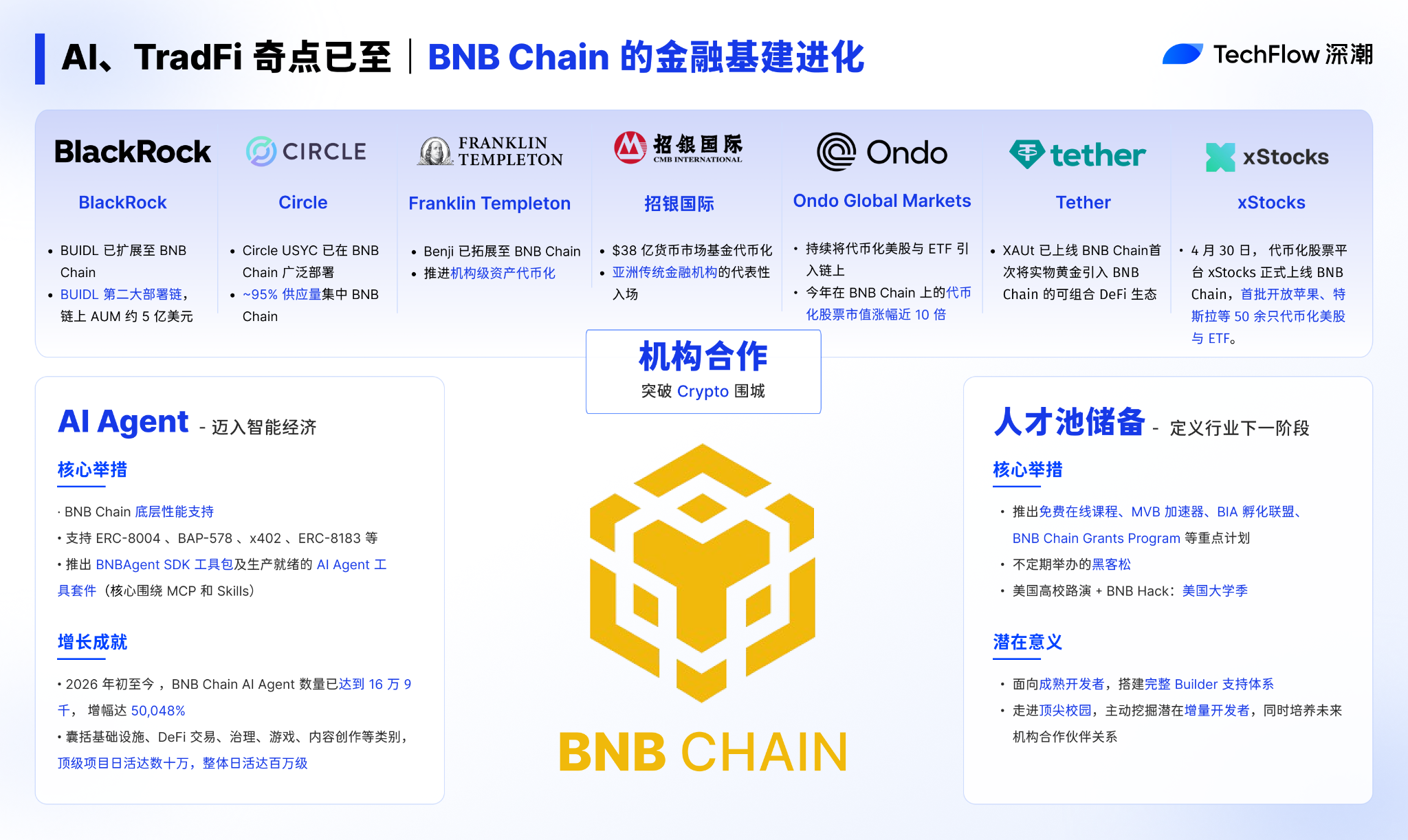
From "Chain" to "Infrastructure": Accommodating Institutional On-chain and Integrating into Daily Life
As He Yi shares:
The core value of Web3 should not be limited to cryptocurrencies but should be viewed as a more efficient, low-cost, all-day operational financial infrastructure.
As financial infrastructure, the target audience is not just current crypto users but should encompass a wider range of public daily payment, wealth management, and asset allocation needs.
Therefore, looking back at the actions of BNB Chain over a long period from this coordinate, we find that its thought process is quite clear:
Bring more real assets on-chain, then let these assets flow efficiently in real scenarios to achieve genuine activity and growth.
Institutional collaboration is a key initiative for BNB Chain and is also a vital resource for BNB Chain.
In terms of ecosystem partners, BNB Chain has a number of heavyweight names.
- BlackRock's tokenized US Treasury fund BUIDL has expanded to BNB Chain and has been accepted by Binance as collateral, making BNB Chain the second-largest deployment chain for BUIDL, with approximately $500 million AUM, second only to Ethereum;
- China Merchants Bank International has tokenized the approximately $3.8 billion USD money market fund on BNB Chain, representing a traditional financial institution's entry into the Asian market;
- Franklin Templeton has expanded its proprietary Benji technology platform to BNB Chain, using its low-cost and high-throughput infrastructure to promote institutional-grade asset tokenization.
- At the same time, through continuous deepening of cooperation with Ondo Global Markets, BNB Chain has also brought tokenized US stocks and ETFs into on-chain trading, further ensuring that high-quality financial assets need not be trapped within institutional walls. According to official data, Ondo's tokenized stock market value on BNB Chain has increased nearly tenfold this year.
As we reach 2026, BNB Chain has taken another step in pushing on-chain asset structures towards the real world.
Tether's tokenized gold XAUt has officially gone live on BNB Chain, as the largest tokenized gold product in the crypto market, XAUt allows physical gold to truly enter the composable ecosystem of on-chain finance for the first time.
On April 30, BNB Chain officially announced that the tokenized stock platform xStocks has officially launched, with the first batch opening over 50 tokenized US stocks and ETFs including Apple, Tesla, Nvidia, the S&P 500 ETF, with an additional 100+ assets to be added in the coming weeks.
When looking at these collaborations collectively, BNB Chain is increasingly viewed by more institutions as an on-chain entry point capable of accommodating real assets, real scale, and real liquidity.
In this narrative, stablecoins are the vessels that truly bring real-world assets to life.
They serve the most critical transport layer role: one end connects to a vast number of consumer-level users; the other end holds the liquidity conversion between TradFi institutional assets and DeFi innovation.
Regarding this point, BNB Chain's layout is heavy and pragmatic.
On one hand, stablecoins are deeply tied to institutions and real-world assets; the widely deployed Circle USYC on BNB Chain is a typical representative: According to Dune data, about 95% of USYC supply is concentrated on BNB Chain; as a yield-bearing money market fund token, USYC can be directly integrated by developers into loan markets, perpetual contract platforms, and yield vault scenarios, becoming a composable, collateralizable, yield-generating on-chain asset module. At the same time, tokenized US Treasury products like BlackRock BUIDL further bring institutional-grade assets into on-chain collateral, yield acquisition, and liquidity circulation.
On the other hand, BNB Chain has long launched and repeatedly extended the 0 Fee Carnival, subsidizing gas fees for transfers, withdrawals, and cross-chain bridging of mainstream stablecoins like USDT, USDC, and USD1. Combined with performance optimizations and Gasless transaction support under the EIP-3009 standard, BNB Chain has further reduced the transaction costs of stablecoins, providing the necessary foundation for high-frequency micropayments and consumer-grade stablecoin settlements.
Among them, BSC native stablecoin $U has launched for only 4 months, with a market value surpassing $1 billion, 24-hour peak trading volume exceeding $3 billion, making it rank in the Top 6 for global token trading volume during peak hours; as the first stablecoin on BSC supporting EIP-3009, $U has integrated with AI projects like Aeon and Piverse to accommodate agent autonomous payment scenarios.
Of course, the implications of this series of concerted actions are very direct:
First is the building of trust: top institutions choosing to deploy core products based on BNB Chain itself is a testament to BNB Chain's performance, compliance, and user influence.
Second is the demonstration of capability: breaking through the boundaries of asset categories allows BNB Chain to no longer be limited to a pure crypto narrative but combines traditional yield products with DeFi composability, further leading to innovations in on-chain financial forms.
Ultimately, these specific actions of physical assets, stable yields, and on-chain payments concurrently establish a narrative of open financial infrastructure that truly serves real needs on BNB Chain.
And data is the best annotation to verify the correctness of the path.
As of now, the number of on-chain wallet addresses on BNB Chain has exceeded 800 million, and on this vast base, the average daily active addresses in the first quarter of 2026 are about 4.5 million, leading Layer 1 at certain times. Meanwhile, daily new addresses still maintain a high level, indicating that BNB Chain is connecting a user network that continues to flow and expand.
In terms of the real-world asset dimension, BNB Chain's total market value has surpassed $3.5 billion, with a month-on-month growth rate of 25.93%; the number of wallet addresses holding tokens has reached 42,958, an increase of 9.37%. In just the first quarter of 2026, the total locked value in the RWA field of BNB Chain increased by over $1 billion.
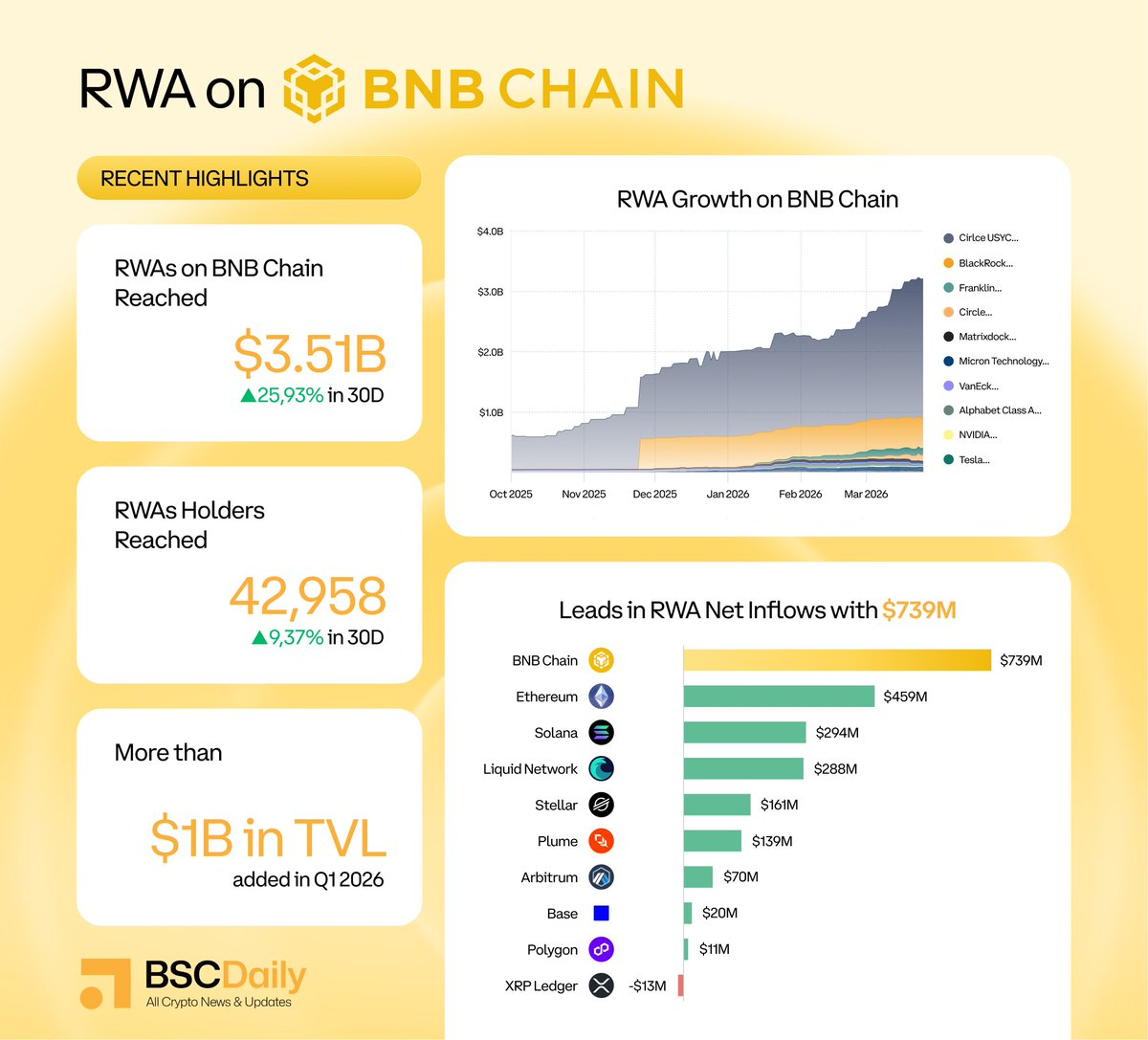
From a broader perspective of tokenized assets, according to Token Terminal data, BNB Chain's total market value has reached $16.6 billion, with an annual growth of over 100%.
When we focus on stablecoins, the data tells more of the story: according to official data, the monthly number of unique stablecoin sending addresses on BNB Chain has reached 15.1 million, ranking first among all public chains.
At the same time, although BNB Chain holds only about 5% of the global stablecoin supply, it has processed nearly 40% of the global stablecoin trading volume, further highlighting the high-frequency liquidity and real use of stablecoins as payment and settlement tools in the BNB Chain ecosystem.
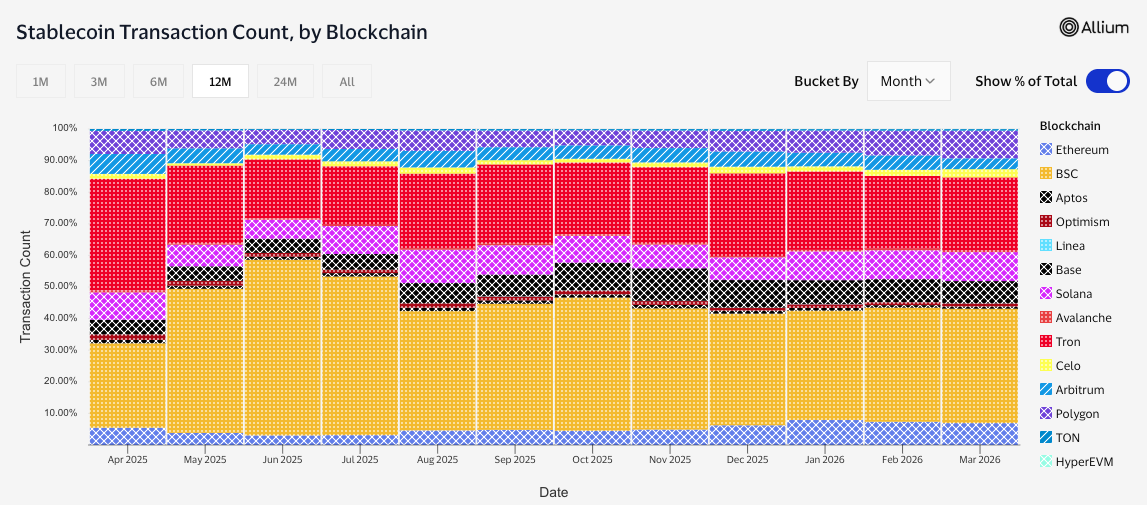
The true significance behind these numbers is: not only has the scale increased, but the structure has changed:
BNB Chain is no longer driven solely by crypto-native assets; more and more growth is coming from real-world assets, stable yield products, as well as payment and allocation scenarios.
And BNB Chain is gradually shaping the prototype of the "next-generation financial infrastructure" that everyone expects amid this structural change:
It accommodates both institutional-grade assets and integrates into the daily lives of ordinary people.
But this is just the beginning.
Because the same path is being reenacted with AI at a faster speed.
The AI Agent Layout Behind the 50,048% Increase
It's hard for anyone to ignore such growth:
On January 1, 2026, the number of AI Agents on BNB Chain was 337.
Four months later, this number transformed into 169,000, an increase of 50,048%. As a result, BNB Chain occupies over one-third of the ERC-8004 agent deployment share, surpassing Ethereum and Base to become a leading network.
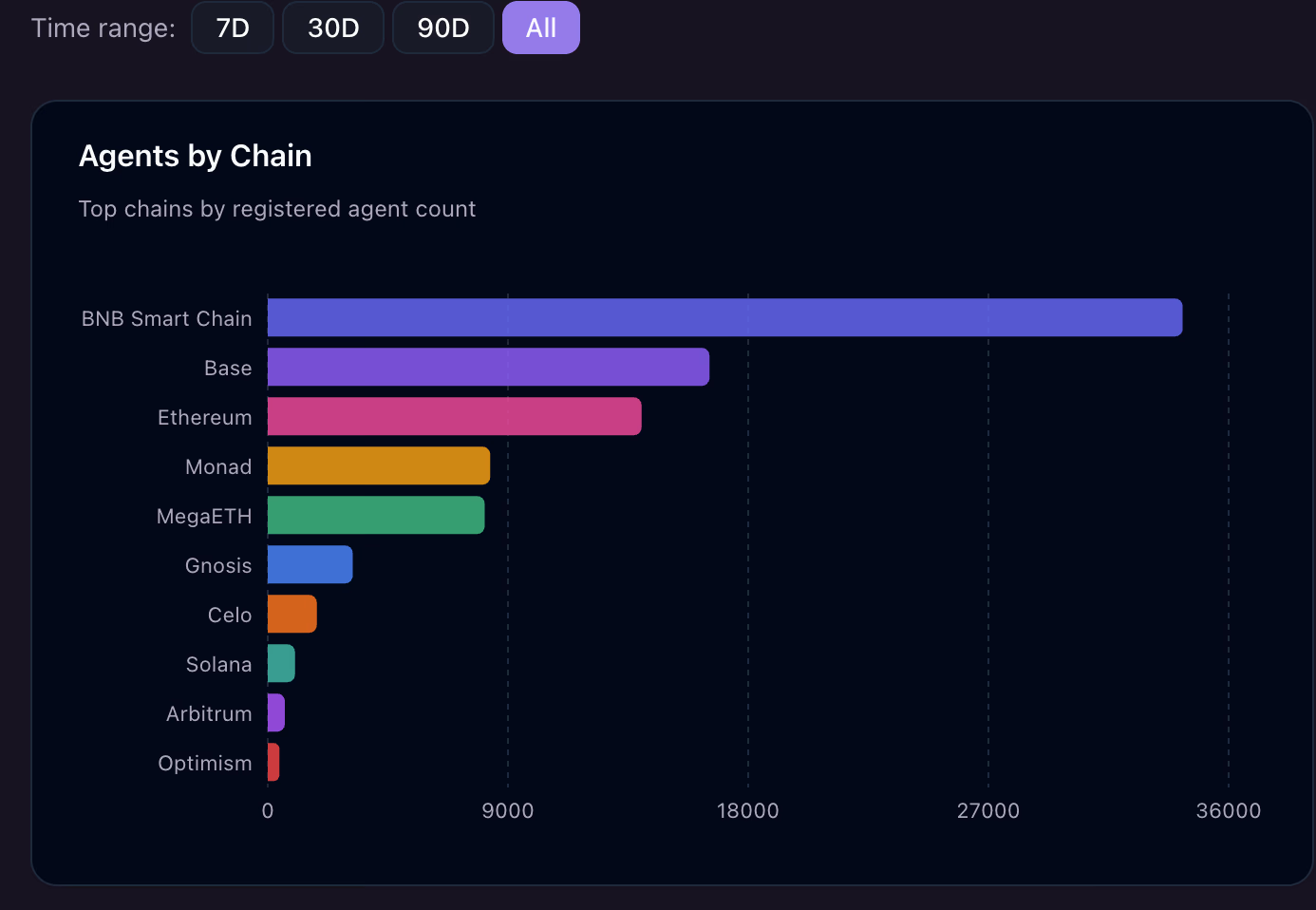
This is an almost vertical explosion.
And the explosion is not a coincidence; it's because the foundation has been laid well.
In terms of inherent conditions, what Agents need, BNB Chain happens to provide: Agents typically require frequent tool invocation, on-chain data reading, micro-payments, or automated strategies, and are very sensitive to the underlying network’s gas, throughput, and confirmation speed. BNB Chain's low gas costs, high throughput, and sub-second confirmations just provide the suitable growth soil for such Agents.
However, "suitable" is not enough; BNB Chain is also dedicated to achieving more functional and detail-oriented adaptations.
In February 2026, the ERC-8004 standard officially went live on BNB Chain’s mainnet and testnet. This standard provides verifiable and portable on-chain identities for AI Agents, allowing Agents to register identities, establish reputation scores, autonomously discover each other across different platforms, and complete transactions without any centralized intermediaries.
On this basis, BNB Chain further launched the BAP-578 standard that allows AI Agents to become on-chain assets that can be owned, traded, and upgraded. Agents can hold assets, execute logic, interact with protocols, and can even be "hired" or bought and sold.
Supporting this are:
- x402 payment abstraction layer, supporting Agent autonomous payments and settlements to achieve 24/7 intermediary-free collaboration;
- ERC-8183, aimed at solving the commercial transaction trust issues between AI Agents;
- BNBAgent SDK, a complete end-to-end Python toolkit that helps developers quickly build AI Agents supporting identity, payment, and business processes.
Besides infrastructure, BNB Chain's multi-chain architecture also provides differentiated operational space for the AI ecosystem.
BSC serves as the main execution layer, accommodating high-frequency Agent interactions; opBNB, with its extremely low costs and high throughput, is specially designed for AI content generation, social, and consumer-level applications; BNB Greenfield acts as a decentralized data storage layer, supporting the storage, monetization, and privacy protection of AI training data.
With a three-tier architecture and clear division of labor, whatever scenario the Agent runs in, there will be corresponding infrastructure to support it.
In March 2026, BNB Chain further launched production-ready AI Agent tools that support real-time on-chain data access, autonomous trading, independent wallet management, as well as Skills and MCP integration. From infrastructure to development tools, the links are connected, enabling developers to start building immediately.

Looking back at all this, BNB Chain has designed the entire infrastructure with Agents as primary citizens starting from the protocol layer.
As the infrastructure gradually takes shape, the ecological results are also starting to show.
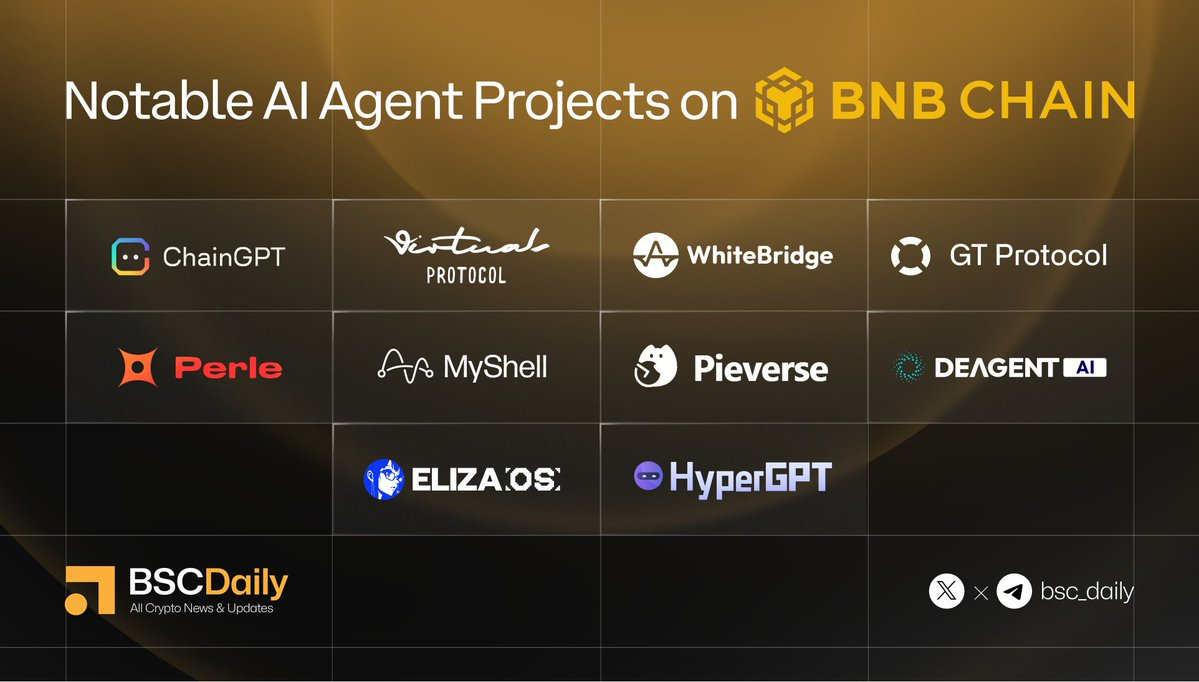
Based on quantity, the diversity is remarkable: Currently, the BNB Chain AI ecosystem includes multiple categories such as infrastructure, DeFi trading, governance, gaming, and content creation; top projects include AI smart contract generation and trading tools ChainGPT, agent coordination network WhiteBridge, automated trading and asset management GT Protocol, among others, with some projects achieving daily active user counts in the tens to hundreds of thousands, while the overall ecosystem boasts millions of daily active users.
Autonomously executing DeFi strategies, monitoring contracts, participating in governance, performing data analysis, and even "hiring" other Agents to collaborate on tasks. AI has evolved from merely being a brain that answers questions to now having "hands" and "feet", with on-chain interactions entering a new phase of "humans expressing intentions while Agents execute."
At this point, two scorecards are on the table:
In terms of RWA and TradFi direction, institutional entry, asset on-chain, and high-frequency circulation;
In terms of AI direction, multi-layer standards, tools, and architectures are in place to change the interaction logic.
But it’s not over yet; how far an ecosystem can go depends not only on how many Agents have run today and how many assets have gone on-chain but also on how many people are willing to build, use, and innovate tomorrow.
Therefore, we can see that, while continuing to enhance capability, BNB Chain is also actively "planting seeds" for the ecosystem.
Planting Seeds: Focusing on the Potential Forces Most Likely to Lead the Next Stage of the Industry
Infrastructure determines how fast we can run today, while talent determines how far we can go tomorrow.
In this regard, BNB Chain has set up a fairly complete support system for builders.
At the entry level, the BNB Chain Developer Specialization Course is a free online course tailored for software developers without a blockchain background, covering core content such as smart contracts, tool usage, and on-chain building; it serves as an important entry point into the BNB Chain builder support system.
For project growth support, BNB Chain offers key programs such as the MVB accelerator, BIA incubation alliance, and BNB Chain Grants Program, providing comprehensive incubation support including marketing assistance, ecosystem connection, advisory guidance, and potential investment for high-potential projects.
Additionally, irregularly held hackathons serve the function of "quickly turning ideas into prototypes."
Education, acceleration, funding, competitions—one path is followed to the end. But if it's only achieved up to this point, it still seems like a conventional action for public chains: what's more contested is the execution capability.
What truly leaves a deep impression is another thing BNB Chain did this spring in the United States.
It did not just continue to compete within a mature developer pool, but actively sought to find new growth, targeting those who have not yet been fully immersed in the industry but are most likely to change the industry in the future.
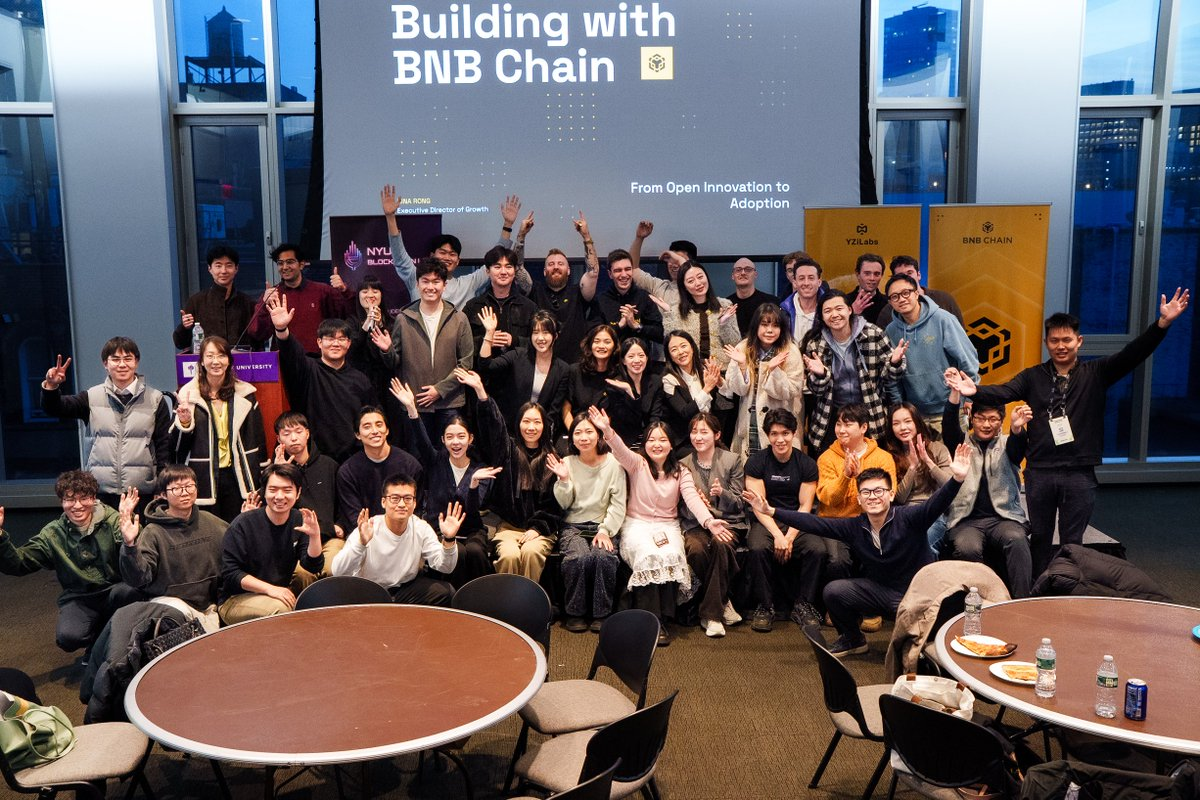
In spring 2026, BNB Chain, in collaboration with YZi Labs, initiated a university roadshow across top institutions on both the East and West Coasts of the United States:
- March 24: New York University;
- March 30: Harvard University;
- March 31: Massachusetts Institute of Technology;
- April 8: Stanford University;
- April 9: University of California, Berkeley.
Each stop had a very pragmatic format, not simply a brand presentation that concluded with a lecture: through live demonstrations, developer resource sharing, and open Q&A segments, top developers from the BNB Chain ecosystem engaged with hundreds of students on-site about real on-chain building opportunities from the perspective of "something you can start doing today."
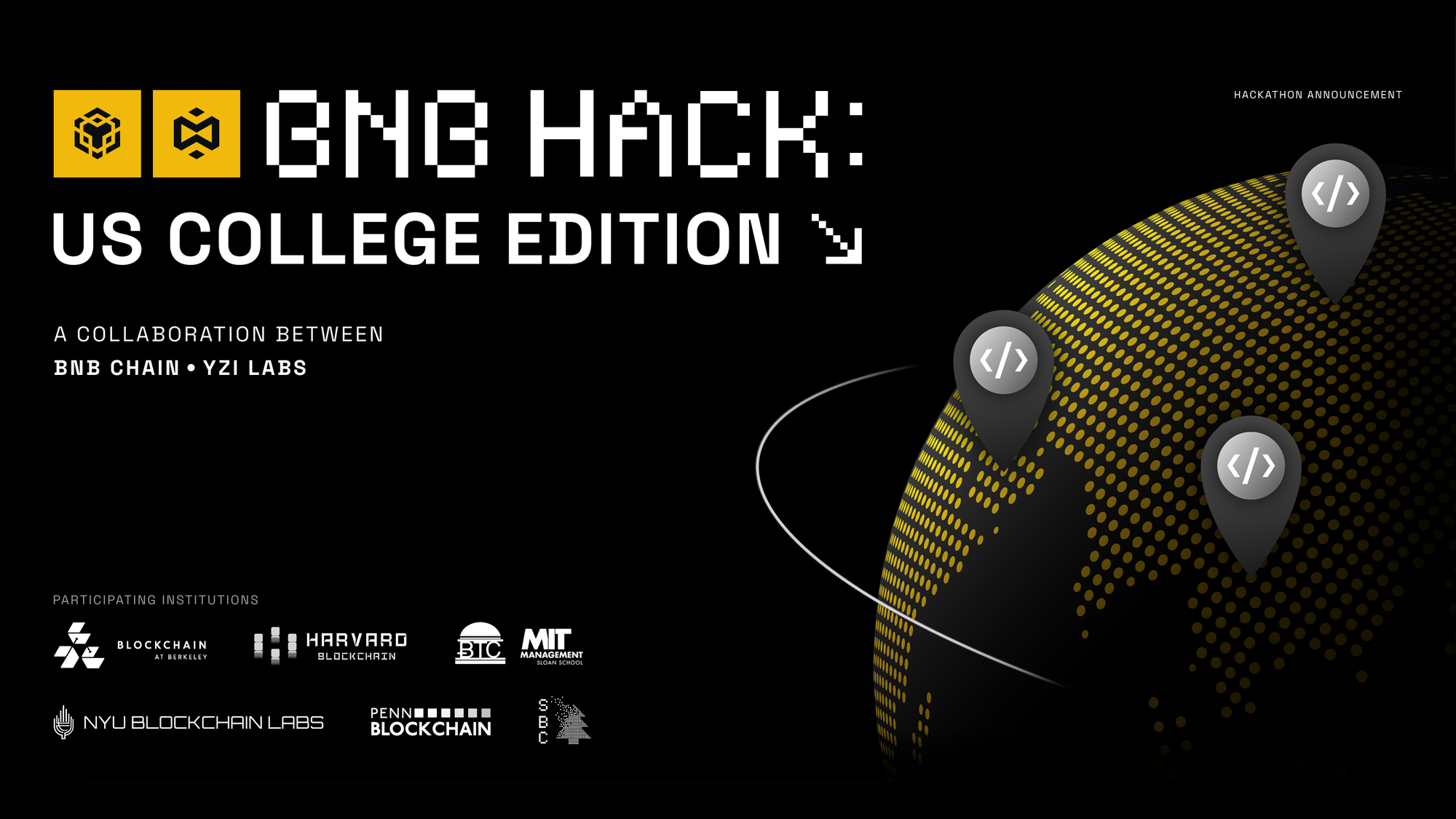
Following the roadshow, BNB Hack: US University Season quickly followed up, providing students with a platform to transition from idea communication to practical demonstration: this is a 4-week online hackathon open to invited students from U.S. universities and blockchain clubs, covering themes of AI, DeFi, and infrastructure; outstanding projects can receive a $10,000 prize and present at the Demo Day at Consensus Miami.
From a thought in a campus classroom to taking the stage at Demo Day, BNB Chain attempts to pave the most challenging path in the middle for students.
We consider this series of university roadshows as "planting seeds" because the future growth logic it points to deserves serious attention.
Universities have always been the deepest talent pools, especially top-tier institutions, gathering individuals with the strongest learning abilities, the highest enthusiasm for cutting-edge technologies, and the least path dependence.
Where will these students sitting in NYU, Harvard, and Berkeley classrooms be in five years?
Some of them might be inspired by today's roadshow to become the next-generation builders of on-chain applications, at which point BNB Chain will more naturally be their first development environment.
Another group, perhaps they will not choose blockchain but instead enter firms like JPMorgan, BlackRock, and Goldman Sachs, becoming decision-makers and executors driving traditional institutional assets on-chain. For BNB Chain, the seeds planted will not only relate to developer relations but also to potential soil for future institutional collaborations, asset on-chain efforts, and financial integrations.
From this perspective, this roadshow may warrant more long-term attention than other functional updates and cooperation announcements.
Because it is betting on a group of individuals who have not yet fully entered the industry but are most likely to define the next stage of the industry.
Attracting mature developers is about seizing the present.
Stepping into top campuses is about securing the future.
Clearly, BNB Chain aims to win in both."
In the current market cycle, many people like to say that Layer 1 narratives have failed.
Behind the failure are those Layer 1s that rely on concepts to support valuations and subsidize data with gimmicks, gradually receding.
However, Layer 1s that truly possess real users, real assets, and real scenarios are still doing well—even better than before.
Perhaps this is the key reason why we do not see failures with BNB Chain.
Whether it's institutional assets on-chain, stablecoins in high-frequency circulation, autonomous operation of AI Agents, or proactive engagement with top talent, what BNB Chain is striving for includes not only growth in this market cycle but also positioning in the next market cycle;
From a well-functioning chain to becoming the default foundation for the next generation of finance and intelligent collaboration.
And real infrastructure is not established on the day it announces its transformation into a foundation, but rather when enough people start relying on it silently.
This is a continuous evolution. The previous stage's performance is already laid out, and in the next stage, BNB Chain will continue to be on the path.
免责声明:本文章仅代表作者个人观点,不代表本平台的立场和观点。本文章仅供信息分享,不构成对任何人的任何投资建议。用户与作者之间的任何争议,与本平台无关。如网页中刊载的文章或图片涉及侵权,请提供相关的权利证明和身份证明发送邮件到support@aicoin.com,本平台相关工作人员将会进行核查。


