Source: Coinbase
Compiled by: Felix, PANews
Coinbase Institutional and Glassnode jointly released the "Charting Crypto" report for the second quarter of 2026, stating that the outlook for the cryptocurrency market in the second quarter of 2026 is neutral due to the ongoing and highly uncertain geopolitical landscape.
PANews has summarized the highlights of the report, and the details are as follows.
The ongoing and highly uncertain geopolitical situation makes it difficult for short-term investors to make confident decisions. Therefore, the report suggests adopting a risk-reward balancing strategy in the current environment. Financial markets are primarily driven by macroeconomic events and the latest developments in Middle Eastern conflicts, which are rapidly changing. Although the final impact of the conflicts on the global economy remains unclear, the International Monetary Fund (IMF) released a statement lowering this year's global GDP growth forecast from 3.4% to 3.1%, assuming that "the duration and scope of the conflict remain limited." However, the Oxford Economics Institute estimates that the severity of oil supply disruptions could slow global GDP growth to 1.4% in 2026, as "the United States and most major developed economies will fall into recession."
There are still some significant idiosyncratic factors in the crypto market, such as regulatory developments and the rise of AI. However, the importance of these factors is far less than the broader uncertainties that make it hard for market participants to grasp. The report cautiously optimistically believes that the macro situation has turned positive, which may help many crypto assets rebound in the short term and potentially recover later this quarter. In fact, the technical indicators for both the cryptocurrency and stock markets have generally turned positive, but this still depends on whether Iran can reach an agreement.
In addition to geopolitics, the IMF's spring meetings recently convened a group of finance ministers and central bank governors to discuss the systemic risks that the newly launched Mythos AI model from Anthropic may pose. The report noted that the model's ability to exploit vulnerabilities could impact the market in the future.
Meanwhile, the report highlighted two endogenous factors in the crypto space worth monitoring in the medium to short term. The first is the progress of the CLARITY Act, and the second is the advancement of post-quantum cryptography.
It is worth mentioning that the report stated that if the Middle Eastern conflict were to end completely, accompanied by a drop in oil prices and easing inflation, it could help risk assets strengthen overall. Positive progress on regulatory issues could also reignite enthusiasm for cryptocurrencies. Conversely, if the conflict escalates and oil prices rise further, it could undermine investor confidence and hinder global economic growth as the risk of a global recession increases.
Global Investor Survey
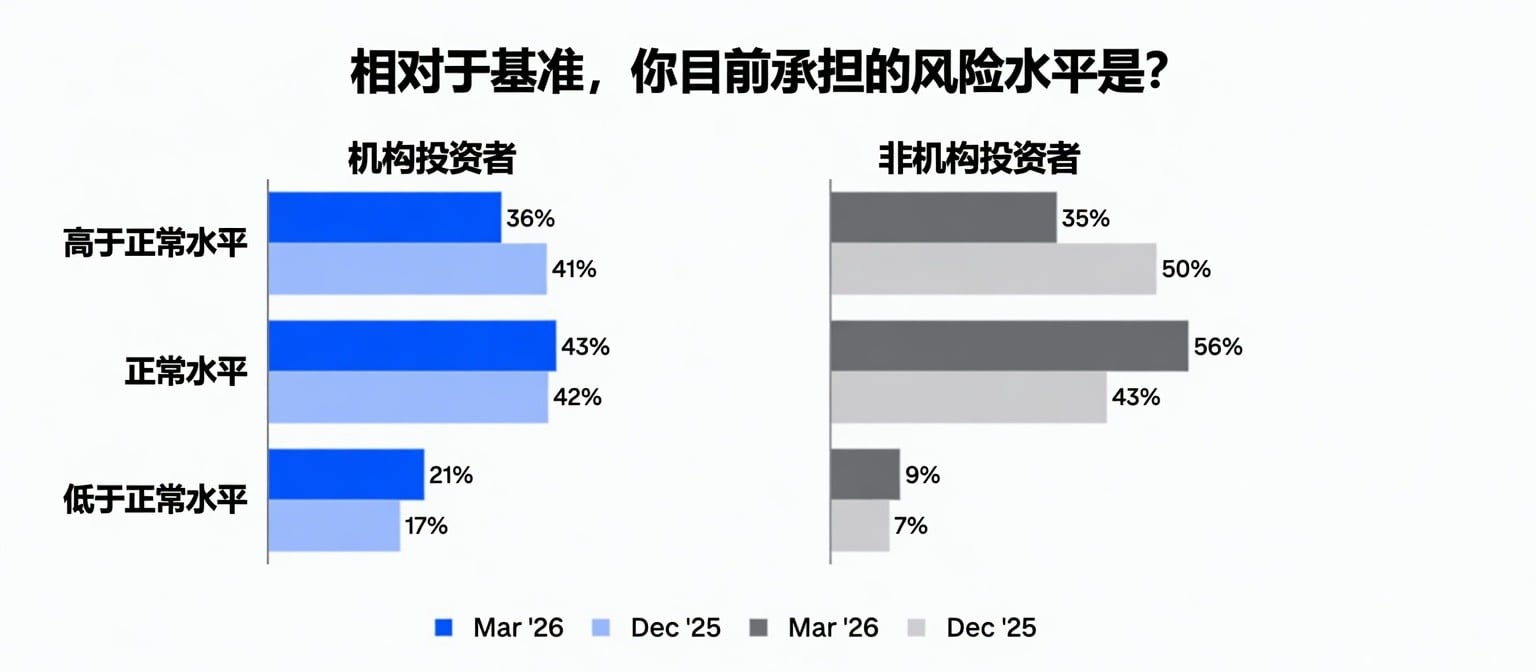
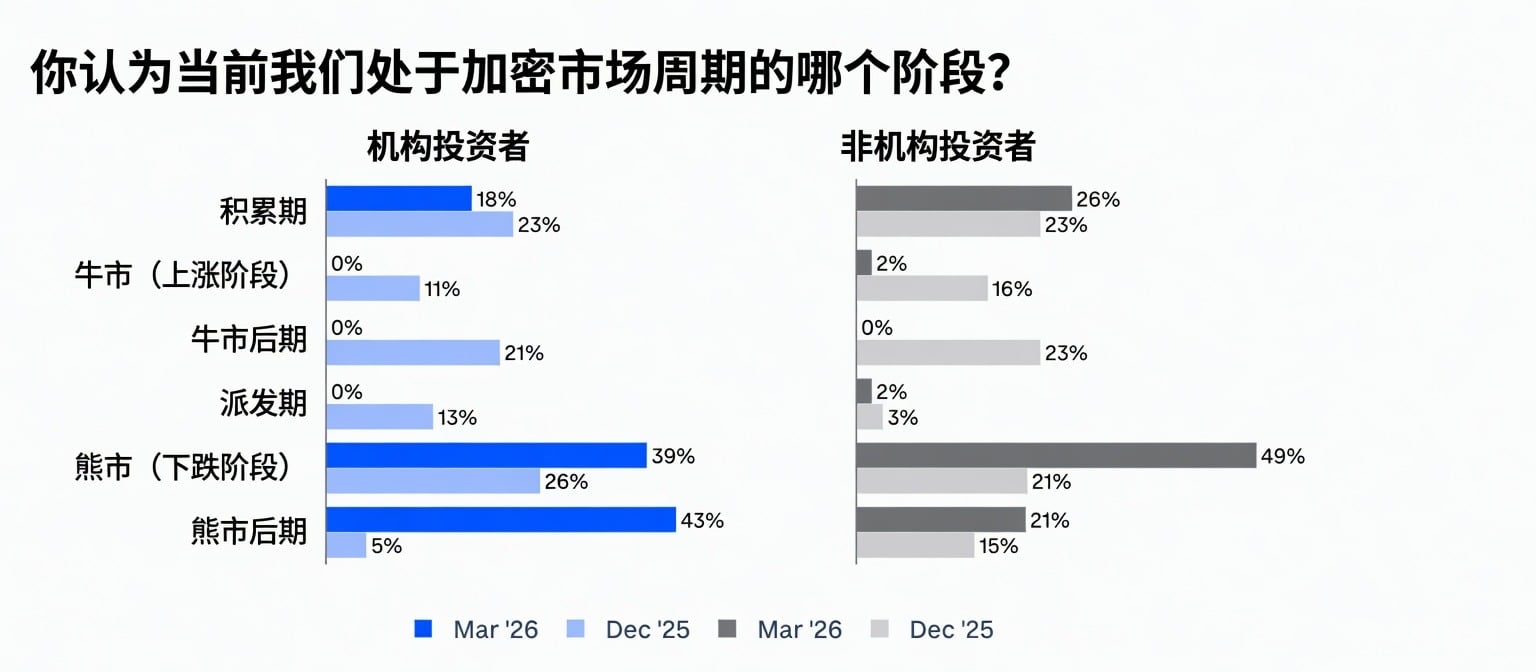
Between March 16 and April 7, 2026, a survey was conducted among 91 global investors (29 institutional investors and 62 non-institutional investors) to understand their views on cryptocurrency market trends, industry positioning, risk management, and more.
The survey showed that by the end of the first quarter, investor sentiment had significantly shifted toward a bearish outlook at the end of the cycle. Currently, around 82% of institutional investors and 70% of non-institutional investors believe the market is in a bear market (downtrend) or at the end of a bear market, up from 31% and 36% in December 2025.
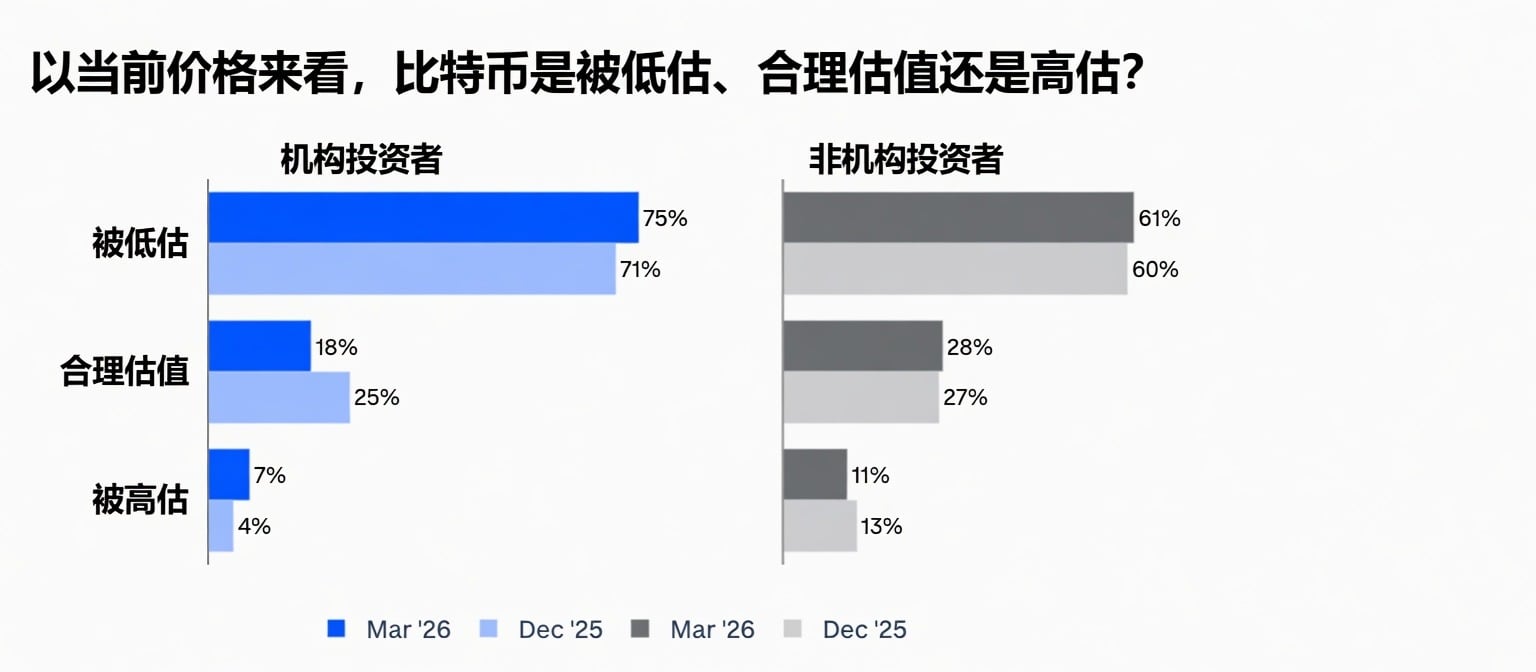
However, investors still view Bitcoin as significantly undervalued. Three-quarters of institutional investors (75%) and about three-fifths of non-institutional investors (61%) believe Bitcoin is undervalued, with little change compared to December last year; while only 7% of institutional investors and 11% of non-institutional investors think Bitcoin is overvalued.
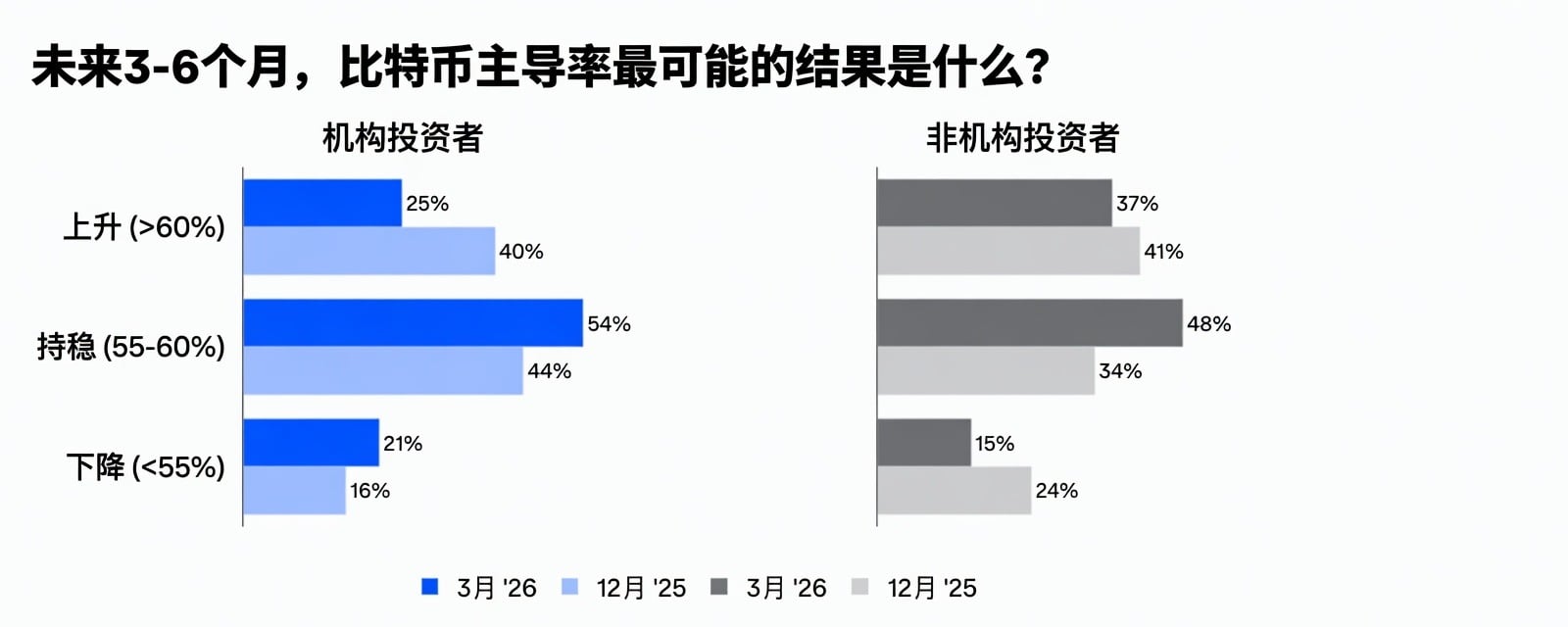
Furthermore, expectations regarding Bitcoin's dominance have shifted to a "steady state." The proportion of institutional investors expecting an increase in Bitcoin's dominance has dropped from 40% to 25%, while the majority of institutional investors (54%) now expect dominance to remain around current levels (up from 44% previously, with another 21% of institutional investors expecting dominance to decrease).
Market Overview
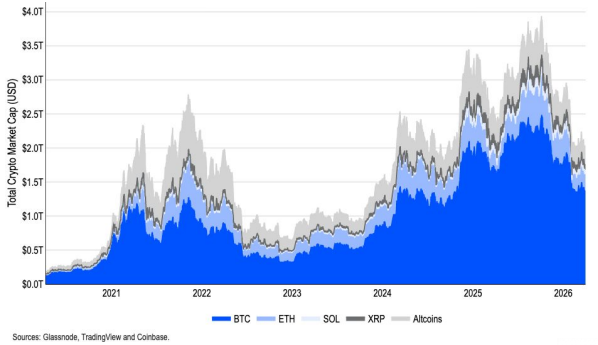
Due to widespread selling, the total market capitalization of cryptocurrencies (excluding stablecoins) fell by about 18% in the first quarter of 2026. Notably, during the same period, the total supply of stablecoins increased from $30.8 billion to $31.8 billion, indicating that some sellers may have chosen to stay within the crypto ecosystem, waiting for market volatility to subside.
In terms of correlation with macro assets, in the fourth quarter of 2025, the daily return correlation between Bitcoin and U.S. stock returns (represented by the S&P 500 index) rose to 0.58, which means that despite some differences in absolute performance metrics, this correlation is still statistically significant.
At the same time, most market participants are disappointed that the correlation between Bitcoin and gold remains negligible, as gold has become one of the best-performing assets in 2025.
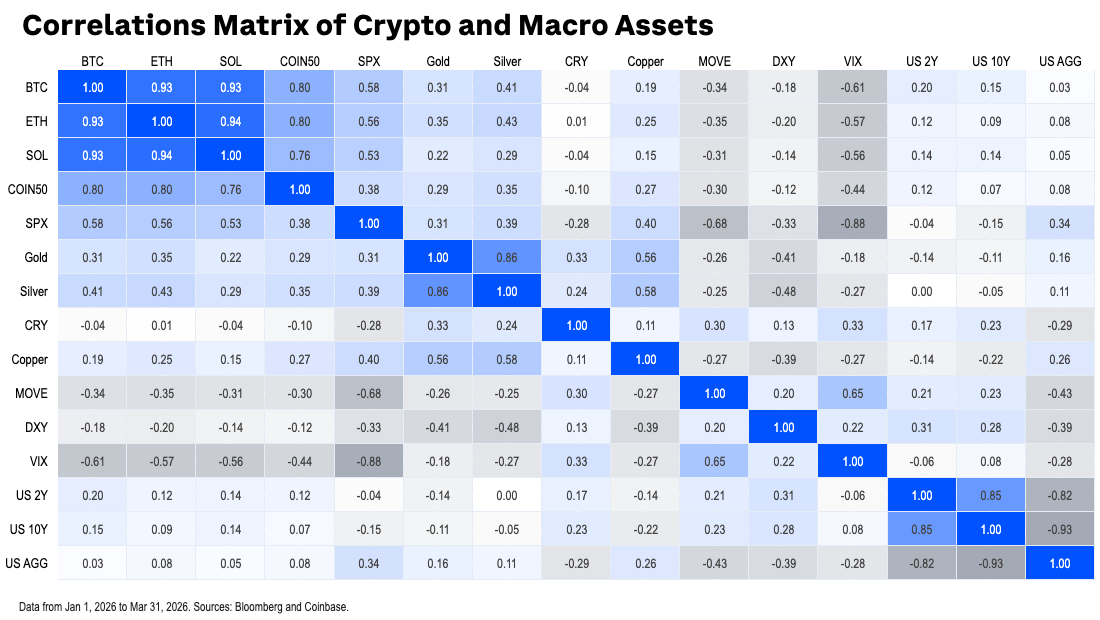
Cryptocurrency and Macro Asset Correlation Matrix
Bitcoin
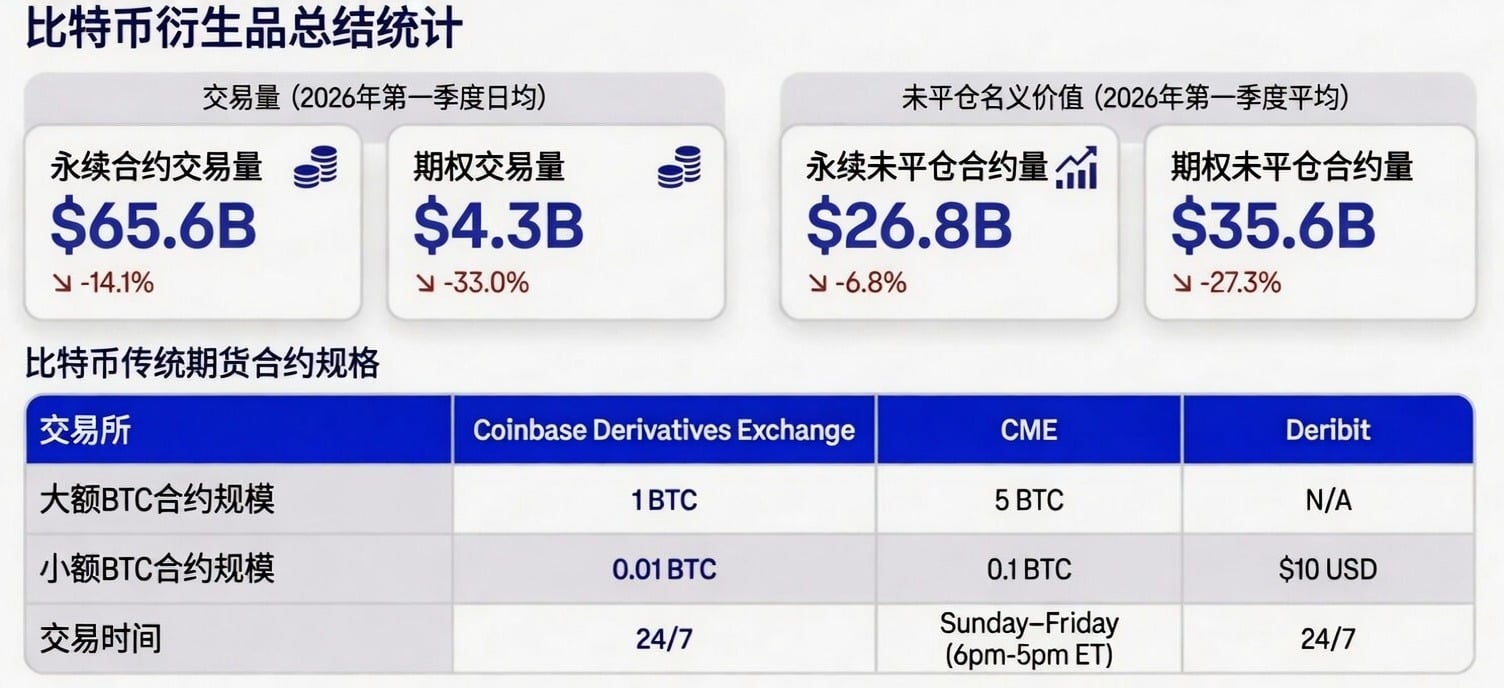
In the first quarter of 2026, the open interest of Bitcoin options increased slightly by 2.4% (compared to the end of the fourth quarter of 2025), while the open interest of perpetual contracts showed a larger recovery, increasing by about 8.6%. The latter indicates that Bitcoin's market structure may be normalizing after the deleveraging event on October 10, 2025.
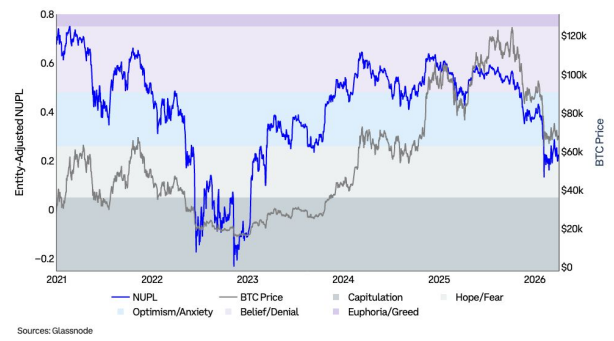
Unrealized Net Profit/Loss (NUPL) is the difference between the relative unrealized profit and the relative unrealized loss. These intervals are intended to reflect the sentiment of different investors.
In terms of the NUPL indicator, after the February sell-off, investor sentiment shifted from anxiety to fear and persisted until the end of the first quarter of 2026. Particularly during the early stages of the Iran conflict, this sentiment state was maintained. Recently, the indicator seems to have broken into the optimistic range in April, but is still largely driven by news events.
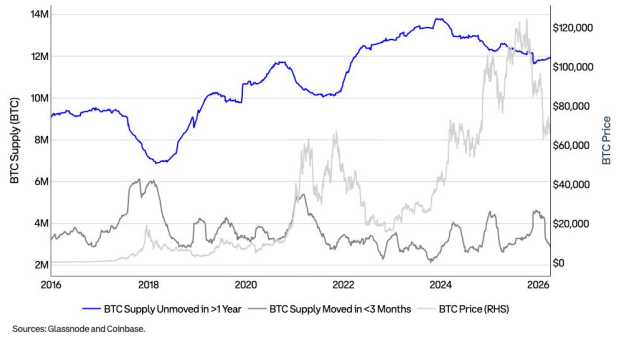
The supply of Bitcoin transacted in the last three months decreased by 37% in the first quarter of 2026, while the proportion of supply that has not been traded for over a year increased by 1%, indicating that some pure speculators may have been squeezed out of the market.
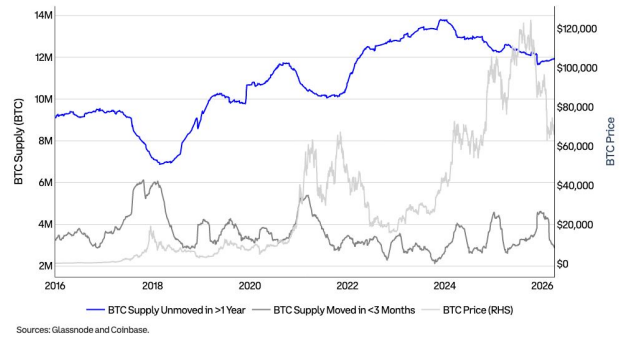
The following chart shows the percentage of the total Bitcoin supply that is profitable, alongside two statistical intervals set at +1 and -1 standard deviations. These intervals represent significant warning zones and accumulation zones. The current indicator suggests that Bitcoin is in an accumulation zone, confirming a positive technical formation as we move into the second quarter of 2026.
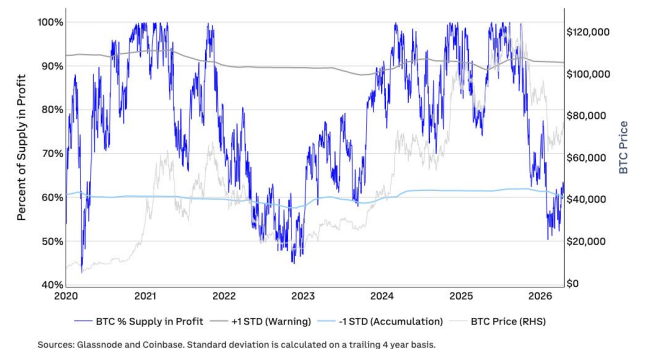
The following chart compares the circulating supply of Bitcoin that has not been traded for at least a year with the recently (within three months) active trading Bitcoin circulating supply. In the first quarter of 2026, the supply of Bitcoin traded in the past three months decreased by 37%, while the supply that has not been traded for over a year increased by 1%, indicating that some pure speculators may have been squeezed out of the market.
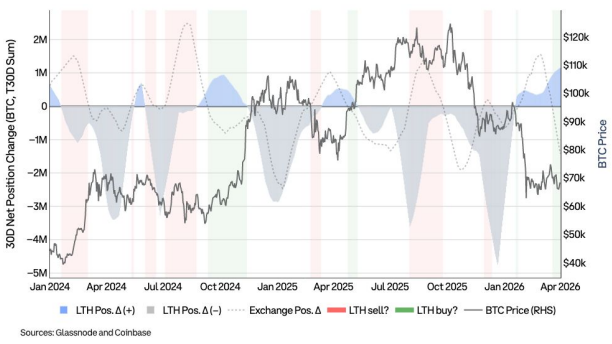
The following chart shows the net change in holdings of long-term holders (based on a threshold of 155 days or more) versus the net change in exchange holdings. The report suggests that the convergence of these two data points (i.e., the increase in long-term holder holdings alongside the increase in exchange net holdings) could reveal the actual timing of profit-taking.
The periods highlighted in green in the chart indicate an increase in long-term holder holdings and a decrease in exchange holdings, suggesting tokens are leaving exchanges, which increases the likelihood that long-term holders are more inclined to accumulate rather than distribute during this period.
Ethereum
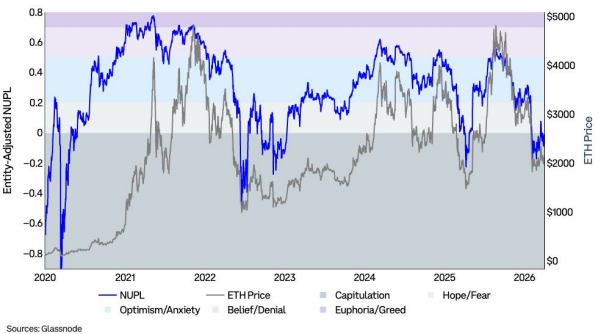
During the sell-off in early February 2026, NUPL broke through the "surrender" phase and remained in that phase for most of the first quarter of 2026, but since early April, market sentiment has started to shift toward the "hope" phase.
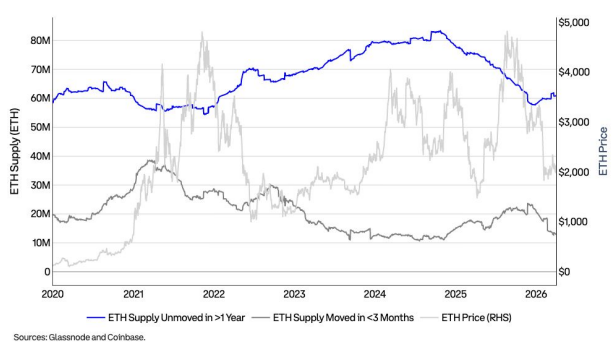
In the first quarter of 2026, the share of ETH that has not changed for over a year increased by 1%, while the share that has changed in the past three months decreased by 38%, indicating that many pure speculators may have been squeezed out of the market.
Related Reading: 2026 Q1 Cryptocurrency Market Share Research Report
免责声明:本文章仅代表作者个人观点,不代表本平台的立场和观点。本文章仅供信息分享,不构成对任何人的任何投资建议。用户与作者之间的任何争议,与本平台无关。如网页中刊载的文章或图片涉及侵权,请提供相关的权利证明和身份证明发送邮件到support@aicoin.com,本平台相关工作人员将会进行核查。


