Written by: Yangz, Techub News
In the never-sleeping Web3 world, April 18 was originally just an ordinary day. However, for the liquidity re-staking track and the entire DeFi ecosystem, a "quake" worthy of being recorded in history quietly unfolded on-chain. In less than an hour, a hacker (allegedly from the Lazarus Group) minted 116,500 rsETH out of thin air using the Kelp DAO's cross-chain bridge, worth about $292 million. Considering that rsETH is widely used as collateral, the hacker did not rush to cash out but instead transferred these worthless "air certificates" into mainstream lending protocols like Aave, obtaining about $236 million in ETH, directly pushing major protocols like Aave into the abyss of bad debts.
This is not the first time a cross-chain bridge has been attacked, but this time it tore open a long-standing wound in the Web3 industry: when there is a vacuum in the handover between the underlying infrastructure (protocol layer) and the superstructure (application layer), who should bear the cost of the disappearing billions of assets?
In the following half-month, this crisis has turned into a public game of technology, responsibility, and power. From the initial "mutual shirking" to today's "proactive accountability" by the LayerZero CEO, this marks a phase-ending point in the debate over boundaries of responsibility.
The Deadly "1/1 DVN"
To understand this debate, one must first dissect the hacker's attack method. Interestingly, this attack did not originate from complex smart contract vulnerabilities; the root of the problem lies in a configuration parameter: 1-of-1 DVN.
This so-called DVN, or decentralized validator network, is the component responsible for validating cross-chain messages in the LayerZero V2 architecture. The 1-of-1 configuration means that as long as one validator signs, the cross-chain message is considered valid and executed. Worse still, the operation of this "key" is not entirely controlled by Kelp but relies on the underlying RPC nodes. The hacker poisoned the RPC nodes and combined it with a DDoS attack to hijack the only validator node, feeding it false "source chain destruction records." The validator believed it, signed off, and thus this large amount of assets was generated out of thin air.
So, the key question is, who should bear the blame for this "1/1 DVN"?
Mutual Shirking: The Collision of Two Logics
In the initial period after the attack, public opinion initially leaned towards LayerZero. Social media was filled with mockery towards Kelp DAO: as a top protocol managing hundreds of millions of dollars, it was almost unforgivable to use the "paper lock" of a single validator.
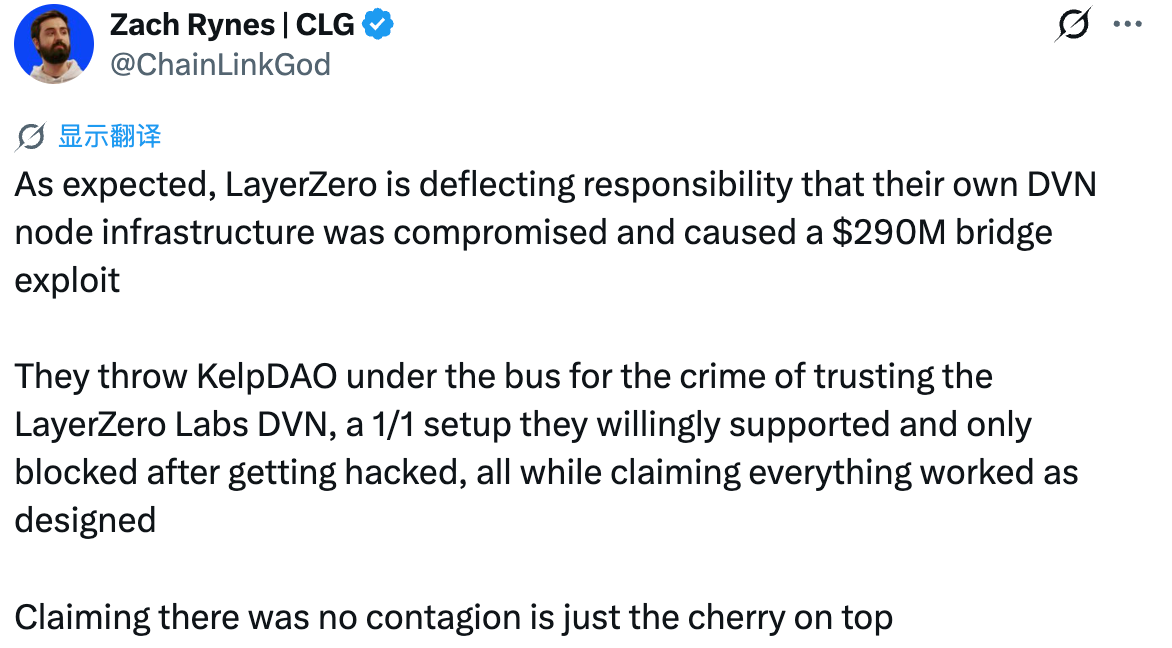
However, when Kelp presented the "official documentation" on April 21, a dramatic reversal of opinion occurred. Kelp's core argument can be summed up in one sentence: if the official documents and default configurations themselves are dangerous, then the responsibility lies with the party that wrote the documents and set the defaults. This is not a user configuration error but rather a "guiding flaw" of the product itself. Although LayerZero CEO Bryan Pellegrino repeatedly emphasized in response to doubts that this was an application layer choice, not a protocol layer vulnerability, the focus of blame began to shift from Kelp's "executive incompetence" to LayerZero's "systemic arrogance"—knowing that the default configuration carried risks yet still presenting it as a standard quick-start example.
Furthermore, voices from third-party developers further amplified the controversy. Yearn core developer banteg found through technical review that the LayerZero V2 quick-start guides used this dangerous single-source validation as the default setting on Ethereum, BNB Chain, Polygon, Arbitrum, and Optimism. Chainlink community leader Zach Rynes' criticism was even sharper: accusing LayerZero of treating users who follow its official guidelines as "scapegoats" to cover up the fragility of its own infrastructure in the face of top hacker attacks.
So, who's right and who's wrong? Actually, neither is completely wrong nor completely right. The essence of this debate is actually a collision of two logics. One is "geek ethics": the tools are neutral, and users should be responsible for their choices. The other is the "safety default principle": the factory state of the product should be in the highest safety state. Users can voluntarily lower the threshold for convenience, but the product should not guide users into danger.
In traditional software engineering, "safe defaults" have become a consensus. Operating systems default to enabling firewalls, browsers default to blocking pop-ups. These design choices are not because users are foolish, but because system designers have a responsibility to foresee "worst-case usage." However, in the world of Web3, the prevailing logic is "you're responsible yourself"—you keep your private keys, you check your configurations, and you bear your losses.
Bryan's "Accountability": A Carefully Designed Retreat
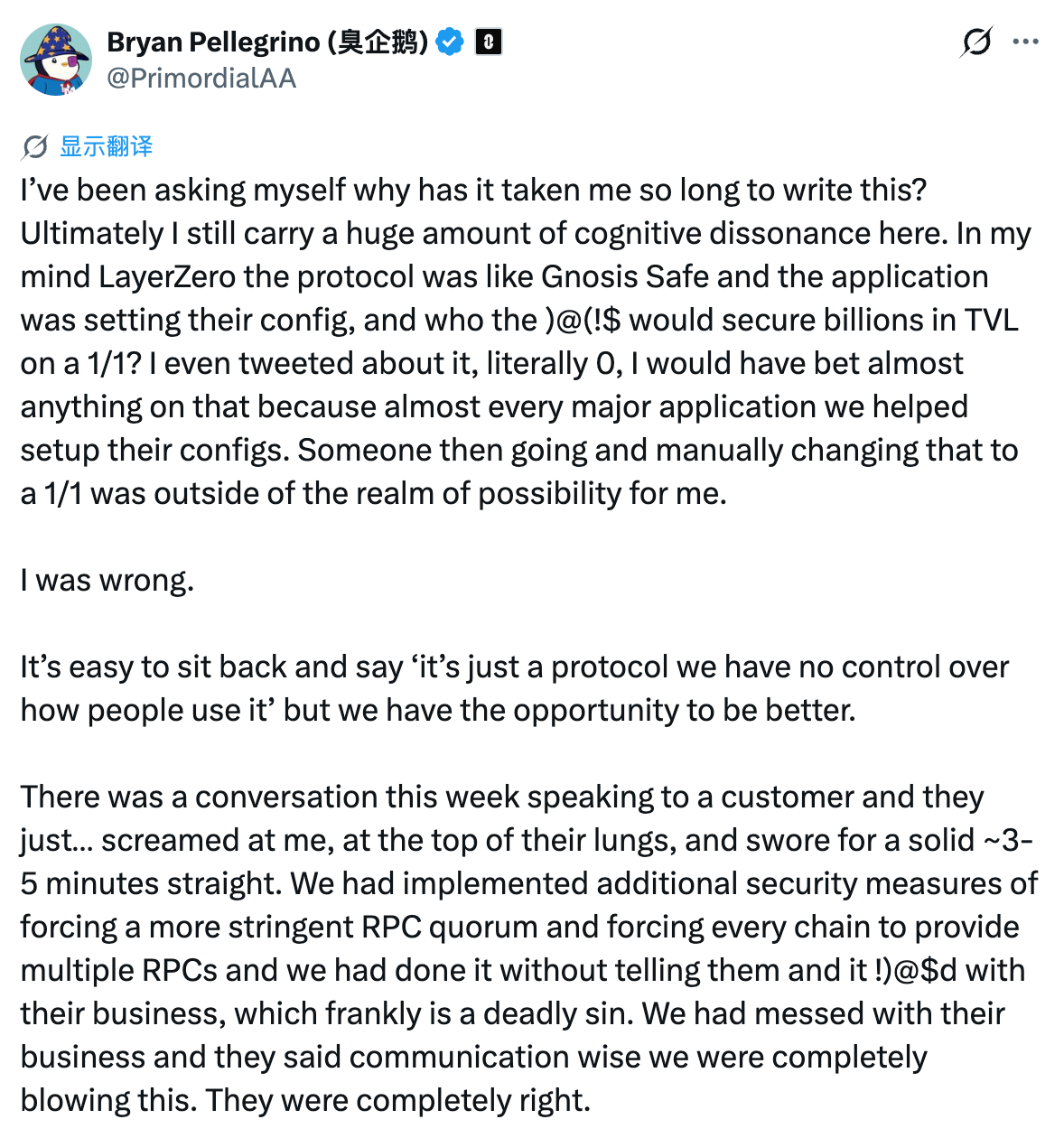
Under the dual strangulation of public opinion and the capital market, ZRO's price became the most honest thermometer, falling from a high of $1.98 all the way down to $1.32. On May 5, Bryan Pellegrino, who had previously been rigid in his stance, finally chose to back down and candidly said, "I was wrong."
This time, he did not continue turning in circles around "technical neutrality," but mentioned being caught in some form of "cognitive dissonance," mistakenly assuming that users had the professional awareness to identify and avoid the weak configuration of 1/1. He then proposed a remedy aimed at regaining market trust: a complete shift towards serving asset issuers, enforcing stronger security settings, and collaborating with DeFi United to deeply participate in the post-disaster reconstruction of rsETH.
Of course, the cleverness of this statement lies in the "unspoken words."
Bryan neither mentioned the word "compensation" nor admitted that Kelp DAO was without fault. With a piece of public relations wisdom, he said, "We have the opportunity to do better," elegantly transforming an incident involving $292 million into a "regret in the pursuit of excellence."
It is clear that this is a carefully calculated stance. LayerZero does not intend—and most likely will not—to dig into its own pockets to cover this nearly $300 million black hole, but it must stop losses by assuming this form of "indirect responsibility." It recognizes that as the dominant player in the cross-chain sector, if it only provides tools without taking on certain responsibilities, its moat will be non-existent. By proactively accepting responsibility, LayerZero is essentially looking for a dignified exit for itself and the precarious ZRO coin price.
Conclusion
The loss of $292 million is not only a deficit on the books but also a comprehensive stress test of the foundation of trust in DeFi. Fortunately, even though the protocols shifted the blame amongst themselves, the industry still exhibited a certain awe-inspiring "self-healing" resilience.
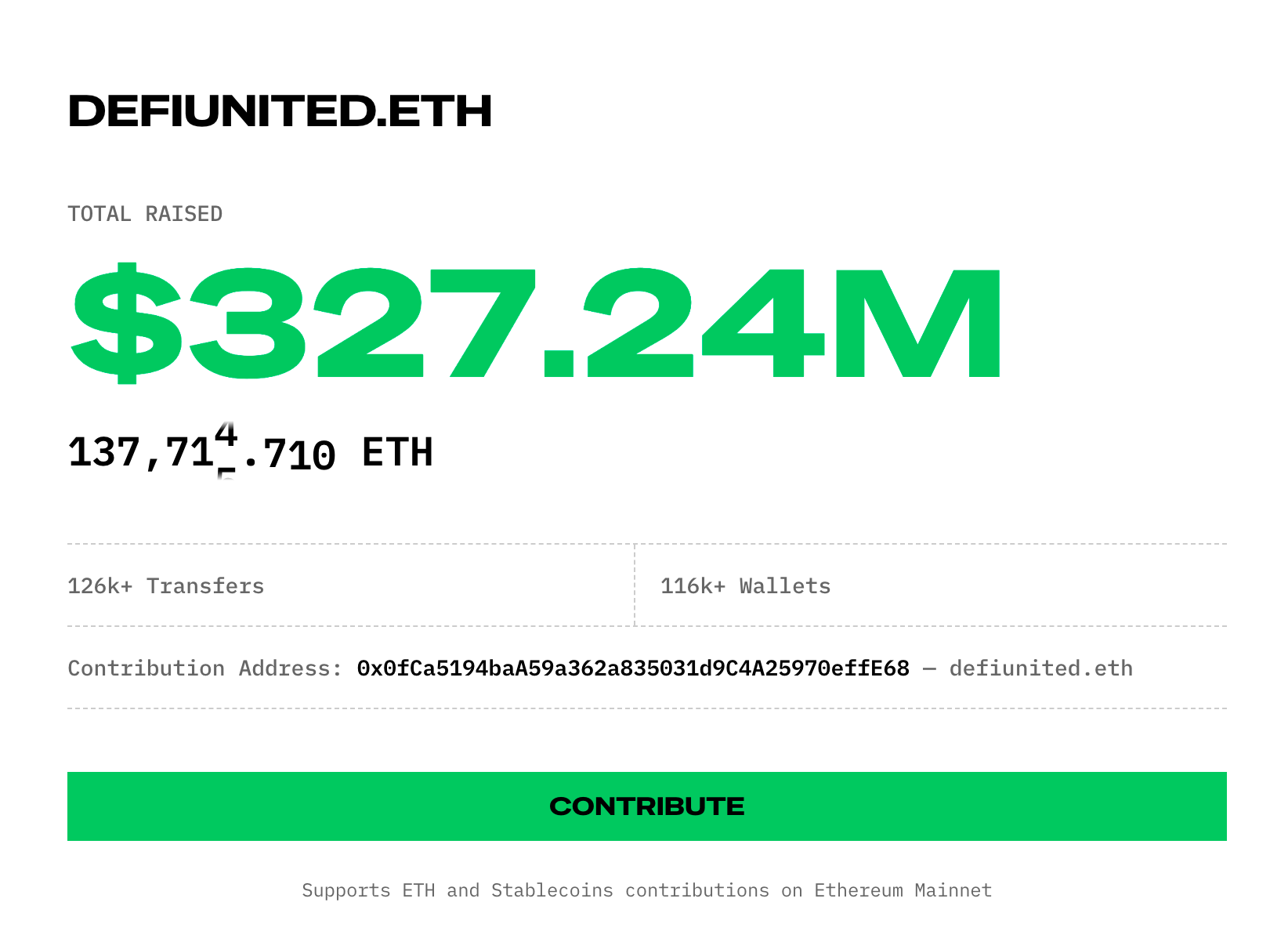
As the hardest-hit lending protocol, Aave did not sit idly by. When the American law firm Gerstein Harrow attempted to freeze approximately $71 million of ETH already recovered by Arbitrum DAO, to alleviate the liquidity deadlock, the Aave governance team has submitted an emergency motion requesting the court to lift the restriction notice. At the same time, the DeFi United plan, spontaneously formed by several protocols led by Aave, is making breakthrough progress. Through multi-party investment and revenue-sharing mechanisms, more than $300 million has been raised, steadily swallowing the bad debts on the Aave platform.
The losses from this incident were indeed heavy, but if they lead to a reverence for "safety boundaries" from infrastructure providers, a heightened vigilance regarding "default configurations" from developers, and a collaborative self-rescue ability from the industry in the face of crisis, then this tuition fee may not be in vain. When Bryan Pellegrino stood up to say, "We have the opportunity to do better," and when DeFi United joined forces to fill the ecological void, what they sought to protect was not only the bad debts generated by rsETH but also the last thread of confidence users have in this ever-changing decentralized world.
免责声明:本文章仅代表作者个人观点,不代表本平台的立场和观点。本文章仅供信息分享,不构成对任何人的任何投资建议。用户与作者之间的任何争议,与本平台无关。如网页中刊载的文章或图片涉及侵权,请提供相关的权利证明和身份证明发送邮件到support@aicoin.com,本平台相关工作人员将会进行核查。